Set Up the King's Standard: The Land, the Treason, and the Flight of Jabez Colver
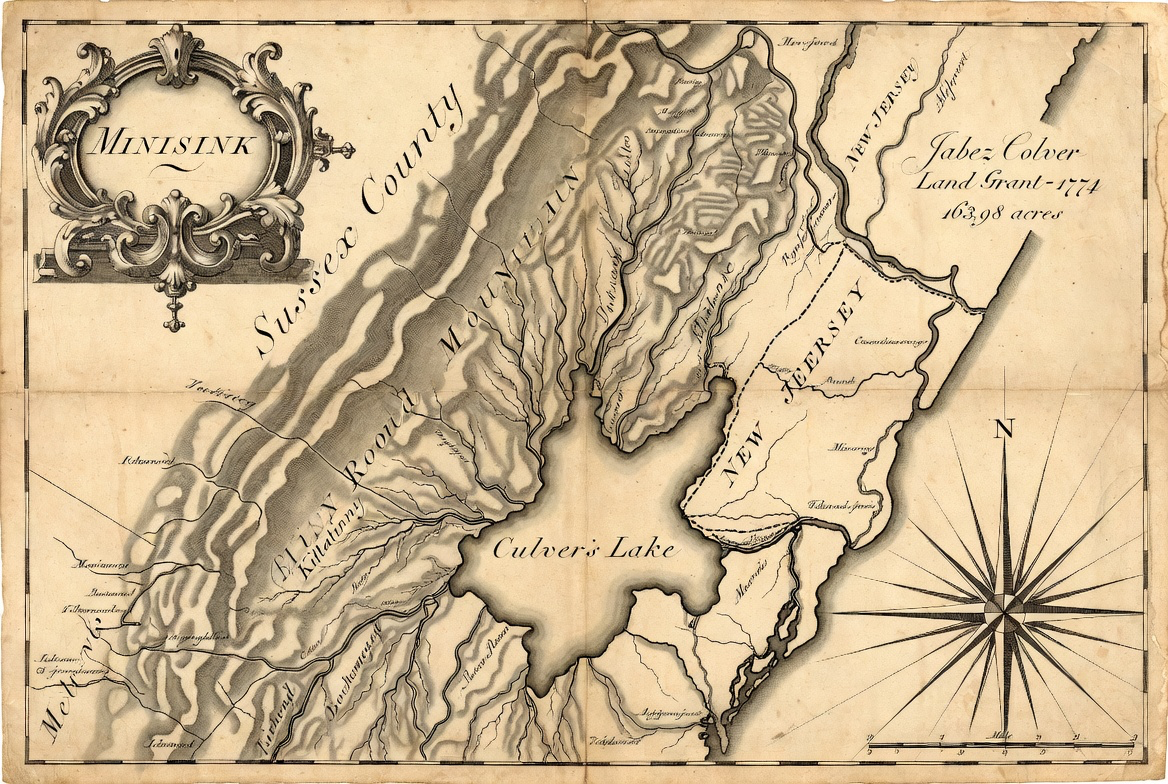
In the summer of 1774, a Connecticut-born minister named Jabez Colver laid out £245 in proclamation money and became the owner of 163.98 acres on the east side of the Minisink Mountain, at the northeast end of the Great Pond — the water we now call Culver's Lake, in Frankford Township, Sussex County, New Jersey. Three years later that same man stood before the Supreme Court of New Jersey, charged with treasonous speech. A decade after that, his family sold the land and he set his face toward Canada. This is the story of a frontier farm, a handful of dangerous words, and the long road to Upper Canada — told from the original documents.
The Land: 163.98 Acres at the Great Pond
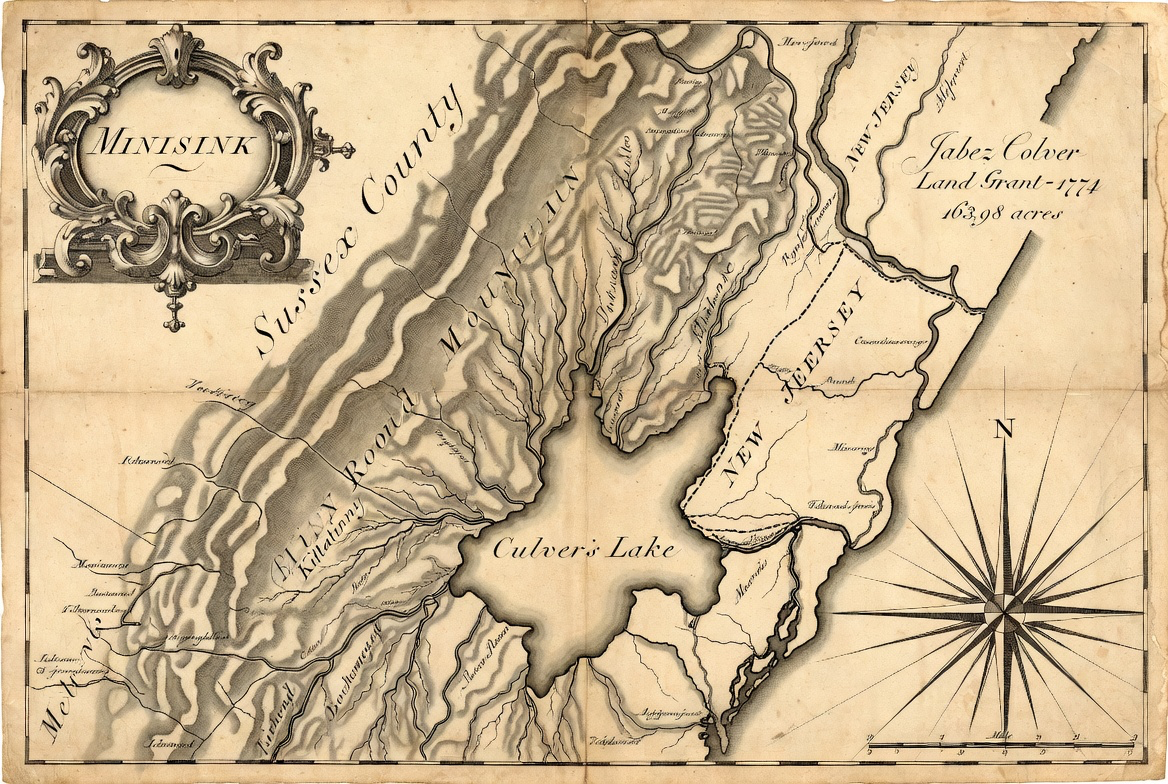
The deed is dated 4 August 1774. The sellers were Henry Cuyler and John Smyth, the surviving executors of Henry Cuyler the elder, a wealthy New York City merchant whose will gave his executors power to sell off his New Jersey lands. The buyer was "Jabez Colver of the County of Sussex and Province of New Jersey." The price — £245 18s. in proclamation money (on the order of $50,000 in 2026 dollars) — was a substantial sum, the mark of a man of some means rather than a struggling squatter.
The land itself is described with the lovely precision of an eighteenth-century survey: beginning at "a chestnut tree standing on the southwest side of a brook called Borago's Brook," then running by compass bearings and chains around 163 acres "and sixty-eight hundredths of an acre, strict measure." The tract had been surveyed for the elder Cuyler back in 1767 by Oliver DeLancey — himself one of New York's most prominent Loyalists — and recorded in the Surveyor General's office at Perth Amboy. The deed was proved before Stephen Skinner, a member of His Majesty's Council for New Jersey, in September 1774.
It is worth pausing on those names. Cuyler, DeLancey, Skinner — the men whose hands touched this transaction were, almost to a man, future Loyalists. Jabez Colver was buying into a world that was about to be torn apart.
📜 Read or download the complete 1774 deed (PDF) — all three pages of the original recorded conveyance (NJ deed book G3, folio 506), followed by a full typed transcription. You can also page through the whole document right here in the viewer below.
The Words: "Set Up the King's Standard"
By the spring of 1777 the Revolution had come to the Sussex County frontier, and it had come as a civil war between neighbors. On or about 1 April 1777, in Newtown (now Newton) Township, Jabez Colver fell into conversation with a man named Benjamin Hull. What he said in that conversation would put him in the dock.
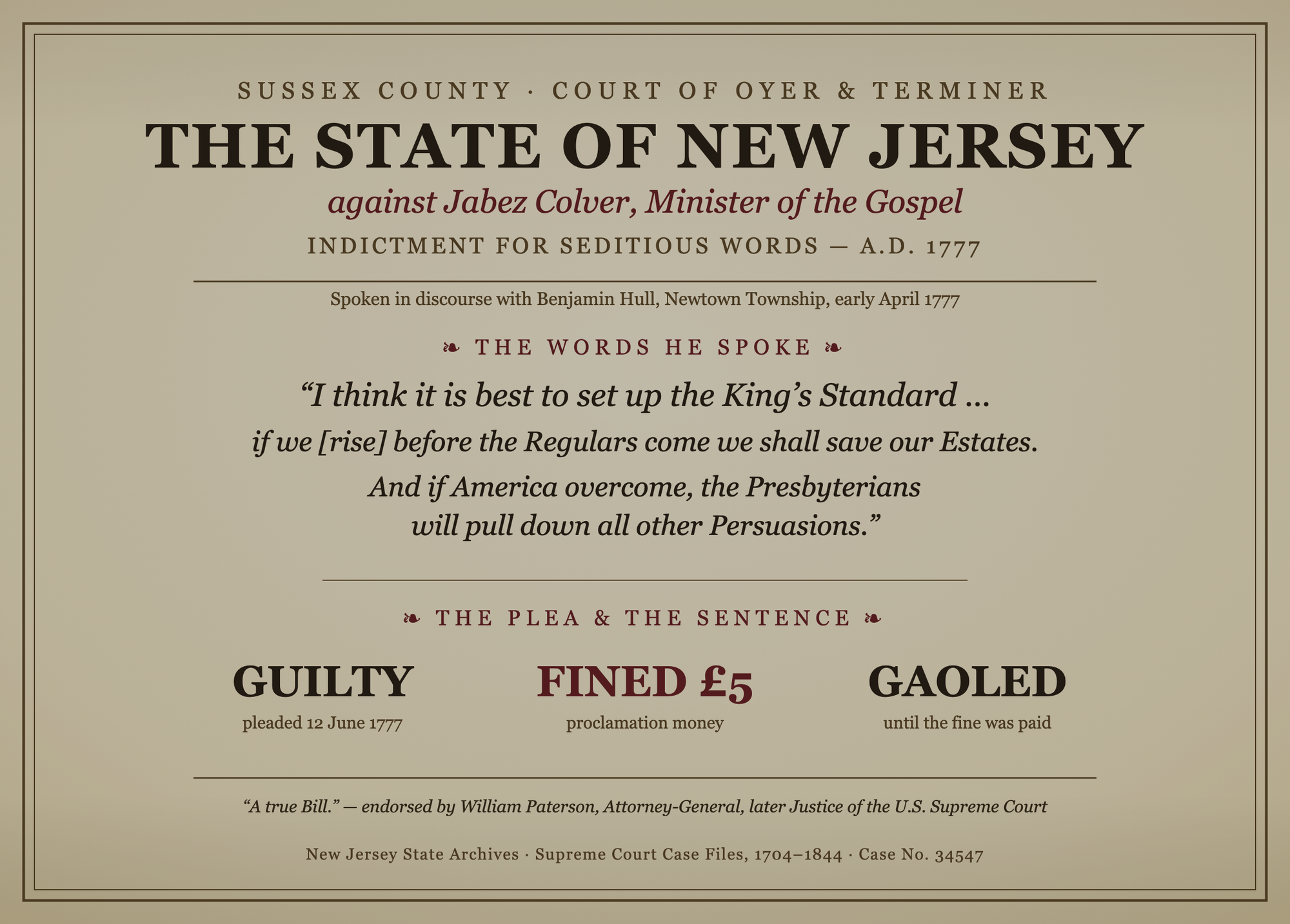
According to the indictment, Colver was heard to say:
"I think it is best to set up the King's Standard … and I think it would be best to let [Joseph] Barton set up the King's Standard, for if we [rise] before the Regulars come we shall save our Estates. And if America overcome, the Presbyterians will pull down all other Persuasions."
To modern ears this might sound like grumbling. In April 1777 it was something far more dangerous. To "set up the King's Standard" was to call for armed rising in the King's name. Joseph Barton was no abstraction either: he was a real Sussex County Loyalist who raised a battalion for the Crown. Colver's words were, in effect, an invitation to take up arms against the new state — and a prophecy that a Patriot victory would mean religious persecution of everyone who was not Presbyterian.
The Law: New Jersey's War on Words
On 4 October 1776, New Jersey had passed "An Act to punish Traitors and disaffected Persons." Among other things it made it a crime to "maliciously and advisedly" speak contemptuously of the state government or the Continental Congress, or to spread "false Rumours" meant to "alienate the Affections of the People from the Government." This was the statute under which Colver was indicted for seditious words.
It was no dead letter. Between 1776 and 1786, New Jersey courts heard 89 seditious-words cases, and Sussex County — frontier, divided, and full of Loyalist sympathizers — led the entire state with 22 of them. New Jersey's own constitution carried no guarantee of free speech; that protection would not arrive until the First Amendment was ratified in 1791. In 1777, a careless sentence could land you in court.
The Sentence — and How He Got Off Lightly
Colver was indicted on 28 May 1777. The grand jury foreman, John McMurtrie, endorsed the bill "A true Bill," and the indictment was drawn by the Attorney-General, William Paterson — a future signer of the U.S. Constitution, U.S. Senator, Governor of New Jersey, and Associate Justice of the United States Supreme Court (the city of Paterson, New Jersey is named for him). And the bench that heard the case was no ordinary frontier tribunal: presiding were Robert Morris, New Jersey’s first Chief Justice, and John Cleves Symmes of the state Supreme Court — men whose later lives would touch the U.S. Constitution, the settlement of the Ohio country, and even the White House (see An Extraordinary Bench, below).
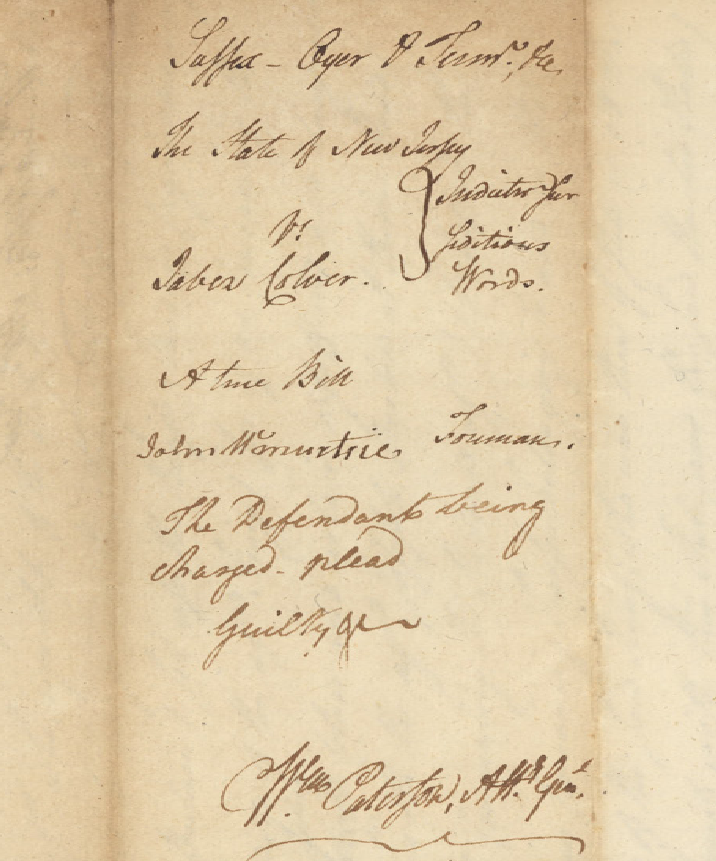
On 12 June 1777 Colver pleaded guilty. The court fined him £5 and ordered him imprisoned until the fine was paid. By the standards of the day, this was a gentle outcome.
How gentle becomes clear when you look at what loyalism could cost elsewhere. Across the new states, suspected Tories faced a widening net of punishment: loyalty-oath laws that, if refused, brought disenfranchisement, the loss of the right to sue, trade, or hold office, and — increasingly — arrest, imprisonment, and banishment. Tens of thousands had property confiscated outright under state confiscation acts, a kind of "civil death" that let the states punish without mass executions. And beyond the law lay the mob: the favorite frontier ritual for an "obnoxious Tory" was tarring and feathering, a humiliation that could maim or kill. Against banishment, a ruined estate, and the tar barrel, a £5 fine for a Presbyterian minister who had openly called to raise the King's Standard looks like mercy.
📜 Read or download the complete 1777 court file (PDF) — the original manuscript indictment and Court of Oyer & Terminer record from the New Jersey State Archives (Case No. 34547), followed by a full typed transcription. The full file is embedded below — scroll within the viewer to read every page.
An Extraordinary Bench: Who Sat in Judgment
For a backwoods sedition case, the courtroom at Newtown on 28 May 1777 held a remarkable concentration of men who would help shape the new nation — and one who, like Colver, would lose everything for the Crown.
- Robert Morris, Chief Justice — the very first Chief Justice of New Jersey’s Supreme Court (1777–79), an office his own father had once held. George Washington would later make him the first U.S. District Judge for New Jersey.
- John Cleves Symmes, Justice of the Supreme Court — soon a delegate to the Continental Congress and the force behind the vast “Symmes Purchase” in the Ohio country. His daughter Anna married William Henry Harrison, the ninth U.S. President; through her, Symmes was great-grandfather to a tenth, Benjamin Harrison.
- William Paterson, Attorney-General — who drew the indictment. He would sign the U.S. Constitution, serve as U.S. Senator and Governor of New Jersey, and sit as an Associate Justice of the United States Supreme Court. The city of Paterson, New Jersey bears his name.
- Mark Thomson, one of the presiding justices — a colonel of the Sussex County militia who later represented New Jersey in the U.S. Congress.
- The grand jurors — McMurtrie, the two Westbrooks, Cortright, Sutfield, Simonson, Hover and the rest — were no grandees but Colver’s own neighbors: Sussex County farmers and millers, many of Dutch and Palatine stock, sworn to weigh the loyalty of the man down the road.
And the Loyalist whom Colver named in his fateful sentence — Joseph Barton of Newton — was no stranger to that bench. A former assemblyman (the lone vote against impeaching the last royal governor, William Franklin), Barton took a warrant from Brigadier-General Cortlandt Skinner to raise a Loyalist battalion, becoming lieutenant-colonel of the 5th Battalion, New Jersey Volunteers. Captured in August 1777, he ended his days an exile at Digby, Nova Scotia — part of the same Loyalist diaspora that would soon carry Jabez Colver north to Canada.
The Sale, and the Road to Upper Canada
Conviction did not end the matter; it only marked the beginning of the end of the family's time in New Jersey. The records indicate the Colvers sold their Sussex County land in 1787 — there is no evidence the farm was confiscated; they sold it themselves and moved on. (We are presently seeking the 1787 deed in the New Jersey State Archives to complete the chain of title.)
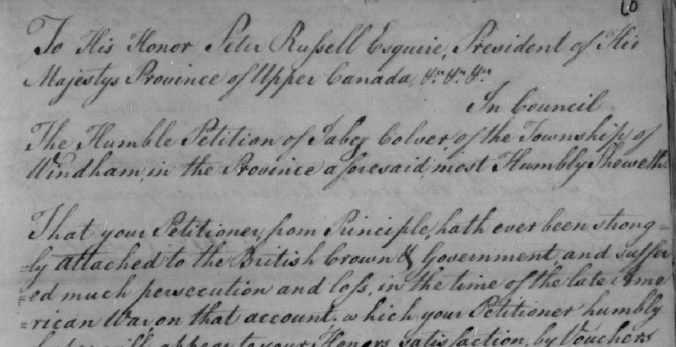
By 1792, encouraged in person by Lieutenant-Governor John Graves Simcoe, Jabez Colver removed with his large family to Upper Canada, settling first near Newark (Niagara-on-the-Lake) and then in Windham Township in the Long Point country, where he helped plant the region's earliest Presbyterian congregations. In his Upper Canada petitions he looked back on his New Jersey years and described exactly what we see in Case No. 34547: a man who "suffered imprisonment and loss of considerable property during the late rebellion on account of his loyalty." The frontier farmer convicted of seditious words in 1777 became, in the end, a founding minister of a new community under the British Crown.
A Lake Still Bears His Name
There is a final irony to the story. The Loyalist minister who was fined and jailed for his words, who sold his land and fled the country, never returned to Sussex County — yet his name never left it. The “Great Pond” of the 1774 deed (earlier known as Round Pond) is today Culver’s Lake, named for the very man this account follows: the Reverend Jabez Collver (1731–1818), who bought that 163.98-acre tract on its northeastern shore. Two and a half centuries later, New Jersey vacationers boat and swim on a 555-acre lake that quietly memorializes a convicted Tory.
His later Canadian story — the petitions, the land grants, the church at Windham — is told in our companion post, Echoes from the Frontier: The Petitions of Rev. Jabez Collver.
Sources
- 1774 deed: Indenture, Cuyler & Smyth (executors of Henry Cuyler) to Jabez Colver, 4 Aug. 1774, recorded G3, folio 506; survey by Oliver DeLancey returned 19 Jan. 1767, Surveyor General's Office, Perth Amboy, Book 5, p. 3.
- 1777 court case: State of New Jersey v. Jabez Colver, Supreme Court Case Files, 1704–1844, Case No. 34547, New Jersey State Archives; with the Sussex County Court of Oyer & Terminer minutes, 28 May – 14 June 1777.
- New Jersey State Library, NJ 250 exhibit, "Seditious Words" — njstatelib.org.
- Lake name and history: “Culver’s Lake,” Wikipedia, and local Frankford Township histories.
- Background on Loyalist punishment: Museum of the American Revolution, Scars of Independence; American Battlefield Trust, "Tarring and Feathering."
© 2026 Albert B. Collver III · The Collver Family History Project. Original historical documents reproduced here are in the public domain; the research, text, and annotations are the author’s. Please cite or link rather than republish.