Echoes from the Frontier: The Petitions of Rev. Jabez Collver

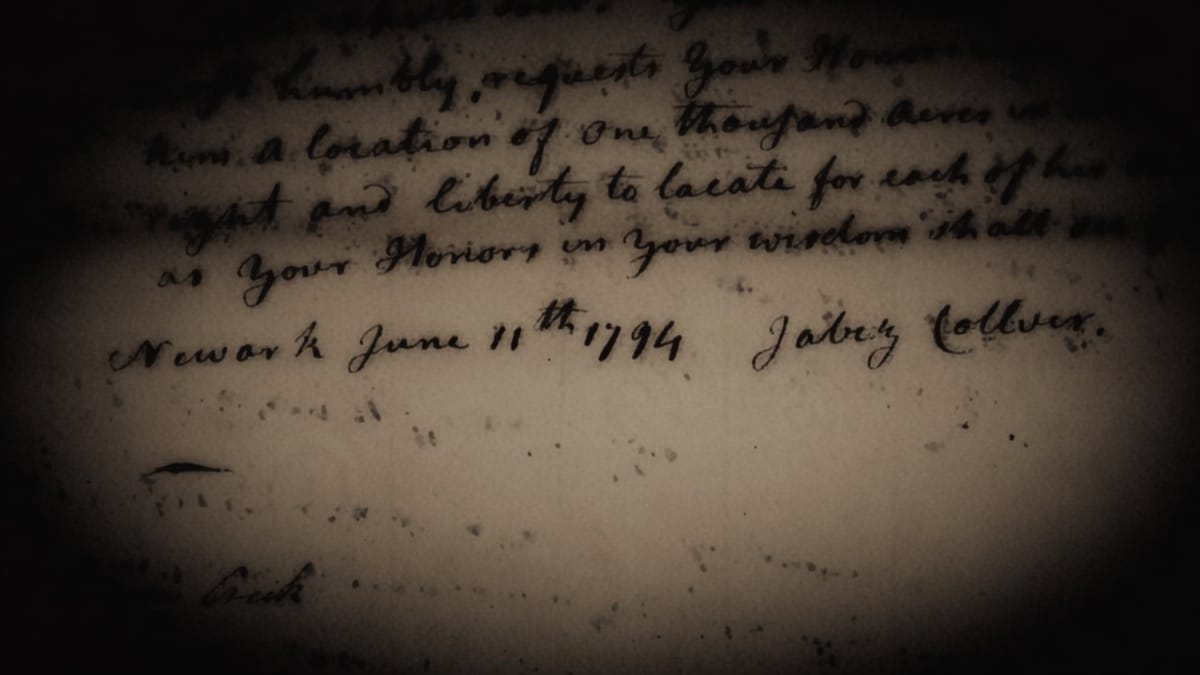
Some voices from the past do not fade. They linger in the yellowed pages of old petitions, waiting to be read again.
In the decades after the American Revolution, as the forests of Upper Canada slowly gave way to new settlements, Rev. Jabez Collver (also spelled Culver or Collyer) put pen to paper and spoke directly to the governors who held the power to grant or withhold the future.
These are not the polished words of a statesman. They are the careful, sometimes desperate, requests of a man who had lost property, endured imprisonment, and crossed into a new country with a wife and many children, hoping to begin again.
Below are the full surviving petitions of Jabez Collver, transcribed from the original Upper Canada Land Petitions. Following them are three passages that still speak with particular clarity across the centuries.
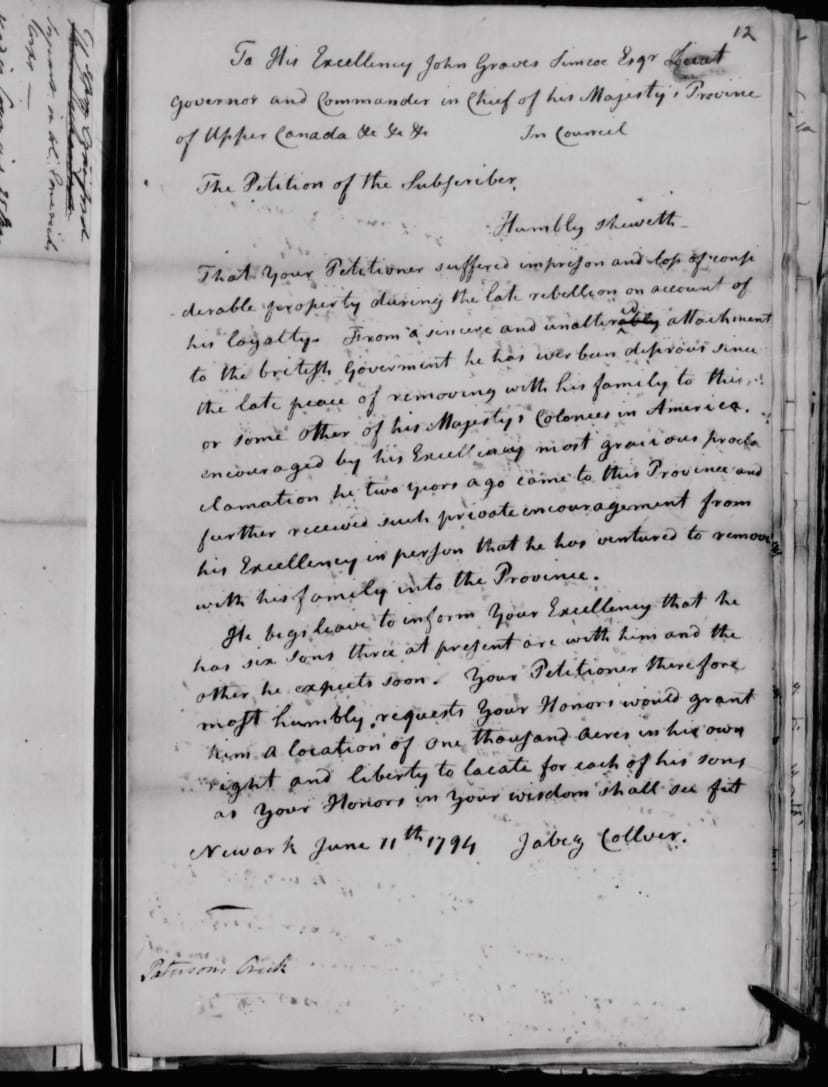
1. Petition to Governor John Graves Simcoe – 11 June 1794
To His Excellency John Graves Simcoe Esq.
Lieutenant Governor and Commander in Chief of His Majesty’s Province of Upper Canada &c. &c.
In Council
The Petition of Jabez Collver
Humbly Sheweth
That your Petitioner suffered imprisonment and loss of considerable property during the late rebellion on account of his loyalty. From a sincere and unalterable attachment to the British Government he has ever been desirous since the late peace of removing with his family to this or some other of His Majesty’s Colonies in America.
Encouraged by His Excellency’s most gracious proclamation he two years ago came to this Province and further received such private encouragement from His Excellency in person that he has ventured to remove with his family into the Province.
He begs leave to inform Your Excellency that he has six sons — three at present are with him and the other he expects soon.
Your Petitioner therefore most humbly requests Your Honor would grant him a location of One Thousand Acres in his own right and Liberty to locate for each of his sons as Your Honor in your wisdom shall see fit.
Newark, 11th June 1794
Jabez Collver
Note on Location:
The petition is dated Newark, 11 June 1794. At that time, Newark was the name of the settlement now known as Niagara-on-the-Lake, Ontario. It served as the first capital of Upper Canada from 1792 to 1797. The name was later changed to Niagara (and eventually Niagara-on-the-Lake) to avoid confusion with Newark, New Jersey.
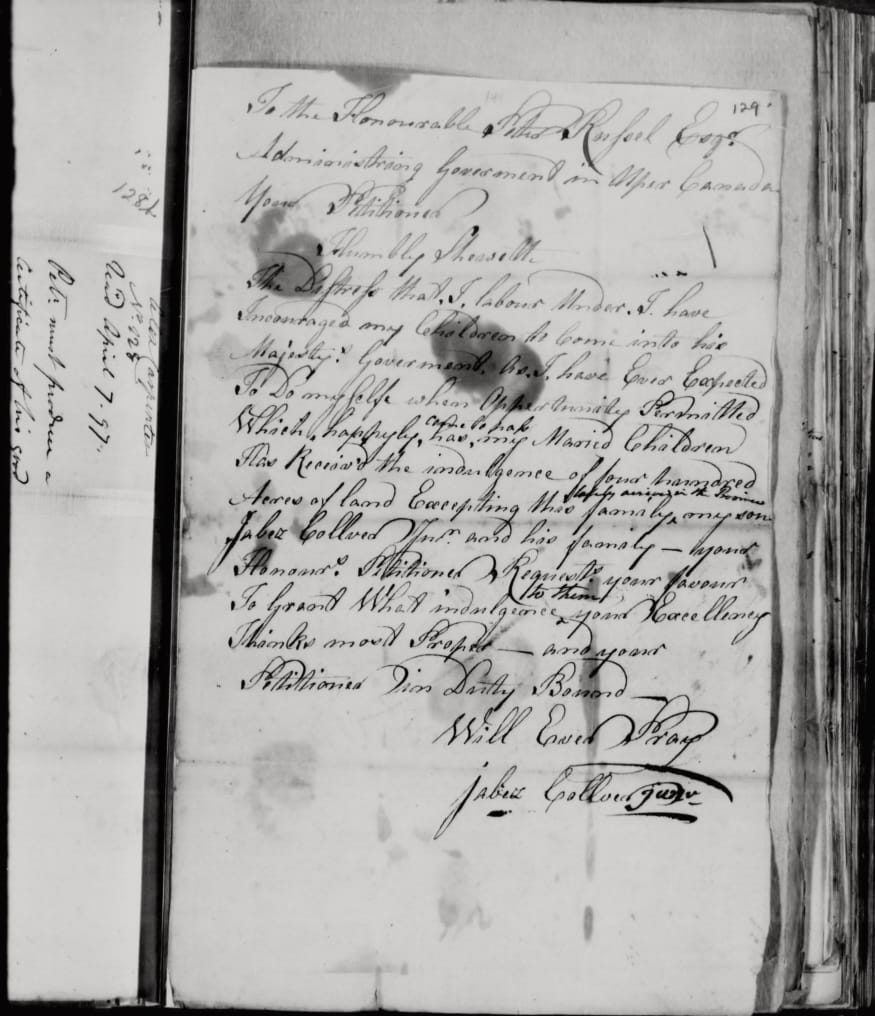
2. 1797 Petition to Peter Russell — On Behalf of His Son Jabez Jr.
To the Honourable Peter Russell Esqr.
Administering Government in Upper Canada
York
Honourable Sir,
The Petitioner humbly sheweth the distress that he labours under. He has encouraged his children to come into His Majesty’s Government, as he had ever expected to do himself when opportunity permitted; which happily came to pass.
His married children have each received the indulgence of four hundred acres of land, excepting this family, lately arrived in the Province — his son Jabez Collver Junr and his family.
Your Honour’s Petitioner requests your favour to grant them what indulgence your Excellency thinks most proper; and your Petitioner, in duty bound, will ever pray.
Jabez Collver
(Received 14 October 1796; read 7 April 1797. Upper Canada Land Petitions, “C” Bundle 2, No. 129 — Rev. Jabez Collver’s petition on behalf of his son Jabez Collver Jr.)
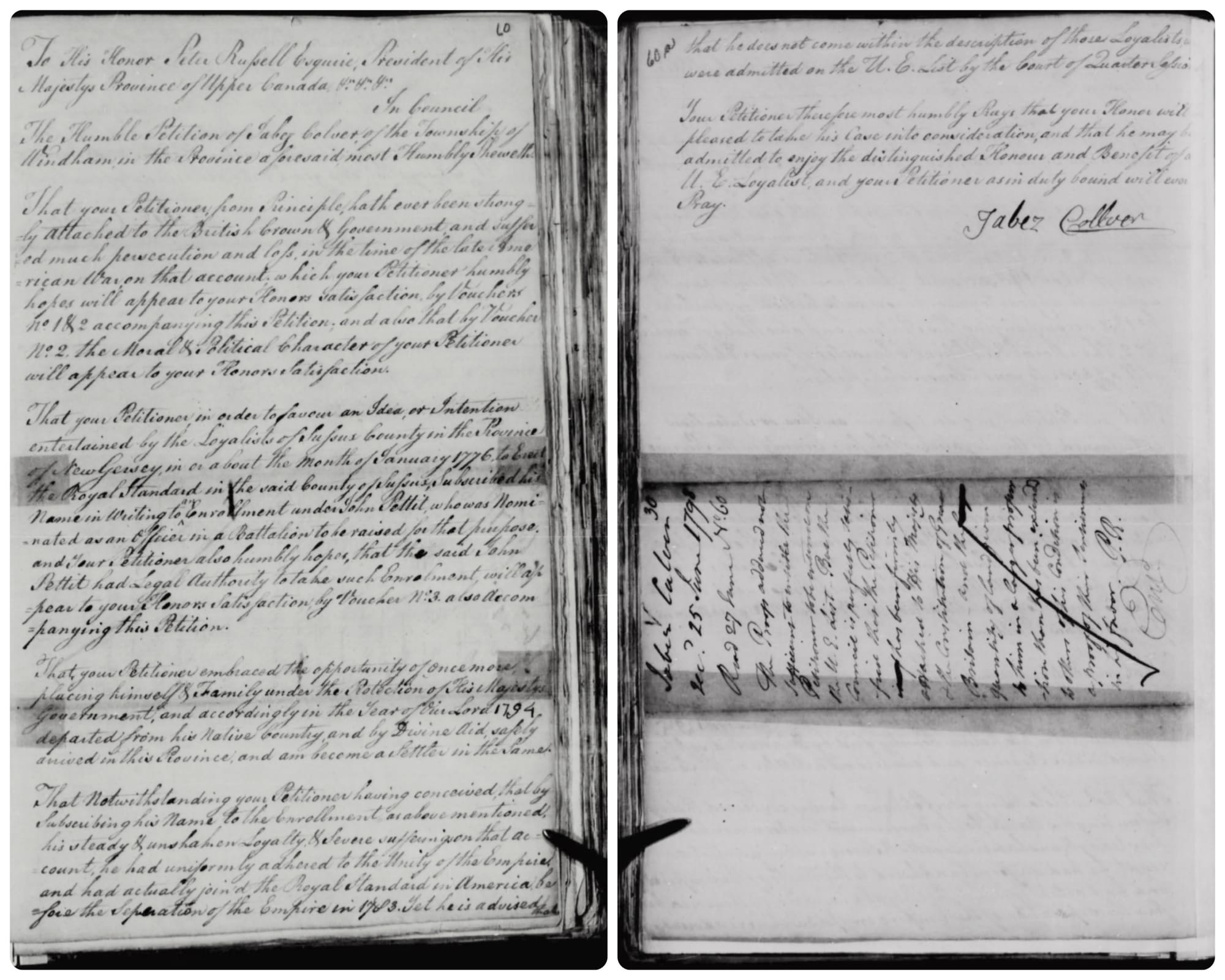
3. 1798 U.E. Loyalist Petition – 25 June 1798
To His Honor, Peter Russell Esquire, President of His Majesty’s Province of Upper Canada, &c. &c. &c.
In Council
The Humble Petition of Jabez Collver of the Township of Windham… most humbly sheweth:
That your Petitioner from principle hath ever been strongly attached to the British Crown & Government, and suffered much persecution and loss in the time of the late American War on that account…
That your Petitioner in order to favour an Idea or Intention entertained by the Loyalists… in or about the month of January 1776, to Erect the Royal Standard in the said County of Sussex, and subscribed his Name in Writing to enrolment under John Pettit…
That your Petitioner… in the Year of our Lord 1794 departed from his Native Country and by Divine Aid safely arrived in this Province…
Your Petitioner therefore most humbly Prays that your Honor will be pleased to take his Case into consideration, and that he may be admitted to enjoy the distinguished Honour and Benefit of a U.E. Loyalist…
Jabez Collver
York, 25th June 1798
Official Response (written sideways on the document):
“The Proofs adduced not sufficient to entitle the Petitioner to be entered on the U.E. List — But the Council is perfectly satisfied that the Petitioner has been firmly attached to His Majesty & the Constitution of Great Britain — and that the quantity of land given to him in a larger proportion than others of his Condition is a proof of their Sentiments in his favor.”
Three Passages That Still Echo
1. The Cost of Loyalty
“That your Petitioner suffered imprisonment and loss of considerable property during the late rebellion on account of his loyalty.”
In one quiet sentence, Jabez reminds us that loyalty in revolutionary times was not abstract. It carried a real price — prison, confiscated land, and the long road north.
2. A Father’s Hope for His Children
“He begs leave to inform Your Excellency that he has six sons — three at present are with him and the other he expects soon… grant him a location of One Thousand Acres in his own right and Liberty to locate for each of his sons.”
This is more than a request for land. It is a father trying to secure a future for an entire family line in a new country.
3. The Quiet Acknowledgment of Loyalty
“The Proofs adduced not sufficient to entitle the Petitioner to be entered on the U.E. List — But the Council is perfectly satisfied that the Petitioner has been firmly attached to His Majesty… and that the quantity of land given to him in a larger proportion than others of his Condition is a proof of their Sentiments in his favor.”
Even when the formal title of United Empire Loyalist was withheld, the government still recognized his steadfastness and had already rewarded him with extra land. It is a small but telling moment of historical mercy.
Why These Documents Still Matter
These petitions are not grand political statements. They are the intimate, handwritten records of one man’s attempt to rebuild a life after war and displacement.
Reading them today, we hear the voice of someone who had already lost much and was asking, with dignity and restraint, for the chance to begin again. They remind us that the story of Upper Canada was not written only by governors and generals, but by fathers, ministers, and settlers who carried their hopes — and their losses — into the wilderness.
Jabez Collver never received the full formal recognition he sought in 1798. Yet he received land, raised his family in Windham Township, and helped plant the first Presbyterian congregations in the Long Point region. His words, preserved in these petitions, remain as quiet testimony to the human cost — and quiet resilience — of building a new country.
Some voices from the past do not fade. They simply wait to be read.
© 2026 Albert B. Collver III · The Collver Family History Project. Original historical documents reproduced here are in the public domain; the research, text, and annotations are the author’s. Please cite or link rather than republish.