The Family Pamphlet: The Collver-Culver Genealogy, 1630 to 1916
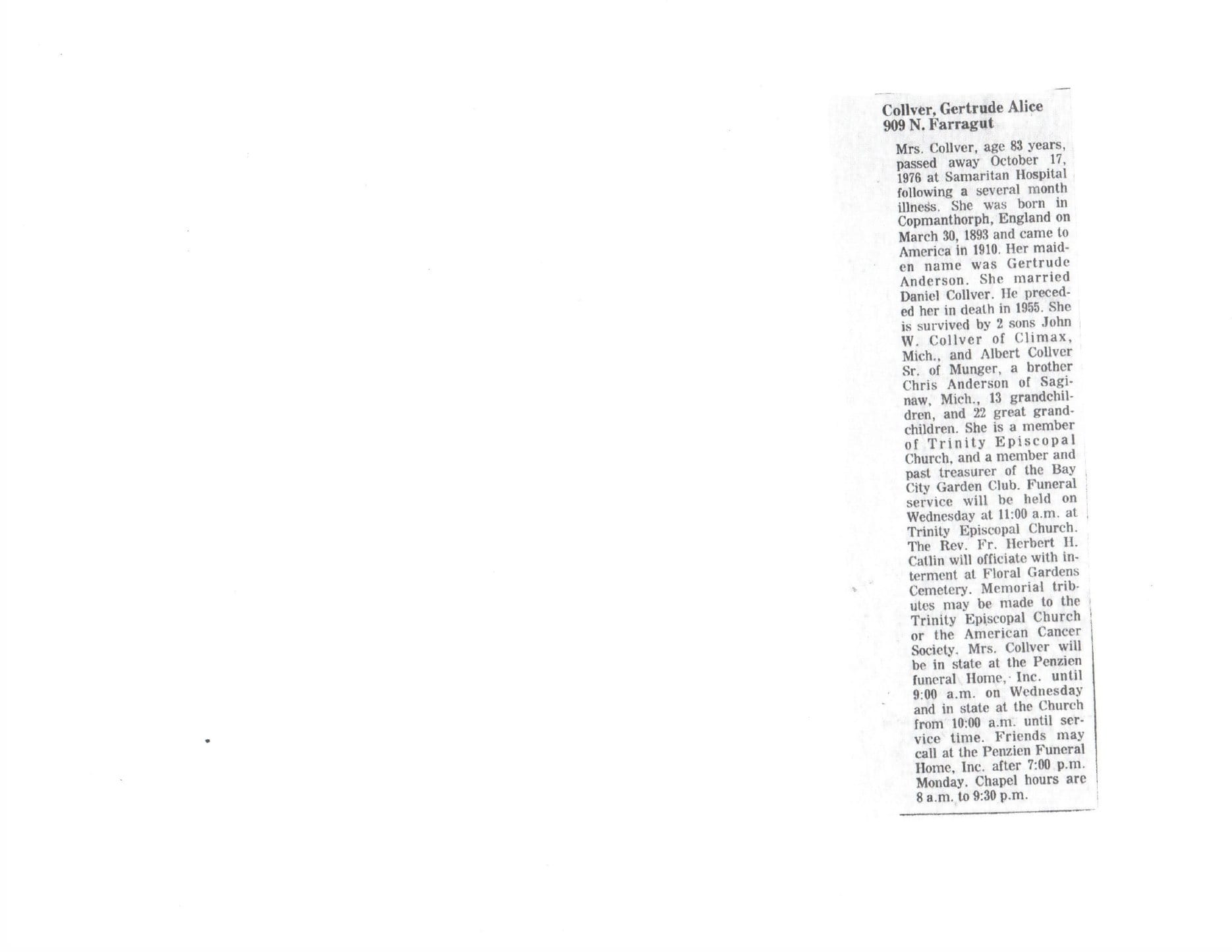
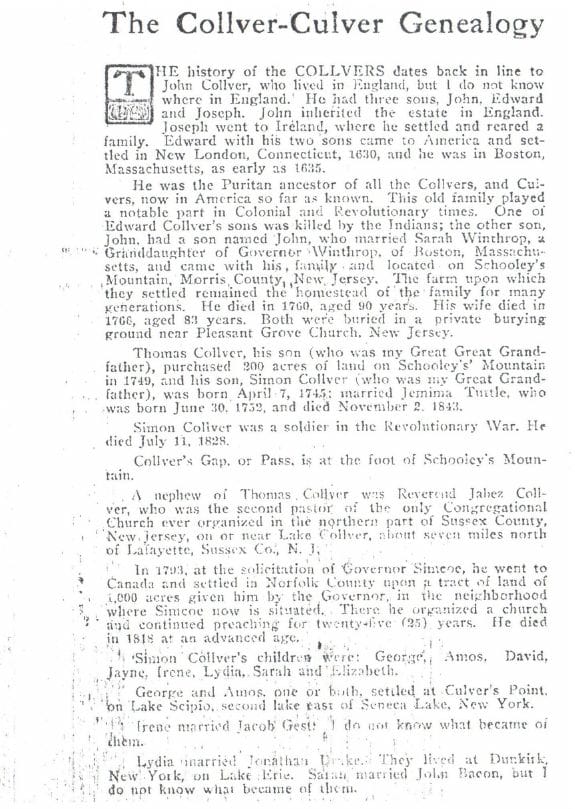
A reader asked where to find the rarest book in the family. Here it is — all eleven pages — together with the 1976 obituary pasted inside that tells you exactly whose shelf it came from.
For Molly.
Yesterday a reader — a descendant of Sgt. Tim Culver of Sheshequin, whose comment has already sharpened this Saturday's post — asked a fair question: where can one find the "family pamphlet of 1916" that these articles keep citing? The honest answer: almost nowhere. The Collver-Culver Genealogy, 1630 to 1916 was privately printed, without so much as a title page, and WorldCat records exactly one library copy on earth, at Library and Archives Canada in Ottawa. So today, rather than send anyone to Ottawa, I am putting the whole thing here: all eleven pages, scanned cover to coda, free to read and download at the end of this post.
But first, let me tell you what this particular copy is — because a rare pamphlet is one thing, and a family's own working copy is another.
The obituary pasted on page seven
Tucked into this copy, photocopied onto what I have always counted as its seventh page, is a newspaper obituary from Bay City, Michigan, dated October 1976:
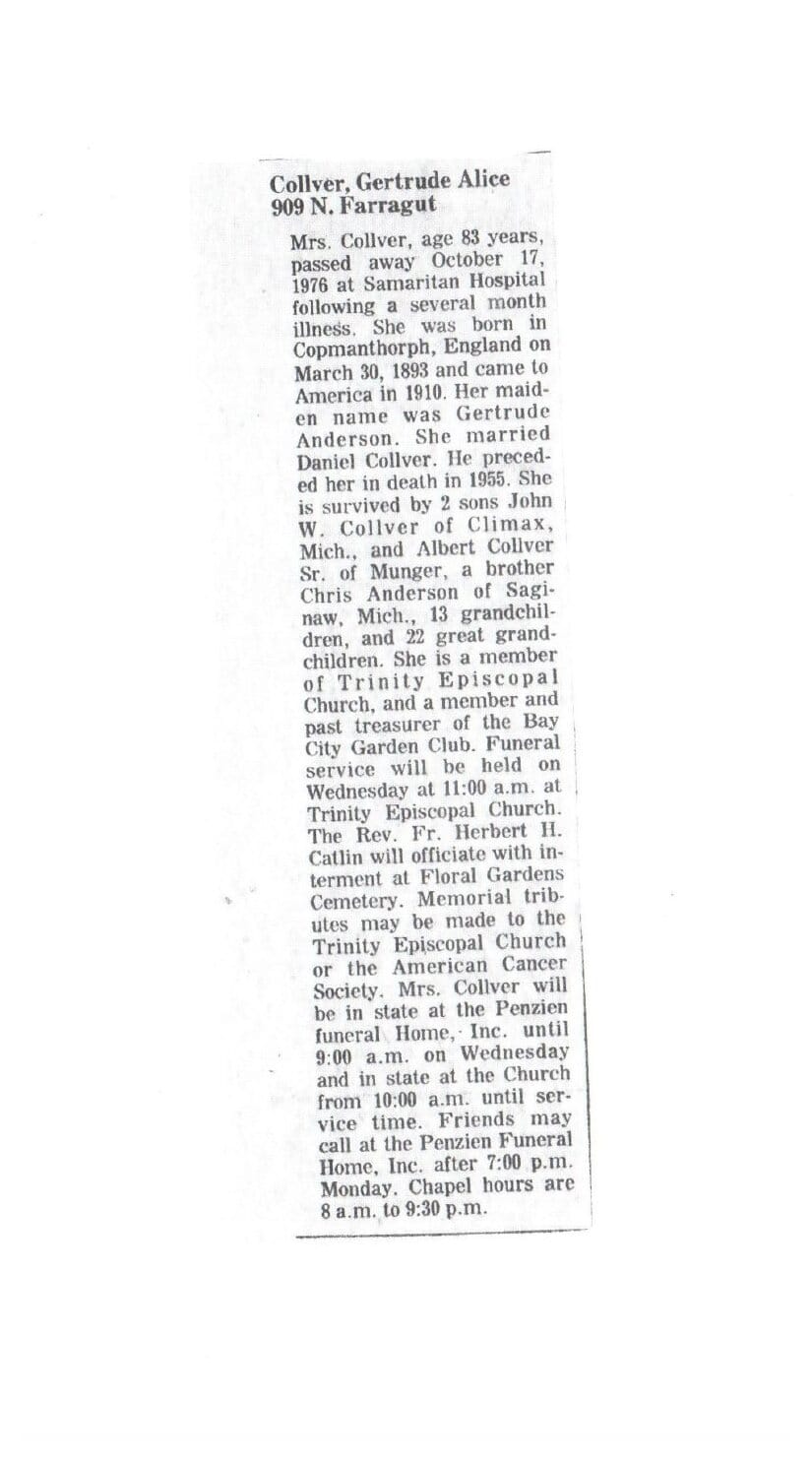
Gertrude Alice Collver, age 83 — born in Copmanthorpe, England, on March 30, 1893; came to America in 1910; maiden name Anderson; widow of Daniel Collver; survived by two sons, John W. Collver of Climax and Albert Collver Sr. of Munger. She was my great-grandmother. Albert Collver Sr. was my grandfather — the same grandfather who first told me, when I was a boy, the family stories out of Simcoe that started me down this road.
That clipping is the pamphlet's pedigree. It tells you whose shelf this copy sat on: it came down through Daniel and Gertrude's household to my grandfather in Munger, Michigan, and so to me — sixty years of one family adding itself into the margins of its own history. And it carries a quiet joke of its own: the family that left England around 1637 married England back into the line in 1910. Gertrude of Copmanthorpe, Yorkshire, outlived by three centuries the question this whole project keeps asking — which English village did we come from? Hers, at least, we know.
Who wrote it? A small detective story
The pamphlet is anonymous. No author, no printer, no place, no date — only the running heads and eleven pages of begats. But anonymous genealogists always leave fingerprints, because they cannot help knowing too much about their own line. Watch the possessives: Thomas Collver is "my Great Great Grandfather." Simon (1745–1828) is "my Great Grandfather." David Jayne Collver (1787–1878) is "my Grandfather." That plants the author two generations below David Jayne, in the Clyde, Ohio branch — descendants of Thomas Collver of Schooley's Mountain, the quiet brother of our much-chronicled Robert. And the coverage gives the same answer: Simon B. Collver's household gets the loving detail — a wedding anecdote datable to November 1867, the Civil War companies, who moved to Cleveland and when — while other branches get a courteous line or two. The latest internal dates are 1913–14.
So the field narrows to Simon B. Collver's two children still living around 1916, both of Cleveland: Julia Ann Collver Mason, or David Jayne Collver Jr., the New York Central passenger agent who carried his grandfather's name — whose son Leon, a vice-president of a Boston travel house, would certainly have known how to get eleven pages typeset and printed. One of these two, I am fairly sure, is our author. If you descend from the Clyde branch and your family remembers who typed eleven pages of begats sometime around 1916, the comments below are open.
Read it with care
Like every family history of its era, the pamphlet preserves and invents in the same breath. In its favor: it records Thomas Collver's purchase of 200 acres on Schooley's Mountain in 1749 — a claim I have since verified against the New Jersey deed abstracts, which show the Schooley tract sold to Thomas Culver by Thomas Batson in that very year. It states Jabez’s Upper Canada grant as 1,000 acres, agreeing exactly with the land books — a figure long misreported, including by me until a word-by-word verification of this scan settled the smudged numeral, as an inflated 3,000. It preserves the two "lost Collvers" — Amos, who vanished westward in the 1830s, and Andrew Jackson Collver, youngest of thirteen, last rumored in San Francisco. It names Civil War regiments for a dozen descendants. And, to its credit, it calls Jabez's Sussex County church "Congregational" — a point on which it was more careful than some later histories (and, until yesterday, than one footnote on this very site).
Against it: the pamphlet has Edward settling New London in 1630 — a town not founded until 1646, by a man documented at Dedham, Massachusetts in 1637. It repeats the Sarah Winthrop marriage, the grandest and most durable of the family legends, demolished by the genealogists in 1945. Take it as testimony, not as verdict: this is what the family believed about itself in 1916, told with complete sincerity by someone who loved the subject.
The pamphlet
Here it is in full. Genealogists should feel free to cite by page; the running heads are original. Prefer text? A complete verbatim transcription — every page, original spelling preserved, checked word-by-word against the scan — is here, searchable and citable.
Coda
After eleven pages of begats, the pamphlet ends with a shrug I have quoted before and will keep quoting, because no one has ever put the whole matter better: "Collver is pronounced Culver, and some spell it that way."
One last thing. This copy told its story because somebody pasted an obituary into it. If your branch of the family has its own copy — of this pamphlet, or of anything — with different things pressed between the pages, I would very much like to hear what they are. That is, after all, exactly how this post came to be written: someone left a comment.
© 2026 Albert B. Collver III · The Collver Family History Project. Original historical documents reproduced here are in the public domain; the research, text, and annotations are the author’s. Please cite or link rather than republish.