The Judge, the Preacher, and the Log Gaol

Nathaniel Pettit, Jabez Collver, and the price of a signature
For Kathy Hall UE
There is a village in New Jersey that was named for its jail.
Not for a founder, not for a church, not for some hopeful classical borrowing — for the jail. In 1753 the new county of Sussex held its first court at the public house of a tavern-keeper named Jonathan Pettit, in Hardwick Township, and the following April the county ordered a gaol built on land given by Samuel Green, the deputy colonial surveyor, a few steps from Pettit’s door.1 It was built of squared logs, as nearly everything there was, and the settlement that grew up around the courthouse-tavern and its prison took the only name that could have suggested itself: Log Gaol. Gaol is simply the older English spelling of jail — same word, same sound — so the name meant exactly what it looks like it means. The village is called Johnsonburg now, and I suspect the change was a relief to its postmaster.
I did not go looking for Log Gaol. Log Gaol came looking for me, the way these things do, in the days after A House Divided was published — in the form of a single sentence written by my sixth great-grandfather, and a comment from a reader descended from the family that sentence names.
The sentence
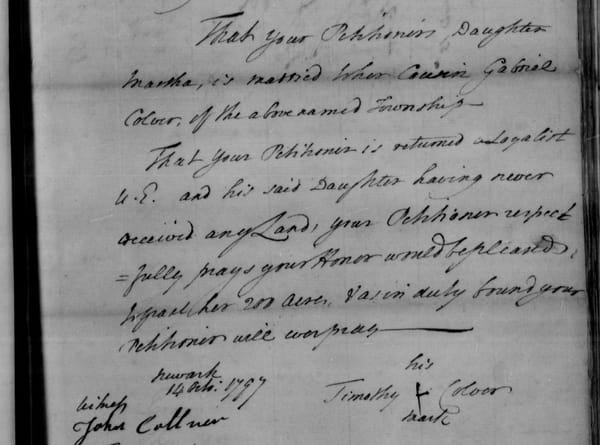
When Rev. Jabez Collver petitioned Upper Canada in 1798 for a place on the United Empire Loyalist list, he had to explain what, exactly, he had done for the King. His answer reached back twenty-two years:
That your Petitioner, in order to favour an Idea, or Intention entertained by the Loyalists of Sussux [Sussex] County in the Province of New Gersey [New Jersey], in or about the Month of January 1776, to Erect the Royal Standard in the said County of Sussux, Subscribed his Name in Writing to an Enrollment under John Pettit, who was Nominated as an Officer in a Battalion to be raised for that purpose.2
Readers of the earlier posts will remember what that signature cost him: a sedition conviction in June 1777, a fine, a committal, and eventually a farm in another country. What the petition never explains is the man at the center of it. Who was John Pettit? For a long time I could not say. He appears in no muster roll of the New Jersey Volunteers — no Pettit ever held a commission in that corps under any spelling3 — and a man who is named once, in one petition, as the officer of a battalion that never came to exist, is nearly as hard to catch as a man who never existed at all.
Then a reader wrote. Kathy Hall UE, a descendant of the Pettits, left a comment describing her family’s own tradition: Loyalists of Log Gaol in Sussex County, a father and brothers named Nathaniel, John, Andrew, and Charles, an imprisonment, and a caravan north to the Niagara in 1787. Her account sent me into the compiled genealogies, the Dictionary of Canadian Biography, the Loyalist Trails newsletter archive, and Ancestry’s family-history books — and what came back was a family, a prison, and a date that made me sit still for a moment. This post is what the records show, offered with the usual caution: some of it is proven, some of it is probable, and I will tell you which is which.
The Pettits of Log Gaol
The Pettits were a Hunterdon County family before they were a Sussex County one. Nathaniel Pettit II and his wife Elizabeth Heath farmed at Amwell, in the Society’s Great Tract, and beginning in 1749 their sons — “eventually eight sons,” the family history says — moved north into the newly opening hills of Sussex.4 Three of those sons concern us.
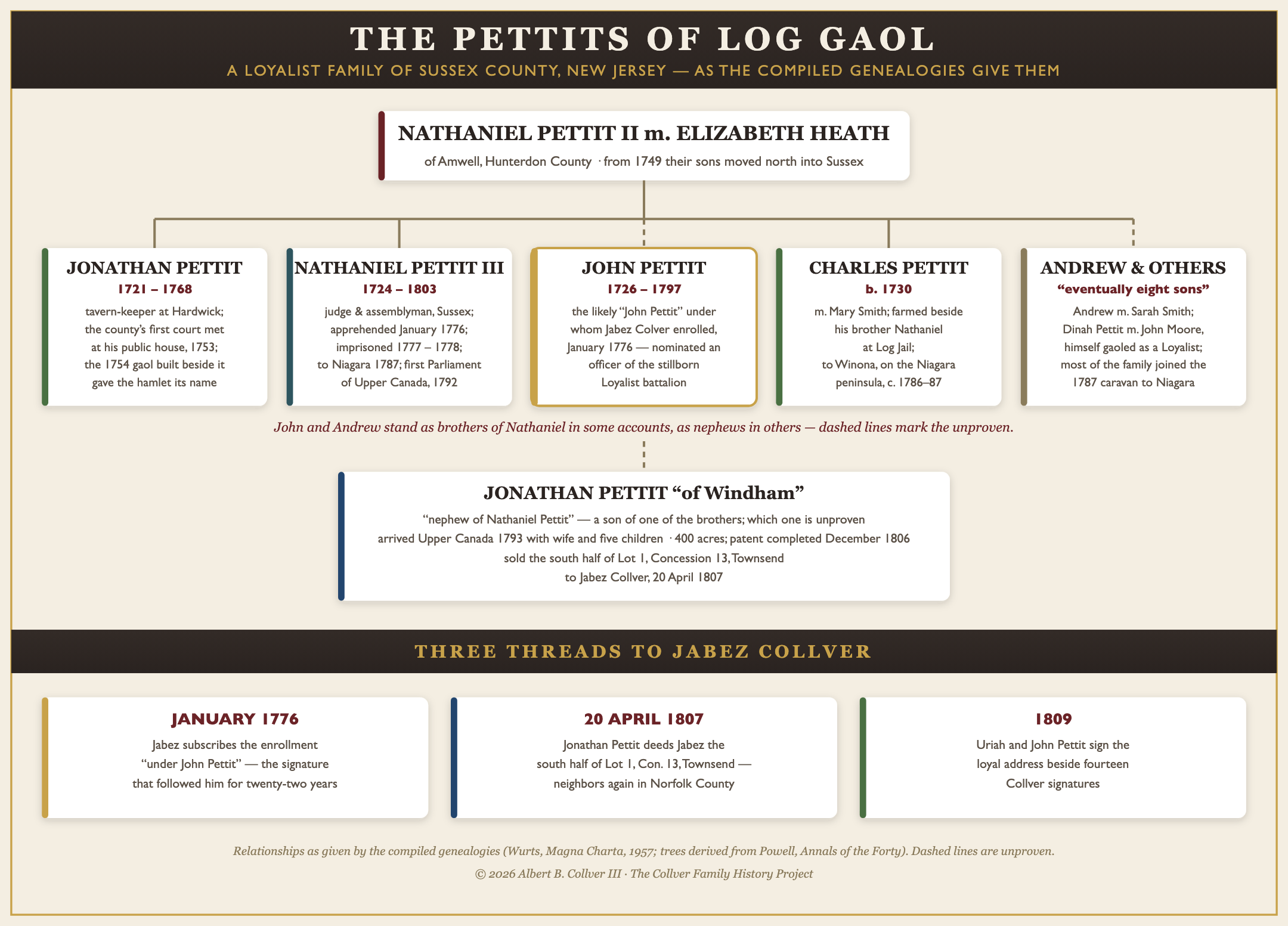
Jonathan Pettit (1721–1768) kept the tavern at Hardwick — the Dark Moon, a name almost too good for a public house beside a prison. The county’s first court sat in his house in 1753; the county’s first gaol rose beside it in 1754; and the hamlet took the gaol’s name for its own. Jonathan was made one of the first justices of the new county. He is the reason there is a place called Log Gaol at all.
Nathaniel Pettit III (1724–1803) was the family’s great man. He owned two mills, sat as a judge of the county Court of Common Pleas from 1766, and represented Sussex in the New Jersey Assembly from 1768. When the troubles came he did not trim. On January 12, 1776, he was brought before the provincial committee of safety for refusing to pay the taxes levied by the revolutionary congress; he was fined, disarmed, and stripped of his judgeship.5 Lorenzo Sabine, the great chronicler of the Loyalists, gives him a single dry sentence: “Nathaniel, a magistrate in the county of Sussex, apprehended January, 1776, by the Committee of Safety; disarmed, ordered to pay £8, in part of the expenses of the proceedings against him, and to give security for his future good behavior.”6
John Pettit (1726–1797, if the compiled genealogies have him right) is the quiet one — and, I believe, the man in my grandfather’s sentence. I will come back to him.
Now set two dates side by side. Judge Pettit was apprehended by the Committee of Safety in January 1776. Jabez Colver subscribed his name to the Loyalist enrollment “in or about the Month of January 1776.” These are not two events. They are two ends of the same event: a scheme among the Sussex Loyalists to raise a battalion and set up the King’s standard, answered by a crackdown that took the county’s own judge first. The enrollment Jabez signed was the paper trail of that scheme; the proceedings against Pettit were the government’s reply. My grandfather’s twenty-two-year-old memory of the month, it turns out, was exact.
The battalion itself was stillborn. No royal standard ever flew over Sussex County, and when a real Loyalist battalion was finally raised from that country in late 1776 it was commissioned under Joseph Barton, the Newton assemblyman-turned-colonel — the same Barton whose name appears in the seditious words Jabez was convicted of speaking the following spring.7 The Sussex plot of January 1776 survives only in the punishments of the men who joined it.
So who was the John Pettit “Nominated as an Officer”? The compiled genealogies give Judge Nathaniel a brother John, born 1726 — a man of about forty-nine in January 1776, of the right family, the right township, and the right politics. The other John Pettit in the records, the “Esquire John” who died at Grimsby in 1851, was fourteen years old that January, which settles his candidacy. I hold the brother as the likely identification and say so plainly: likely, not proven. One account makes John a nephew of the judge rather than a brother, and until the Pettit family’s own literature — the Grimsby Historical Society’s Annals of the Forty, which no library has yet put online — can be consulted, the dashed line stays dashed.8
A conspiracy is a hard thing to document; that is rather the point of one.
The prison the town was named for
What happened next to the Pettits is not dashed at all.
Judge Pettit was arrested again in the spring of 1777 — the season the new state’s Council of Safety began sweeping the counties for the disaffected — and this time there was no £8 fine. He was imprisoned from April 4, 1777, to May 28, 1778, nearly fourteen months, and bought his liberty at the end of it with heavy fines and bonds; the family history says the fines ran to more than a thousand pounds (very roughly two hundred thousand dollars in today’s money — more than a good farm was worth).9 A letter preserved at Trenton adds a strange, precise detail: Colonel John Symmes wrote Governor Livingston in 1777 that Judge “Nathaniel Pettit did not escape from the North Sussex jail when the prisoners from the South jail escaped” — a glimpse of a county with two jails, a jailbreak, and one famous prisoner who pointedly stayed put.10
And where did the judge sit? Here the record produces the detail that gives this post its title. When Adam Green — son of the same Samuel Green who had given the land for the gaol in 1754 — petitioned for entry on the United Empire Loyalist roll in 1808, he supported his claim with a statutory declaration, and the declaration states that Adam spent time in Log Gaol prison with Judge Pettit in 1777.11 Four of Samuel Green’s five sons, the family’s chronicler notes, were housed during the rebellion in the gaol their father had voted to build. John Moore, who had married Dinah Pettit, was held there too: “You will have heard of the sufferings of those imprisoned at Log Gaol,” his family’s historian writes, “– for that was where John Moore was held.”12 Moore’s own petition of 1795 gives his summary of those years in the third person: “on account of his attachment to the British Constitution he became suspect, lost business and suffered fines and imprisonment.”
Sit with the picture a moment. The judge of the county, jailed in the log prison that stood beside his late brother’s tavern, in the village that bore the prison’s name; beside him the surveyor’s sons, in the gaol their father sited; and the judge’s own son-in-law-by-marriage among them. Sussex County did not need to build its Loyalists a prison. It had built one already, in the middle of their own settlement, and it filled it with the family of the men who founded the place.
What it was like
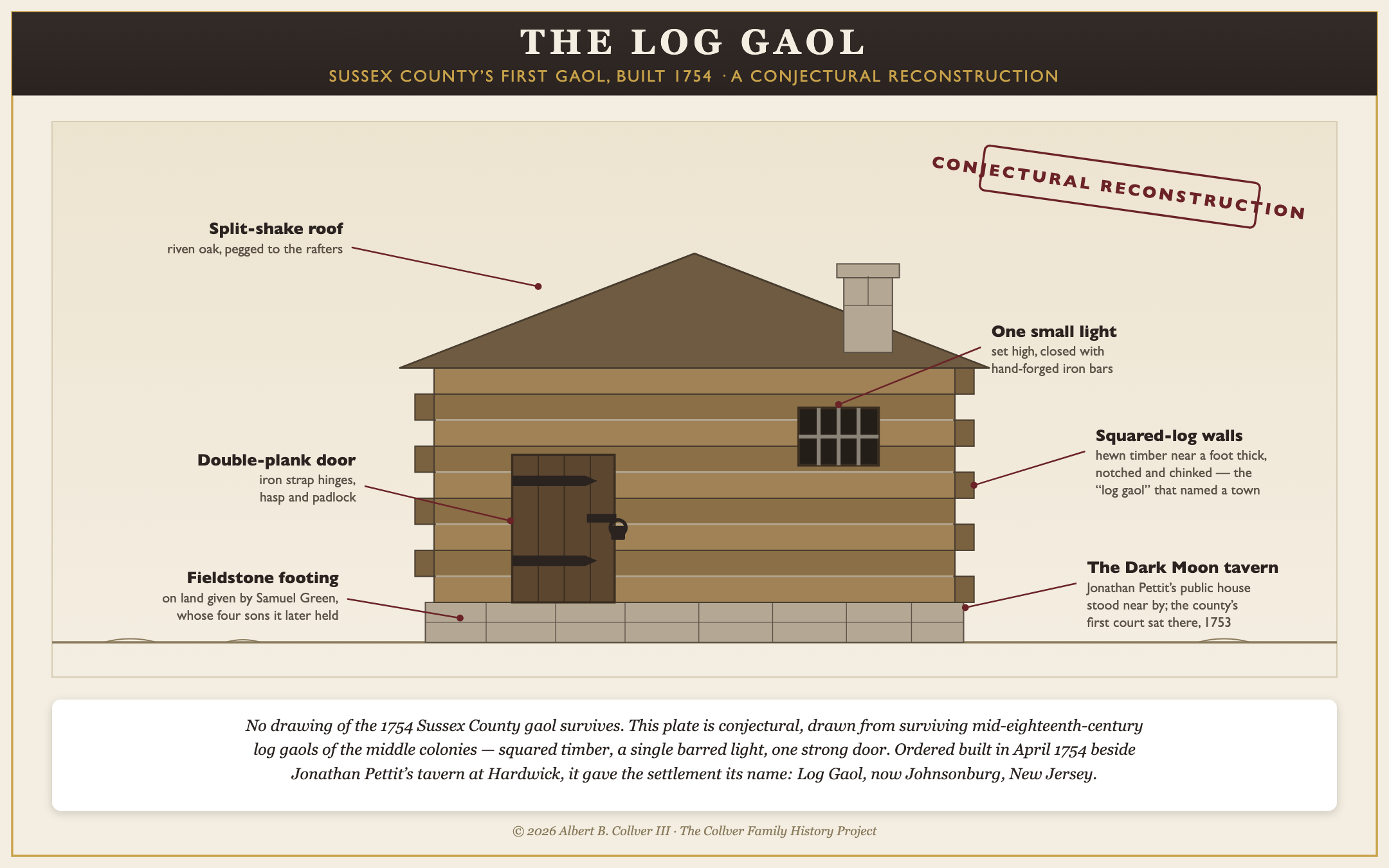
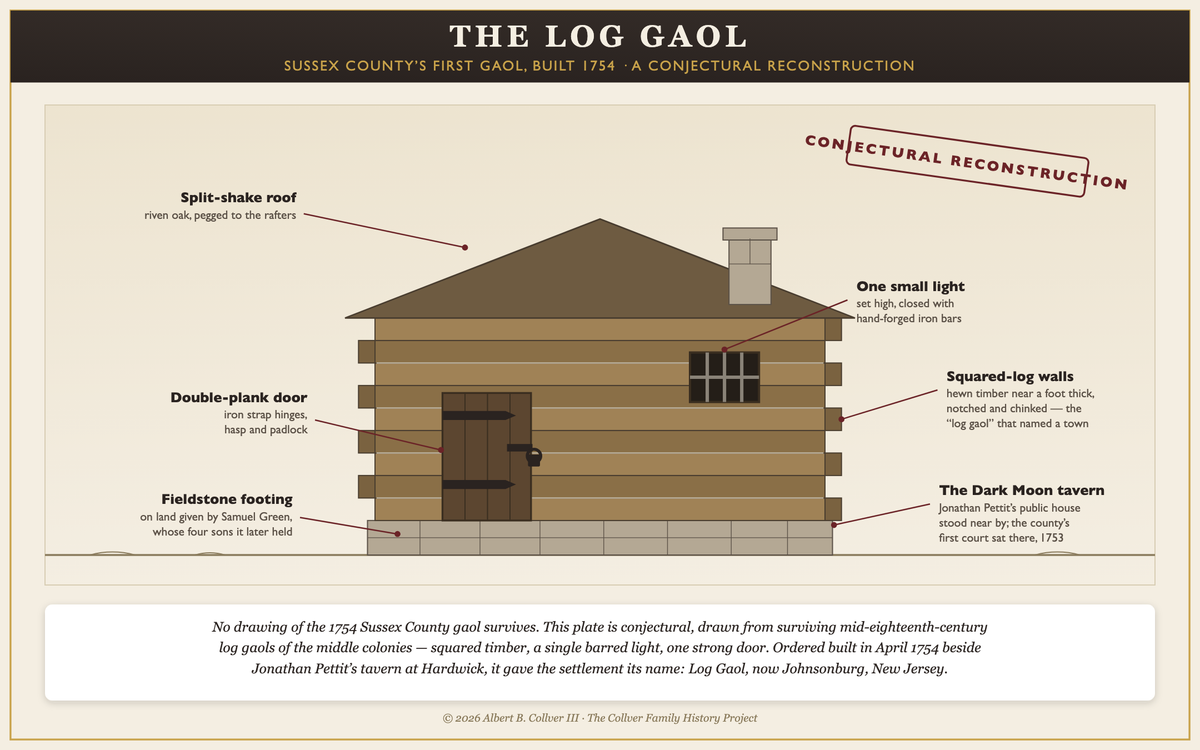
No drawing of the Log Gaol survives, and I want to be careful here, because this is the point in a family history where imagination likes to dress itself up as research. The reconstruction above is labeled conjectural because it is: it is drawn from what mid-eighteenth-century county log gaols in the middle colonies generally were, not from any surviving image of this one. They were small, brutally simple buildings — walls of squared timber near a foot thick, notched at the corners and chinked tight; a single door of doubled planks on iron strap hinges, with hasp and lock; one small window, set high and closed with hand-forged bars. A gaol of this kind was not a house of correction with cells and keepers; it was a strongbox for people, one or two common rooms in which debtors, felons, and — after 1776 — the politically suspect waited together for the court to decide what they were.
What did waiting in such a box feel like? The State of New Jersey’s own minute-book obliges with an answer, from the summer Judge Pettit sat confined. In July 1777 a group of prisoners taken up from Bergen County petitioned the Council of Safety from the gaol at Morristown, “Setting forth, that the Gaol is exceedingly unhealthy, dangerous and disagreable,” and praying to be let out on parole to private lodgings while they awaited a hearing.13 That is a petition, and petitions exaggerate; but “unhealthy” and “dangerous” were the plain truth of eighteenth-century confinement everywhere — small rooms, no sanitation, gaol fever always one prisoner away — and no one at the time bothered to dispute it. Confinement was also only half the punishment. The other half was financial: fines, fees, bonds, and recognizances, the machinery that could hold a man “till paid” and strip an estate without ever confiscating it. Judge Pettit’s thousand pounds bought his freedom, not his acquittal.
By the Revolution the county’s official gaol was no longer the log one — the county seat had moved to Newton in 1765, where the courthouse kept prisoners in its cellar — and Newton’s gaol has its own Loyalist story: in 1780 the partisan James Moody raided it and freed the Loyalist prisoners held there.14 The Green and Moore declarations show the old Log Gaol was pressed back into service for the overflow of the disaffected. Between the two of them, the North jail and the South jail of Colonel Symmes’s letter acquire faces.
And Jabez?
Now to my own grandfather, and to the claim this post set out to weigh. In his first petition to Upper Canada, in June 1794, Jabez wrote that he had “suffered imprison[ment] and loss of considerable property during the late rebellion on account of his loyalty.”15
For a long time I read that sentence with one eyebrow raised. Every Loyalist petition claims suffering; suffering was the currency the land boards traded in. But the record, assembled, now stands like this. Jabez signed the January 1776 enrollment — his own sworn account, made against interest, since it confessed treason to the winning side of a war he had just lived through. The scheme’s leaders were prosecuted; the judge at the head of the family that led it went to prison for fourteen months. Jabez himself was indicted for his seditious words in the spring of 1777, pleaded guilty on June 12, 1777, and was fined five pounds (about six weeks of a laboring man’s wages — call it a thousand dollars today) and committed until it was paid — a documented imprisonment, however brief, in the very season Adam Green and John Moore and Judge Pettit lay in Log Gaol one township over.16
How long did he sit? No record says, and I will not invent one. The scale of the sentence is the best evidence we have: the same machinery that priced Judge Pettit’s offense at a thousand pounds and fourteen months priced the preacher’s words at five pounds — a small offender’s fine, which argues a small offender’s confinement, days or weeks rather than the judge’s year and more. If he lay in gaol from his indictment in May until his plea on June 12, as men charged with sedition commonly did unless a neighbor stood surety for them, that alone would account for a month. Anything more precise would be invention. But the one man entitled to characterize it chose his word in 1794 with a preacher’s economy — not troubled, not questioned, but imprisoned — and every other man in this story who used that word of himself, the record has since borne out.
Where Jabez was held — Newton’s cellar, the old log prison, or somewhere else — no surviving record says, and I will not pretend otherwise. But the absence of a gaoler’s ledger is not the absence of a gaol; the registers of that county’s justice in that decade survive only in fragments, and the fragments we do have keep proving his petition right. The man said he was imprisoned for his loyalty. He was convicted for his loyalty, committed under that conviction, and surrounded — network, neighbors, and the officer of his enrollment — by men whose imprisonment is documented to the very building.
When the Upper Canada council rejected his UE petition in 1798, it did so for want of proofs, adding — the words still smart on his behalf — that “the Council is perfectly satisfied that the Petitioner has been firmly attached to His Majesty.”17 Rejected on paperwork, not on loyalty. Two hundred and twenty-eight years later, the paperwork is finally coming in.
There is also a larger, more respectable version of that raised eyebrow, and it deserves a fair answer. Historians have long pointed out that most of the Americans who streamed into Upper Canada after Simcoe’s 1792 proclamation — the late Loyalists, the literature calls them — came for the two-hundred-acre grants and the low taxes rather than for the King; Alan Taylor’s history of the borderland treats the wave, tens of thousands strong, as economic migrants whose new allegiance ran about as deep as the land was cheap, and the “smoldering and often agonizing debate over the trustworthiness of his settlers,” as one recent account puts it, began inside Simcoe’s own government.18 Jabez crossed in the proclamation’s first seasons, squarely inside the suspect wave, and the Council that rejected his UE petition was applying exactly that suspicion. A skeptic may fairly ask whether the preacher was simply one more land-seeker with a practiced story.
The answer is the whole burden of this post, so let me state it plainly. Jabez’s loyalism is not documented from the 1790s, when it paid; it is documented from January 1776, when it cost. The enrollment under John Pettit, the seditious words, the guilty plea, the fine and the committal — every one of these survives in his enemies’ records, written down by committees and courts that had no interest in flattering him, sixteen years before there was an acre of free land on offer. Free land could tempt a man to profess loyalty; it could not arrange for him to be convicted of it fifteen years in advance. And anyone who imagines the crossing itself as an economic opportunity should read what the 1790s arrivals at Long Point actually received: land, window glass, and ironware — no rations, no seed, no livestock — in a settlement whose first winters were remembered for “the cry of the children for bread.” Jabez made that bargain in his early sixties. Men do such things for conviction, or for family, or for God; rarely for a speculation.
The threads that held
The Pettit story does not end in the gaol, and neither did the acquaintance.
In 1787 the family went north — a caravan of Pettits, Greens, Moores, Smiths, and Lewises out of Log Gaol and its townships, remembered in the family accounts as several hundred strong, that crossed to the Niagara in the summer of 1787. Judge Pettit went with them, and Upper Canada gave him back everything New Jersey had taken: land in five townships, a seat on the district land board, and in 1792 election to the first Parliament of Upper Canada.19 He had been an assemblyman for Sussex under the King and became an assemblyman for Lincoln under the same King; the constituency moved, the allegiance never did. He died at Ancaster in March 1803 and lies buried in the Anglican churchyard at Grimsby.
And the Collvers kept meeting Pettits. A Jonathan Pettit — certified in his land petition as a “nephew of Nathaniel Pettit,” arrived 1793 — settled in Windham Township, Norfolk County, the same township and the same year as Jabez; in December 1806 his 400-acre patent was completed, and on April 20, 1807, a Jonathan Pettit deeded Jabez Collver the south half of Lot 1 in Townsend’s 13th concession.20 Two years after that, when the Norfolk settlers signed their loyal address to the Crown, Uriah Pettit and John Pettit set their names in the same column as fourteen Collvers. Whether the Windham Jonathan was the deed’s Jonathan, and which brother was his father, are questions the Ontario land records can settle and I intend to let them. But the pattern needs no more proof: for over thirty years, wherever the preacher’s family put down its name, a Pettit signed nearby.
Johnsonburg is a quiet crossroads today; the log gaol is long gone, and the village long ago traded away the strangest place-name in New Jersey. St. Andrew’s churchyard at Grimsby still keeps the judge. And this spring, two hundred and fifty years after a preacher signed his name under a Pettit, a descendant of the Pettits wrote to a descendant of that preacher to compare the family stories — which is how this post came to be written. The enrollment of January 1776 has one signature left to account for, and it seems the families it bound together are still keeping company.
Sources and footnotes
- The courts were established at Jonathan Pettit’s public house by ordinance of November 20, 1753, and the jail ordered built in April 1754 on land donated by Samuel Green: George Wyckoff Cummins, History of Warren County, New Jersey (New York: Lewis Historical Publishing Co., 1911), 17–18, 25–26; summarized in Jean R. Walton, “On the Road to Logg Gaol,” NJPH (New Jersey Postal History Society) 48, no. 2 (May 2020): 67–68. ↩
- Petition of Jabez Collver, received June 25, 1798, Upper Canada Land Petitions, Bundle 4, Petition 60, Vol. 92, LAC microfilm C-1648, images 870–871. Transcribed in full in Echoes from the Frontier. ↩
- The complete officer roster of the New Jersey Volunteers (242 commissions) contains no Pettit: On-Line Institute for Advanced Loyalist Studies, royalprovincial.com. Joseph Barton appears as lieutenant-colonel of the 5th Battalion, commissioned November 27, 1776. ↩
- The Pettit genealogy: John S. Wurts, Magna Charta, Part 7 (1957), ch. 261, “The Pettit Family,” 2308–2318; and the family reconstructions derived from R. Janet Powell, ed., Annals of the Forty (Grimsby Historical Society, 1950–59). The two do not agree in every particular, which is why the chart above carries dashed lines. ↩
- “Pettit, Nathaniel,” Dictionary of Canadian Biography, vol. V (University of Toronto/Université Laval), biographi.ca. ↩
- Lorenzo Sabine, Biographical Sketches of Loyalists of the American Revolution (Boston, 1864), II:562. Sabine’s same entry credits “Charles, Deputy-Secretary of the Province” to this family — an error; that Charles Pettit was a Whig official and no relation of use here. ↩
- For Barton’s battalion and Jabez’s 1777 sedition case, see Set Up the King’s Standard. ↩
- John Pettit (1726–1797) as brother of the judge: the Annals-derived genealogies. As nephew: a Pettit family account preserved on the genealogy.com surname forum. Annals of the Forty vol. 1 (Loyalist and pioneer families of West Lincoln) is the arbiter, and exists only in libraries; it is on my desk-list. ↩
- Imprisonment dates and fines: DCB, vol. V; “fined more than £1000” and the year in jail: Wurts, Magna Charta, 2313–2317. ↩
- Symmes to Livingston, 1777, quoted in Wurts, Magna Charta, 2316. ↩
- David B. Clark UE, “Five Brothers; Two Loyalists – The Green Family,” Loyalist Trails (UELAC newsletter) 2009-08 (February 22, 2009). Clark: “Fatefully, that same gaol would house at least four of Samuel’s sons during the rebellion.” ↩
- Judith Nuttall, “John Moore of New Jersey and Grimsby,” Loyalist Trails 2009-10 (March 8, 2009), including Moore’s 1795 petition to Lieutenant Governor Simcoe. ↩
- Minutes of the Council of Safety of the State of New Jersey (Jersey City, 1872), 95 — the same July 1777 sittings, readers of A House Divided will remember, at which seven Colver men of Morris County were cited as “dangerous to the present Government.” ↩
- The county seat and gaol at Newton from 1765: Walton/Cummins, above. Moody’s raid on the Newton gaol, 1780: James Moody, Lieut. James Moody’s Narrative of his Exertions and Sufferings in the Cause of Government (London, 1783), and the site histories of Newton, N.J. Accounts differ on the exact date; they agree on the cellar and the freed prisoners. ↩
- Petition of Jabez Collver, June 11, 1794, Upper Canada Land Petitions, “C” Bundle 1, Petition 12, Vol. 89, LAC microfilm C-1647, images 89–90. ↩
- The plea, fine, and committal-until-paid of June 12, 1777: New Jersey State Archives, Sussex County sedition case file (case abstract SSV00001 #34547), treated in full in the King’s Standard post. ↩
- Endorsement on the 1798 petition, above. ↩
- For the skeptical case: Alan Taylor, The Civil War of 1812: American Citizens, British Subjects, Irish Rebels, and Indian Allies (New York: Knopf, 2010), on the “late Loyalists” as economic migrants; David Mills, The Idea of Loyalty in Upper Canada, 1784–1850 (Montreal: McGill-Queen’s University Press, 1988); Marvin L. Simner, “A Misguided Attempt to Populate Upper Canada with Loyalists after the Revolution,” Journal of the American Revolution, December 15, 2022 (the “smoldering… debate” phrase is his). For what the 1790s Long Point settlers were actually given — and the hunger that followed — L. H. Tasker, “The United Empire Loyalist Settlement at Long Point, Lake Erie,” Ontario Historical Society Papers and Records 2 (1900). ↩
- DCB, vol. V. A first-person account of the 1787 caravan survives at one remove: an 1882 manuscript by Pettit’s grandson Lawrence Lawrason Jr., drawn from the judge’s own travel journal — a copy is reported in Special Collections at Brock University, and it too is on the desk-list. ↩
- Jonathan Pettit of Windham: Upper Canada Land Petitions, “P” Bundle 2, No. 20, 20a–c (petition May 25, 1796; Nathaniel Pettit’s certificate August 24, 1796; patent fees paid December 22, 1806). The Townsend deed of April 20, 1807: R. Robert Mutrie’s abstracts of the Townsend Township records. ↩
© 2026 Albert B. Collver III · The Collver Family History Project. Original historical documents reproduced here are in the public domain; the research, text, and annotations are the author’s. Please cite or link rather than republish.