A House Divided: The Collvers in the American Revolution
Two hundred fifty years ago, the Revolution split this family into two houses — one for Congress, one for the King, both loyal to their cause. The story of the divide, and of the four weddings that mended it.
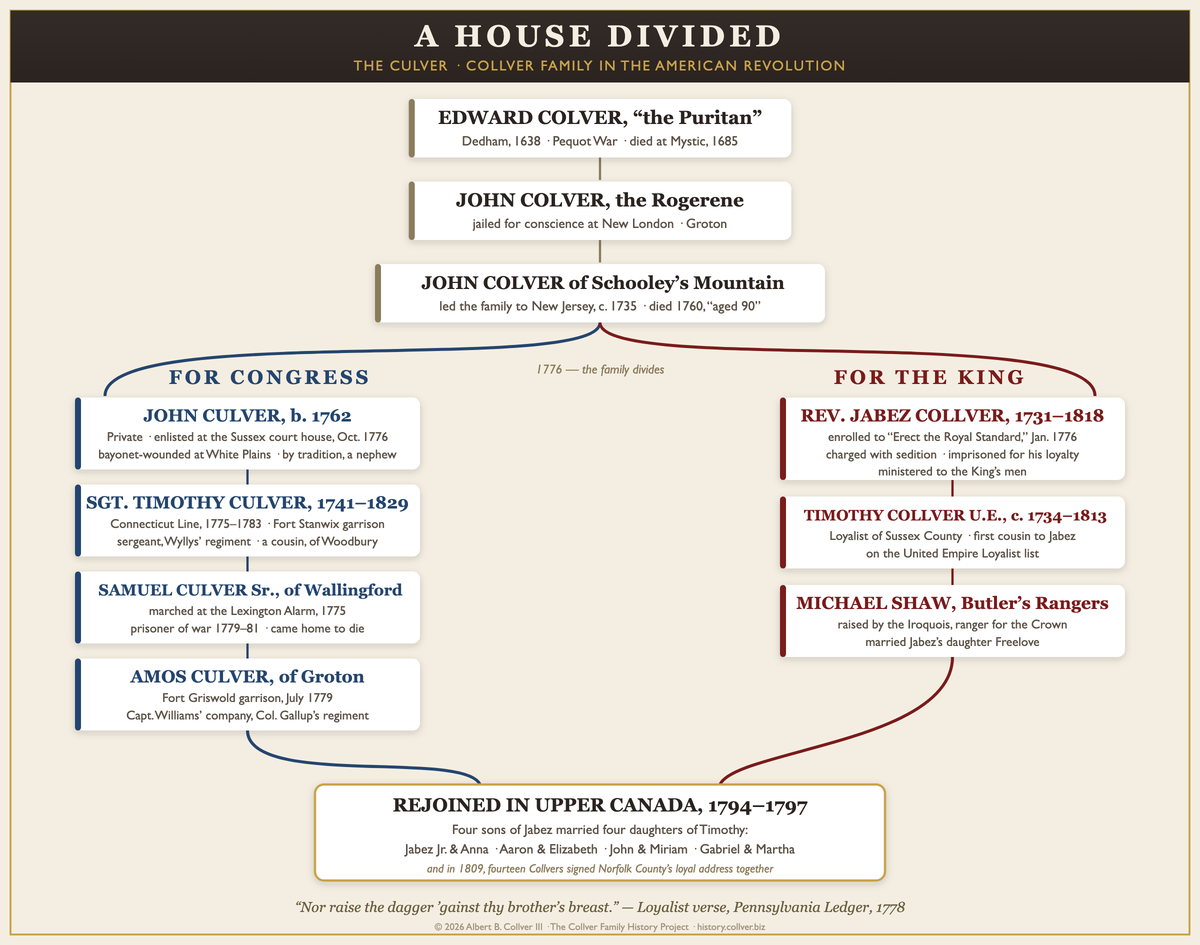
"Infatuate monster! stay thy guilty hand, / Nor raise the dagger 'gainst thy brother's breast."
— Loyalist verse, Pennsylvania Ledger, March 14, 1778
In January of 1776, in Sussex County, New Jersey, a forty-four-year-old Presbyterian minister took up a pen and subscribed his name to a paper. Six months before the Declaration of Independence, signing your name to a political paper was the most dangerous thing an ordinary man could do, and everyone knew it. The minister was Jabez Collver, pastor at Wantage, my sixth great-grandfather — and the paper was not the one you are thinking of.
Two hundred fifty years ago this summer, the American Revolution divided the Culver family — by then a century and a half in America, Dedham to Mystic to Groton to Schooley's Mountain — into two houses. One house fought for Congress. One house stood for the King. Both houses believed they were being loyal, because both houses were. What follows is the story of that division: who signed what, who marched where, who bled, who fled, and how — remarkably — the two houses stitched themselves back together on the far side of the war, four weddings at a time.
It is a Fourth of July story, told from both sides of it.
The story we told
The family literature, told with complete sincerity by people who loved the subject, long remembered Rev. Jabez Collver as a chaplain in the Revolution — in some tellings, a chaplain in Washington's army. It is a natural memory for a family to keep. He was a minister; there was a war; ministers in wars are chaplains; and by the time anyone wrote the stories down, his descendants had been loyal Canadians for a century and loyal Americans for another, and the word Loyalist had lost its sting on one side of the border and its shine on the other.
But Jabez left us his own account, in his own hand, and it says something more interesting.
The paper he actually signed
In June of 1798, petitioning the Executive Council of Upper Canada, Jabez set down what he had done in the first winter of the war:
"…in order to favour an Idea or Intention entertained by the Loyalists of Sussex County in the Province of New Gersey in or about the month of January 1776 to Erect the Royal Standard in the said County of Sussex, [he] subscribed his name in writing to an Enrollment under John Pettit, who was Nominated as an Officer in a Battalion to be raised for that purpose…"
Note what this was and what it was not. No battalion ever mustered; no John Pettit appears anywhere in the rolls of the New Jersey Volunteers, the Loyalist corps raised later that year. The January 1776 enrollment was not an enlistment. It was a declaration — a signature, on paper, in a county already tipping toward revolution, stating before his neighbors that if a standard were raised he would stand under the King's. It was, in other words, precisely the same act his Patriot neighbors performed when they signed their county associations — the same pen, the same courage, the opposite flag.
The rebellion's new government did not treat it as a formality. Jabez was charged with sedition, and in his petitions he states plainly that he "suffered imprisonment and loss of considerable property during the late rebellion on account of his loyalty." I have written about the sedition case and the petitions at length in "Set Up the King's Standard" and "Echoes from the Frontier"; for today, the single fact matters: in January 1776 the family's patriarch-minister put his loyalty in writing, and it was not loyalty to Congress.
Nine months later, at the same court house
Now walk nine months forward, to October 1776, and stand at the Sussex County court house — very likely the same building where the sedition proceedings against Jabez would run. A boy named John Culver, born in Morris County in 1762, steps up and enlists in the Continental service. He is about fourteen years old.
We know John's war because he told it himself, under oath, in his federal pension declarations half a century later. He served under Captain William Reynolds, in the regiments of Colonels Butler and Lee; he fought at White Plains, Short Hills, Springfield, and Morristown; and at White Plains he "received a wound from a bayonet." When his first two-year term expired he enlisted again — three years or the duration — and was finally discharged on "the 14th day of November next after the surrender of Lord Cornwallis," having served, he was "pretty certain," not less than five years. He was nineteen.
For his birth, John swore he had seen the date "on the family Register of his father's family — but has no recollection of what has become of it at this time." There, in one sentence from a Tennessee courtroom in 1832, is the whole tragedy of this family's record-keeping: the register existed, he saw it, and it is gone. His pension file carries one more surprise — a letter of endorsement written in 1833 by his neighbor, the congressman for Bedford County, Tennessee, who vouched that John "is a man of excellent character and is universally reputed to have served as he has declared." The congressman was James K. Polk, eleven years before the presidency.
Who was John to Jabez? Here I must be as honest as the records force me to be. John was born in Morris County in 1762 and was living in Sussex County — Jabez's county — when he enlisted; Jabez had an elder brother John, born in 1729, of exactly the right age and place to be this John's father. The pension file names no parents; the DAR applications for his descendants, which I purchased and read this week, likewise stop at John and are silent above him. So the careful statement is this: John Culver the Continental private was the Reverend Jabez Collver's kinsman beyond reasonable doubt, and by strong tradition and every circumstance his nephew. If the lost family register ever surfaces, it will settle the matter. Until then: uncle and nephew is the likeliest reading of the evidence — a Loyalist minister and a Patriot boy-soldier, one county, one family, one war.
July 1777: the whole clan called in
The new state did not stop with the minister. In July 1777, New Jersey's Council of Safety — the revolutionary government's security board, Governor Livingston himself presiding — swept up the family wholesale. On July 15 and 16, warrants went out to cite, among the inhabitants of Morris County, John and James Colver, then Thomas Colver and two Roberts — "Robert Colver" and "Robert Colver Sen'." — to appear and take the Oaths of Abjuration and Allegiance: a formal renunciation of George III, and an oath of fidelity to the state that had replaced him. The company they were cited in tells its own story. The same warrant lists carry the Frayers, the Bodines, and the Safrenes — the German-descended Sovereen family that would soon marry into this one. The in-laws were rounded up together.
Most complied. On July 21, one Robert took the oaths, listed among men cited "on the score of being dangerous to the present Government"; Timothy Colver — yes, the future United Empire Loyalist — swore the same day, as thousands of eventual Loyalists did, with a magistrate at their elbow and a farm to lose. Joseph Collver — the clerk, pleasingly, spelled it with the family's own double L — "one of the people called Quakers… took and subscribed Affirmations, to the Effect of the Oaths." He was no Quaker; he was a Rogerene, and no Rogerene would swear an oath at all. The clerk, meeting a scruple he had no category for, reached for the nearest label he knew.
And then, on July 23, this, in the state's own minute-book:
"Robert Culver of Morris C° being excited [cited] to take the Oaths, refused, and entered into recognizance to appear at the next General Quarter Sessions of the Peace to be held for said County."
One Robert swore. The other Robert — the minutes never say which was father and which was son — looked at the same oath and declined it, accepting a criminal recognizance instead. Line for line, it is the most defiant sentence any member of the family produced on either side of the war.
The cousins who marched
The New Jersey Culvers were transplanted Connecticut people, and the cousins who had stayed behind in Connecticut went, almost to a man, the other way from Jabez.
Samuel Culver Sr. of Wallingford — descended, like the New Jersey branch, from Edward Culver the Puritan — marched at the Lexington Alarm in April 1775, in the war's first hours. Taken prisoner in 1779, he was held until January 1781 and died that March, weeks after his release: a prisoner of war who came home to die. Amos Culver of Groton, the old family seat, stood garrison duty at Fort Griswold in July 1779, a private in Captain John Williams' company of Lieutenant Colonel Nathan Gallup's regiment. Fort Griswold's name still runs cold in Groton — the massacre there came two years later, in September 1781 — and while no Culver appears among that day's casualties, Amos had walked those ramparts.
And the Litchfield branch — descended from Lieutenant Edward Colver, the Pequot War veteran's soldier son — supplies the figure who completes the symmetry. Nathaniel Colver (1728–1809), grandson of that Lieutenant Edward, served in the Revolution against the King — by the family's own account attaining "some rank, such as that of first lieutenant" — and then spent his later years as an itinerant Baptist preacher in the Vermont hills. Hold him up beside Jabez and admire the composition: each house had its preacher. One pulpit prayed for Congress and one prayed for the King, and both, I am confident, believed heaven was listening. Nathaniel's grandson and namesake became the Rev. Nathaniel Colver, D.D., of Boston's Tremont Temple, one of the great abolitionist ministers of the next century — the family's pulpit habit, like its wars, ran on for generations.
There is a small archival heartbreak attached to Amos. His muster roll survives at the National Archives — the docket on the outside reads "Capt John Williams, Aug 1779 at Fort Griswold, Col Gallup" — but the paper was microfilmed still folded, docket-side out, and the names inside have never been photographed. The roll that would show a Culver's name at Fort Griswold exists, and the archive has kept it folded for two hundred years. The Connecticut State Library holds the record the historian Johnston transcribed in 1889, and one day I intend to see it flat.
A tale of two Timothys
One more pair of cousins, and a correction I owe to a reader. The family's genealogies have long carried a Timothy Culver who somehow managed to be both a Connecticut Continental sergeant and a United Empire Loyalist — a feat beyond even this family's flexibility. There were, of course, two Timothys, first cousins of each other and of Jabez. Sergeant Timothy Culver, born at Woodbury, Connecticut on December 29, 1741 — the date is his own sworn statement in his pension file — served the Patriot cause almost continuously from 1775 to 1783: the siege lines at Roxbury, the Fort Stanwix garrison, Wyllys' regiment for the duration, invalided at last into Colonel Nicola's corps after he was hurt hauling timber for the winter huts in 1781. He ended his days at Sheshequin, Pennsylvania — where, by one of the war's quieter ironies, the farm his family came to own was the very ground on which the valley's first Revolutionary blood had been spilled: a December 1777 raid, hunting hidden Loyalists. Timothy Collver the Loyalist, born in New Jersey about 1734–38, son of Robert of Schooley's Mountain, stood with the Crown, appears on the United Empire Loyalist list — U.E., for "Unity of Empire," the honorific Upper Canada gave those who adhered to the King — and ended his days in Norfolk County, Upper Canada, in 1813.
Two men, one name, two flags — and a century of family trees that quietly welded them into one impossible veteran. My thanks to Molly Sexton, whose sharp-eyed comment on an earlier post sent me back to the Woodbury records and helped pull the two Timothys apart for good.
The minister's war
So what does a Loyalist pastor actually do for eight years, in a rebel county, after the King's battalion he signed for never musters?
He ministers. The Sussex County records of the war decade show Jabez doing exactly what a settled minister does: standing bondsman for widows, taking inventories of neighbors' estates, marrying the young. And the marriage register gives us the detail that resolves the chaplain legend better than any argument could. Among the weddings Rev. Jabez Culver performed in these years was that of James Brittain and Eleanor Butler at Knowlton — and James Brittain was an ensign in the New Jersey Volunteers, the Loyalist provincial corps. The preacher was marrying the King's officers.
Here, I think, is the true shape of the memory the family kept. Jabez was a chaplain of the Revolution, in every practical sense — baptizing, marrying, burying, and consoling soldiers and soldiers' families through the whole of the war. But the men he ministered to were the King's men. The family remembered the ministry and forgot the flag; and once the flag was forgotten, "chaplain in the Revolution" drifted, as such phrases do, toward the winning side. The legend is not a lie. It is a truth with the allegiance sanded off.
Every family at the wedding table
Nor was the divide a Culver peculiarity. Look around the families the Collvers married among, and the whole neighborhood splits in your hand. Isaac Gilbert — whose descendant Samantha Gilbert later married into my direct line — served as a sergeant in the Queen's Rangers. Michael Shaw, who had been captured and raised seven years by the Iroquois as a boy, rode with Butler's Rangers and married Jabez's daughter Freelove. A Captain James Shaw of the New Jersey Volunteers fell mortally wounded at Eutaw Springs. Ensign James Brittain, married by Jabez himself, stood on the Loyalist rolls — while the Hann family, soon to be Collver in-laws, sent a private to the Hunterdon County militia on the Patriot side. Every family at the wedding table was also at war.
The marriages that mended it
And it was the wedding table that put the house back together.
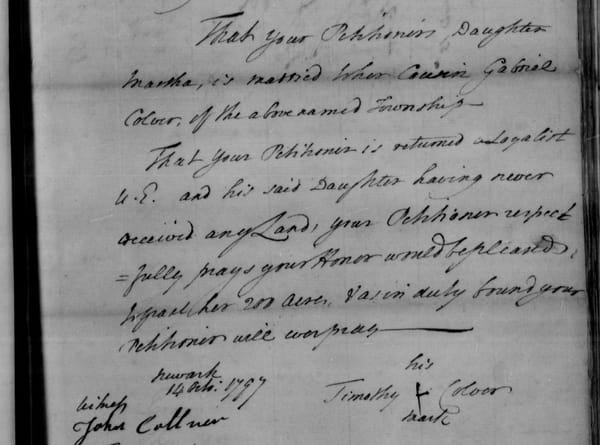
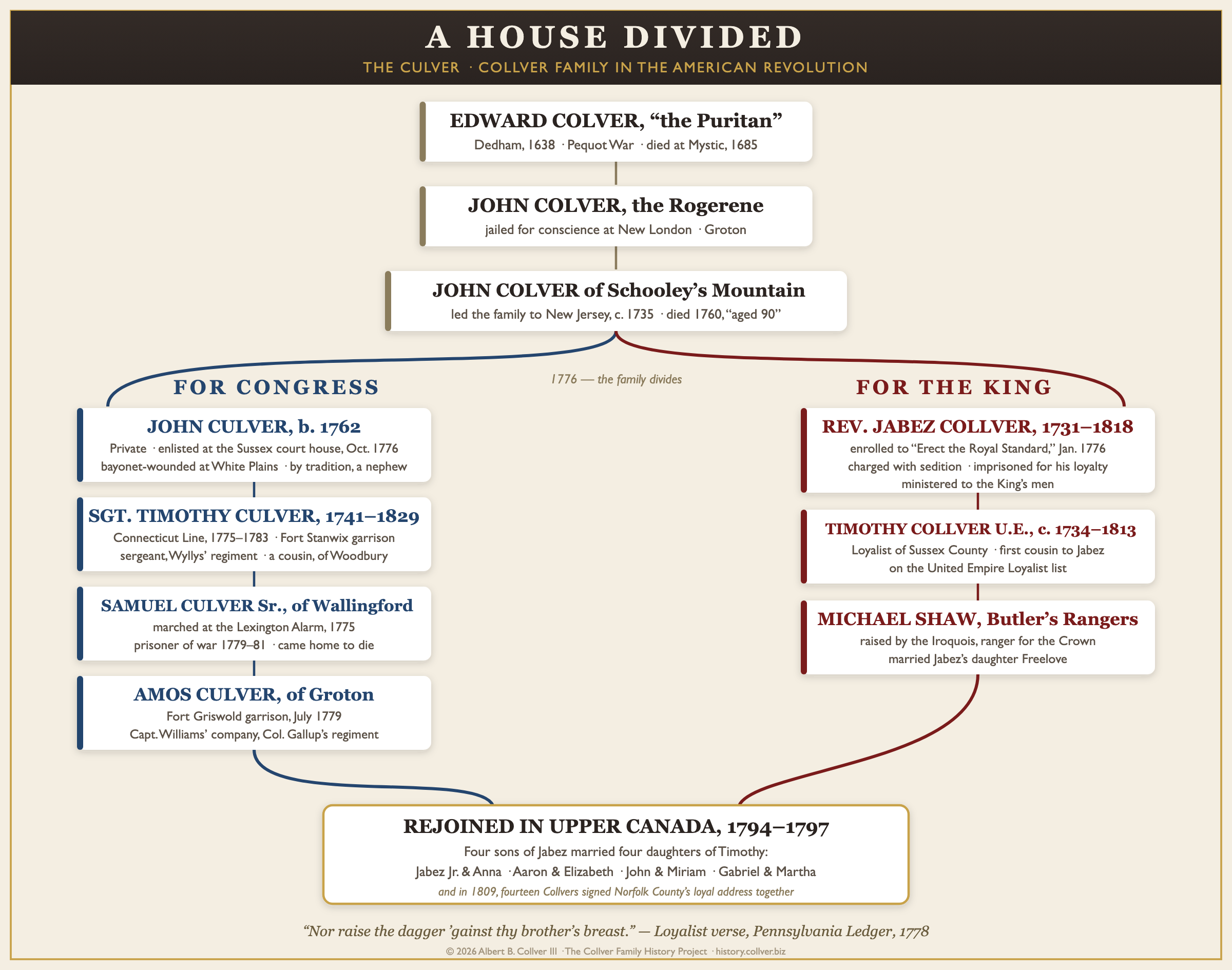
Between roughly 1785 and 1797, four sons of Loyalist Jabez married four daughters of Loyalist Timothy — Jabez Jr. and Anna, Aaron and Elizabeth, John and Miriam, Gabriel and Martha — four weddings that fused the two branches of the family into one, and that the old Norfolk historian E. A. Owen indexed, with admirable economy, as "Culver (The quartette)." Owen devoted a full chapter to the four couples and their descendants; his 1898 account is now in the public domain, and I have reproduced it in full here. Jabez himself watched it happen with evident satisfaction. "We hear John is married to another of Timothy Collvers daughters," he wrote to his son Ebenezer in March 1790, "so that we have three out of their family." And the Patriot kin were not cast out: the family's American branches kept their own lines, their own registers, and — as we shall see — their own versions of the stories.
The walk north
The war's losers do not usually get to choose their exile; the Collvers chose theirs deliberately, and late. Jabez tried New York first — the Chemung country — and then, in 1793, on the invitation of Lieutenant Governor John Graves Simcoe, with (as his petition puts it) "private encouragement from his Excellency in person," the family went north for good. His son John led the way, wintered near the Grand River, and reached the Norfolk County wilderness in February or March of 1794; Jabez followed with the rest, sixty-two years old and starting over for the fourth time in his life. Cousin Timothy's crossing became the family's epic in miniature: he and his wife walked from New Jersey to Norfolk and back and north again — better than a thousand miles on foot — Timothy carrying a five-foot staff with a brass head and a steel tip, with which, the story insists, he once speared a wolf.
One glimpse survives of Jabez from the New York years, and it may be the best thing any stranger ever wrote about him. In March of 1791, Colonel Thomas Proctor — a United States officer riding through the Chemung country on a treaty mission to the Six Nations — passed an evening in his company and set it down in his journal:
"Took up our quarters this night in company with Mr. Jabez Colloor, a dissenting minister… with whom we spent a most agreeable evening, and, during our conversation together, he enjoined me, in a very becoming manner, should I at any time see the honorable Major-General Sullivan, late the commander-in-chief against the Indians in the year 1779, to tender to him the grateful thanks of himself and his parishioners… for opening a way into the wilderness, under the guidance of Providence, to the well-doing of hundreds of poor families for life."
Weigh what that message carries. The man sending his thanks had been indicted, fined, and imprisoned by the Revolution; the man he was thanking was the Revolution's general. Jabez had lost his property to the cause Sullivan served — and there he sits at a stranger's fire, a "dissenting minister" a long way from any pulpit, asking that the general be told his road had done Providence's work for hundreds of poor families. He could not bless the rebellion; he would not curse the road it cut. If a single evening can hold the whole man, it is this one.
Upper Canada, it must be said, read the paperwork coldly. When Jabez petitioned in 1798 to be placed on the United Empire Loyalist list, the Executive Council turned him down — and in the same breath conceded everything that mattered:
"The Proofs adduced not sufficient… But the Council is perfectly satisfied that the Petitioner has been firmly attached to His Majesty and the constitution of Great Britain, and the quantity of land given to him in a larger proportion than has been extended to others of his condition is proof of their sentiments in his favour."
Rejected on paperwork; vindicated on loyalty. Any genealogist will recognize the feeling.
New Jersey, for its part, never quite erased him. Jabez had held extensive land in Sussex County, and the county's church historian recorded in 1888 that Culver's Gap and Culver's Pond — the notch in the Kittatinny ridge and the lake beneath it, which carry the name to this day — "were probably named for him." An 1872 county directory, for good measure, spells the pass the family's own way: "Collver's Gap, a beautiful pass through these mountains." The state indicted the man and kept the name.
How the other side's propaganda became our family legend
One more inheritance from the divided years, and the strangest. When I was a boy, my grandparents — Albert Sr. and Jane — told me that around Simcoe, Ontario, there had been stories of the Collvers scalping people. It is a jolting thing to hear about one's ancestors across the breakfast table, and for years I filed it under unaccountable.
The newspapers of 1794 account for it. That summer — the very season the Collvers were moving to Simcoe's settlement — the American press ran a war-scare story that began in a Rutland, Vermont paper on July 8 and spread down the seaboard within weeks:
"A Rutland paper states, that it is reported by a gentleman of veracity from Canada, that the Indians frequently visit Governor Simcoe, with scalps of the citizens of the United States; that the Governor, for the encouragement of the business has offered a guinea a piece for them, and has actually purchased 15 at that rate."
The story was fourth-hand rumor even as printed — historians treat the "guinea a scalp" charge as war-scare propaganda, and by December 1794 a variant had crossed the ocean to The Times of London. But consider what happened next, slowly, over a century: the town the Collvers helped build was named Simcoe; the propaganda said Simcoe bought scalps; and somewhere in the long attic of local memory, "Simcoe scalp stories" and "the Collvers of Simcoe" fused. The Americans invented an atrocity about the governor; three generations later the Loyalists' own great-grandchildren were telling it about themselves. Each side's wartime propaganda became the other side's family legend — a caution I commend to every family historian, and file beside the family's other borrowed legends as a specimen of how these things grow.
The last word: Woodhouse, November 16, 1809
Let the family have the last word on where its loyalty came to rest — because they put it in print.
In the fall of 1809, a seditious newspaper editor at Niagara was attacking the Lieutenant Governor of Upper Canada, and the magistrates and principal inhabitants of Norfolk County answered with a loyal address, dated at Woodhouse on November 16 and printed in the York Gazette on December 6. The text deserves quoting at length — few documents catch the voice of a Loyalist settlement so well:
"At a time when we see the Editor of a certain News Paper published at Niagara, presumptuously arrogating to himself the Office of a public Censor… endeavoring to sow Distrust in the minds of the well affected, and by the most gross and unfounded Calumnies against Your Excellency's Public and private Character, endeavoring to excite tumult, and to alienate the minds of His Majesty's loyal Subjects from His Person and Government. We His Majesty's dutiful and loyal Subjects, the Magistrates and principal inhabitants of the County of Norfolk, deem it our duty most respectfully to lay before Your Excellency, our Sentiments on the occasion…
We think it unnecessary to make sounding professions of our attachment to that inestimable Constitution under which, we have the happiness to live; should Circumstances unhappily render it necessary, we hope by our actions, to convince Your Excellency, that we are not insensible to the blessings we enjoy."
Beneath it, among roughly one hundred seventy-five signatures, stand fourteen men of this family: Jabez Collver, senr. — the Reverend, then seventy-eight — with Jabez second, Jonas, three Timothys, Nisbett, Aaron, Griffis, Ebenezer, Gabriel, John, and two signing as Culver, William and Daniel. The typesetter's long s renders them "Jabez Collver, fenr." and "fecond," which no reader of this blog will mind by now.
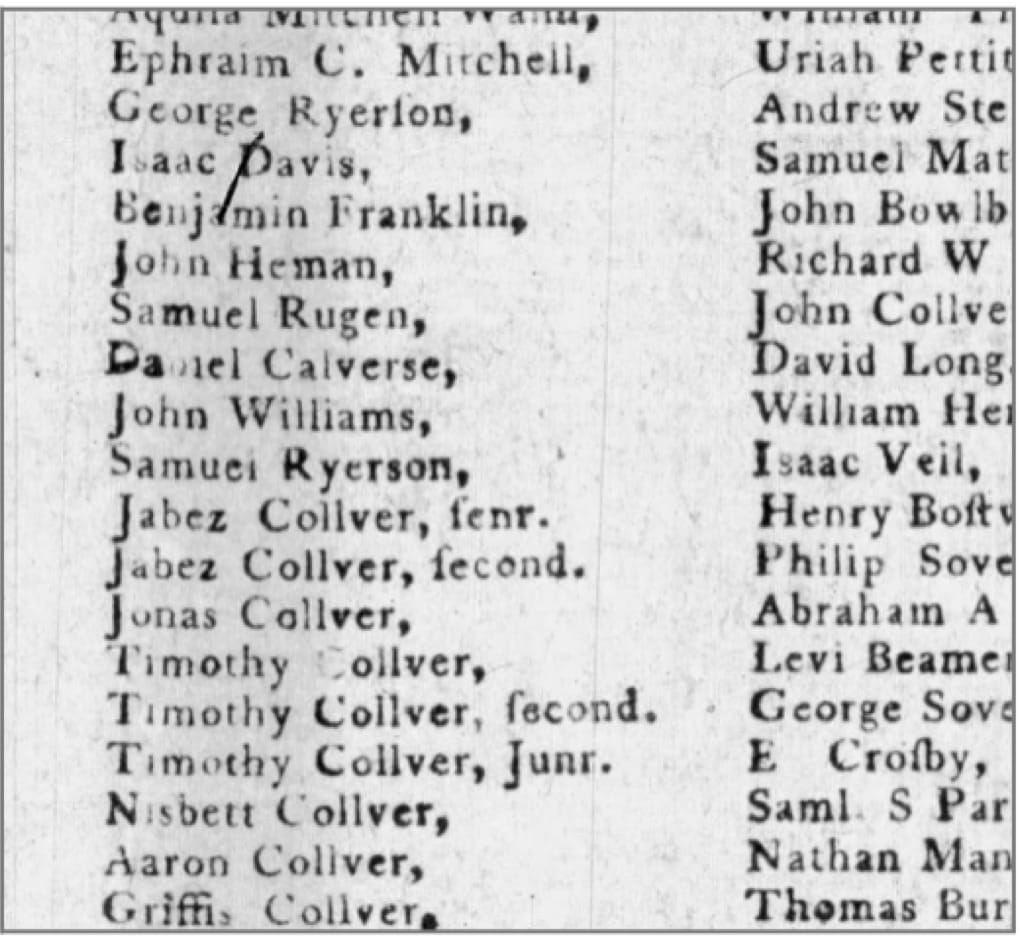
Savor the symmetry. In 1776, Jabez Collver signed a paper for the Crown and was charged with sedition. In 1809, thirty-three years later and five hundred miles north, the same man signed a paper against a seditious editor — surrounded this time not by a doomed battalion that never mustered, but by two generations of his own descendants. It is the only political document I know of that the whole family signed together, and they used it to say, one last time and in one voice: we meant it.
Two hundred and fifty years
This Saturday the United States turns two hundred fifty, and I will spend the anniversary the way the family has always marked its allegiances — in a pew, this time in Troy, Illinois, an American descendant of the man who chose the King.
Both lines ran forward. Patriot John's twelve children spread through Tennessee into the American South and West; the Loyalist Collvers built Norfolk County, then sent their own grandchildren streaming back over the border into Michigan and Iowa and Oregon until, by my grandfather's generation, the Loyalist line was American again. The wheel turned all the way around. I carry the blood of the sedition charge and the citizenship of the bayonet wound, and on the Fourth of July I find I can honor both without contradiction.
Because here is what the records taught me, and it is the one thing I would have you take from this long story. The Revolution did not divide this family between the loyal and the disloyal. It divided it between two loyalties — and then, being family, they out-married, out-walked, and out-lived the division. The war lasted eight years. The family, at last count, is on year three hundred eighty-eight.
A happy Fourth of July — from both houses.
In case you missed it: the story of how this family spells its name is told in "Why We're Collver, Not Culver," and the 1916 family pamphlet that preserved so many of these traditions — errors, legends, and all — is reproduced in full in "The Family Pamphlet."
Principal sources for this essay: Upper Canada Land Petitions, "C" Bundles 1 and 4 (Library and Archives Canada, reels C-1647–48), read from the manuscript images; Revolutionary War pension files R.2573 (John Culver) and S.40871 (Timothy Culver), National Archives; Minutes of the Council of Safety of the State of New Jersey (1872), pp. 96–99; Craft, History of Bradford County, Pennsylvania (1878), quoting Col. Thomas Proctor's journal of March 26, 1791; Haines, Hardyston Memorial (1888); Calendar of New Jersey Wills, vols. II–VI; Stryker, The New Jersey Volunteers (1887); Johnston, Record of Service of Connecticut Men in the War of the Revolution (1889), p. 555; the York Gazette of December 6, 1809, and the Farmer's Library (Rutland) of July 8, 1794, from the original images; R. Robert Mutrie, "Jabez Collver of Townsend Township" (2016); Rosenberger, Through Three Centuries: Colver and Rosenberger Lives and Times (1922); and E. A. Owen, Pioneer Sketches of Long Point Settlement (1898).
© 2026 Albert B. Collver III · The Collver Family History Project. Original historical documents reproduced here are in the public domain; the research, text, and annotations are the author's. Please cite or link rather than republish.