A Mason's Sign at the Rope
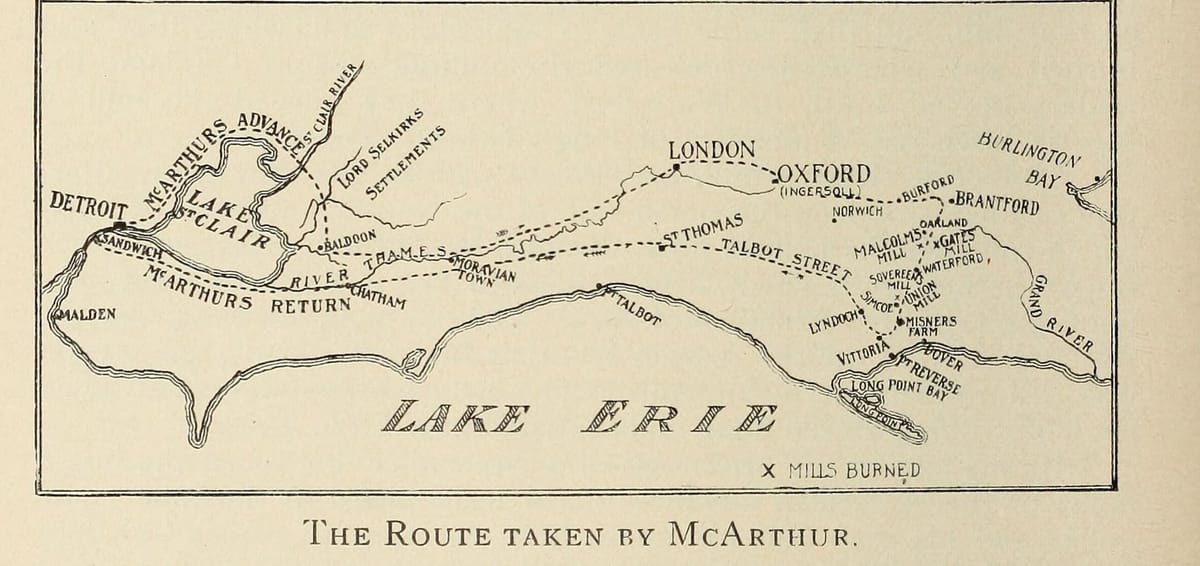
In the first days of November, 1814, on a hilltop above Waterford in Norfolk County, Upper Canada, two middle-aged millers stood under a great oak with a rope over its limb. The rope was already around the neck of one of them. Around them sat a column of mounted Kentucky and Ohio militia at the end of the deepest raid the War of 1812 ever drove into the province, and the mill the two men had twice pulled back from burning was finally, properly, on fire below the hill. The American brigadier general watched from his horse.
What happened next is the family's great set piece of that war, and it turns on a single gesture — which is why, before the rope, this post has to go back two years, to a document that looks like it has nothing to do with war at all.
The lodge warranted the week the war began
On the twenty-fourth of June, 1812 — six days after the United States declared war, the news still crossing the lake — the Provincial Grand Lodge at Niagara issued a warrant "at the petition of our trusty and well beloved Brethren, Amos Dodge, Eliakim Crosby, John Collver," authorizing them "to form and hold a lodge in the Township of Townsend, which is hereby designated Number Twenty-Six," with "John Collver to be Junior Warden."
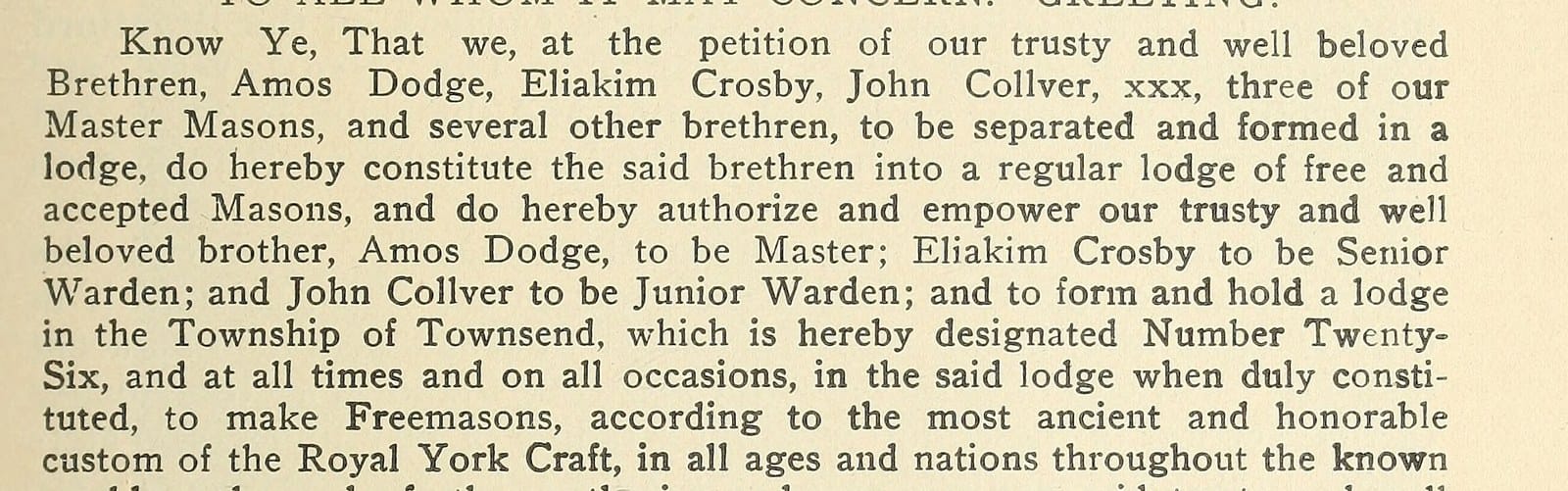
The founding Junior Warden is our John — the poet-preacher of the Norfolk settlement, son of the Reverend Jabez, then forty-four years old — and the little roll of founding brothers reads like the family's wedding register set to a different music. Sherman Hyde, who had lately bought old Jabez's Windham land. Abram Massecar. And Morris Sovereen, of the German clan so thoroughly married into this family that the book in progress calls them the double in-laws — in whose house the new lodge met through the war, in the upper front room, the door tyled at the stairhead.

Tyled is the Craft's own word, and it is a roofer's word before it is a ritual one — the tyler tiles, covers, shuts the weather out, from the old French tuile, the Latin tegula, a roof-tile. In lodge use the tyler is the brother posted at the shut door, and the word is worth keeping in view, because this whole story is about what that shut door was worth. For two wartime years, at the head of Morris Sovereen's stairs, a farmhouse door in Townsend township was the boundary of a brotherhood that did not stop at the border the war was fought over.
The lodge itself became a war story in the family's telling. It "worked at intermittent periods up to 1822," the Masonic historian of Ontario records, "for W. Bro. John Culver, prior to his death, frequently entertained the old members with stories of the perambulations of the lodge from village to village, even in the dark days of 1812–15" — the places later known as Brantford, Scotland, Port Rowan, Port Ryerse, and Simcoe. A lodge on foot, in wartime. And the same historian, combing the Grand Lodge papers eighty years on, paused over the family's name in his dry way: "John Collver, or Culver, as it was given at a later date, was J.W." — the spelling drift that is this family's signature, documented this time by a Grand Lodge.
McArthur comes east
In the autumn of 1814, Brigadier General Duncan McArthur crossed at Detroit with a mounted column of Kentucky and Ohio militia and rode east through the province's undefended rear — the last great raid of the war. His targets were not forts. They were mills: the one thing a settlement cannot quickly replace, the machines that turned a district's harvest into bread and an army's flour. Five flouring mills of the Long Point country went to ash in a week, and the period map of the raid marks each one with an X and the terse legend mills burned. Two of the five were family properties — the Culver-Woodruff mill on Patterson's Creek, the relief society's ledger fixing "Mr. Culver and Mr. Woodruff's" loss at £1,751 5s. — and the same week's raiders ransacked William Culver's tavern in the Gore of Woodhouse for good measure. The book will keep the whole ledger; this post follows the column to one mill only, on the Nanticoke at Waterford.
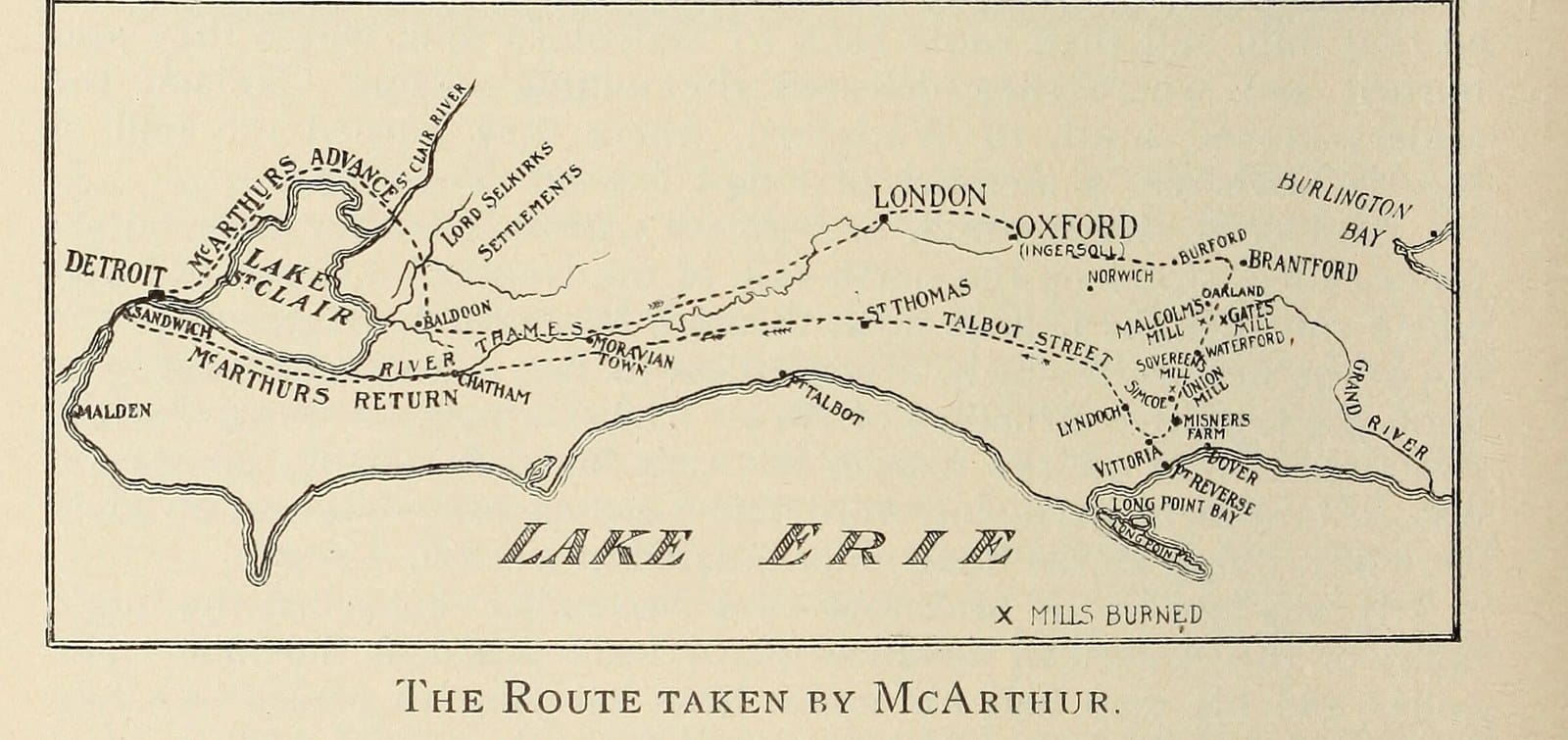
Morris Sovereen had warning. "A messenger from … a brother Mason who lived near Burford, a member of lodge No. 11" rode ahead of the column — a lodge man carrying news to a lodge man, the Craft's web working a day ahead of the war. Then came the bugle and the blue coats, McArthur "on a black horse and well mounted," and a half-dozen troopers who dashed into the mill, fired it, and rode on across the creek, "expecting to see Bro. Sovereen's property ascend to heaven in smoke."
They had misjudged their man. Sovereen and his neighbor, Brother William Schuyler, who lived beside the mill and worked in it, waited out the troopers' departure and then went in with a few pails and a couple of leathern buckets — left behind, the account notes with a straight face, by a military company on its way to Detroit — and put the fire out. The Americans, seeing from the far bank that the mill did not burn, sent six men back with instructions to fire it again "and to threaten to hang to the nearest tree any who attempted to save it." By the time the six rejoined their column, the fire was out a second time.
Two extinguishings, under an explicit promise of the rope, by two men with buckets against a mounted brigade. "This was too much for McArthur." Sovereen and Schuyler were seized, dragged across the stream, and marched up the hill south of the mill to a massive oak — the spot, in later years, the site of the Waterford Baptist church, a few yards east of the town hall. The rope went over the branch.
The sign
The 1899 account tells the next minute better than any paraphrase could, and this post gives it exactly:
"The old man saw that his hour was near at hand. The Americans were a rough and ready set and all they required was an order and it would be carried out. A rope was already around the neck of Bro. Schuyler, and Sovereen as a last hope for life rushed up to McArthur, who still sat his horse, and making a Masonic sign shouted 'Spare our lives and burn all I have.'
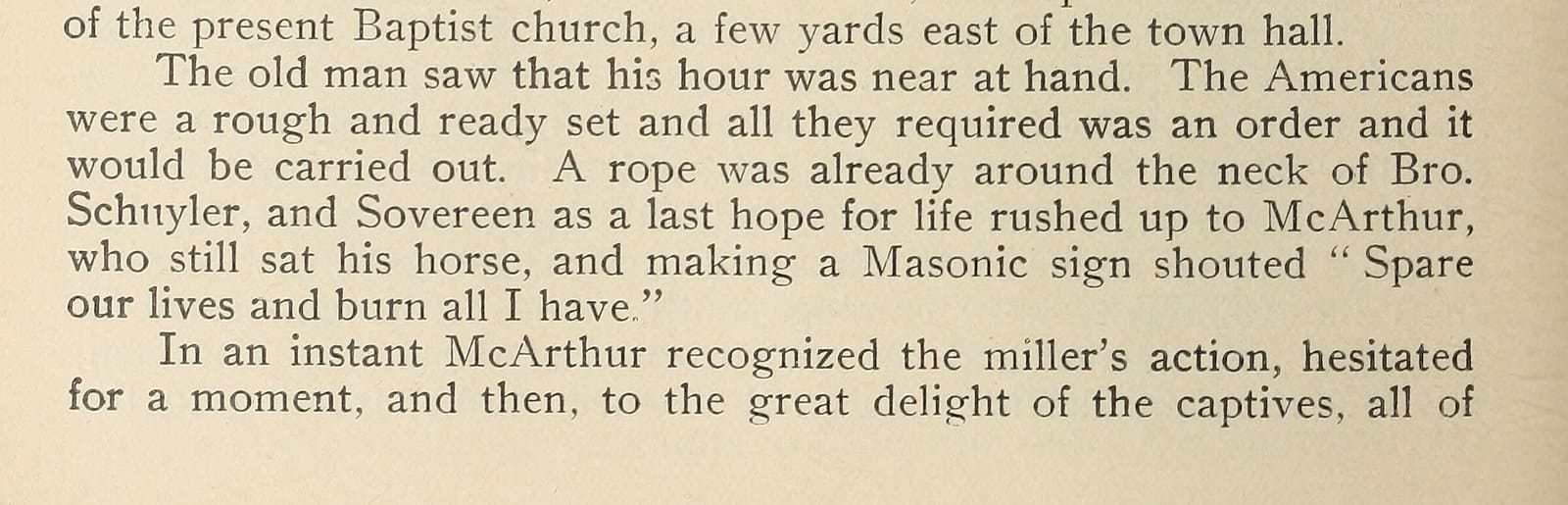
"In an instant McArthur recognized the miller's action, hesitated for a moment, and then, to the astonishment of the raiders, who were all on horseback, except those who were handling the rope and the prisoners, he shouted to his men: 'Let them down, boys — I'll spare their lives.' The mill had by this time been reduced to ashes."

The two men walked home. The sign that the little Townsend lodge had been teaching in an upper room through the whole war — the lodge John Collver had helped warrant the week the war began — proved, on one November hilltop, negotiable currency between enemies: a Kentucky general and an Upper Canada miller, at rope's length, members of one brotherhood before they were men of two warring nations.
How we know it — the honest pedigree of a tradition
A story this good obliges its teller to show his sources, and here the record is unusually candid about itself. The account above is John Ross Robertson's, in his History of Freemasonry in Canada (1899), and Robertson — a careful historian with no patience for lodge-room legend — set down exactly where he got it.
He got it, first, from W. Bro. Thomas W. Clarke, born in 1812, made a Mason in 1832, who "gives the story of the raid as he heard it from the lips of the veteran brother" — from Morris Sovereen himself. He got it, second, from Bro. Isaac Kitchen of Waterford, seventy-one years old in 1894, born beside the mill and a lifelong neighbor of William Schuyler, who "has often heard him relate this incident." And he got it, third, from Bro. Leeman Sovereen, Morris's own son, "who heard his father tell the story over and over again." Three witnesses, each one remove from the tree itself; a tradition, plainly labeled — but a tradition recorded from the participants' own circle while their children lived, which is as close to the oak as history gets without a court reporter under it.
It is Kitchen's testimony that supplies the story its closing bell. Old Schuyler, he told Robertson, "would always conclude the story by saying: 'My God, if Morris Sovereen hadn't been a Mason we would have stretched hemp.'"

And the man who carried the tale down this family's generations was one of our own: "Gabriel Culver, who was a Mason, frequently tell[ing] his friends an interesting story of how Sovereen's life was saved through Masonry." Which Gabriel — the Reverend Jabez's son, the 1822 lodge petitioner, or his cousin of the same name — the record does not settle, and this project's standing rule for the family's two Gabriels is to force no identification the paper will not carry. The storytelling is the point, and it was a Culver doing it; Robertson adds that this Gabriel was step-father to the man who gave him the anecdote, a Becker of Waterford; the Becker family's own registrations leave no room for a Culver step-father, and the relation is best taken as Robertson's slip. The tale reached print, in any case, through the family's own hearth: Robertson's first witness, Thomas W. Clarke, had married the elder Gabriel's daughter Nancy in 1833.
One more Waterford name deserves a sentence. Readers of Friday's post met an Isaac Kitchen, a grandson of Jabez Jr. on his mother's side, buried in 1916 in ground the obituary still called "Collver's Burying Ground." He is Robertson's Bro. Isaac Kitchen. The Ontario death registration gives his age as ninety-two years, seven months, and sixteen days — a birth in June 1823, which makes him seventy-one in 1894 — and the obituary calls him "the oldest Mason in Norfolk County" and buries him under Masonic auspices. The witness who had the story from Schuyler's lips was the Reverend Jabez's great-grandson.
The price of the ashes
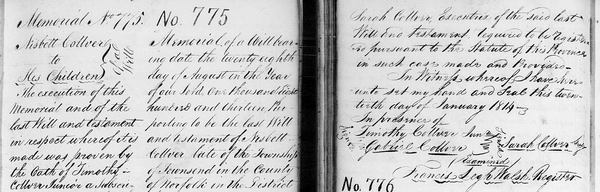
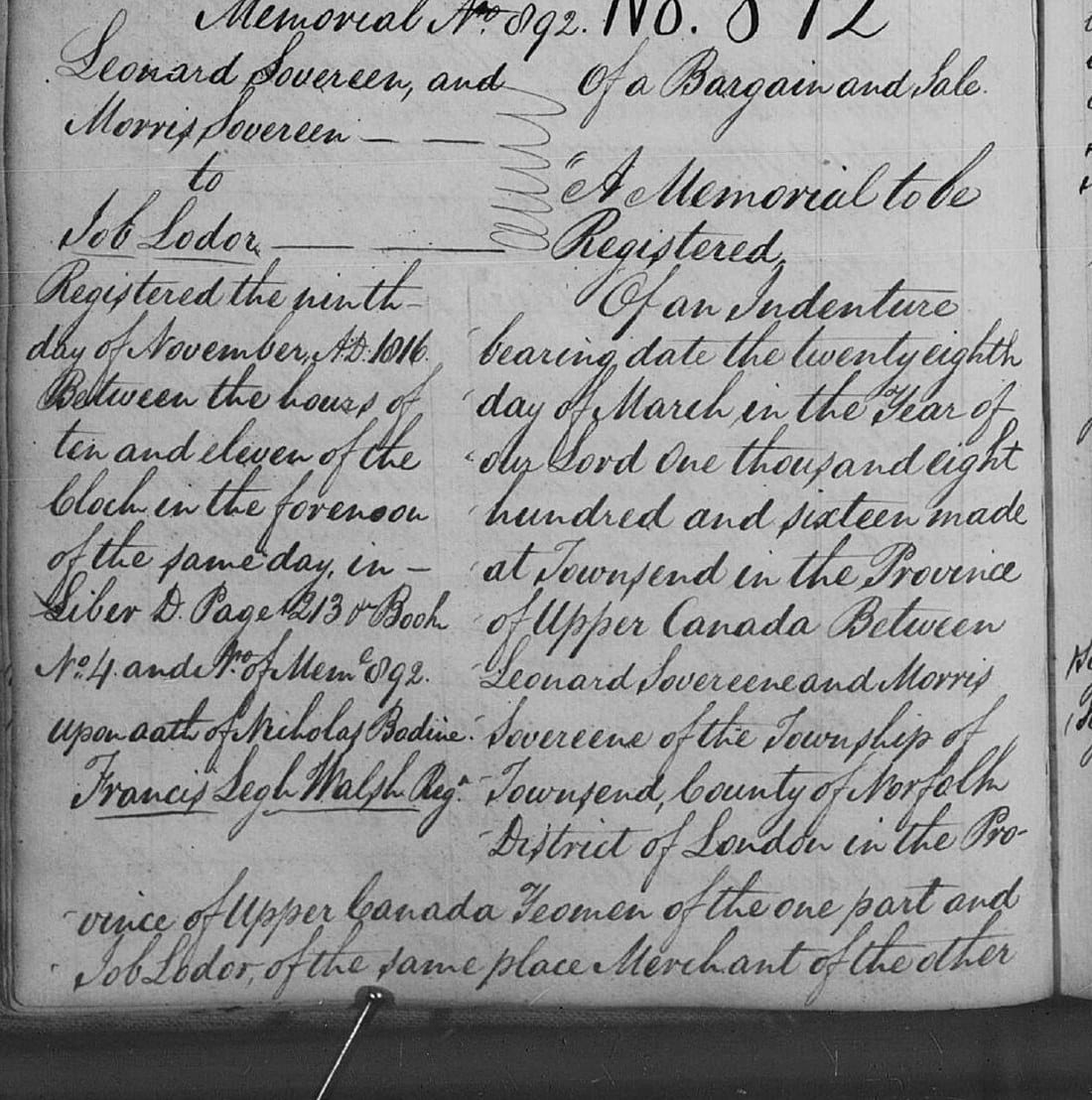
The war ended that winter. The mill did not stay ashes. Sixteen months after the fire, on the twenty-eighth of March, 1816, Leonard and Morris Sovereen of Townsend, yeomen, sold to "Job Lodor of the same place, Merchant," the parts of Lots 6 and 7 in the eighth concession of Townsend that held the Waterford mill seat — the parcel described from "the North East corner of Job Lodor's Garden" around the north shore of the mill pond — for £1,005. The sale survives, like so much in this family's story, as a county registry memorial: No. 892 in the Norfolk deed book, registered the ninth of November, 1816, "between the hours of ten and eleven of the clock in the forenoon." The county history says Loder "purchased the mill and enlarged it"; the memorial dates and prices the purchase. A thousand pounds for a pond and a privilege and whatever had been raised again on the ashes — the Kentuckians had burned a building, and a building, in a settlement of millwrights and in-laws, was the one thing the family's world knew how to replace.
Morris Sovereen kept his life, his lodge, and his story, and told it over and over to his son. The lodge kept walking its villages until 1822. The oak kept the hill until a Baptist church wanted the spot — a denominational succession the family's dissenting soul may be permitted to enjoy. And the sign — the one thing on that hilltop the war could not requisition, burn, or forfeit — kept its value on both sides of a border that armies were then disputing at the price of towns.
One name on that founding roll deserves a last word, because it makes the point sharper than any moral could. The lodge’s first Senior Warden was Eliakim Crosby, American-born, married to a Beemer of the settlement’s most independent-minded clan. He did not stay. Owen, writing eighty years later with the delicacy the settlement reserved for its own, says only that “during the war of 1812 Mr. Crosby was unable to stand the pressure, and he abandoned his farm and returned to the land of his birth, settling in the State of Ohio.” The public records are blunter: an Eliakim Crosby stands on Upper Canada’s list of persons who withdrew from the Province without license during the late war, and an Eliakin Crosby is number nineteen on the roll of individual commissions issued under the Alien Act for the London District — the machinery by which an absent man’s land became the Crown’s. The identification is as near certain as such things get without a document naming both roles in one line, and it means this: the lodge that met at the head of Morris Sovereen’s stairs had, among the three men named in its warrant, one who stayed and one who went over. The sign the Craft taught in that room was learned by men who would end the war on opposite sides of it, and it still worked when it was needed.
The war of 1812 split this family down the middle, as the last post told: a captain dead in the King's service, his own nephew deserted to the enemy. It is worth ending the week's pair on this: the same little settlement that could not keep one surname on one side of the war kept one brotherhood across both sides of it. The door at the head of Morris Sovereen's stairs was tyled against the profane, as the Craft's old roofing word has it. It was never tyled against the enemy — and that, at rope's length on a November hilltop, is what saved two necks.
Sources and notes: The warrant of Lodge No. 26, Townsend, dated at Niagara 24 June 1812 and printed in full — with the officers, the member roll ("Eliakim Crosby, S.W., 1812; — Collver, J.W., 1812; Amos Dodge, W.M., 1812; Sherman Hyde, Abram Massecar, and Morris Sovereen"), the "or Culver, as it was given at a later date" aside, and the perambulations passage — is in John Ross Robertson, The History of Freemasonry in Canada from Its Introduction in 1749 (Toronto, 1899), I, 976–79. The raid, the rescue, the map of McArthur's route, and the whole provenance chain (Clarke from Sovereen's lips; Kitchen from Schuyler, with the "stretched hemp" conclusion; Leeman Sovereen from his father; Gabriel Culver the family's teller) are Robertson I, 979–83, whence every quoted phrase above; the work is in the public domain and the page images reproduced here are from the archive.org scan. The £1,751 5s. loss of "Mr. Culver and Mr. Woodruff" at the Patterson's Creek mill is the Loyal and Patriotic Society's relief report (1814). The 1816 sale of the Waterford mill seat is memorial No. 892, Norfolk County deed register (Deeds 1813–1825, image 127, FamilySearch image group 008198250): Leonard & Morris Sovereen to Job Lodor, 28 March 1816, £1,005, registered 9 November 1816; E. A. Owen, Pioneer Sketches of Long Point Settlement (1898) supplies "purchased the mill and enlarged it." Robertson's Bro. Isaac Kitchen (b. c. 1823) and the Isaac Kitchen buried in "Collver's Burying Ground" are one man: Ontario death registration 1916 no. 23646 (d. Simcoe 27 January 1916, aged 92 years 7 months 16 days; parents Wheeler Kitchen and — Culver); the obituary reprinted in Loyalist Families of the Grand River Branch (1991), 166–67, which dates the clipping 1917 in error, calls him "the oldest Mason in Norfolk County"; Mutrie and Owen make his mother Easter Ann Collver, daughter of Jabez Jr. Thomas W. Clark m. Nancy B. Collver 22 May 1833 (Mutrie). Eliakim Crosby’s departure is Owen, 487 (the Beemer sketch: Maria Beemer, b. Niagara District 1793, m. Eliakim Crosby, the Kent Farm, and his removal to Ohio); the two public lists are in E. A. Cruikshank, “A Study of Disaffection in Upper Canada in 1812–15,” Transactions of the Royal Society of Canada, 3rd ser., VI, sect. II (1912), 55 (persons who withdrew without license) and 60 (individual commissions under the Alien Act, London District, no. 19). "Divided Again" (11 September 2026) is this post's companion; the full War-of-1812 family ledger is chapter ten of the forthcoming book.
Adapted from the forthcoming book — We Are Doves: Four Centuries of the Collver–Culver Family.
© 2026 Albert B. Collver III · The Collver Family History Project. Original historical documents reproduced here are in the public domain; the research, text, and annotations are the author's. Please cite or link rather than republish.