The Scalps That Never Were
My grandparents came home from Simcoe with a story that the Collvers had once scalped people. The story is real. It began in a Vermont newspaper in July 1794, and it was never about us.
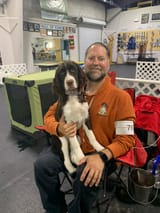
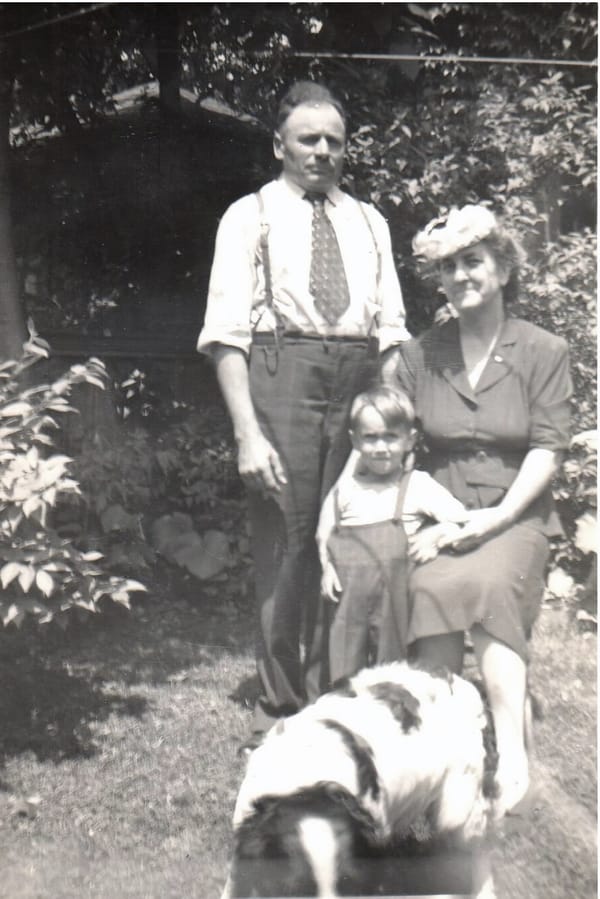
I heard the worst story my family ever told about itself at my grandparents' kitchen table in Munger, Michigan, when I was a boy. Albert and Jane Collver had made visits over the years to Simcoe, Ontario, the old family country north of Lake Erie, where the cousins still farmed and the cemeteries were full of our spelling. They came home with two stories that fit together strangely.
The first was that up there, there were old stories of the Collvers scalping people. My grandparents delivered the nickname that went with it with a certain relish: we had been, they said, the "Cutthroat Collvers." The second was that the family had been so revered up there that the Canadians had built a monument to them.
Feared and honored, cutthroats and worthies, a legend of violence and a block of granite, carried home in the same car. My grandparents told both with complete sincerity, as things heard in the old country from people who had them from people who knew. They were right about more than they could have proven. There were scalp stories. There is a monument. The family was revered. What no one at that table could have said is where the scalps came from. The answer does not lead to anything the family did. It leads to something the United States said.
A guinea a piece
On Tuesday, the eighth of July, 1794, a small newspaper in Rutland, Vermont, The Farmers' Library, or, Vermont Political and Historical Register, ran this item on its third page, under the heading "RUTLAND, JULY 8":
It is reported by a gentleman of veracity from Canada, that the Indians frequently visit Governor Simcoe, with Scalps of the citizens of the United States; that the Governor, for the encouragement of the business, has offered a Guinea a piece for them, & has actually purchased fifteen at that rate: That no business can be done by agents for lands in the Canadas: & that on the British frontier, they were repairing and fortifying their garrisons, and raising men to man them.
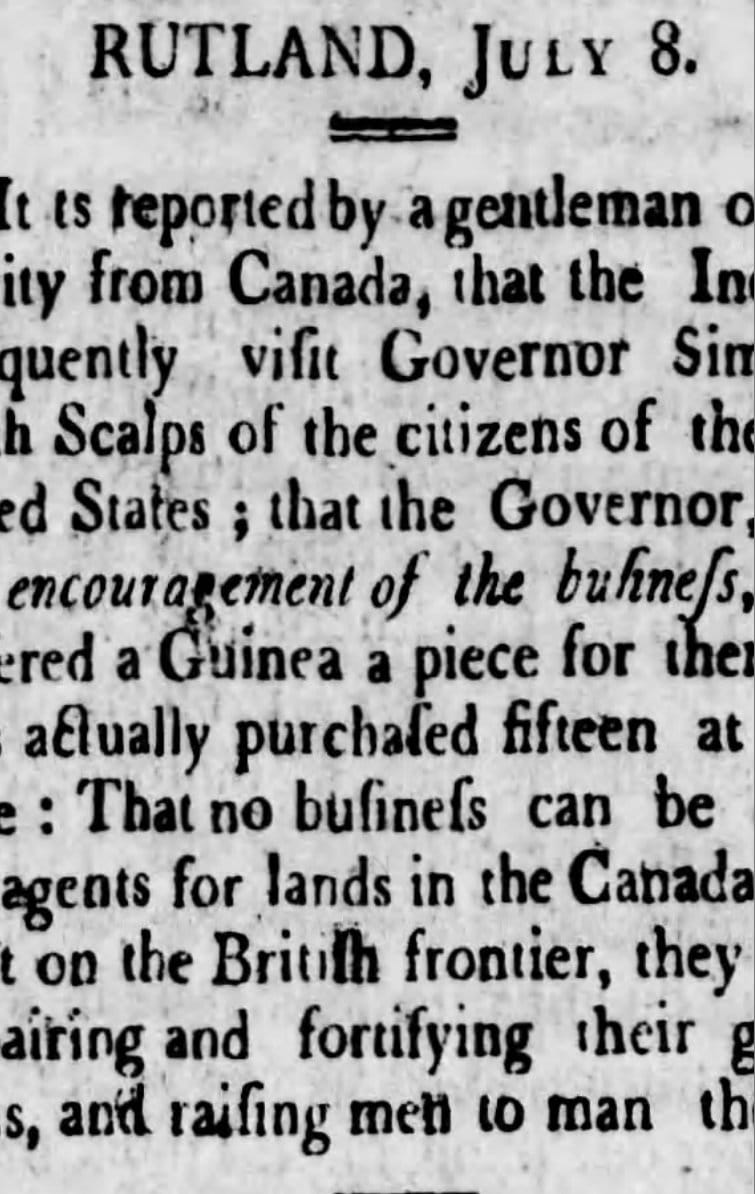
A guinea was a gold coin worth twenty-one shillings, no small sum on a farm. The whole of the evidence is in the first line: "a gentleman of veracity from Canada," unnamed, reported by someone else.
To see why anyone printed it, remember the summer it landed in. The United States and Britain stood nearer to a second war in 1794 than at any time between the two they actually fought. British garrisons still sat on American soil at Niagara and Detroit, more than a decade after the peace. General Anthony Wayne's legion was marching that season against the Indian confederacy of the Northwest, which the British were believed to arm. And John Graves Simcoe, the first lieutenant governor of Upper Canada, was to the republican newspapers of the seaboard the nearest available villain. Atrocity flows toward the enemy's name. It always has.
How a rumor travels
Watch the paragraph move, because its route is the whole mechanism.
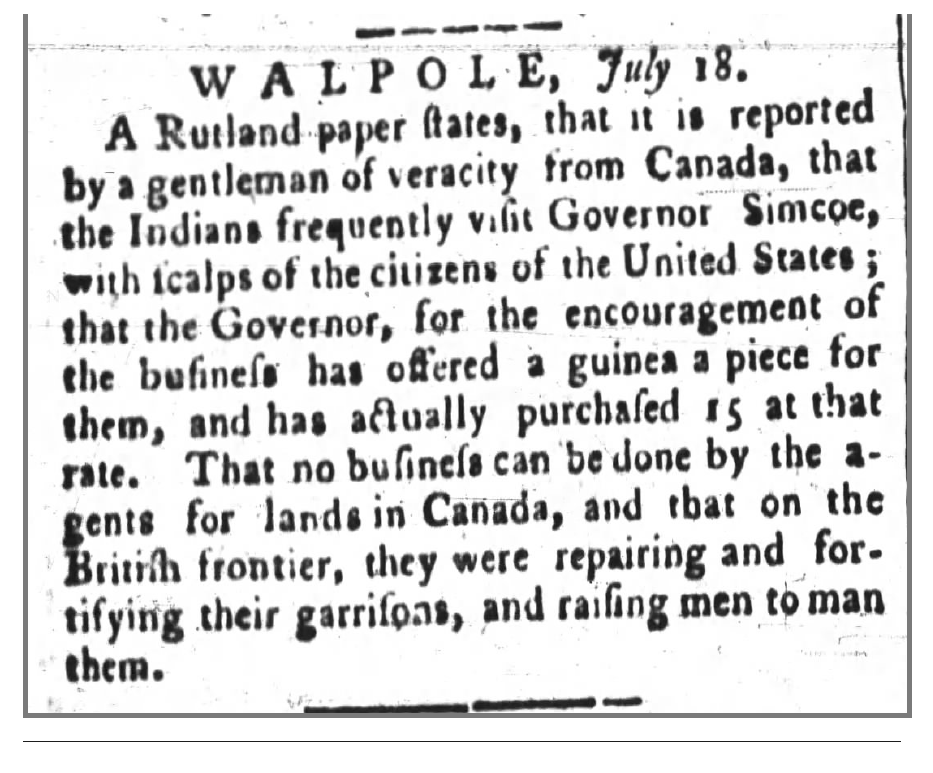
Six days later, on the fourteenth of July, Spooner's Vermont Journal at Windsor reprinted it, now beginning "A Rutland paper states." Four days after that it was at Walpole, New Hampshire, in the same words. By the fifteenth of August it had reached The State Gazette of North-Carolina at New Bern, eight hundred miles from the gentleman of veracity, still at fourth hand and now continental. The copy in our family's clipping file is that New Bern printing.
In the autumn the story did what rumors do when no one stops them. It grew. An account out of Baltimore, printed in the Philadelphia Aurora on the twenty-second of October, had Simcoe himself setting off for the Miami country with two hundred rangers, his men resolved not to come back without General Wayne's scalp. By early November the guinea a piece had become a price on one head in particular. A report from New York, which the Aurora printed on the tenth of November, said that "the satellite, (Gov. Simcoe) has offered one hundred guineas, for the head or scalp of Gen. Wayne." The satellite was the Aurora's sneer for an officer of the King: a small body that shines only by borrowed light and goes round a larger one. A paper at Whitestown, New York, carried the same story, and a paper at Greenfield, Massachusetts, carried it from Whitestown.
Then, on Saturday, the twentieth of December, 1794, the story finished its journey in the last place a reader might expect to meet a Vermont rumor: page three of The Times of London.
And it is added, by a Gentleman lately from Niagara, that Governor Simcoe has offered 100 guineas for the head or scalp of Gen. Wayne.
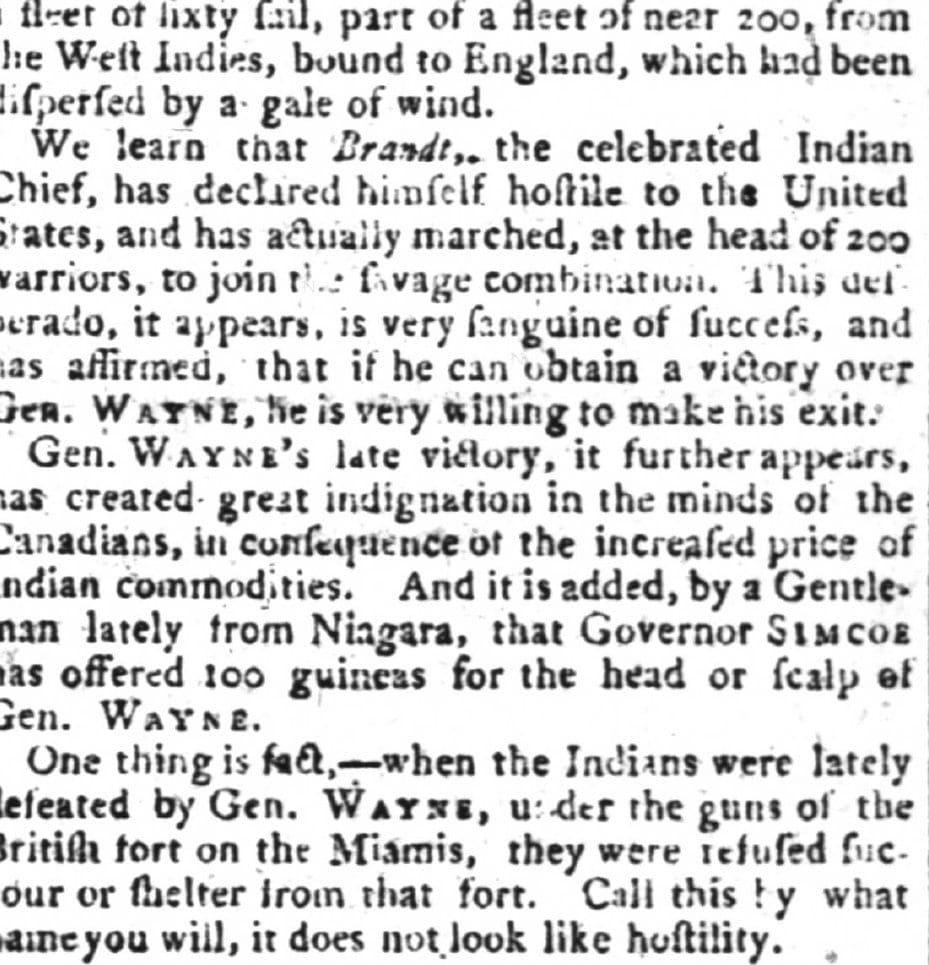
The London item ends a few lines further on with a remark about the British fort on the Miami, which had refused shelter to the Indians after Wayne defeated them: "Call this by what name you will, it does not look like hostility." A sentence born in Rutland in July was, by Christmas, news on both sides of the ocean.
By then the campaign it slandered was over. Wayne had met the confederacy at Fallen Timbers on the twentieth of August and won, and kept his scalp. A treaty to settle the quarrel between Britain and the United States had been signed in London a month before The Times went to press. The story did not care. Stories of this kind never do.
No historian of Simcoe's government has found anything underneath it: no bounty, no order, no payment, no fifteen scalps. Even its first printing could name no witness better than a gentleman of veracity, from Canada, unnamed. Every later printing rested on that one.
The summer we moved
Now set the family's calendar beside the newspaper's.
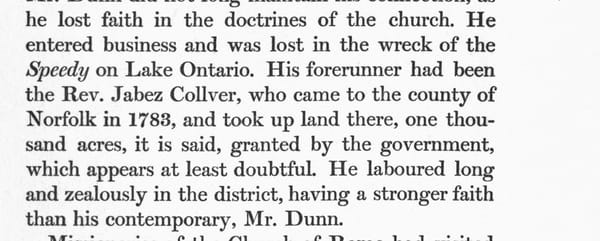
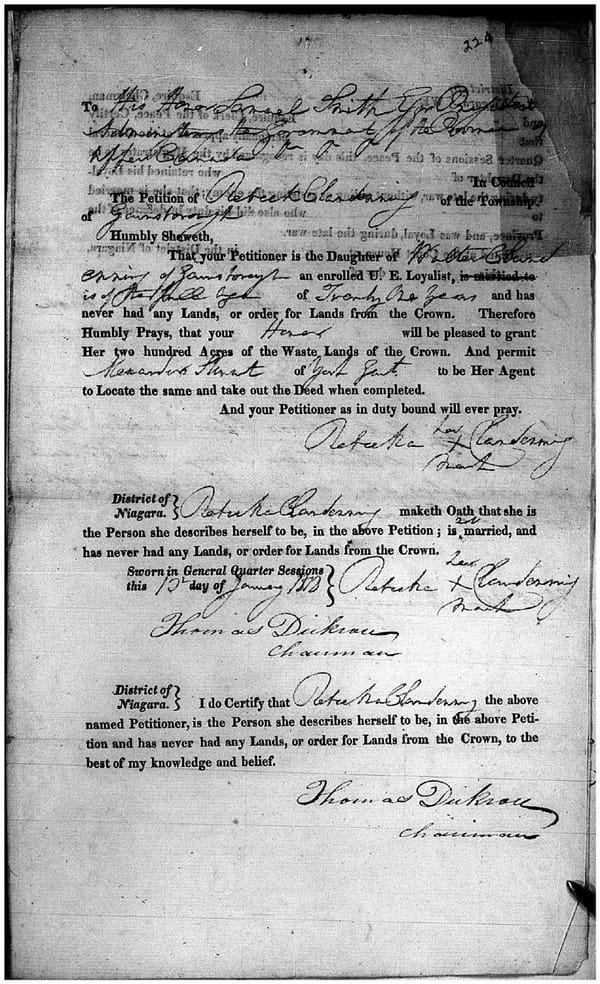
The Reverend Jabez Collver, my sixth-great-grandfather, had left New Jersey with his family in 1793 and reached the Long Point country north of Lake Erie the following winter. His petition to Governor Simcoe for land is dated the eleventh of June, 1794, twenty-seven days before the Rutland item. The order granting him a thousand acres came three days later. So the summer the American papers taught their readers that Simcoe bought American scalps at a guinea apiece was the very summer this American family staked everything it had on Simcoe's good faith. Its people were building their first cabins in his province while the story ran. And the county town they helped to found, laid out on the mill lands of Jabez's son Aaron, took the governor's name. It is called Simcoe to this day.
Then give the two facts a century to settle together. In Norfolk County, Simcoe stopped meaning a governor anyone remembered and came simply to mean home: the market town, the fairgrounds, the address on the family's letters. Somewhere in those hundred years the stories fused. Tales about Simcoe and tales about the Collvers of Simcoe became, in mouths that had no reason to keep them apart, tales about the Collvers scalping people. The nickname did the rest. By the time the story crossed the kitchen table in Munger it had a relish to it, almost a pride, the way every family polishes its one wicked legend. And not a soul in the chain that carried it had done anything worse than clear land and keep the Sabbath.
The mechanism, put plainly, is enemy propaganda, plus a place name, plus a hundred years. We were not cutthroats. We were loyal to a man the other side called one, and we moved to a town that took his name, and the story could not tell us apart.
The other half of the story
The monument my grandparents hung on the end of that story deserves the same kind of check, and it comes out the same way. There is a monument.
On the afternoon of Friday, the twenty-fifth of October, 1912, in a rain that kept many people home, a block of gray granite was unveiled at the Old Windham Cemetery in Norfolk County to mark the graves of the Reverend Jabez Collver and his wife. Lieutenant-Colonel Atkinson, the county's member of the provincial parliament, presided and read the inscription aloud. It calls them "U.E. Loyalists from New Jersey." U.E. stands for Unity of the Empire, the mark of honor the Crown gave to those who had kept faith with the King through the Revolution and their descendants. The Crown's Council had in fact refused Jabez that designation in 1798, over paperwork, while certifying his loyalty in the same minute. The granite carved it anyway. After a hundred and fourteen years there was no clerk left to object.
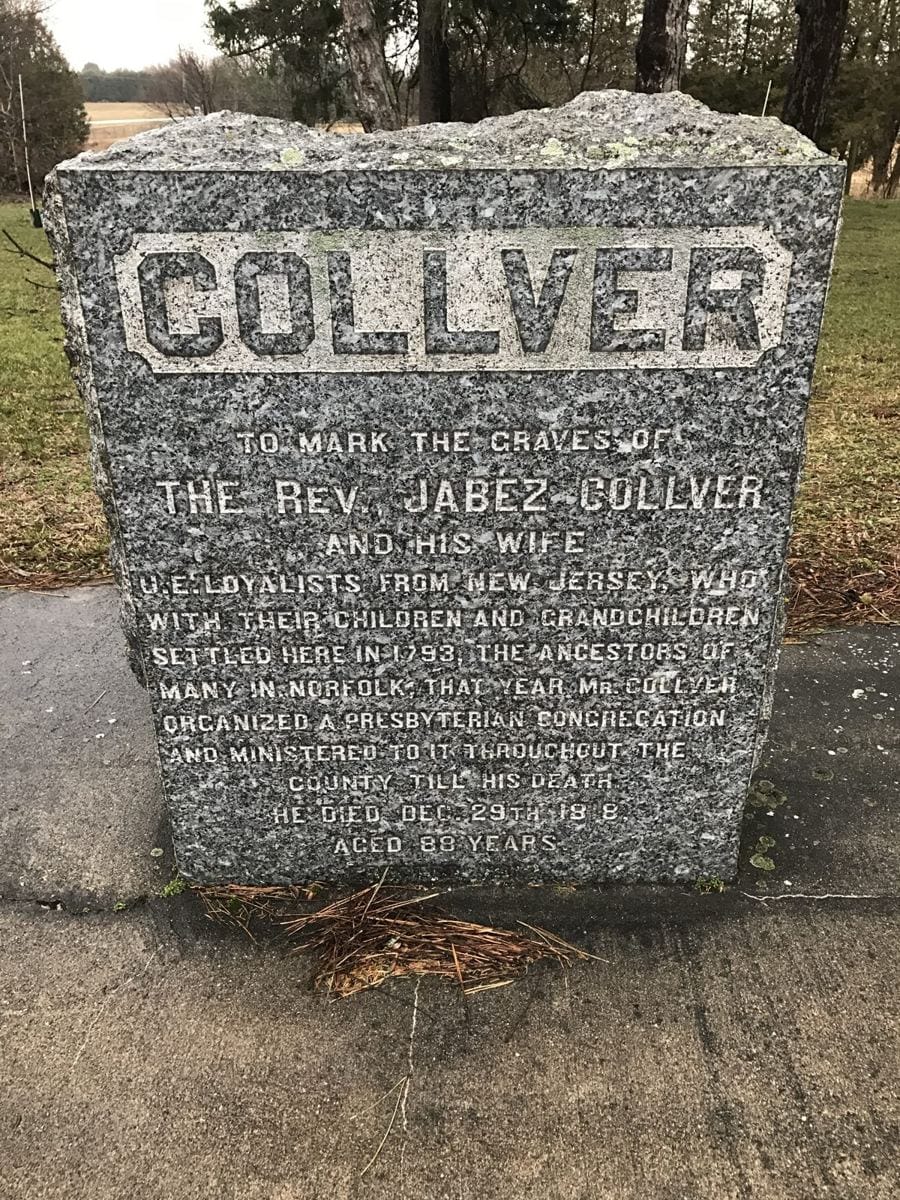
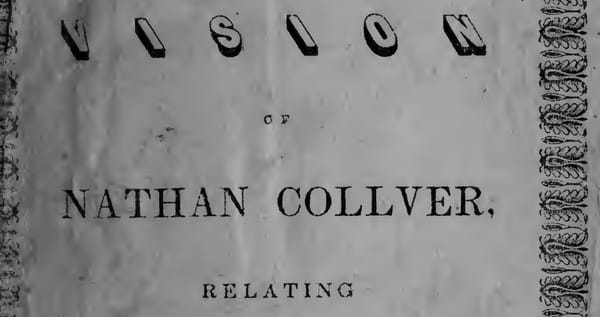
But Canada did not build it. A descendant did. Mrs. Alice Collver Rose of Simcoe, the wife of a local physician, paid for the stone herself. The account of the day says she "sought to keep the name of the donor a secret, but it came out." Alice was a great-granddaughter of Nathan Collver, whose deathbed vision was the subject of last Friday's post, so the monument over the patriarch's grave was paid for out of my own direct line.
The reverence was real. Jabez was honored in public, with granite, a crowd, and Scripture read as the veil came down. What drifted, across the two generations between that wet afternoon and my grandparents' kitchen, was the reason. A family that remembered itself honored reached, as families do, for the grandest explanation on the shelf, and found the scalps already sitting there. The stone honors a preacher. Memory handed it to the cutthroats.
What the story was pointing at
This project has spent its time checking the stories I was told at that table. The governor's daughter, the general's chaplain, and the three thousand acres all came apart in the documents, and every one of them, once it fell, turned out to be pointing at something true. This one points the farthest. The darkest thing my family ever believed about itself began as its adopted country's propaganda against the man who gave it refuge. A libel aimed at a governor, left running for a hundred years, will land on whoever ends up keeping his name.
Of all the corrections this project has had to make, I find this one the gentlest. The worst thing my family ever believed about itself turns out to be something the United States once believed about somebody else.
I do not think my grandparents would mind the correction. I think they would enjoy it. They told the story with relish because it was a good story, and it is a better one now. If your own family has a wicked legend, it is worth asking where it was first printed. Somewhere there may be a gentleman of veracity, unnamed, who started it.
Sources
- The Farmers' Library, or, Vermont Political and Historical Register (Rutland, Vt.), 8 July 1794, 3 ("RUTLAND, JULY 8"). The earliest printing found, and the one later papers credit.
- Spooner's Vermont Journal (Windsor, Vt.), 14 July 1794, 3; The New-Hampshire Journal (Walpole, N.H.), 18 July 1794; The State Gazette of North-Carolina (New Bern), 15 August 1794, 2, reprinting the Walpole item.
- Aurora General Advertiser (Philadelphia), 22 October 1794, 2 (Baltimore, 17 Oct.), and 10 November 1794, 2 (New York, 6 Nov.); The Recorder (Greenfield, Mass.), 19 November 1794, 3, crediting a Whitestown paper of 22 October.
- The Times (London), 20 December 1794, 3.
- Jabez Collver's petition, 11 June 1794, and the order of 14 June: Upper Canada Land Petitions (Library and Archives Canada).
- "Unveiling the Collver Monument," printed account of 25 October 1912 (copy in the family archive); the Old Windham stone as photographed by the author, March 2017.
We Are Doves comes out in December from Three Doves Press. The two-page sell sheet (PDF) has the contents, the editions and prices, and a few lines from the book. If your library or historical society might want a copy, please pass it along.
Adapted from chapters thirteen and fourteen of the forthcoming book We Are Doves. © 2026 Albert B. Collver III.