What the National Histories Said
Between 1905 and 1914 three of Canada's national reference works made room for the Reverend Jabez Collver. Each paid him an honor, and each made a small mistake. The documents had already answered every one of them.

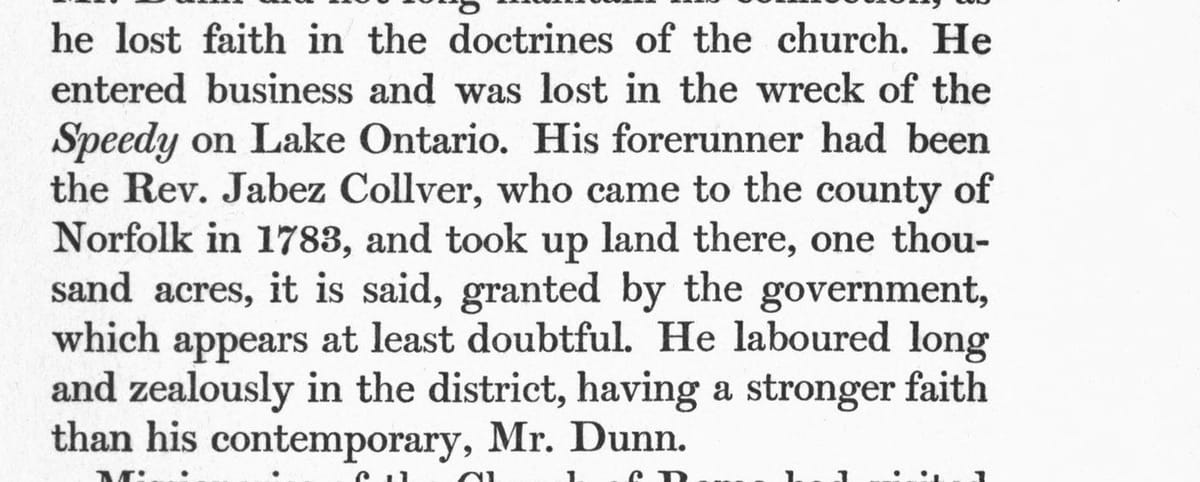
On the back of a folded petition in the national archives of Canada, a government clerk wrote a few short lines in the summer of 1794. One block, written crosswise to the rest, reads: “Jabez Collver, June 14th 1794. Order 1000 Acres for himself & 200 for each of his Sons that are come in with him.” Above it is written “Entd in Land Book A page 161,” which is to say, entered in the register of grants.
A hundred and eleven years later a national biography looked at the same thousand acres and was not sure they existed. “One thousand acres, it is said, granted by the government,” wrote Duncan Campbell Scott in 1905, “which appears at least doubtful.”
The clerk had settled the question before Scott was born. This post is about what happens when a family is noticed by the big books, and about where the corrections come from when the big books are wrong.
Three shelves
By the early twentieth century the Collvers of Norfolk County had been in Upper Canada for more than a hundred years, long enough to be visible from the national altitude. In the space of nine years, three of Canada’s reference shelves looked down at the family’s patriarch, the Reverend Jabez Collver, and wrote him in.
The first was John Graves Simcoe (Toronto, 1905), Scott’s volume in the Makers of Canada series, a set of biographies of the men the young Dominion counted as its founders. The second was James Croil’s Genesis of Churches in the U.S., Newfoundland and the Dominion of Canada (Montreal, 1907), the work of a Presbyterian church historian surveying the origins of every denomination on the continent. The third was Canada and Its Provinces (Toronto, 1914), the great cooperative history edited by Adam Shortt and Arthur Doughty, in which a chapter on the Presbyterian Church and its missions gave Jabez his sharpest ranking of all.
All three spell the name the Canadian way, Collver, with the double L. All three credit him with coming at the invitation of Governor Simcoe. Each gives him an honor, and each makes a mistake. The honors are generous. The mistakes are more useful.
The forerunner
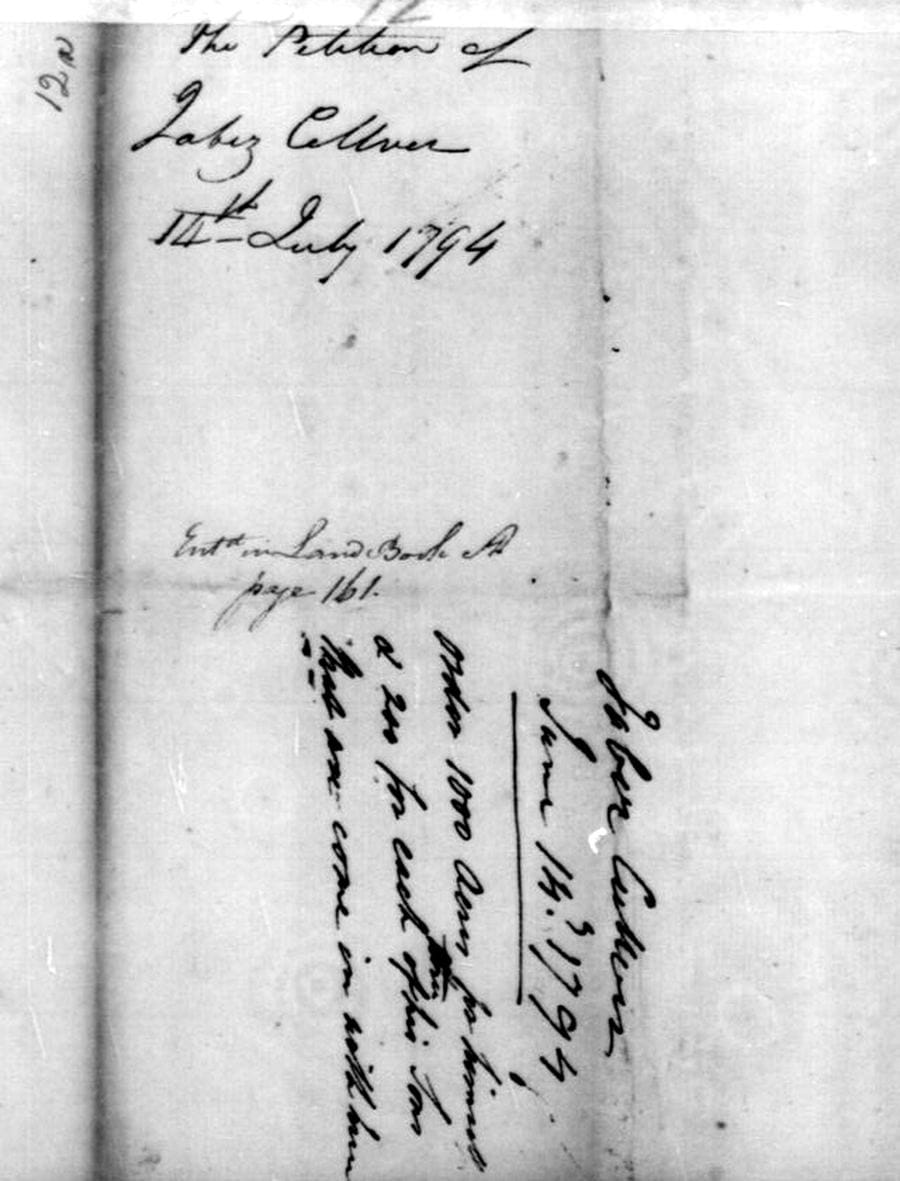
Scott came to Jabez sideways, by way of another minister. The Reverend Robert Dunn had arrived at Niagara from Scotland in 1784 and built a church with the help of every denomination in the neighborhood. Then, Scott writes, “he lost faith in the doctrines of the church,” went into business, “and was lost in the wreck of the Speedy on Lake Ontario.” The next sentence turns to our man:
“His forerunner had been the Rev. Jabez Collver, who came to the county of Norfolk in 1783, and took up land there, one thousand acres, it is said, granted by the government, which appears at least doubtful. He laboured long and zealously in the district, having a stronger faith than his contemporary, Mr. Dunn.”
It is a fine epitaph. One minister lost his faith and drowned; the other kept his faith and kept on working. A family could hang that sentence over the mantel.
It also has two errors in it, and the first one takes something away with it. Jabez did not come to Norfolk in 1783. He was still in New Jersey then, and he stayed there for another ten years. The family left in 1793 and reached Norfolk early in 1794; the petition with the clerk’s docket on its back was written that June, and in it he asks for land as a newcomer. Scott’s 1783 is probably the great Loyalist migration of 1784 taken as everyone’s date of arrival. But notice what correcting it costs. If Jabez came in 1794, he was not Dunn’s forerunner at all. Dunn was there first, by ten years. The title “forerunner” stands on the wrong date, and it falls with it. I would rather say so than keep a compliment the record does not support.
The second error is the doubt. Scott had no reason to know about a docket in a bundle of land petitions, and “it is said” was an honest way to report a family claim he could not check. But the claim was true. The Council ordered the thousand acres on 14 June 1794. Three years later the Upper Canada Gazette printed the grant in its list of patents “ready to be issued,” under a spelling only a typesetter could love: “Coliver Jabez,” in Windham. The land lay in Windham Township, and Collvers were still farming that concession in 1877.
The noted pioneer
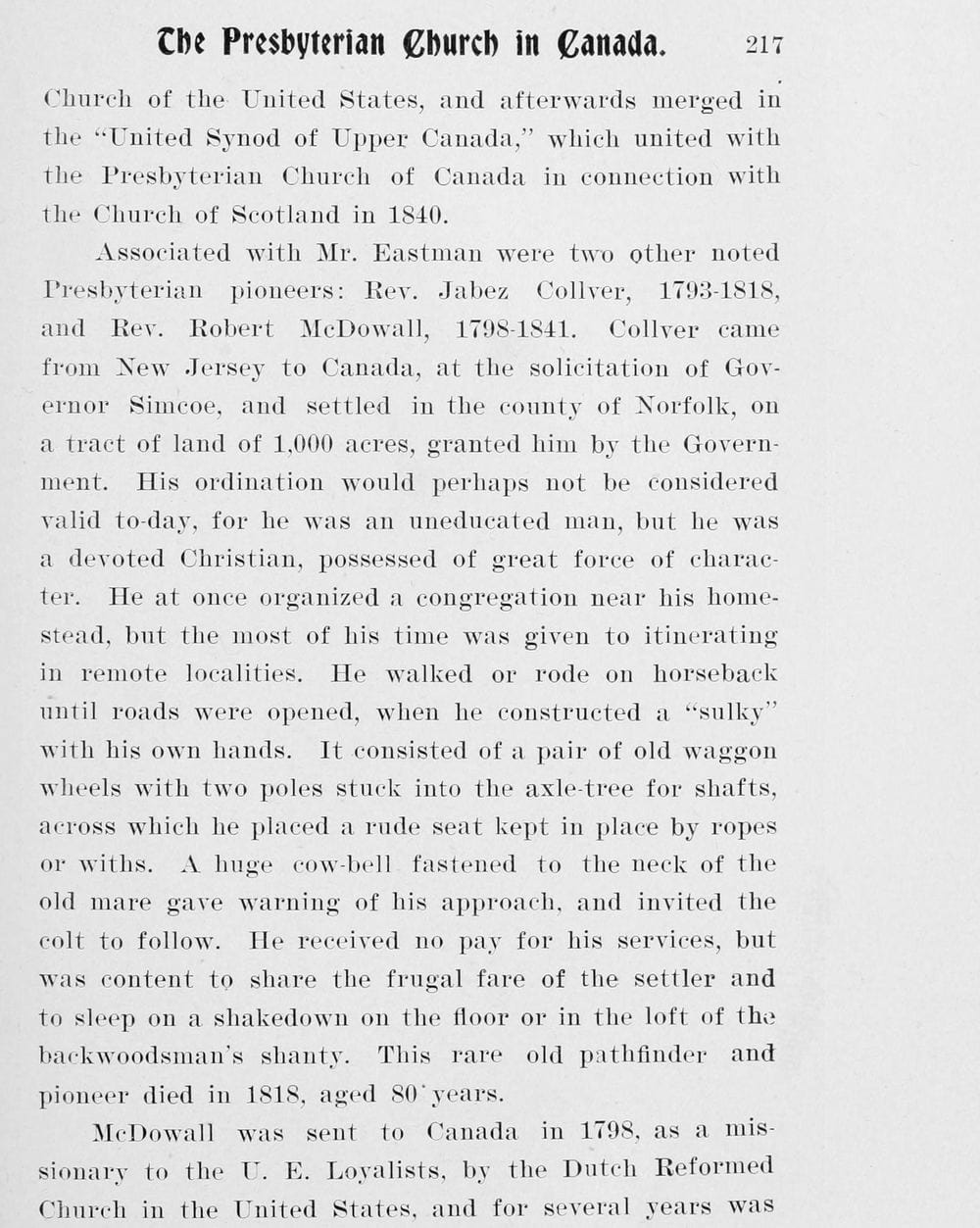
Croil, two years later, had no doubts about the land. Jabez, he writes, “settled in the county of Norfolk, on a tract of land of 1,000 acres, granted him by the Government.” Two national authorities, two years apart, disagreed about the same thousand acres, and the one who simply believed the family turned out to be right.
Croil counts Jabez among the “noted Presbyterian pioneers” of Upper Canada, with his dates as “1793–1818,” and then gives us the best picture of him at work that any printed source preserves:
“He walked or rode on horseback until roads were opened, when he constructed a ‘sulky’ with his own hands. It consisted of a pair of old waggon wheels with two poles stuck into the axle-tree for shafts, across which he placed a rude seat kept in place by ropes or withs. A huge cow-bell fastened to the neck of the old mare gave warning of his approach, and invited the colt to follow. He received no pay for his services, but was content to share the frugal fare of the settler and to sleep on a shakedown on the floor or in the loft of the backwoodsman’s shanty.”
A sulky was a light two-wheeled cart for one person, so called, the dictionaries suggest, because its driver rode alone. Withes (Croil spells it “withs”) are tough, flexible twigs, willow or hazel, twisted and used as rope. A shakedown is a bed made up on the floor out of whatever straw or blankets the house could spare. Put together, it is a portrait of an old man in his sixties and seventies, bumping along the concession roads on a homemade seat tied down with twigs, a cow-bell clanking at the mare’s neck, the colt trotting behind, preaching for nothing and sleeping in other people’s lofts.
Then Croil reaches for his verdict:
“His ordination would perhaps not be considered valid to-day, for he was an uneducated man, but he was a devoted Christian, possessed of great force of character… This rare old pathfinder and pioneer died in 1818, aged 80 years.”
The age is the simple error. Jabez was born on 19 June 1731, a date fixed by the papers of his father’s estate in New Jersey, and he died on 29 December 1818. He was eighty-seven, not eighty.
The other sentence is not quite an error. It is an opinion, and an old one. The establishment had said it to his face. In July 1800, when Jabez applied to the court at London District for a license to marry his own people, Captain Samuel Ryerse, founder of Port Ryerse and a pillar of the establishment, lodged a protest against the validity of his ordination. The license was refused, sought again, and finally granted in March 1804. Croil’s “would perhaps not be considered valid to-day” is the same objection, a century later and more politely put.
As for “uneducated,” the answer is in the collection of a museum in Simcoe, Ontario. It is a small hand-stitched booklet of about thirty-eight pages, written out in Jabez’s own hand and titled “The Doctrine of Christ or pure divinity.” It is laid out as a formal sermon, with first, second, and third heads in the old Reformed manner. It argues for the Trinity against those who “deny the divinity of Christ,” and it argues at length for the final perseverance of the saints. On its thirty-seventh page it is signed “Jabez Collver — 16th June 1817,” three days before his eighty-sixth birthday. A man the national history called uneducated wrote a short system of theology in the Canadian bush and sewed it together himself. Croil never saw it. The national histories wrote from an altitude where detail blurs, and the copybook is exactly the kind of detail they could not see.
The second minister
Seven years after Croil, Canada and Its Provinces set Jabez into the founding of Canadian Presbyterianism. In 1793 three ministers met at Montreal and organized the first presbytery in Canada, a presbytery being the body of ministers and elders that governs the churches of a district. Then:
“In the same year from New Jersey, at the request of Governor Simcoe, came the Rev. Jabez Collver to join Bethune of Glengarry, the only minister then in Upper Canada. Collver settled in Norfolk County, where he organized a group of congregations, to which he ministered for the next fifteen years.”
This is the highest ranking any of the three gives him. If John Bethune at Glengarry, in the far east of the province, was the only Presbyterian minister in Upper Canada when Jabez came, then Jabez was the second, and the first in all the western half of it.
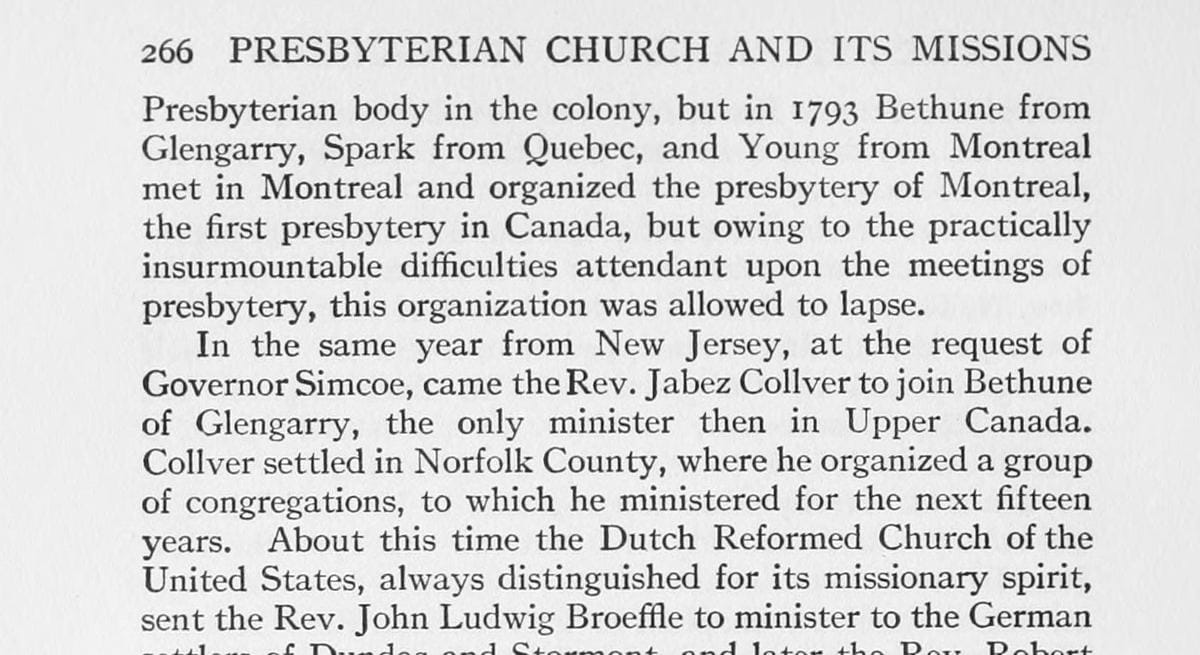
And again the error is a number. “The next fifteen years” would end his ministry about 1808. Jabez preached in Norfolk from 1794 until his death at the end of 1818, a quarter of a century. The correction does not need an archive. It is in Croil, seven years earlier, who has the dates exactly right: 1793 to 1818.
The shoebox
So the tally runs like this. Three national works; three honors, forerunner, noted pioneer, second minister in the province; and a handful of small errors: a decade added at one end, a grant doubted, an age shortened, a ministry clipped by ten years. One of the honors, Scott’s “forerunner,” does not survive its own correction. The other two hold.
What I find most instructive is where the corrections came from. Not one of them required a better historian. Every one was answerable from papers that already existed: a petition docket in a bundle of land records, a printed list of grants in a provincial newspaper, an estate file in New Jersey, a court’s minute book, and a hand-sewn booklet that a branch of the family carried to Michigan and back before it reached a museum. The big books confer the honor. The shoebox holds the proof.
That is worth remembering the next time a county history or a reference book tells you something about your own people. It may be generous, and it may be mostly right, and it was written by someone looking from a long way off. The family Bible in the closet, the deed in the attic, the letter nobody has read in fifty years: those are written from close up. When the two disagree, it is usually the close-up page that deserves the benefit of the doubt.
The docket is still in the national archives, on microfilm, where anyone can read it. The copybook is still in Simcoe. The ground is still there in Windham Township. Scott’s doubt is the only thing in the story that has not lasted.
Sources
- Duncan Campbell Scott, John Graves Simcoe, The Makers of Canada (Toronto: Morang, 1905), 164–65.
- James Croil, Genesis of Churches in the U.S., Newfoundland and the Dominion of Canada (Montreal, 1907), 217.
- Adam Shortt and Arthur G. Doughty, eds., Canada and Its Provinces, vol. XI (Toronto, 1914), 266.
- Petition of Jabez Collver, 1794, and docket of 14 June 1794: Upper Canada Land Petitions, “C” Bundle 1, Petition 12 (RG 1, L 3, vol. 89), Library and Archives Canada, microfilm C-1647, images 89–90.
- Upper Canada Gazette, or American Oracle (West-Niagara), 19 April 1797, 4, “List of Grants lying in the Secretary’s Office ready to be issued.”
- London District Court of Quarter Sessions, minutes 1800–1804, as compiled in Mutrie’s Collver genealogy (the license file and Captain Ryerse’s protest of 8 July 1800).
- Jabez Collver, “The Doctrine of Christ or pure divinity,” manuscript copybook, 1811–1817, Norfolk Historical Society, Eva Brook Donly Museum, Simcoe.
Adapted from the forthcoming book We Are Doves, chapter eleven. © 2026 Albert B. Collver III.