Start Here
The surname Collver descends from the Old English culfre — a dove. The centuries did a great deal to the spelling, but the meaning held. That is the first thing to know about this family, and it is the subject of the first post you should read.
This site is the public workshop of the Collver Family History Project — an attempt to trace one family from England under Charles I, through New England and New Jersey, to the shore of Lake Erie in Upper Canada, using original documents rather than inherited stories. The inherited stories are here too; they are treated with affection and checked against the record. A book is taking shape from this work. The blog is where the research shows itself first, documents and all.
Where to begin
The posts appear weekly, but not in the order the family lived them. Read them this way and the story tells itself.
The name and the crossing
- Why We're Collver, Not Culver — the dove etymology, and how one branch's spelling drifted apart from its cousins'.
- The Ship That Never Was — Edward Colver's Atlantic crossing in the Great Migration, and why the ship the family literature names cannot be the one he sailed.
- The Captain of the Dove — Captain Christopher Colver, who took the family name to sea.
The Revolution
- Set Up the King's Standard — the Rev. Jabez Colver's New Jersey land, his conviction for seditious words in 1777, and the flight that followed.
- A House Divided — the war splits the family, with sons on both sides.
- Pull Down All Other Persuasions — who was actually in the courtroom in 1777, and what each of them believed.
- The Judge, the Preacher, and the Log Gaol — the men who tried him, and the gaol (jail) that may have held him.
The new country
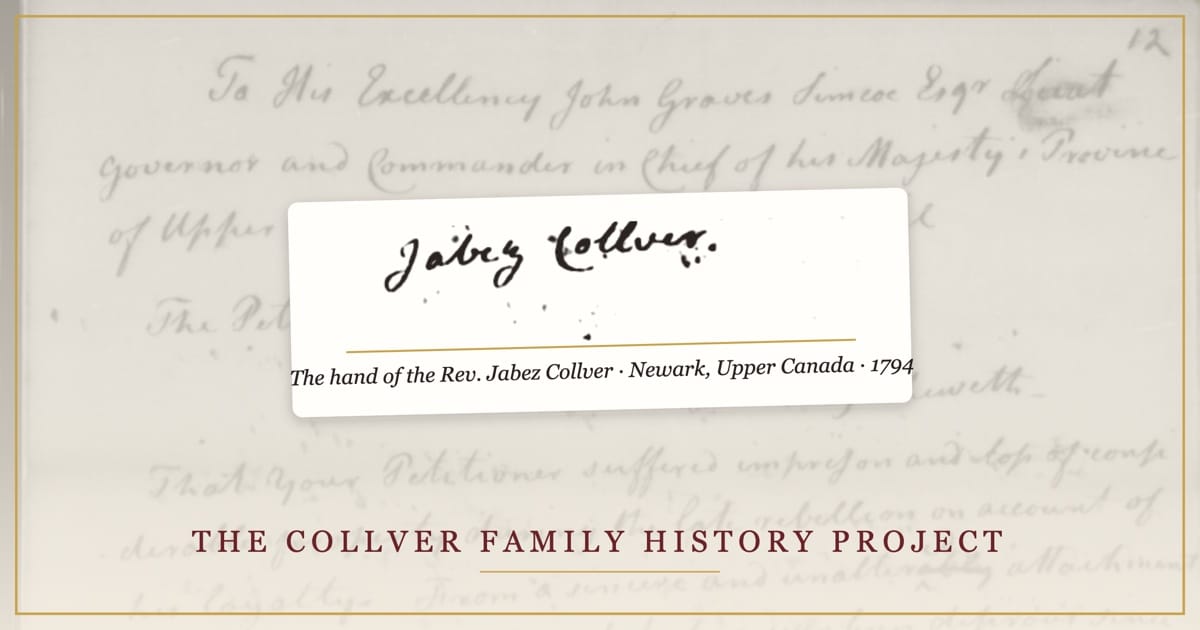
- Echoes from the Frontier — Jabez's petitions to the Crown from Upper Canada, with his signature in his own hand.
- The County's First Deed — the first deed recorded in Norfolk County, and the family's place in it.
- The Archive Now Speaks and The Family Pamphlet — how the documents survived, and the 1916 genealogy this project corrects with gratitude.
How this project works
Every substantive claim traces to a primary source — a deed, a court minute, a petition — reproduced here as the original scan alongside a typed transcription you can download and check against it. Where the record is silent, I say so; the absence of a record is not the absence of an event, but neither is it evidence. And when I find that I have been wrong, the correction is published, not buried.
Listen instead
Each post is also an episode of A House Divided, the project's podcast, read aloud at podcast.collver.biz.
Follow along
The research continues weekly, and subscribers receive new posts by email — subscribe free here. Two hundred and fifty years after the Revolution scattered this family across a border, its descendants are still finding pieces of the story — in deed books, in court minutes, in petitions. Some of those pieces may belong to your family too.