The Visionary
About 1790 a young man who doubted heaven and hell asked God to show him whether they were there. His father wrote down what he said he saw, and the family kept it in print for more than fifty years. Also: the first printed proofs of We Are Doves have arrived.

One evening about the year 1790, most probably in one of the family's cabins on the Chemung River in New York, a young man named Nathan Collver lay in bed and prayed a prayer he did not quite believe in. He asked, in his own words, "that if there was Heaven and Hell, I might know it." Then he felt "a blow, which struck me on the breast."
What he said he saw that night became the most widely printed thing this family has ever produced. His father took it down. A printer at Windsor, Vermont, published it in 1793, and printers kept setting it in type for more than fifty years after that. Nathan is my fifth-great-grandfather. Between a will of 1732 and the age of family letters, his little pamphlet is the only place where my own direct line speaks in its own voice.
The hard case
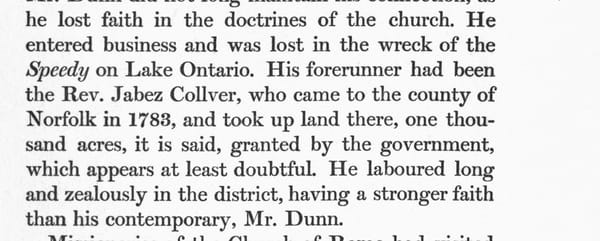
Nathan was born at Wantage, in Sussex County, New Jersey, in 1764, a son of the Reverend Jabez Collver. He was not the son a minister prays for. His father, who had every reason to be gentle with his memory, put it plainly: before the vision Nathan "always appeared to be a great enemy to all the duties of religion and to reading the Bible." He was, his father added, "naturally something rough in his temper."
Nathan was harder on himself. He had been "rather inclining to believe that there was neither Heaven nor Hell," so "hardened in my heart as to hate the Holy Bible," and persuaded "that I should die like a beast." In the vocabulary of his generation he was a deist, from the Latin deus, "god": one who allowed that a God had made the world, but doubted that he had ever spoken in it, and doubted that anything waited on the far side of the grave. The Revolution had made that kind of doubt respectable among educated men. Thomas Paine's Age of Reason would make it popular a few years later. Nathan came to it early, and on the frontier.
He also kept a fear he did not admit to anyone, and by his own account it had troubled him for nearly two years. The prayer in bed was the fear speaking.
Beyond the sun
What follows in the pamphlet is a guided tour of both destinations.
A shining figure comes to him, Christ "with a bright circle shining round about him," brighter "than the sun shining in his strength," and carries his spirit "beyond the sun, moon, and starry regions" to a city whose streets "shone like the purest glass." From there Nathan is brought to "the bar of God's awful justice." A very large book is opened. The righteous stand on the right hand and the wicked on the left, and Nathan finds his own name on the left, written "very black." The Judge pronounces his own name, "which was JEHOVAH, and his name made Heaven rejoice and Hell tremble," and holds a great sword over the sinner's head.
Then comes the scene that carried the pamphlet through half a century of reprints:
...in the midst of my fears, contrary to my expectation, Jesus Christ arose from his seat, came and kneeled between me and the bar of God, and placed his own head under the sword, which was held over mine; and like a mediator, he plead my cause in a most moving and affecting manner, and said, "Oh Father, I have died to save this sinner and now oh! Father, spare this sinner, oh! thou Father I stand between the sinner and the stroke of thy wrath, oh! thou Father why should he perish."
The sword is withdrawn. The sins are "blotted out." Christ shows Nathan "the nail holes in his hands: this said he I have borne for thee," and "all the Heavenly Host sung for joy."
The rest of the heavenly tour mixes the sublime with the very particular. Nathan hears the children of heaven sing a verse of their own: "Babes thither caught from wombs and breast, / Claimed right to sing above the rest." Near King David he is introduced to Nathan the prophet, who "said he was of my name, and when I came there to stay I should sing with him." The ballad printed at the back of the pamphlet rhymes it home: "Because one name we both did bear." And he recognizes people. "I saw several persons in Heaven, whom I knew," he reports, "that is Simon Dunn, and his mother, Barnabas Swayze, Jonathan Hopkins, and my wife's mother." A genealogist cannot help noticing that even in glory Nathan knew the neighbors, and that the names are New Jersey names.
The dark regions
Having seen heaven, Nathan asks how he is to know there is a hell. Christ puts out his hand, bids him stand on it, and carries him down to "the dark regions of the DAMNED CREW." There he sees the Devil, "something in human shape, but large in size and very black," with "a chain about his neck." He sees people he had known in this world, and here the visionary shows a discretion his father must have approved: "the names I keep secret."
Then Nathan asks the question the next generation would ask in earnest. Why might these not have been saved? The answer is that "they had a chance once to have been saved, but they neglected it, and their chance was now gone and the fault was their own." Their torment, they tell him, has no end; "when thousands of years were past, it was still a beginning." He hears them "say the words never, never, never, it was that killed them and yet they could not die."
Yet the vision has its mercies, and one of them is a matter of doctrine. Nathan had "heard that some believed there were little infants in hell." He looked for them. Christ "shook his head and said nay, there were no babes in hell."
Taken from his own mouth
I cannot verify a vision. What I can examine is the paper around it, and the paper is unusually good.
The account was written down by Nathan's father. Jabez served as his son's amanuensis, a word from the Latin a manu, "at hand," for the servant who took down a master's words as he spoke them. At the end of the pamphlet the father signed a certificate of his own:
The foregoing account is what I his father, JABEZ COLLVER, have taken from his own mouth, and I have written it as nearly in his own words as I could... I here declare there has been nothing written to impose upon the reader.
The certificate says three things a father could know. First, that the vision changed the man. Nathan "is greatly altered in his practices," Jabez writes, "often reading God's word," keeping "constant prayer in his little family," "a peace maker in my family," and "much concerned for the souls of people," for "the rest of the time which he lived, which was not two years."
Second, that its one checkable prophecy came true, at least as the family told it. In the vision Christ gave Nathan a charge for Stephen Kent, whom the pamphlet calls "my sister's husband": he was to make "speedy preparation for death, for that his time was short on earth." Jabez reports that the message lay "heavy on his mind" until Nathan delivered it, and that Kent was drowned about two months afterward. That sequel rests on the father's certificate, and I give it at that weight.
Third, that Nathan held to it at the end. He died in 1792, at Chemung, not yet thirty. "A little before his death," Jabez writes, "I asked him what he had thought then of his vision, and he told me what he had said before, and what was written about it was all true, and he was not afraid to die in the witness of it."
The ballad had already given him the words:
With Scripture truth these things I write,
Their truth I soon must prove in death;
What there I saw I now indite,
And soon will seal with my last breath.
To indite, from the Old French enditer and the Latin indicere, "to declare," is to set a thing down in words for others to read. Nathan indited, his father wrote, and the printers did the rest.
Half a century in print
The first edition came out at Windsor, Vermont, in 1793, the year after Nathan's death, as A Very Remarkable Account of the Vision of Nathan Culver. The time and the place matter. Vermont and the rest of New England were then full of Universalism, the teaching that a God of love will in the end save every soul he made, so that hell, if it exists at all, will one day stand empty. Against that teaching the pamphlet's never, never, never was ready-made. Whether or not anyone intended it so, the dead man's testimony entered a live argument, and it kept being reprinted while the argument lasted.
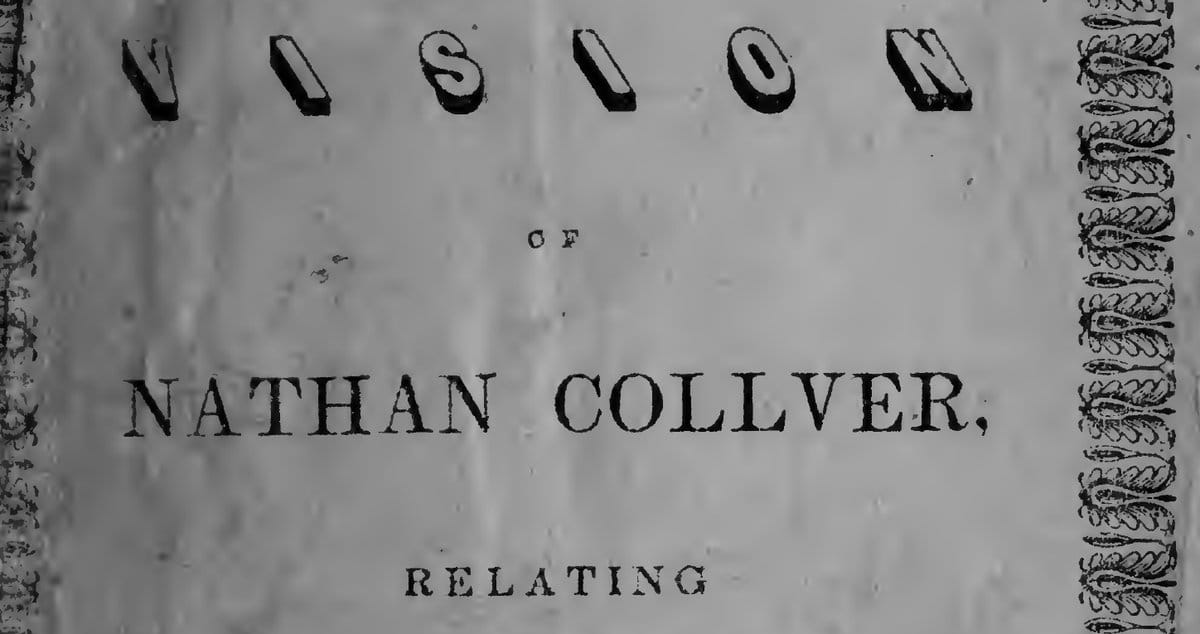
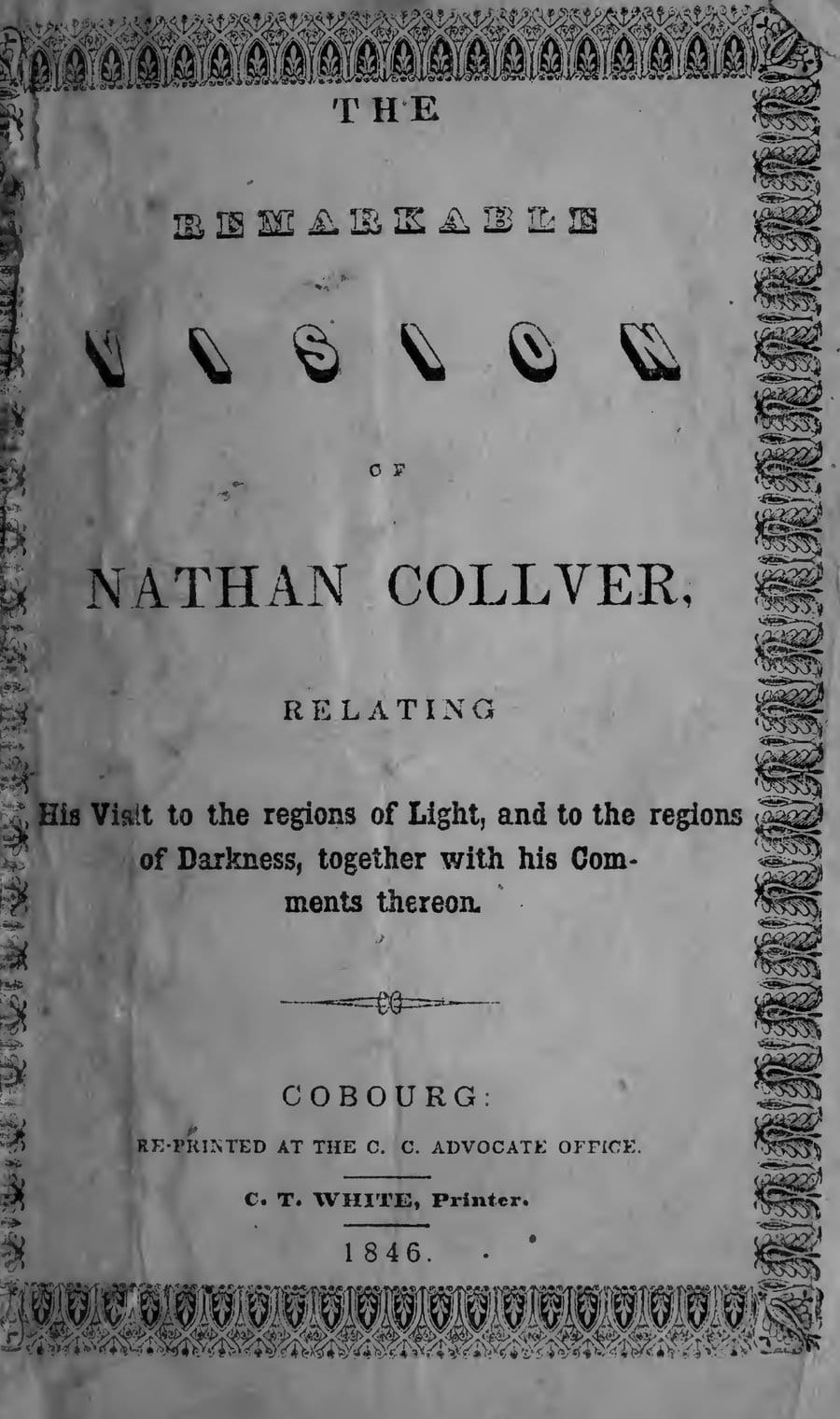
The copy I work from was printed at Cobourg, in what was then Canada West, in 1846, "Re-printed at the C. C. Advocate Office, C. T. White, Printer," fifty-four years after Nathan died. Its title page spells the family name the Canadian way, COLLVER, with the double L. Its signature line reads "NATHAN COLLVER. Upper Canada." Nathan never saw Upper Canada. He died two years before his family walked there. The reprint had quietly naturalized him into the country they made their own. That copy is now in the library of the University of Toronto.
Two gospels out of one house
The family did not settle the question of hell. It published both answers.
Nathan's younger brother John, the pioneer and lodge warden of the Norfolk years, was a poet. In 1828 he printed The Upper Canada Hymn Book, one of the earliest hymn collections produced in the province, and, in the county historian's phrase, "towards the close of his life he became enamored with the doctrines of Universalism." In September 1832 he wrote to Francis Walsh that "our friends have agreed to form a Universall Society in Townsend and Windham," the two townships where his father had preached. The doctrine his brother's vision answered, John signed his name to.
Stand back and look at one household. The father kept a hand-stitched booklet of divinity that staked the existence of God on the saints' perseverance. One son saw an eternal hell and sealed his testimony with his last breath. Another son founded a society on the hope that the hell his brother saw would one day be empty. One father, three answers to the oldest question there is, and the family's way through the disagreement was characteristically practical. It kept all three, printed two of them, laid the father and the poet in the same acre at Old Windham, and let the trustees be Presbyterian. The theology divided; the ground did not.
The orphan in the swamp
Nathan left a wife, whose given name the records have not yet given back, and a small son, Jabez B. Collver, born in September 1789. The grandfather whose name the boy bore took him in. In 1794 the old minister walked his family north to Upper Canada, and the visionary's orphan went with them, raised now by the visionary's amanuensis.
One story of that walk survives, and the county historian E. A. Owen kept it. Camping in the Grand River swamp on the way in, the four-year-old "sat on a huge rattlesnake, but one of his uncles succeeded in rescuing him without serious consequences." It is a family anecdote and I offer it as one. But every generation that came after him, William Valentine, John Milton, the mail carrier at Munger, my grandfather, my father, and I, hung that afternoon on an uncle's quick hand.
I do not know what Nathan saw. I do know that his father believed him, wrote it down, signed his name to it, and saw it into print; that the family kept it in print longer than any other document it owned; and that it is the one voice my own line has left from the eighteenth century. What it testifies to I leave where the family left it, between the reader and the God of Nathan's vision.
A word about the book
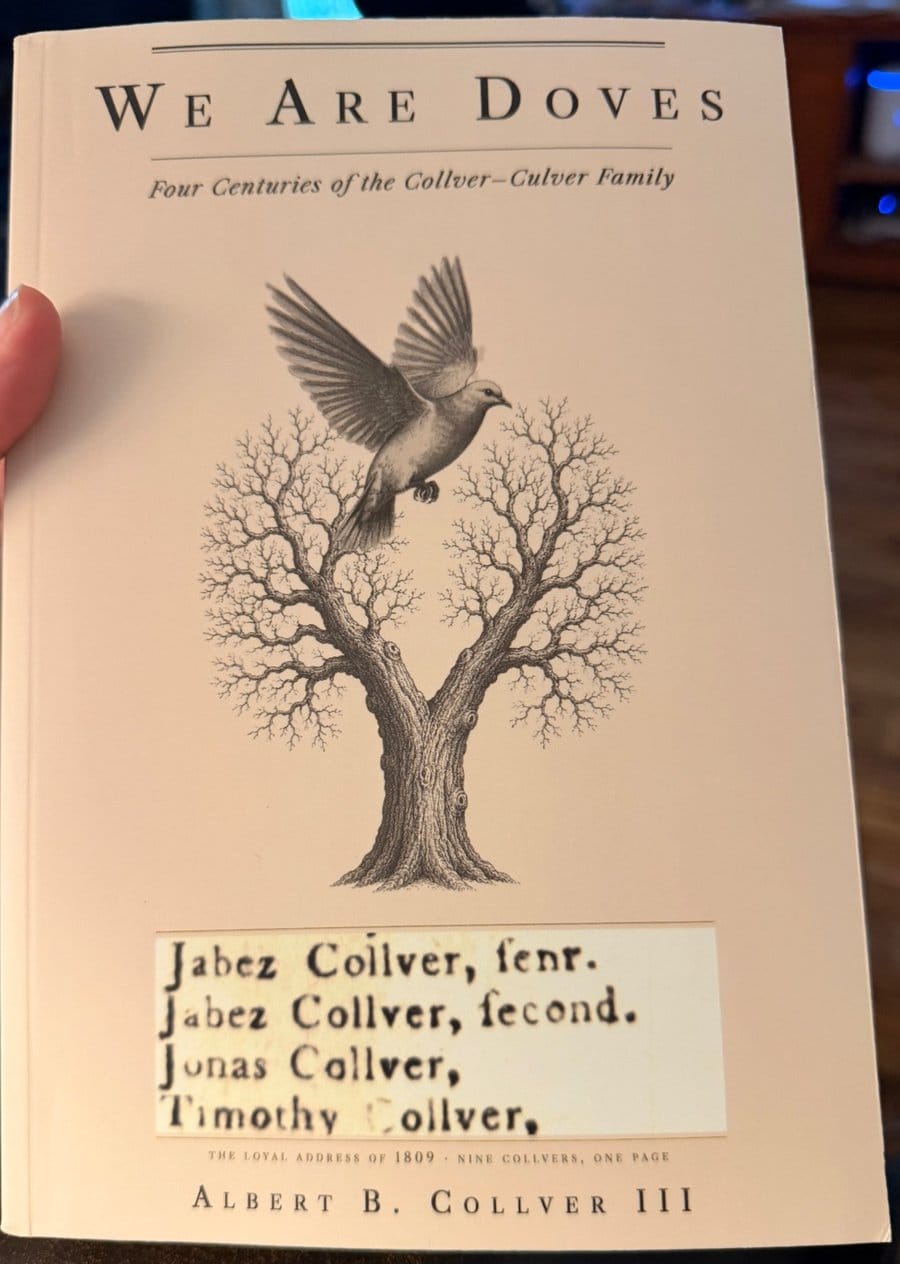
The Collvers have a habit of putting their testimony into print, and this autumn the family is doing it again. The first printed proof copies of We Are Doves: Four Centuries of the Collver–Culver Family have arrived, and I am reading them now, pen in hand, for the things that only show up on paper: a faint photograph, a caption that runs off the foot of a page, a list that indents where it should not. Nathan's vision is in chapter eleven, and the 1846 title page is one of the plates.
The names on the cover come from the loyal address of 1809, where nine Collvers signed one page. The first of them, "Jabez Collver, senr.," is the father who took his son's vision "from his own mouth" nearly twenty years before.
If the proofs behave, the book will be published in early December, in paperback, hardback, and as an e-book. Readers of this newsletter will hear first.
Sources
- The Remarkable Vision of Nathan Collver, Relating His Visit to the regions of Light, and to the regions of Darkness, together with his Comments thereon (Cobourg: Re-printed at the C. C. Advocate Office, C. T. White, Printer, 1846), 16 pp.; University of Toronto Library copy (BT 833 C6). The vision, pp. 3–9; Nathan's "Comments," pp. 9–12; "Jabez Collver's Account," pp. 12–13; the ballad, "Nathan Collver's Call to Poor Sinners," pp. 14–16. First edition: Windsor, Vt., 1793, as A Very Remarkable Account of the Vision of Nathan Culver.
- E. A. Owen, Pioneer Sketches of Long Point Settlement (Toronto, 1898): the John Collver and Nathan Culver notices. Owen places Nathan's death in New Jersey; the 1790 census and the family's letters place the household on the Chemung, in New York.
- John Collver to Francis Walsh, 23 Sept. 1832, Norfolk Historical Society collections, 2961–62.
- Mutrie's Collver genealogy, Nathan and Jabez B. sections; 1790 U.S. census, Chemung.
Adapted from the forthcoming book We Are Doves. © 2026 Albert B. Collver III.