The Bride's Own Loyalists
The family remembered Jane Cregar's great-great-grandmother only as Rebecca. The Crown's own paper gives her surname back: a Loyalist's daughter's petition of 1819, the patent of her lot, and the 1838 sale by William Shingler and Rebecca his wife.
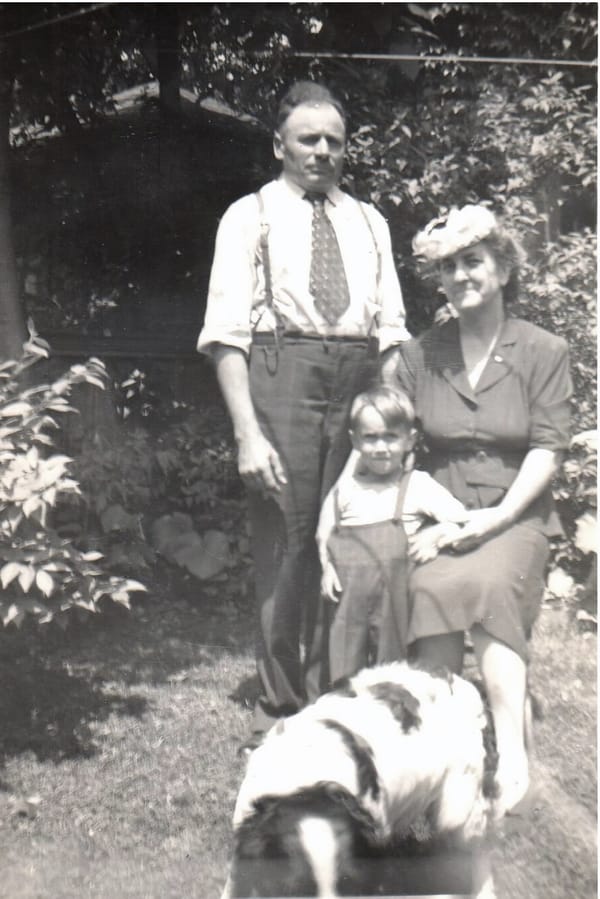
In June of 1947, at Flint, Michigan, Albert Bernard Collver Sr. married Jane Ellen Cregar. He was home from the Pacific and twenty-two; she was a Bay County girl whose people had come down from Ontario a generation earlier, the way half of the Thumb had. The wedding is in the family’s Bible and in the county clerk’s ledger and in one photograph. What nobody at it knew, on either side of the aisle, is that the two families had already met once, a hundred and sixty years before, on the wrong side of a war.
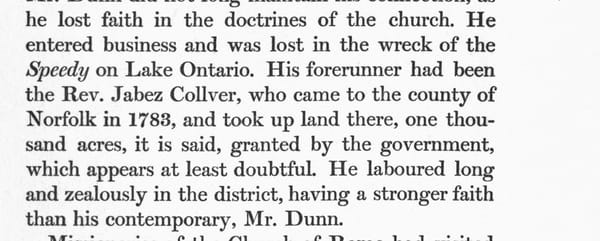
This blog has spent a year on the groom’s side of that story. The Reverend Jabez Collver chose the King in Sussex County, New Jersey, took his people over the lake in the 1790s, and is cut in granite at Windham as a United Empire Loyalist. The bride’s side kept quieter. The Cregars were Niagara people, Bertie Township, and their records are thin. The one thing the family carried about Jane’s grandmother’s line was a name without a surname: Iva Dell Shingler’s father, Jeremiah, had been born in Canada West in 1833 to William Henry Shingler and a wife remembered only as Rebecca.
This is the story of how Rebecca got her surname back, and what came with it.
A word first
U.E. is an abbreviation that became a rank. In November 1789 Lord Dorchester, governing at Quebec, ordered that the families who had “adhered to the Unity of the Empire” during the late war be set down on a list, so that they and their children might be distinguished from later comers, and he added the practical part: every son and daughter of a person on that list was to have two hundred acres of Crown land on coming of age, for nothing but the fees. The clerks shortened the honour to two letters. A son applying under the order was an S.U.E., a daughter a D.U.E., and a petition endorsed D.U.E. meant the Crown had accepted both the father’s loyalty and the daughter’s parentage.
That is the whole mechanism of this post. A Loyalist’s daughter did not need a baptismal certificate in Upper Canada. She needed her father’s name on Dorchester’s list and a brother willing to swear to her. The Crown then wrote her down, located her on a lot, and in due course patented it to her by name. Every step left paper, and the paper is now online.
The girl with the mark
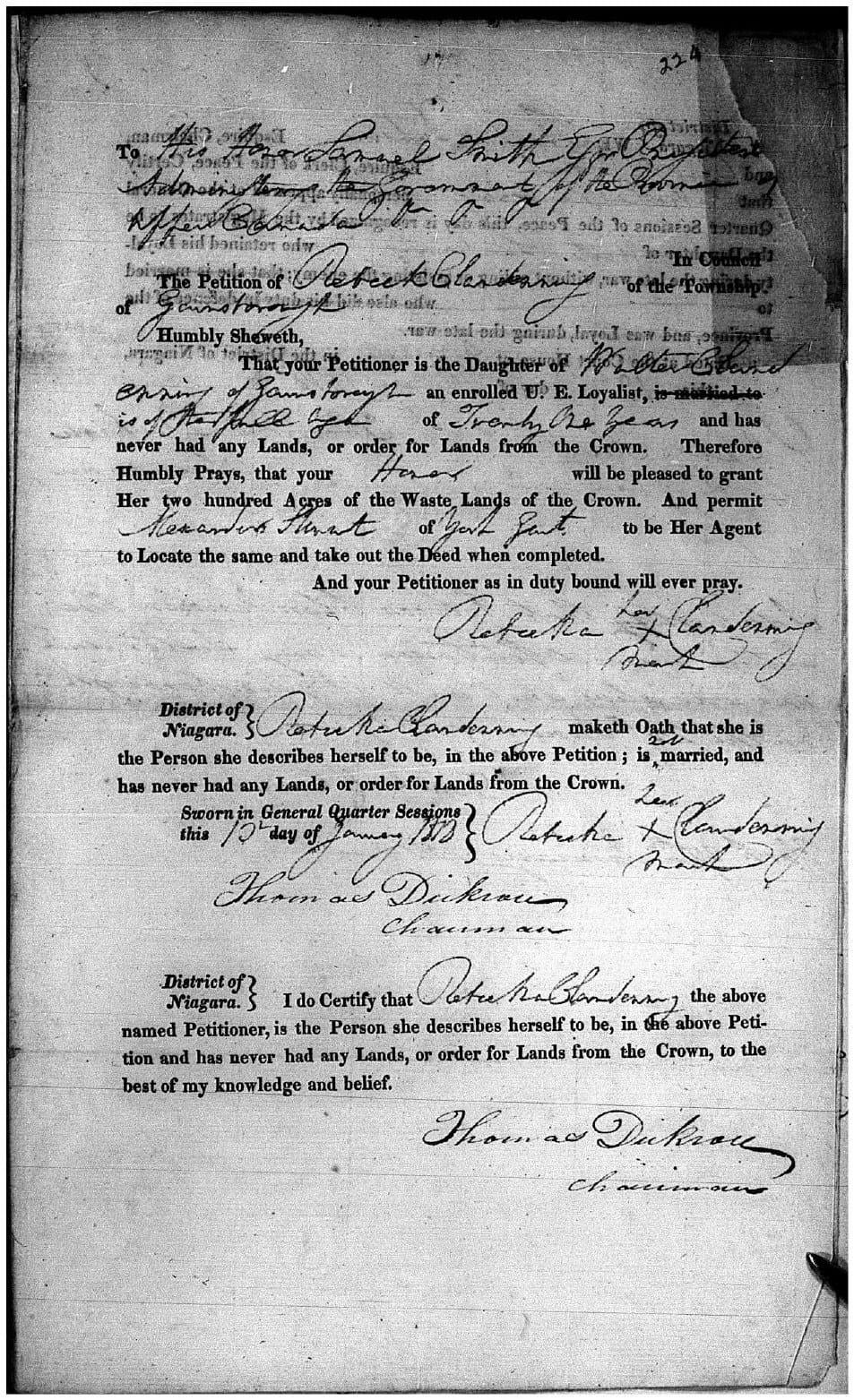
The first document is a printed form, filled in by hand, received at York in January 1819. The Petition of Rebeka Clandenning of the Township of Gainsborough Humbly Sheweth, That your Petitioner is the Daughter of Walter Clendenning of Gainsborough, an enrolled U. E. Loyalist, is of the full age of Twenty one Years and has never had any Lands, or order for Lands from the Crown. She asked for her two hundred acres and named an agent at York to locate them. She signed with a mark, between the two halves of her name, and swore to the petition before the Niagara quarter sessions on the thirteenth of January. The clerk’s form had the words is married to printed on it; someone struck them through. In the oath beneath, the word not is squeezed in above the line: is not married.
Her brother Daniel brought the paper to York. The docket on the back, in the land clerk’s hand, says what the Council did with it on the twenty-seventh of January: Granted. D U E. Ent’d in Land Book I, page 53. The order to the Surveyor General issued on the sixth of February.
So in January 1819 there was an unmarried Rebecca Clendenning, twenty-one, daughter of a man the Crown recognized as a Loyalist, living in Gainsborough Township at the head of the Niagara peninsula. The family’s Rebecca, William Shingler’s wife, was the mother of a Walter born about 1821 and a Jeremiah born in 1833. The two Rebeccas might be the same woman. A petition does not say so. For that, one has to follow the land.
Following the land
The Archives of Ontario indexed every Crown grant in the province on microfiche in 1979, and the Toronto branch of the Ontario Genealogical Society has since put the fiche online. Under Clendenin, Rebecca the index gives one entry: Erin Township, lot twenty-two in the second concession, order-in-council of the twenty-seventh of January 1819, D.U.E. Her brothers Jeremiah and Daniel were located on the lots on either side of her, in the same township, the same year. Erin is in Wellington County, forty miles northwest of the Niagara farms, and the Clendennings never lived there; a Loyalist child’s two hundred acres was a thing to be held or sold, not necessarily farmed.
The registry books for Erin are also online, through the province’s land-registry portal, and the abstract index for that lot opens with the Crown’s own entry. Patent, 2 May 1837, to Rebecca Shingler. Eighteen years after the girl with the mark was located on the lot, the Crown issued the deed for it to a married woman with the family’s surname. The county’s own register of patents, filmed by the Genealogical Society of Utah, says the same.
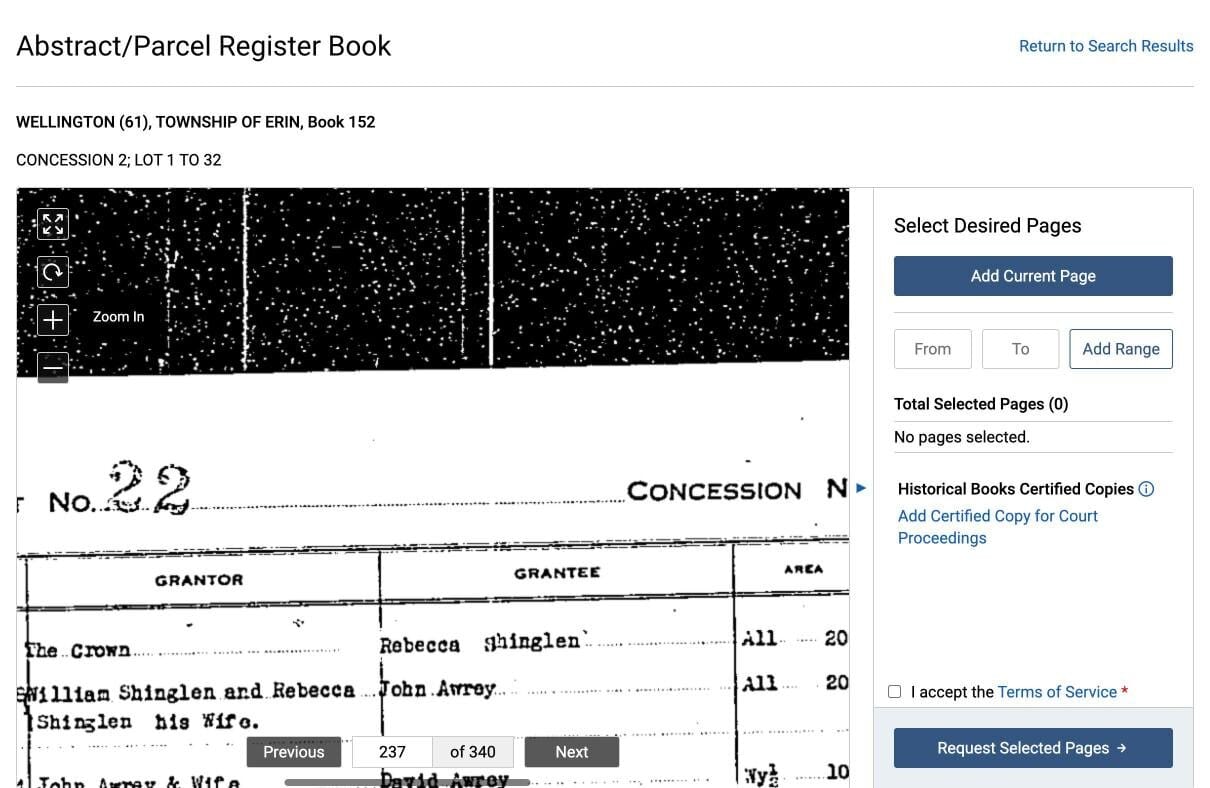
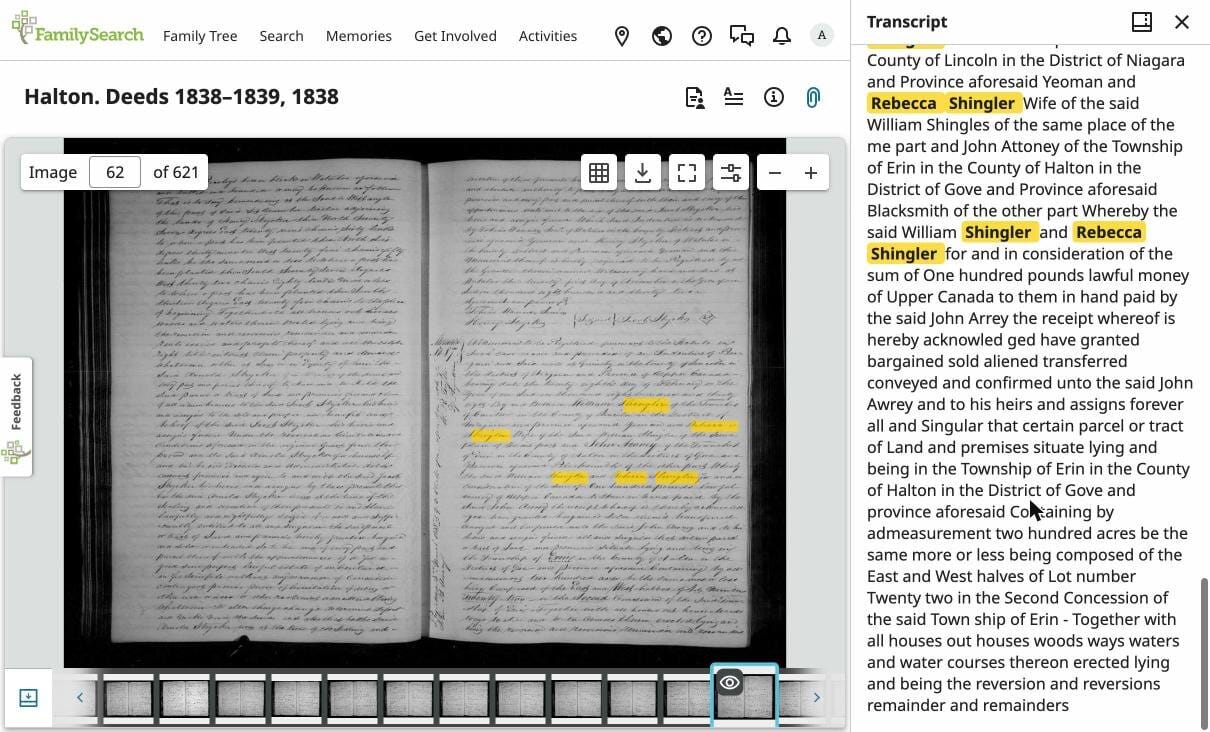
Then the second line of the abstract. Bargain and Sale, 28 February 1838, William Shingler and Rebecca his wife, to John Awrey, the whole two hundred acres. A bargain and sale is simply the old name for an outright conveyance; a memorial is the registered summary of it, and the memorial itself survives in the Halton County deed books on the same microfilm. It was drawn at Grimsby, in Lincoln County, on the Niagara side, and it names the vendors as William Shingler of the Township of Caistor, Yeoman, and Rebecca Shingler his wife. Attached to it is the piece of procedure that settles the matter. Under the law of Upper Canada a married woman could not convey her own freehold unless two justices of the peace examined her separate and apart from her husband and certified that she consented freely. The certificate is there, signed by the justices. The land was hers to sell, and the justices made sure the selling was her own act.
Lay the three documents end to end. The Crown located Rebecca Clendenning, a Loyalist’s daughter, on a specific lot in 1819. The Crown patented that same lot to Rebecca Shingler in 1837. Rebecca Shingler, wife of William Shingler of Caistor, sold it as her own property in 1838, under the procedure reserved for a wife’s own land. A lot cannot be patented to the wrong woman; the Crown issued the deed to the person it had located. The Rebecca Clendenning of 1819 and the Rebecca Shingler of 1838 are one person, and she is the woman the family remembered as Rebecca.
What the clerks had already written
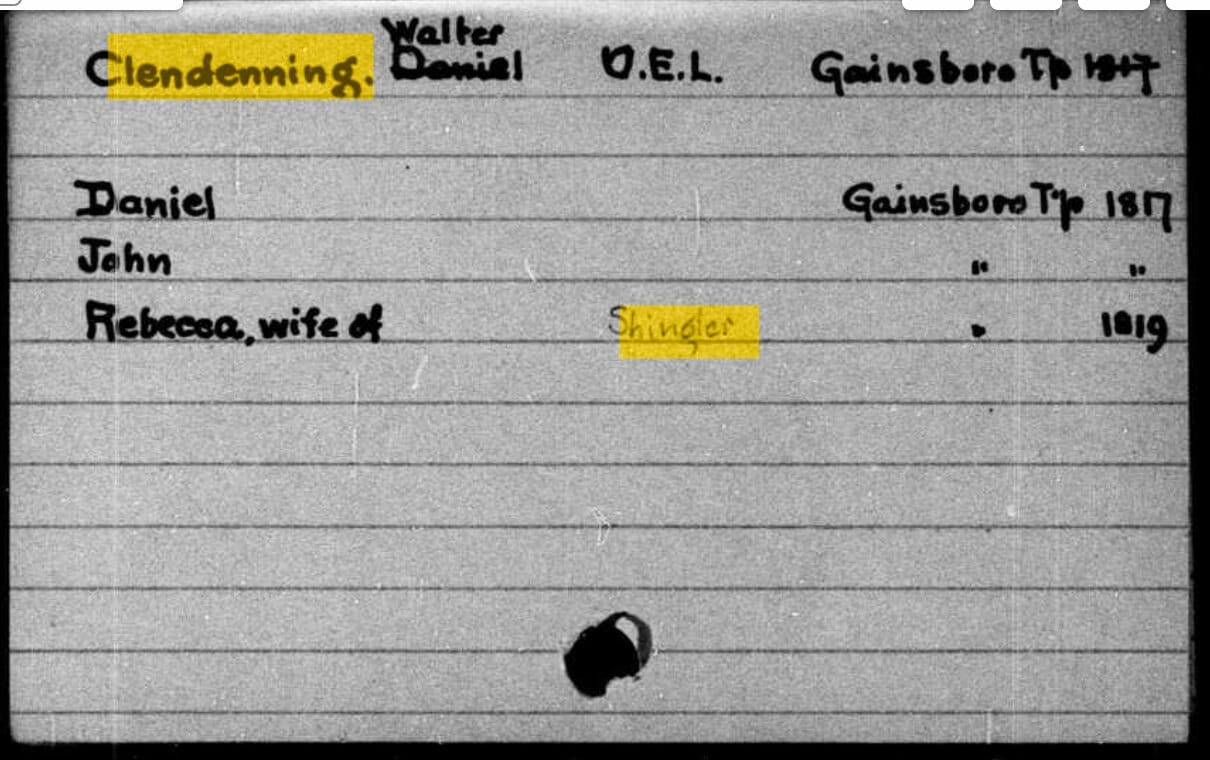
Once the land had spoken, the lesser records fell in behind it, as they usually do. The Crown Lands Department kept its own card index of Loyalist families, and the card for Clendenning, Walter, U.E.L., Gainsboro Tp lists his children with their years: Daniel, 1817. John. Rebecca, wife of Shingler, 1819. The clerk who wrote that card knew in 1819 whom Rebecca had married, which the petition, sworn in January, did not yet know. A Lincoln County deed book, read this week, supplies the other half: a memorial registered on the twenty-fifth of March 1819 on the oath of William Shingler, who had witnessed the deed as William Shingler of the Township of Gainsborough, Yeoman. In the first months of 1819 the unmarried Loyalist’s daughter and the young yeoman were in the same small township, and by the time the card was written she was his wife. The marriage register has not been found, and in a Niagara township of that decade, married by whichever itinerant came through, it may never have been written.
Two Michigan death certificates had said as much all along, in the way such certificates do. When Rebecca’s daughter Sarah died at Detroit in 1926, aged ninety-eight, the informant gave the mother as Rebecca Clendenny; when Jeremiah died at Vassar in 1910, his father was Wm. Shingler and his mother Rebecca. Both certificates also said Rebecca was born in Pennsylvania, and this is where the received story and the records part company. The informants were grandchildren guessing at a great-grandmother; the petition has the woman herself, at twenty-one, in a township her family had held since the 1780s. The documents disagree, and the one she swore to wins.
The caution I owe the reader runs the other way. There was a second Rebecca Shingler in Lincoln County, at Grimsby, in the censuses of 1861 and 1871, and for a week this autumn the record hints wanted her to be ours. She was not. Her own household and her mortality-schedule entry describe a different woman, and the land records exclude her. Two women of one name in one county is the ordinary condition of Ontario research, and the only cure for it is a record that cannot belong to both.
The father
Walter Clendenning was born about 1763 and served, as he put it himself in a petition received at Newark in July 1795, as a Private in Butler’s late Rangers. He had taken up two hundred acres and wanted more, being married to the daughter of Jacob Walker, another Ranger, with three children. The Archives of Ontario’s own index card for him says the same in four words: m. a dau. of Jacob Walker. Her given name is not recorded anywhere I have found. Her sister Ann is, in a petition of April 1797 by Ann’s husband, which calls their father the late Jacob Walker, who served during the American War in Butler’s Rangers and died in this settlement. So Rebecca’s grandfathers on both sides had carried muskets in the same regiment.
Butler’s Rangers needs a gloss for readers south of the lake. It was the Loyalist corps raised at Fort Niagara in 1777 by John Butler of the Indian Department, and it fought the frontier war in the Mohawk, the Susquehanna and the Wyoming valleys, with a reputation on the American side that has not softened in two centuries. Walter’s father James Clendenning had gone into it with three sons from Hardwick Township, Sussex County, New Jersey, and came out of the war at Twelve Mile Creek on the Niagara. James’s widow, also a Rebecca, petitioned in 1797 as widow of James Clandennin, deceased, late a Soldier in Butler’s Rangers, and named her children: John, Abram, Walter, Ann, Eva.
Hardwick is the detail that stops me. Sussex County, New Jersey, in the 1770s, was the Reverend Jabez Collver’s county: the Beemer Meeting House, the Kittatinny ridge, the townships this blog walked through in its first months. Two Sussex County families chose the King. One went north to the Niagara and the other to Long Point, and their roads did not cross again until a June afternoon in Flint in 1947.
The grade
This blog grades its claims, and the family’s genealogies did not, which is most of the difference between us. Rebecca, wife of William Henry Shingler, was the daughter of Walter Clendenning, United Empire Loyalist, private in Butler’s Rangers now stands at proven: a primary record says so at every link, from her own oath to her father’s loyalty, through the Crown’s location and patent, to her own sale of the lot under her married name with the justices watching. The DNA agrees, which is pleasant but was not needed: fourteen of the family’s autosomal matches descend from Walter through sons other than Rebecca, five of them above twenty centimorgans.
Her mother’s given name stands at unknown. Her marriage stands at supported, bracketed between an oath in January 1819 and a clerk’s card the same year. Her birthplace stands where the records put it, in the Niagara peninsula, with the certificates’ Pennsylvania set aside as the informants’ guess. Nothing in this post rests on a family tradition. The family had none; it had a first name, and the first name was right.
What it means now
The book’s chapter on Albert Sr. has a new paragraph this week, inserted where he sits down at the table with his bride’s people. It says, in fewer words than this, that she brought a Loyalist line of her own to the table and nobody at it knew. I held the paragraph for ten days, because a sentence like that in a family history is exactly the kind of sentence that gets printed on no better evidence than a surname and a wish, and I wanted the land to say it first.
The land has said it. Jane Ellen Cregar Collver, who died in 2005, descended from two privates of the same Loyalist regiment, and her husband from the Reverend Jabez Collver, who chose the King at the same hour in the same New Jersey county. Their grandchildren carry both. The granite at Windham says U.E. Loyalists over one family; the Crown’s clerk wrote D U E on the back of a petition for the other; and the two abbreviations, with their two centuries between them, turn out to describe the same table.
Sources.
- Upper Canada Land Petitions (Library and Archives Canada, RG 1 L 3): Rebecka Clandenning, “C” Bundle 11, no. 224, received January 1819, with the Council docket of 27 January 1819; Walter Clandenning, received 17 July 1795, “C” Bundle 1, no. 66; Rebecca Clandennin, widow of James, 10 July 1797, “C” Bundle 3, no. 29b; Abraham Mallat, Newark, 15 April 1797, “M” Bundle 3, no. 131.
- Ontario Land Records Index (Archives of Ontario, 1979; Ontario Genealogical Society, Toronto Branch, digitization): nominal fiche, Clendenin, Rebecca, Erin, lot 22, con. 2, O.C. 27 Jan. 1819, D.U.E.
- Abstract Index to Deeds, Township of Erin, concession 2, lot 22 (Wellington County Land Registry Office; OnLand historical books, book 152): patent 2 May 1837 to Rebecca Shingler; bargain and sale 28 Feb. 1838, William Shingler and Rebecca his wife to John Awrey.
- Halton County Registrar of Deeds, land records 1803–1881, memorial book L, no. 87, registered 3 March 1838 (FamilySearch film 179009, images 62–63), with the justices’ certificate of Rebecca’s separate examination.
- Wellington County register of land patents, Erin, con. 2 (FamilySearch, “Wellington, Ontario, Land Patents 1798–1875”).
- Lincoln County deed copybook, memorial no. 5569, registered 25 March 1819 on the oath of William Shingler of Gainsborough, yeoman (FamilySearch, “Lincoln. Deeds 1815–1817,” image 315).
- Archives of Ontario name index and Crown Lands U.E. card index, cards for Clendenning, Walter (FamilySearch, “Ontario. Miscellaneous Records 1780–1869,” images 772–773).
- William D. Reid, The Loyalists in Ontario: The Sons and Daughters of the American Loyalists of Upper Canada (Lambertville, N.J., 1973), 66–67.
- Michigan Death Certificates: Sarah Merithew, Detroit, 20 July 1926; Jeremiah Shingler, Vassar, 1910.
- Censuses of 1861 and 1871, Grimsby, Lincoln County (the other Rebecca Shingler, excluded).
- We Are Doves, chapter 13, “The American Returns,” new paragraph of 10 October 2026, and the full proof log in the family’s research files.
© 2026 Albert B. Collver III. Written for the Collver Family History Project.