Big John
A cousin asked whether the living generation remembers John Milton Collver, who died in 1955. My father remembered two things: what the grandchildren called him, and a winter. A border card and a newspaper did the rest.
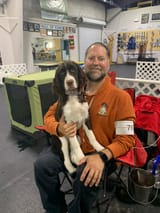
This summer a cousin in Michigan, a descendant of John Milton Collver by another line, wrote with three questions. Two of them could be answered from paper: where the old man had been during the years he seems to vanish, and whether he ever really went out to Saskatchewan. The third could not. “Given that he died in 1955,” he asked, “are there any stories that the living generation recalls about him?”
A family historian can answer most questions with a library card. That one has to be answered with people. So I put it to my father.
Two things came back. The first was a name. The second was a winter.
The name
John Milton Collver was born in Woodhouse Township, Norfolk County, Canada West, on the ninth of August, 1861, six years before there was a Canada to be born in. He crossed to Michigan in 1887, farmed the stump country of Clayton Township in Arenac County, married four times and outlived all four wives, and spent the rest of a very long life going back and forth across the border as if it were a county road. He is my great-great-grandfather. To my father, he was something simpler.
“They called him Big John,” my father said. “And the grandchildren called him Big Grandpa.”
It is the only personal description of the man that the family kept. No letter describes him; the photographs, if there were any, have not come down to us. A name like that invites a picture, and the picture comes ready-made: a big man, broad in the doorway, the kind of farmer who lifts the back of a wagon himself.
Then the paper answers back. On the twenty-seventh of October, 1943, the immigration station at Detroit filled out a card on him as he crossed into Michigan one more time. It is the most detailed portrait of him that exists, and the clerk wrote it in capitals:
COLLVER, JOHN MILTON . . . accompanied by: ALONE . . . SIMCOE, ONTARIO, 8-9-61 . . . 82 yrs 2 mos . . . W . . . RETIRED FARMER . . . Height 5 ft 7 in . . . Complexion MED. . . . Hair GREY . . . Eyes BLUE
Five foot seven. At eighty-two a man has lost an inch or two, so he may have stood five foot eight or nine in his prime. That is an ordinary height for a man born in 1861. It is not big. His son Daniel’s draft card, filled out in 1917, describes a young man “of short build,” which suggests the family did not run tall.
It would be easy to set the card against the family and call one of them wrong. Neither is. The card is right about his height, and the family was never talking about his height. The second half of what my father remembered explains the first. If the great-grandfather was Big Grandpa, then somewhere in the same family there was a Grandpa who was not big, and there was: Daniel, his son, my father’s own grandfather. “Big” did not measure the man. It ranked him. In farm families the word has long done that work, sorting the elder from the younger of two people who share a name or a place at the table. There was another John in the family as well, Daniel’s eldest son, John William, born in 1918. The old man was Big John and Big Grandpa because there were two of each, and he was the senior one.
So the nickname gives us more than the card could. It does not tell us what he looked like. It tells us that four generations were alive at once, close enough that the children needed a way to say which grandfather they meant. A height is a fact about one man. A name like that is a fact about a whole family.
The winter
The second thing my father remembered is harder, and I will give it as he gave it to me.
At noon on Monday, the twenty-fourth of January, 1955, Big John’s son Daniel was carrying the mail out of Munger, as he had for years. Near the corner of Russell Road and Knight Road his jeep went off the road. The Bay City Times ran it on the front page the next day, in a box counting the county’s road deaths for the new year: “Daniel Collver, Sr., 61, Munger rural mail carrier,” killed “when his mail-carrying jeep overturned into a deep ditch along Russell road near Knight road Monday noon.” The Detroit Free Press added the weather. The jeep had “skidded on a snow-covered road.”
That is what the newspapers knew. Here is what they did not know.
The family’s forty acres backed onto Russell Road. Daniel had gone into the ditch at the back line of the farm, one field away from the house. That afternoon two of his sons, my grandfather Albert, whom everyone called Butch, and his brother Dan, walked out across the snowy field to see the place and the jeep before anyone hauled it away. A small boy at the house wanted to go with them. They would not take him. He stayed behind.
The boy was my father. He was six years old, five months short of seven. He tells it as seven, as children do when they count by the year and not by the birthday, and it does not matter. He has kept that field, that snow, and the door that closed on him for seventy-one years.
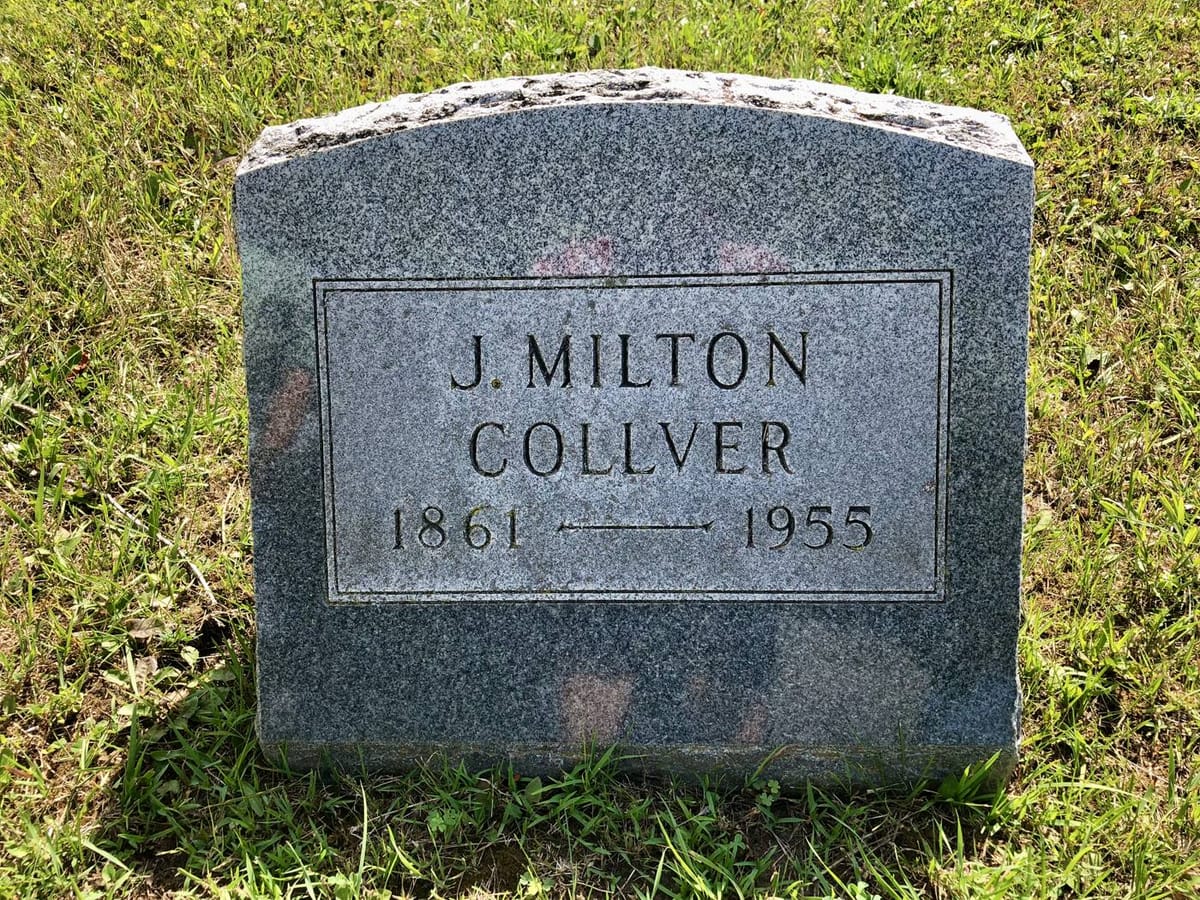
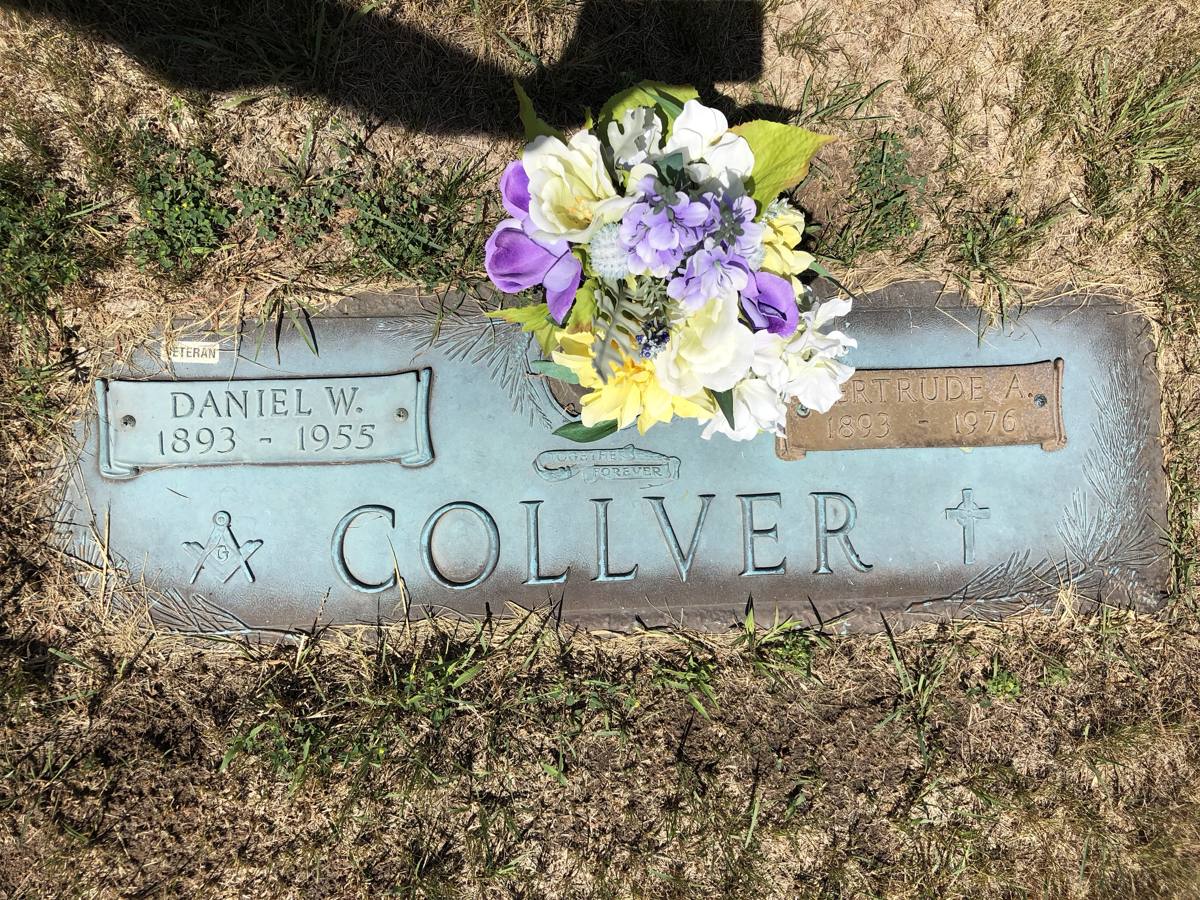
Big John was ninety-three that winter. He had already outlived four wives and his eldest son, Clark, who died in 1951. Now he outlived Daniel too. He died at Bay City on the fifth of June, 1955, four months and twelve days after his son, and was carried back to Clayton Cemetery at Melita, in the township where Clark and Daniel were born. The stone reads J. MILTON COLLVER 1861–1955. Daniel lies a county away, at Floral Garden in Portsmouth Township, under a bronze marker with the square and compasses of his Masonic lodge beside his name. The emigrant and his son were buried the same year.
The seam
Set the two kinds of source side by side and look at what each one holds.
The paper gave us the date, the hour, and the road. It gave us the ditch, the snow, and the man’s age. It gave us a height, a hair color, the color of his eyes. The family could not have given us any of that with certainty. My father’s own memory moved the year of his age by one.
The family gave us the nickname, the field, and the boy left at the house. No newspaper knew that the ditch lay at the back of the family’s own land, or that two sons walked out to it across the snow. No clerk at Detroit could have written down what the grandchildren called the old man, or why.
Neither source is the story. The story is in the seam where they meet. It took a card filled out at a border station in 1943 to show what the nickname really meant, and it took my father to show that Russell Road was not just a road. Family historians sometimes speak as if the documents were the facts and memory the decoration. In this case each one corrected the other, and each one needed the other to make sense.
The question
None of this was written down until this summer. It was not in the family papers, and it was not in the book’s first draft. It lived in one man’s memory, and it came out because a cousin I had never met asked the right question in the right words: what does the living generation remember?
I would put the same question to you. Somewhere in your family is a person who remembers what the old people were called, which field the brothers crossed, who was not allowed to go. The records will keep. They have kept for a century and a half in courthouse basements and on microfilm, and they will be there next year. The memory will not keep. Ask while there is someone to answer.
My father answered. Big John has been dead for seventy-one years, and on a Monday in 2026 he is still the senior of the two.
Sources
- Oral history: Albert B. Collver Jr., told to the author, 20 August 2026 (the nickname “Big John” / “Big Grandpa”; the field crossing, January 1955).
- U.S. Card Manifests, Port of Detroit, 27 Oct. 1943, John Milton Collver (NARA M1478; Ancestry db 1070), read from the card image.
- World War I draft registration card, Daniel William Collver, Sherman, Wexford Co., Michigan, June 1917.
- The Bay City Times, 25 Jan. 1955, p. 1; Detroit Free Press, 25 Jan. 1955, p. 25 (“Crash Kills Mail Carrier”).
- Find a Grave memorial 39096142, Clayton Cemetery, Melita, Arenac Co. (J. Milton Collver, b. 9 Aug. 1861, d. 5 June 1955, Bay City); township cemetery listing, photographed by the author, 2018.
- Daniel W. Collver marker, Floral Garden Cemetery, Portsmouth Twp., Bay Co., photographed for the book.
- The fuller account is in chapter 12 of We Are Doves.
Adapted from the forthcoming book We Are Doves, chapter twelve. © 2026 Albert B. Collver III.