Corrected in the Editing
Before a book goes to press, someone has to go back and check every source again. In this one that check overturned a wedding date, a newspaper, a head count and two of my own corrections.
In three weeks I will tell you that the book is finished. The most important work of the last four months is invisible on its printed page.
Once the chapters were drafted, I went back through every one of them with a single rule: no quotation stands unless it has been read against the page it came from, and no claim stands without its grade. Proven means a document says it. Probable means the documents point to it. Tradition means the family said it and nothing yet confirms it. Every footnote was checked against its source, every transcription against its image where an image exists, and nothing was allowed to survive because it sounded right.
That pass changed the book.
A correction that needed correcting
The first catch was a correction of my own. In July a revision pass “fixed” the book to say that Jabez Colver was held after his 1777 arrest in the new jail at Newton, and that my earlier post on the Log Gaol had been wrong to leave the question open. The double-check caught it. The blog had not been wrong. No record says where Jabez was held, and the post had said exactly that. The book went back to the careful version.
It happened again with a number. “Set Up the King’s Standard” printed the acreage of Jabez’s land at the great pond as 163.98 acres. A later round of corrections to that post changed it to 163.68. When the deed itself was examined at high magnification (registry book G3, page 506), the word was ninety and the figure was 163.98 after all, so the post was corrected back.
The double-check has to be turned on your corrections as hard as on your sources. An eager fix can be worse than the thing it fixes, because it carries the authority of looking like diligence.
The confident negative
The most dangerous sentence in research is “it isn’t there.”
A research pass reported that the 1777 Sussex court term had also convicted Nathaniel Pettit, the judge whose family appears in Jabez’s own story. I read part of the court’s minute book, did not find him, and declared the report an invention. Then I found the account of Pettit’s imprisonment and split the difference. Then the New Jersey Council of Safety minutes for July 1777 settled it: Nathaniel Pettit was among the “Persons duly convicted and fined & Imprisoned by the Court of Oyer & Terminer, at the late Session, at Newtown.” (Oyer and terminer, “to hear and determine,” was the court that tried the cases.) He was convicted at the same term as Jabez. The first report had the fact right. It took an over-claim, an over-correction and a third document to land it.
The same thing happened twice more in the appendices. Two phrases had been struck from the book as inventions: a will clause about “Marcy Hill, that land given by deed of gift,” and the last words of a church history’s sentence, that seven new members were received “into full communion with the church.” Both were real. On the printed page, the will clause is in the Calendar of New Jersey Wills, volume six, page 87, and the church phrase ends the sentence in Clement Heverly’s account of the Wysox church. The earlier checks had used transcriptions that stopped short. Both phrases went back in.
A confident negative is as dangerous as a confident invention. In every one of these cases, somebody stopped reading.
A true fact in the wrong year
The book once said that Jabez, the convicted Tory preacher, performed the wedding of one of the King’s officers during the war. The source was a family website, quoting E. Alfred Jones’s The Loyalists of New Jersey without a page.
Jones’s book is now online, and on page 32 he says it plainly: “James Brittain married Eleanor Butler, at Knowlton, Sussex county, New Jersey, on February 24, 1773, the marriage ceremony having been performed by the Rev. Jabez Collver.” The date is 1773, two years before Lexington, and on the same page Jones says Brittain became an ensign in the Loyalist New Jersey Volunteers in 1779. Jabez performed the wedding of a young man of his own county who later took the King’s commission. The groom was not yet an officer.
Every piece of the old sentence was true: the preacher, the groom, the commission. Put in the wrong order, they told a false story.
A file name is a claim
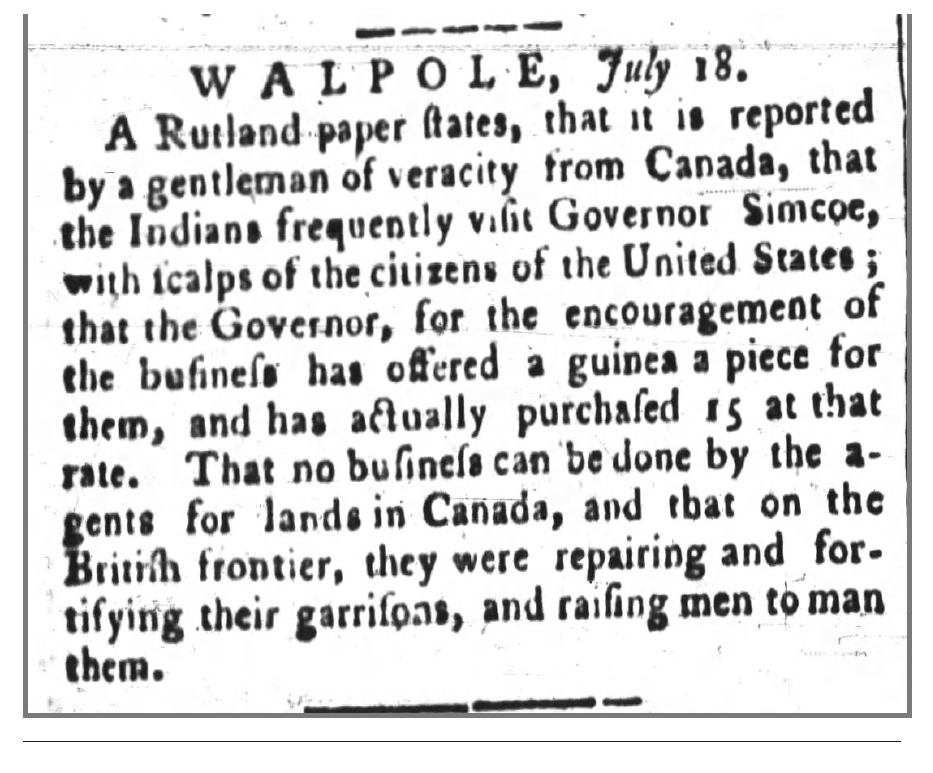
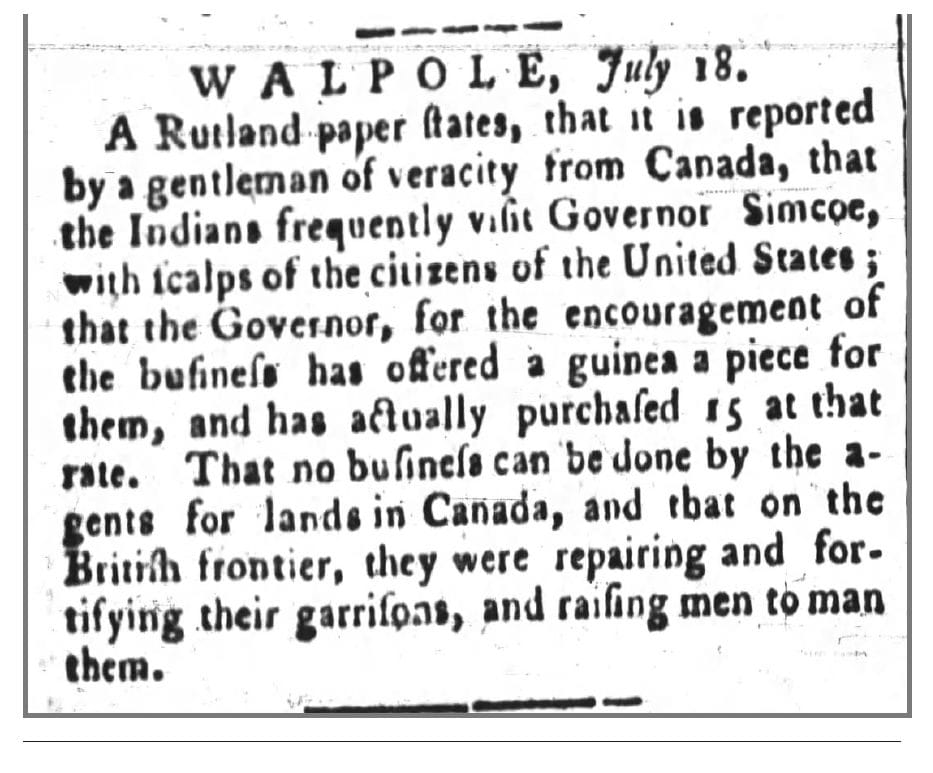
In my clipping file, the 1794 newspaper report behind the family’s scalp legend was labeled as the “Rutland” paper, and the book’s notes treated it as the Walpole, New Hampshire, printing. When the clipping was looked at again, the masthead was neither. It is The State Gazette of North-Carolina, printed at New Bern on 15 August 1794, carrying the story under the dateline “WALPOLE, July 18.” What I had was a reprint of a reprint, hundreds of miles from where the story began.
A photograph labeled “old windham church” turned out, by the location stored inside the image file, to have been taken at Old Woodhouse. Labels are written by people in a hurry, and they are claims like any other.
Counting what is there
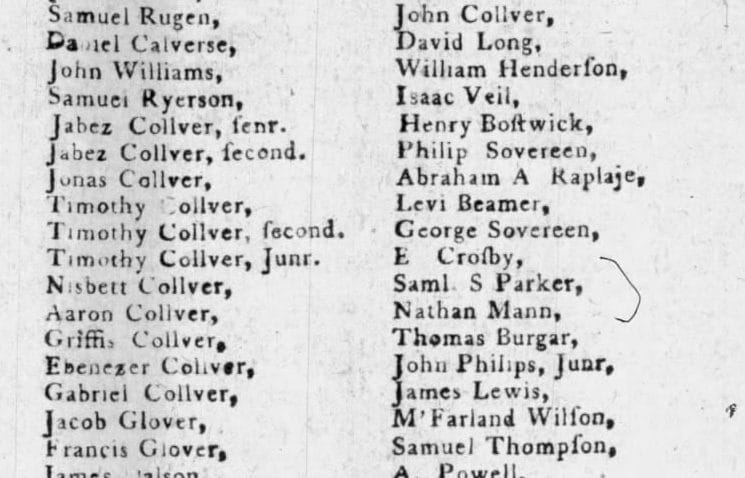
The book once said that the loyal address the men of Norfolk sent the lieutenant governor in 1809, with fourteen of the family among its signers, carried approximately 175 names. When the transcription was counted name by name and checked against the full page of the newspaper, the number was 230. The fourteen family names were exact. The total around them had been a guess.
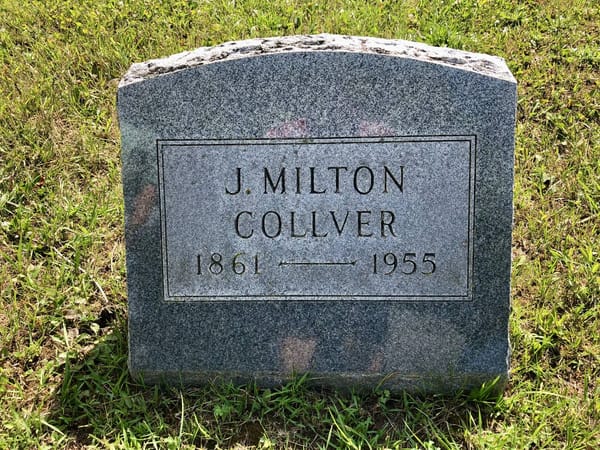
A related case: the cemetery typescript at Old Windham reads John Collver’s stone as 1765 to 1831. But John wrote to Francis Walsh, one of the county’s officials, in September 1832, inviting him to a meeting. So the letter overrules the copy of his gravestone, and the birth year falls with the death year. The book gives him 1768 to 1834.
Not online last year
When I began, the original 1777 indictment of Jabez and the Sussex court’s minute book were, as far as I knew, not digitized. Only a typed abstract had reached us. Then I looked again. The New Jersey State Archives had posted both in late 2024 and early 2025: the case file with the indictment itself, signed by Attorney General William Paterson, and the whole term’s rough minutes. The book now quotes the indictment’s own words, read against the manuscript.
A search that came up empty is worth running again next year.
What readers caught
Some of the best corrections came from you. A reader’s question about wills sent me to the Ontario death registers, which showed that Isaac Kitchen, “the oldest Mason in Norfolk County,” died in January 1916, not 1917 as a published Loyalist history had it. The family genealogies then placed him as a grandson of Jabez Jr. Both posts that named him were corrected the same week, audio included. Another reader’s letter identified a man in a census whom I had said I could not place, and the correction went up under the post.
Why I am proud of this list
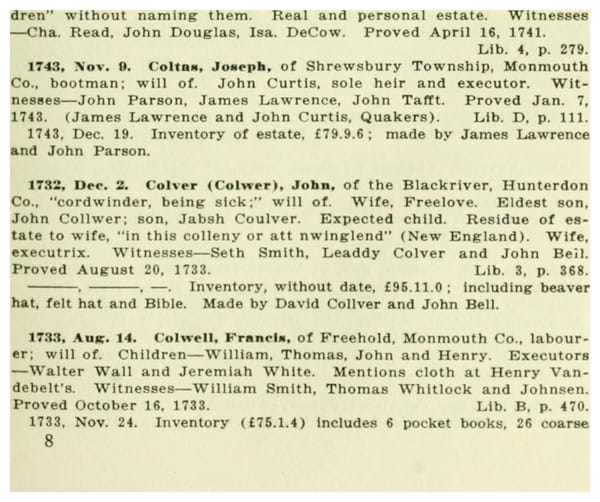
None of these corrections is embarrassing to me, and I hope none of them shakes your confidence. They should do the opposite. A family history that has never been corrected has not been checked. The ones that sit unquestioned on library shelves for a century, like the 1910 genealogy that gave us a Saxon ancestor named Kolver, were not wrong because their writers were careless. They were wrong because nobody went back.
So when the book comes out next month, it will carry its corrections in the open: in the footnotes, where a disagreement between sources is stated rather than smoothed over, and in the grades on every claim. And when you find the next one, as some of you will, write to me. It will go in the ledger, with your help acknowledged and the date beside it.
Sources
- Nathaniel Pettit’s conviction: Minutes of the Council of Safety of the State of New Jersey (Jersey City: John H. Lyon, 1872), July 1777.
- “Marcy Hill” clause: Calendar of New Jersey Wills, vol. VI, 87. Wysox: Clement F. Heverly (as cited in the book’s Appendix B).
- Brittain–Butler marriage: E. Alfred Jones, The Loyalists of New Jersey (Newark: New Jersey Historical Society, 1927), 32–33 (New Jersey State Library digital repository); William S. Stryker, The New Jersey Volunteers (1887).
- The 1794 clipping: The State Gazette of North-Carolina (New Bern), 15 August 1794, 2.
- The 1809 address: York Gazette (York, Upper Canada), 6 December 1809.
- The acreage: Sussex County deed book G3, 506 (registry copy).
- John Collver to Francis Walsh, 23 September 1832, Norfolk Historical Society Collections, 2961–62.
- State v. Jabez Colver, 1777, New Jersey Supreme Court case files, and the Sussex Oyer and Terminer minutes, New Jersey State Archives.
- Isaac Kitchen: Ontario death registration 1916, no. 23646.
Adapted from the editing of the forthcoming book We Are Doves. © 2026 Albert B. Collver III.