A Hat, a Belt, and a Bible
For years I told people a Collver will had left a son a hat and a belt. The will says something else. What my own memory did to it, in one generation, is the best lesson I know for reading a family's stories.
For most of my adult life I told people, and would have sworn to it, that somewhere back in colonial New Jersey there was a Collver will that left a son a hat and a belt. I liked the detail. It had the ring of the eighteenth century about it, the poverty and the dignity of a man’s whole estate reduced to what he could wear. I repeated it for years.
Then, in the second year of this project, I finally read the will.
Beaver hat, felt hat and Bible
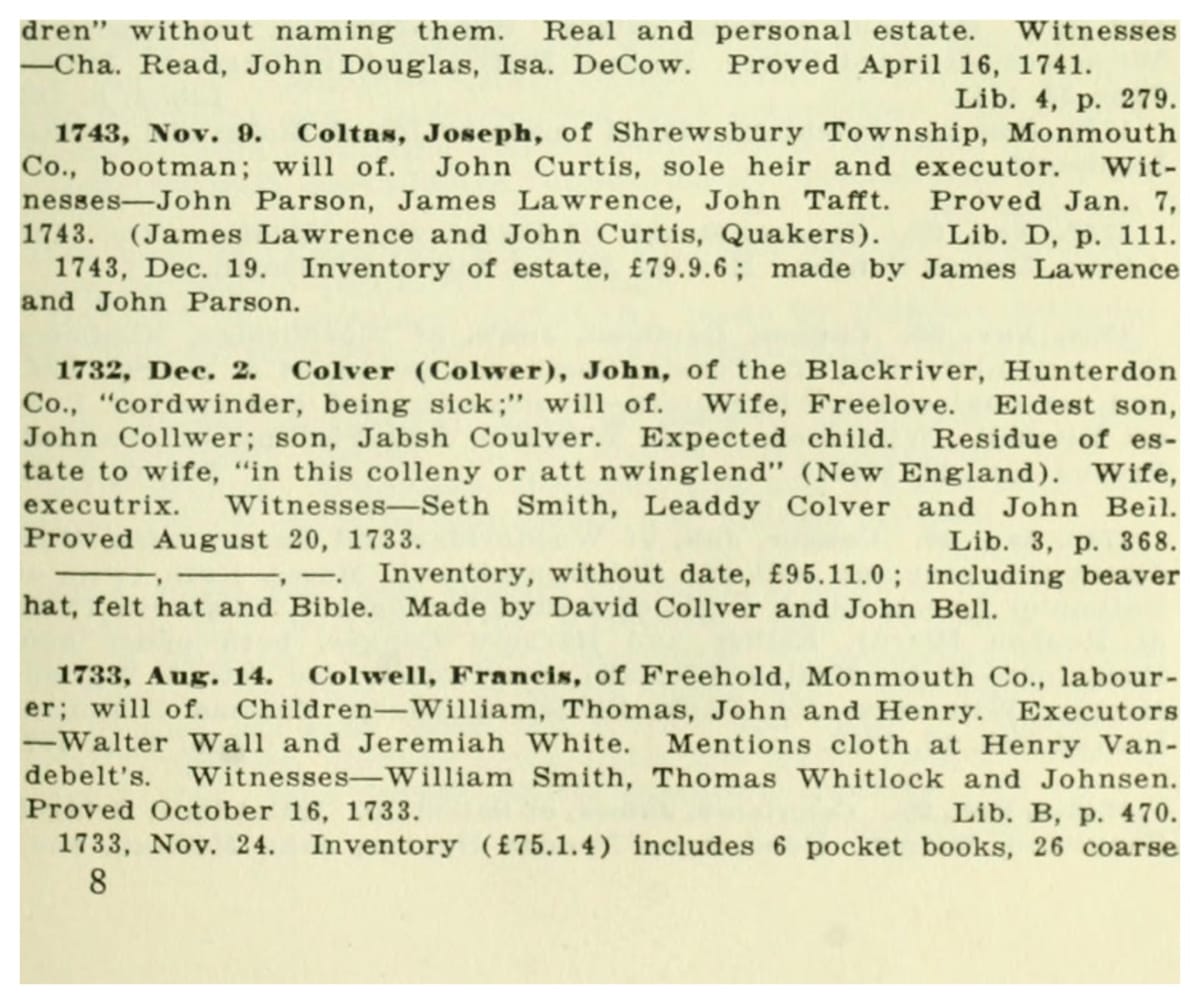
On the second of December, 1732, at Black River in the hills of northwestern New Jersey, John Colver lay sick and made his will. The printed calendar of New Jersey’s colonial wills preserves the abstract. He was a “cordwinder,” the clerk’s spelling of cordwainer, a worker in fine leather, a shoemaker as distinct from a cobbler who only mends. He was my seventh-great-grandfather. His son Jabez, the future preacher and my sixth-great-grandfather, was seventeen months old, and the scribe wrote him down as “Jabsh.”
The will was proved the next August. The appraisers counted the dead man’s goods at £95 11s., and the calendar gives one line of what they found: “including beaver hat, felt hat and Bible.”
There is no belt.
Wrong consonants, right objects. My hat came through the telling intact. My belt did not; it was most likely the Bible, though the felt hat, by sound alone, is the other suspect, worn smooth by fifty years of retelling. And what stopped me was not the error. It was the speed of it. This was one generation, a detail I cared about, and a document I could have looked up at any time. If my own memory could do that to a will in my own lifetime, I had no business scolding the family for what three centuries had done to theirs.
There is a second thing I have always done with that Bible, so quietly that I did not know it was a guess until I sat down to check myself. The dying man owned a Bible. His infant son grew up to be a minister. Somewhere in me, for as long as I can remember, those two facts have joined into a third: that the book went down to the fatherless boy, and that a Bible in an orphan’s hands had something to do with the pulpit he found. I cannot prove a word of it. No record follows that Bible to a shelf. The will does not say who got the Scriptures. It is a true object, a real outcome, and a bridge between them that I built myself, out of hope. I keep it here, in the open and labeled, because that is the only honest place for it. It is not a fact. It is a wish with a pedigree.
Memory composes
Once I had caught myself, I went looking for the pattern in everyone else, and it was not hard to find.
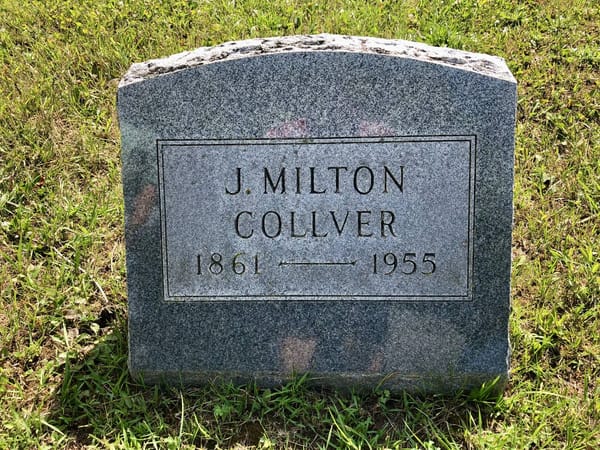
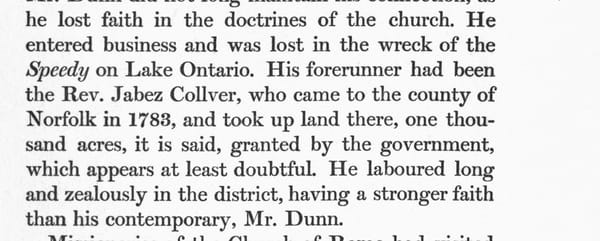
The family said the Crown gave Jabez three thousand acres in Upper Canada. The Order in Council of the fourteenth of June, 1794, gave him one thousand in his own right, with two hundred more for each son who came in with him. The family said he was born in 1739. The probate records put his birth on the nineteenth of June, 1731. The family said he died in 1812. He died on the twenty-ninth of December, 1818, aged eighty-seven. My great-great-grandfather John Milton Collver was remembered as having gone home to Ontario to be buried, and there is a stone with his name on it at Woodhouse. It is a cenotaph, a memorial over an empty grave. He lies in Clayton Cemetery in Arenac County, Michigan.
Set those side by side and notice what the errors have in common. Not one of them is random. The dates drift toward rounder numbers, the acreage toward a grander one, the burial toward the beloved town. Memory does not simply decay. It composes. Every error is an improvement, by the lights of whoever made it, which is exactly why each was carried so faithfully, and exactly why none survived contact with a document.
The three thousand acres teaches the second half of the lesson. In 1916 someone in the family printed an eleven-page pamphlet of our genealogy, the little document I wrote about here in July. Its punctuation is a compositor’s bad dream, and the family has always loved it without quite believing it. On the grant, it says one thousand acres. When I checked the disputed figure on the scan at eight hundred percent magnification, it was a plain 1. The pamphlet, written within one long lifetime of the elders who had known the pioneers, had it right, while the confident later tellings tripled it. And one of those later tellings was this project’s own: an early post on this blog repeated the three thousand, and the same check caught it. The auditors are not exempt from the audit.

Where memory beat the map
So far this sounds like a case against memory. It is not, and the rest of my own childhood list is the reason.
I remembered, from family talk, that there was a Collver’s Gap, spelled our way, somewhere in New Jersey. The maps say Culvers Gap, and I was ready to write my memory down as one more warm improvement. Then a Sussex County directory of 1872 turned up: “Collver’s Gap, a beautiful pass through these mountains, is situated between Long and Collver’s Ponds, on the stage road from Branchville to Port Jervis.” Double L, our spelling, in county print. By 1888 a county historian had already made it Culver’s. It was the maps that had drifted, and the family that had kept the spelling.
I remembered the German neighbors of the New Jersey years as the Hahns. The records of Pleasant Grove spell them Hann, and I assumed my memory had added a letter. Then I read the family’s own genealogy in Theodore Chambers’s Early Germans of New Jersey (1895): the name was “originally Henn and Hahn.” Hahn is German for a rooster; the New Jersey clerks wrote down what they heard, as they did for us. My memory was one aspirated h from the record, and the record admits that the h was there in the beginning.
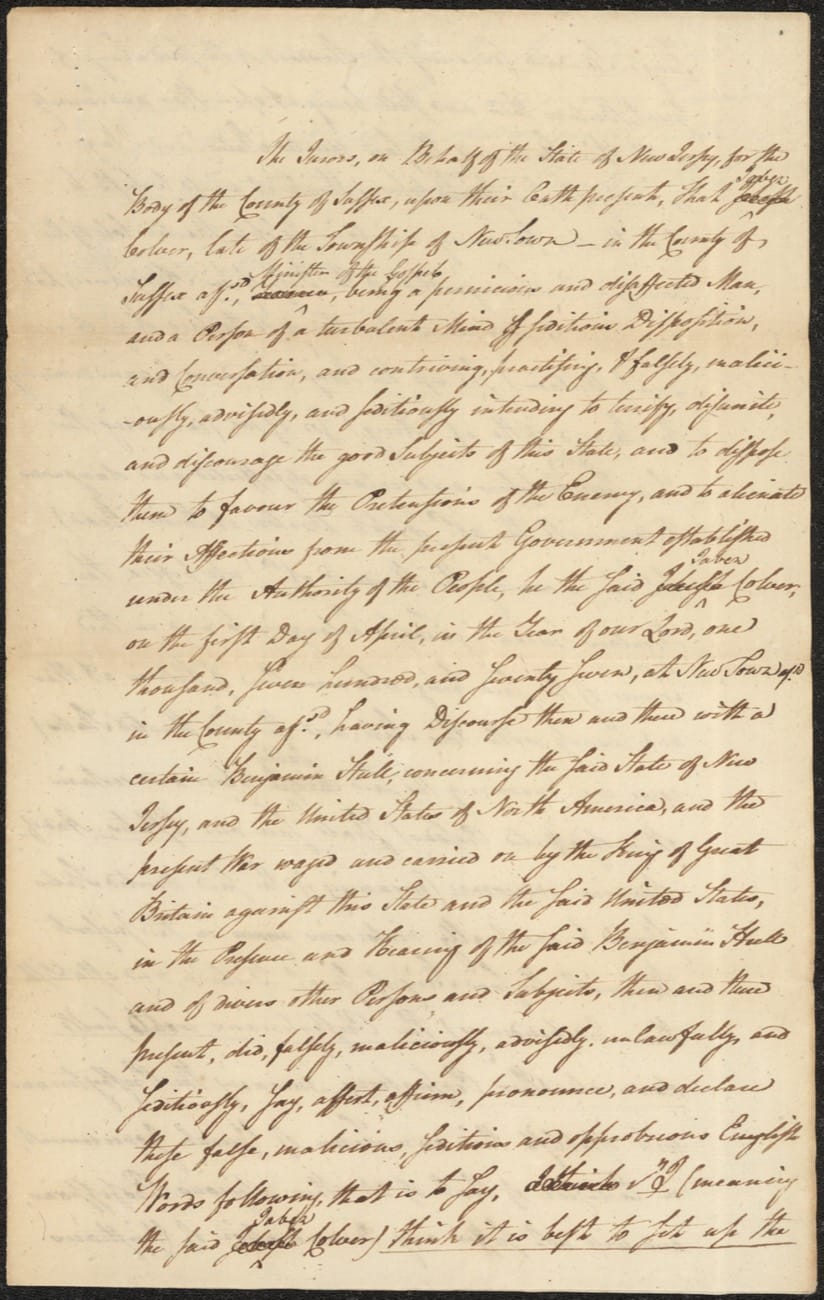
And the vaguest thing the family ever whispered was that someone had informed on the old preacher, that his trouble with the Patriot authorities in 1777 began with a neighbor’s word. No name came with it. When the indictment in State v. Jabez Colver finally came up from the New Jersey archives, it named a witness to the seditious words spoken in conversation that April: Benjamin Hull. The whisper had kept the fact and lost the man, and the paper gave him back.
The method on one page
This is the whole method of the book, as plainly as I can put it, for anyone with a shoebox of stories of their own.
Treat every family story as a hypothesis. Do not take it as gospel, because gospel cannot be tested, and a story that cannot be tested can never be confirmed. Do not throw it out as garbage either. In this family’s whole audit I found no story that was pointing at nothing.
Climb the ladder. Tradition, then print, then record, then document. A story is testimony. A printed genealogy is testimony organized. A census line or a will abstract is the past’s own bookkeeping. A paper in the ancestor’s hand, or sworn before a court, is the bedrock. Climb as high as the surviving paper allows, and say plainly which rung you stopped on.
Grade in the open. Proven, probable, tradition, and never let one pass for another. The temptation to promote a “probable” for the sake of a smoother paragraph is the occupational disease of this work. I have caught it in myself more than once.
When a story fails, ask what it was pointing at. A false grand acreage pointed at a true grant. A false belt pointed at a true Bible. Your grandmother’s story is likely wrong the way a compass is wrong, by a few degrees, not by a hundred and eighty. Correct for the drift. Keep the compass.
And write down your own version now, dated, before you research a word of it. Your memory is composing too, and the version you hold this morning is itself a document, the newest entry in the very tradition you are about to check.
The family remembered better than it knew
Score the family’s memory honestly, then. It lost nearly every date it was given. It inflated the acreage, buried a man in the wrong country, and turned a Bible into a belt. And it kept, across three centuries and two migrations and an international border, the spelling of a mountain pass the maps had forgotten, the name of the German family at the next farm, and the whisper of the man who testified. Not one of its stories was exactly true. Not one of them was empty.
The family remembered better than it knew. Most of the labor of this project has been nothing grander than sitting down with that memory, treating it as an honest, aging, essential witness, and checking.
I still think about the hat and the belt. I told that story wrongly for decades, to people who trusted me, and I would rather confess it here than have a cousin find the will and wonder what else I had polished. If you have a story like it, and every family does, write your version down tonight. Then go and find the paper. It will be wrong. It will be pointing at something. Both, I have come to think, are gifts.
Sources
- Will of John Colver of Black River, Hunterdon Co., 2 December 1732, proved 20 August 1733; inventory £95 11s. “including beaver hat, felt hat and Bible”: Calendar of New Jersey Wills, Administrations, Etc., vol. II (1730–1750) (1918), 105; original Liber 3, p. 368, New Jersey State Archives.
- Jabez Collver’s petition, 11 June 1794, and the Order in Council of 14 June 1794: Upper Canada Land Petitions (Library and Archives Canada); Land Book A, p. 161.
- The Collver-Culver Genealogy, 1630 to 1916 (privately printed, 1916), 11 pp., the grant figure read on the scan at 800%.
- Edward A. Webb, The Historical Directory of Sussex County, N.J. (1872), 25 (Frankford township).
- Theodore F. Chambers, The Early Germans of New Jersey (Dover, N.J., 1895), the Hann family.
- State v. Jabez Colver, Sussex Oyer and Terminer, 1777, New Jersey Supreme Court Case Files no. 34547.
- John Milton Collver’s grave: Clayton Cemetery, Melita, Arenac Co., Michigan; the Woodhouse stone is a cenotaph.
Adapted from chapter fourteen of the forthcoming book We Are Doves. © 2026 Albert B. Collver III.