Divided Again
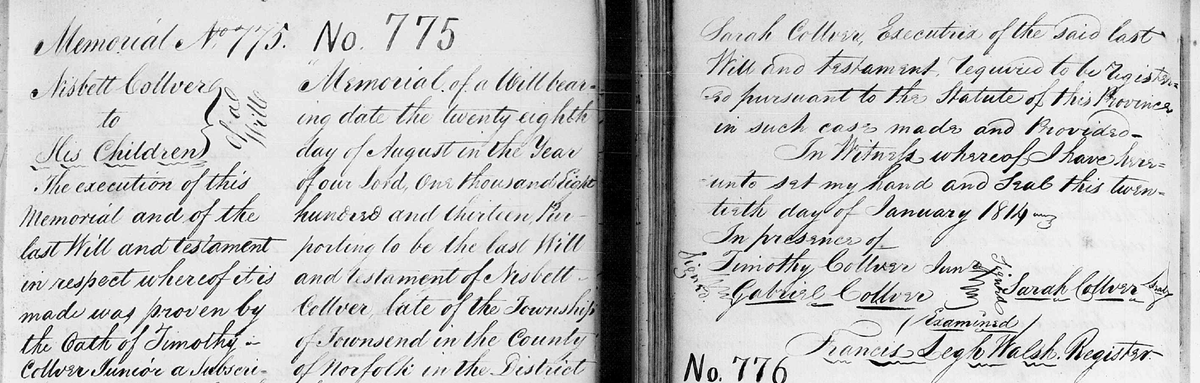
On the twenty-eighth of August, 1813, in the second summer of the war, Captain Nesbitt Collver of Townsend township sat down and made his will.
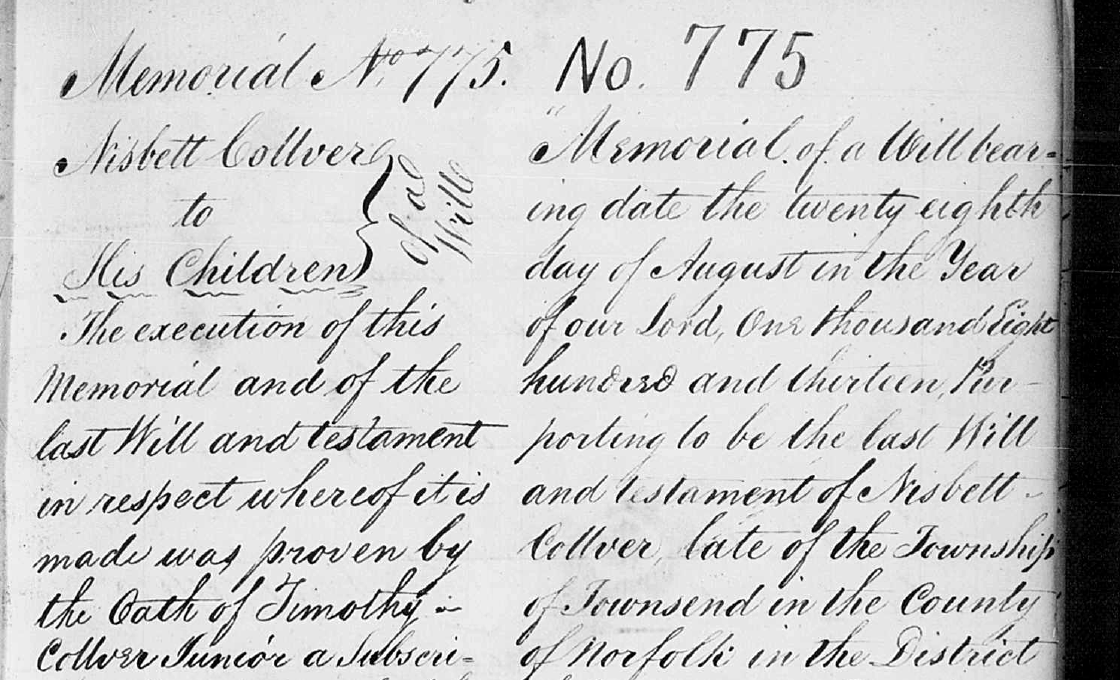
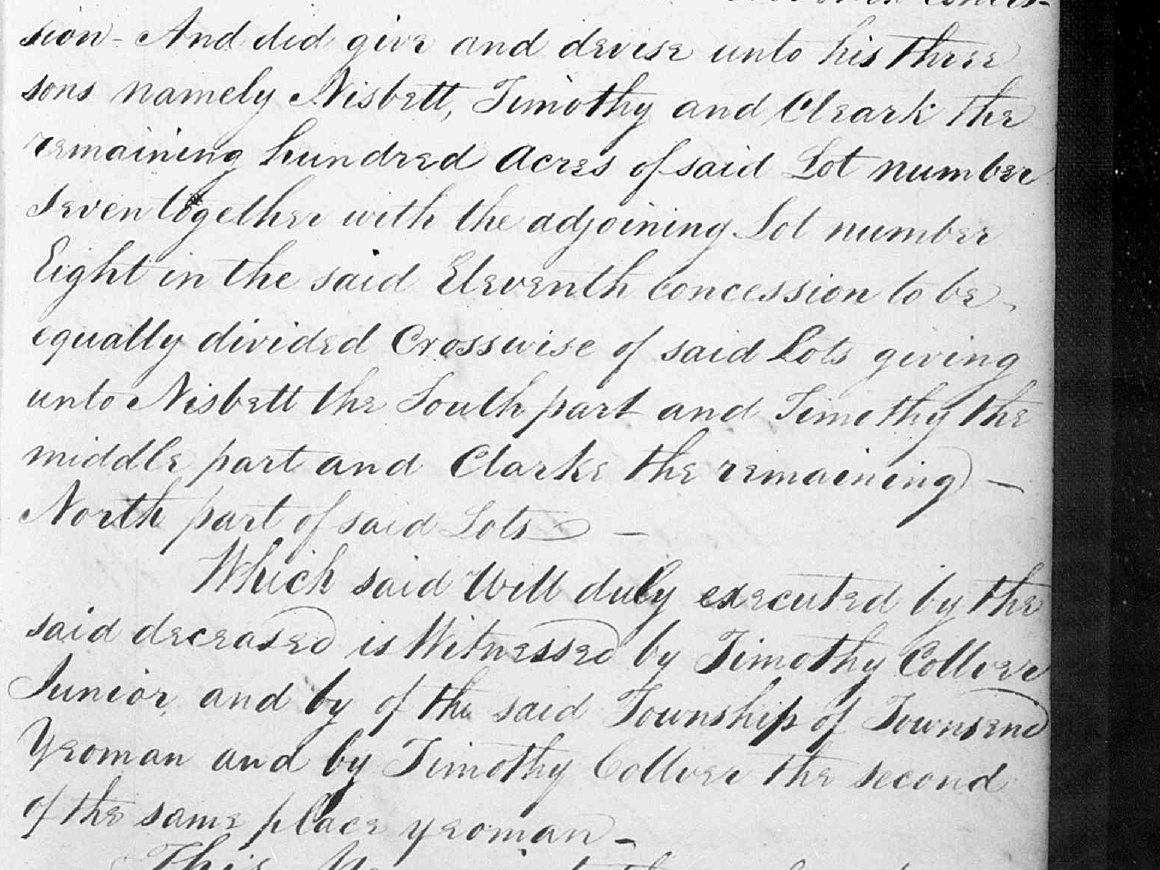
He was thirty-nine years old, and he was methodical. To his eldest son Robert went the south hundred acres of the home lot — Lot 1 in the twelfth concession of Townsend — with a piece of the lot behind it. To his eldest daughter Eunice, fifty acres of Lot 7 in the eleventh concession; to his second daughter Martha, fifty more of the same lot. The rest of that lot, with the whole of the next, he left to "his three sons namely Nisbett, Timothy and Clark," to be divided crosswise — south, middle, north — three strips for three boys. The witnesses were Timothy Collver Junior and Timothy Collver "the second," both of Townsend; in this settlement even the witnessing was a family affair.
A fortnight later he was dead.
The paper does not say whether he wrote it sick or merely prudent, a militia captain putting his house in order before the season's marching. It says only what the record confirms: Nesbitt Collver, captain in the 2nd Norfolk Militia, died in the service on the tenth or eleventh of September, 1813 — in his fortieth year, in the war's worst year. The record is silent on what killed him, and the silence is ordinary; the captains of that war died of camp fever and hard weather at least as often as they died of shot. He is the only uniformed death of the War of 1812 that any record shows for this family. And the war had already taken something else from the same household, which is the subject of this post. But first, the will itself has a story about how anything survives at all.
What a memorial is
The will does not survive as a parchment in a family drawer. It survives because, on the twentieth of January, 1814, "Sarah Collver, Executrix" — his widow — carried it to the county registry, where a clerk copied its substance into the deed book as memorial No. 775.
The word is worth a moment. A memorial, in the registry practice of Upper Canada, was a registered abstract of an instrument — a deed, a mortgage, a will — entered in the county's book so that the title it carried could never afterward depend on one family keeping one paper safe. It comes from the Latin memoriale, "a thing that serves remembrance," from memor, mindful. The county, for a fee, agreed to be mindful on your behalf.
Readers of this blog will recognize the arithmetic, because it is the same arithmetic run the other way. Earlier this month this blog stood in a Tennessee courtroom with an old soldier whose family register — one book, one house, one wagon — had vanished, and took the lesson that communities lodge; families carry. Nesbitt's will is the happy column of that ledger. Sarah lodged it. Two hundred and twelve years later, an American descendant of the family can read the clerk's copy at his desk, image 26 of a digitized register book, the hand still clear: the two lots, the six children, the three strips cut crosswise.
![“In Witness whereof I have hereunto set my Hand and Seal this twentieth day of January 1814… Sarah Collver [sealed].” Wi](https://history.collver.biz/content/images/2026/08/memorial775-sarah-executrix.png)
And the lodged copy does one thing more, quietly, that the family's own memory failed to do: it counts the children correctly. The county history, compiled from the settlement's recollections eighty years on, gives Captain Nesbitt five children and calls the second daughter Patty. The will names six — one of the sons, Timothy, had slipped out of the neighborhood's memory entirely — and Patty, on her father's own paper, is Martha. Nothing in this project has argued the case for registers better than that one dropped boy.
The captain
Who was he? The eldest son of old Timothy Collver, the Loyalist cousin whose long road from New Jersey this blog and the forthcoming book have traced before. Nesbitt was born on Schooley's Mountain in Morris County about 1773 or 1774, came north with the family's Norfolk migration as a young man, and in July 1798 married Sarah Bacon — whose own mother, in the settlement's tightly-woven way, was born a Collver. He farmed the south half of Lot 1, Concession 12, which his father had bought in 1800 and conveyed to him in 1803; he held a captain's commission in the 2nd Norfolk Militia; and in 1809, two years before the war, he signed his name to a page this family has reason to remember.
That December, the York Gazette printed a loyal address from the magistrates and principal inhabitants of Norfolk — the county's answer to a seditious editor at Niagara — and among its signatures stand fourteen men of this family in and around one column, the Reverend Jabez Collver, then seventy-eight, at their head. "Should Circumstances unhappily render it necessary," the address promised the lieutenant governor, "we hope by our actions, to convince Your Excellency, that we are not insensible to the blessings we enjoy." Among the fourteen: Nisbett Collver.
Three years later the circumstances obliged, and the actions were exacted. The family signed as one voice in 1809. It did not get to keep the voice.
The nephew
The war was weeks old when Norfolk's militia was ordered west for the Detroit campaign, and Norfolk's militia — the sons and neighbors of the men who had signed the address — balked. In July 1812, Ensign Timothy Collver of the Norfolk militia, with John Beemer, a justice of the peace of the allied Beemer clan, "rode about the country from house to house for three days," urging the men not to march. The militia refused its orders; General Brock himself complained bitterly of Norfolk in the campaign's darkest week.
Ensign Timothy did not stop at agitation. His name stands in the printed rolls of the British forces in Canada with the terse annotation history reserves for its least ambiguous acts: he "deserted to the enemy." After the war, the government of Upper Canada seized his land — the forfeiture is on record in the provincial archives.
And the deserter was the captain's own nephew.
Here the reader is owed this project's usual honesty about what is proven and what is carried. The desertion and the forfeiture are record. The kinship is the compiled family record's — nephew to Nesbitt, which of Nesbitt's brothers his father was the papers so far read do not say — and so this project carries him as the family carried him, close enough to the captain's table to make the next sentence true either way: in September 1813 one household web held a grave in the King's service and a farm forfeited for the enemy's, and the two entries sit in back-to-back years of one war, in one township, in one regiment, under one surname.
The wheel comes around
Readers of A House Divided will feel the shape of this, because the family had been here before — on the other side.
In 1776, the Reverend Jabez Collver signed a paper for the Crown in New Jersey and was convicted of sedition for it; the family adhered to the King and lost an estate to the republic. A generation later the survivors gathered themselves into a single settlement on Lake Erie's north shore — one township, one militia district, sons and cousins marrying in a ring — precisely, one suspects, so that nothing could ever divide them again. In 1812 the next war found them anyway. A son of the family died in the King's service; a nephew of the same family deserted to the Americans and forfeited his farm to the Crown — the mirror image, loyalty for loyalty, forfeiture for forfeiture, of what the republic had done to his grandfathers' generation in 1777.
In 1776 the divided house at least had the dignity of a whole continent dividing with it. In 1812 the division ran through one kitchen-table connection, and the family had to absorb it at the scale of Sunday dinner. No historian could invent a neater — or a crueler — reprise.
What memory did with them
The family's later literature, it must be reported, handled the pair in the family's usual way, which is to say loyally and badly.
The deserter it simply misplaced. His name drops out of the Norfolk story the family told about itself, though — as the book will show in its Michigan chapters — his road south was only the first of many; within two generations the family followed him across that border in streams, and thought nothing of it.
The captain it promoted. By the time the family's history came to be written down, Nesbitt Collver had become "an officer in the British Army during the Revolutionary War" — a war that ended when he was about nine years old. The claim is impossible, and it is not a lie. It is what a family does with a true thing — our Nesbitt died an officer in the King's service — when the register that held the dates has gone out of reach and the brightest war on the shelf is the one the grandfathers talked about. His real service, 1812, garbled one war backward, by people who loved him. This project has said it before and the captain's case says it best: memory is loyal before it is accurate.
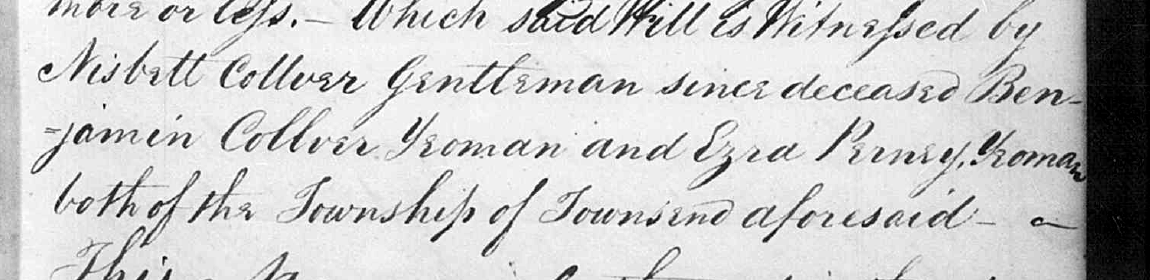
The register, meanwhile, kept both men without comment, because registers do not editorialize. The deed book that holds Nesbitt's will at No. 775 holds, at No. 776, the will of his neighbor Abraham Beemer — witnessed in June 1812 by "Nisbett Collver Gentleman since deceased," the clerk noting, as he copied, that the witness had died between the signing and the registering. Even the spelling drifts across his short paper trail — Nisbit in his father's 1803 conveyance, Nisbett on the 1809 address and in his own will, Nesbitt in the family's later books — three spellings for one man, which readers of this blog's first post will recognize as the family signature more reliable than any signature.
The ground
The captain's line did not die with him. Sarah the Bacon widow raised the six children on the divided lots; the daughters married into the settlement's web as their aunts had; the sons' strips of Lot 7 and Lot 8 passed down and sideways through the connection for a century. And the connection remembered where its dead lay. When Isaac Kitchen — a grandson of Jabez Jr., and so a Collver on his mother's side — was buried in 1916, the obituary named the ground the old way: "Collver's Burying Ground."
Nobody, so far as any record shows, was read out of the family over 1812 — not the mutineers' county, not the deserter's line, nobody. The division of 1776 had cost the family a country, an estate, and twenty years of exile. The division of 1812 cost it a son and a farm — and changed, so far as the record shows, not one wedding, not one entry in anybody's Bible. Something had shifted between the wars. The family had learned to hold its divisions the way its old dissenting sect had held persecution: as weather, to be endured together.
The deserter got the longer story, as deserters do. The captain got the ground.
And the border that divided them became, within a generation, simply a family road — the road the deserter's kin and the captain's kin and nearly every line of this family would travel south again, until the Loyalist house stood American once more and kept both stories. This blog is written on the American end of that road, by a descendant who has driven it north to stand in the old settlement; its subscribers include descendants on both ends. Two hundred and twelve years after a widow carried a will to the county registry, the county is still mindful on our behalf — and so, now, are we.
Sources and notes: Capt. Nesbitt Collver's will, dated 28 August 1813, survives as memorial No. 775 in the Norfolk County deed register (Deeds 1813–1825, images 26–27 of 650, FamilySearch image group 008198250), registered 20 January 1814 by "Sarah Collver, Executrix"; the witnesses and the devises quoted are the memorial's, read from the register images for this project, as is the "since deceased" notation on memorial No. 776 (Abraham Beemer's will). The 1803 conveyance of the south half of Lot 1, Concession 12, Townsend, from Timothy to "Nisbit" Collver is instrument 126 in the Ontario land registry's abstract index for that lot. His death in service, 10/11 September 1813, "in his 40th year," his captaincy in the 2nd Norfolk Militia, and the five-child list corrected above are from E. A. Owen, Pioneer Sketches of Long Point Settlement (1898); Sarah Bacon's parentage is R. Robert Mutrie's Bacon of Townsend Township (2017). The July 1812 Norfolk mutiny ("rode about the country from house to house for three days") follows E. A. Cruikshank's study of disaffection in Upper Canada as compiled in the Mutrie genealogy; "deserted to the enemy" is the annotation at Ensign Timothy Collver's name in Officers of the British Forces in Canada during the War of 1812, and the postwar seizure of his land is on record in the provincial archives. His exact place on the tree — which of the captain's brothers was his father — remains unproven and is stated as such. The 1809 loyal address, dated at Woodhouse 16 November and printed in the York Gazette of 6 December 1809, is transcribed in full in the forthcoming book's documents appendix. This Captain Nesbitt (c. 1773/74–1813, m. Sarah Bacon) is not to be confused with the later Nesbitt Collver (1806–1882, m. Julia Smith) of the same settlement. "The Lost Family Register" (31 August 2026) and "A House Divided" (4 July 2026) are the companion posts on this blog.
Adapted from the forthcoming book — We Are Doves: Four Centuries of the Collver–Culver Family.
© 2026 Albert B. Collver III · The Collver Family History Project. Original historical documents reproduced here are in the public domain; the research, text, and annotations are the author's. Please cite or link rather than republish.