Doves on the Wire

A departure this week from the eighteenth century: a family story that surfaced in the last few days, from correspondence with cousins of the Climax, Michigan branch and a week in the newspaper and census records. It reaches from Munger, in Bay County, to the village of Climax in Kalamazoo County — and it belongs to the same book all these posts are building.
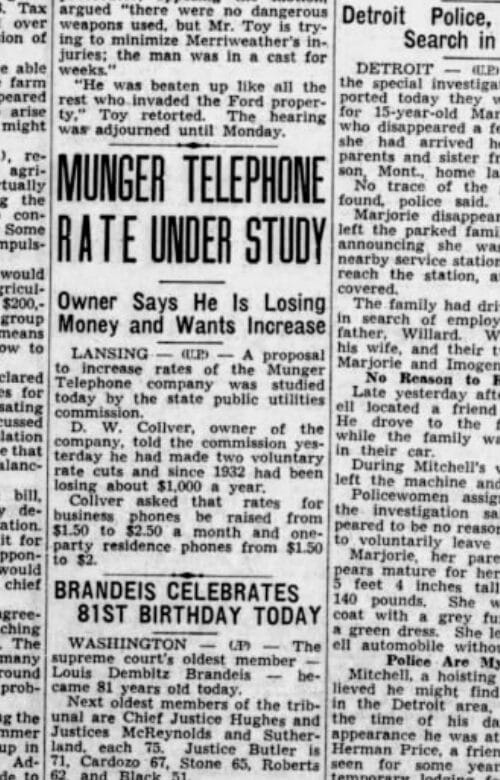
In November of 1937 a farmer's son from Bay County stood before the Michigan Public Utilities Commission in Lansing and told them, plainly, what his telephone company was worth. Daniel W. Collver had cut his own rates twice, voluntarily, and had lost about a thousand dollars a year since 1932. He asked permission to charge business customers $2.50 a month instead of $1.50, and families $2. The United Press put the story on the wire, and the Bay City Times printed it under a headline that said more than it knew: "Owner Says He Is Losing Money and Wants Increase."
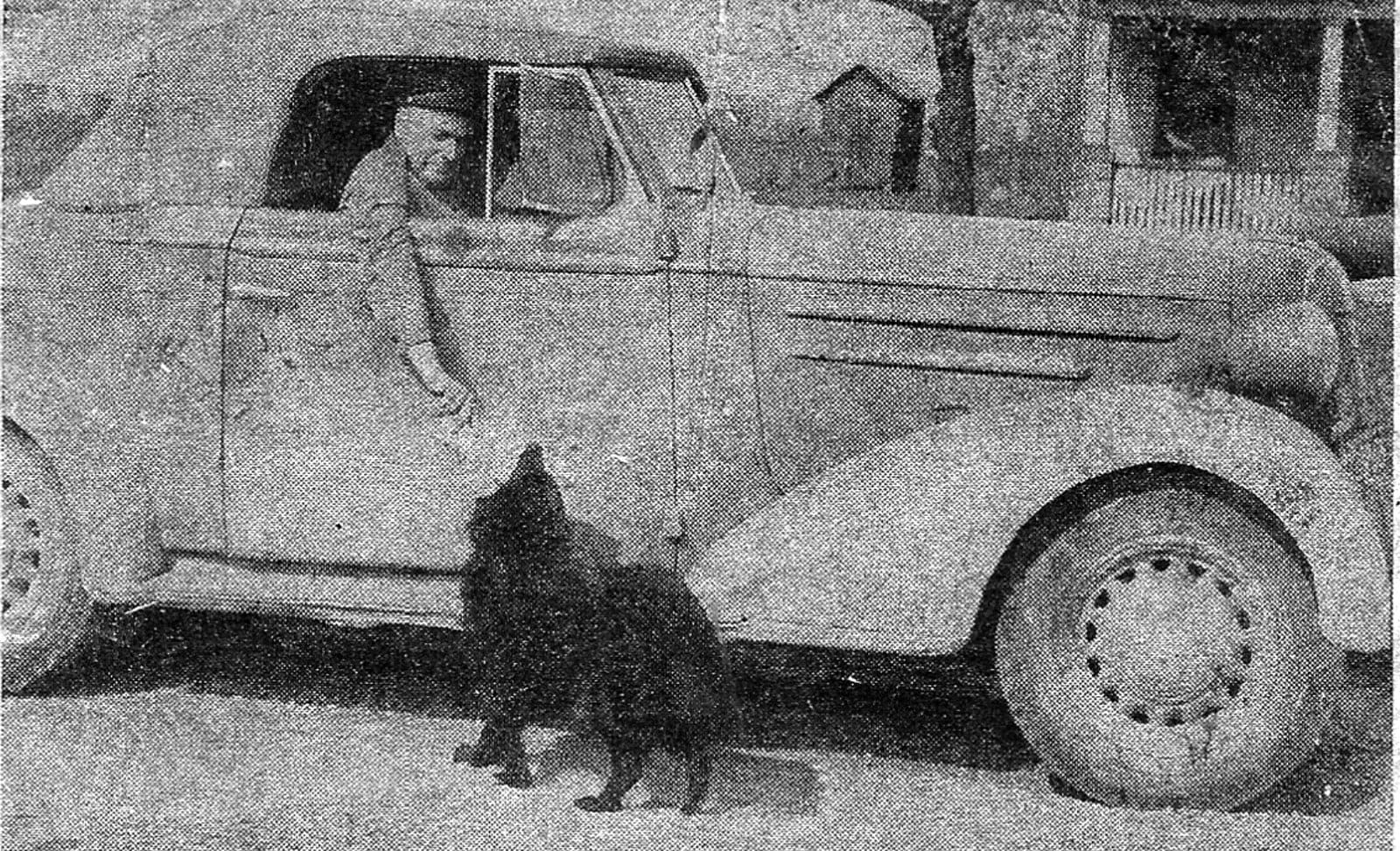
What the headline did not say is how he covered the losses. The census takers did. In 1930 they found Daniel on Munger Road in Merritt Township — occupation, rural mail carrier; industry, U.S. Mail. In 1942 his draft card named his employer as the Post Office Department, R.F.D. carrier out of Bay City. In 1950, at fifty-six, he was still on the route. For a quarter of a century Daniel Collver delivered the mail six days a week so that his neighbors could afford to talk to each other on the seventh. The family kept a newspaper clipping about him and a dog, and the clipping has now come to hand.
The dog belonged to a farmer named David Sowder, on the Bullock road, and for thirteen years he had met the mail. In the beginning he did it by ear. The rural carriers of that era announced themselves with a horn, and from any corner of the farm — the barn, the back field, wherever he happened to be standing — the dog would hear it and come. By the time the photographer found him he was fifteen years old and stone deaf, and the horn had stopped meaning anything at all. So the household adapted. When the mail came his master would point down the road, and the dog, reading the arm instead of the sound, would set off at a trot.
The first photograph shows the rest of it: Daniel leaning out of the door of his mail car with the paper held down at arm's length, and the dog risen on his hind legs to take it. The second shows the delivery completed at the farmhouse door. The paper was the Times itself — the same paper that had printed his father's rate case, carried up a farm lane in a dog's mouth.
The family told this story for two generations as a story about a Collver. It is really a story about a deaf dog, a man who pointed, and a mail carrier who was willing to hand a newspaper down to an animal every day for thirteen years rather than break the habit. The dog was not ours. The route was.
He had bought the little exchange at Munger, near Bay City, in the late 1920s, when his eldest son John was a boy. The switchboard trade came with the household: John worked the board and the lines on his father's exchange, and in 1937 — the very year his father pleaded in Lansing — John went to work for the Michigan Bell Telephone Company, the giant against which every family exchange in the state measured itself. The war took him to Wurtsmith Field at Oscoda as a PBX repairman, keeping the Air Corps talking, and he settled nearby in East Tawas with his wife Mary. His brother Albert, an electrical engineer — my grandfather — would later say only that he "helped his brother John with the telephone company for a while," and the brothers' lives ran close enough, in those Iosco County years, that the help could have come anywhere the wires did.
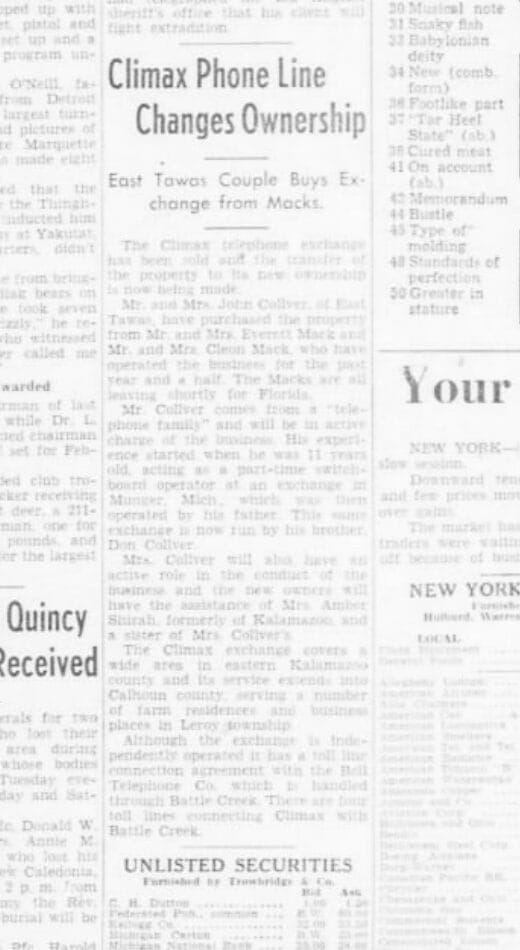
In January 1949 the Battle Creek Enquirer carried a small notice: "Climax Phone Line Changes Ownership — East Tawas Couple Buys Exchange from Macks." Mr. and Mrs. John Collver had purchased the Climax Telephone Company, two hundred miles south in Kalamazoo County — 288 stations, other people's deferred maintenance, and, as John put it later, "more courage than money." The Enquirer knew whom it was getting: "Mr. Collver comes from a 'telephone family' and will be in active charge of the business. His experience started when he was 11 years old, acting as a part-time switchboard operator at an exchange in Munger, Mich., which was then operated by his father. This same exchange is now run by his brother." A telephone family — the paper said it in 1949, a quarter-century before anyone thought the story worth telling at length.
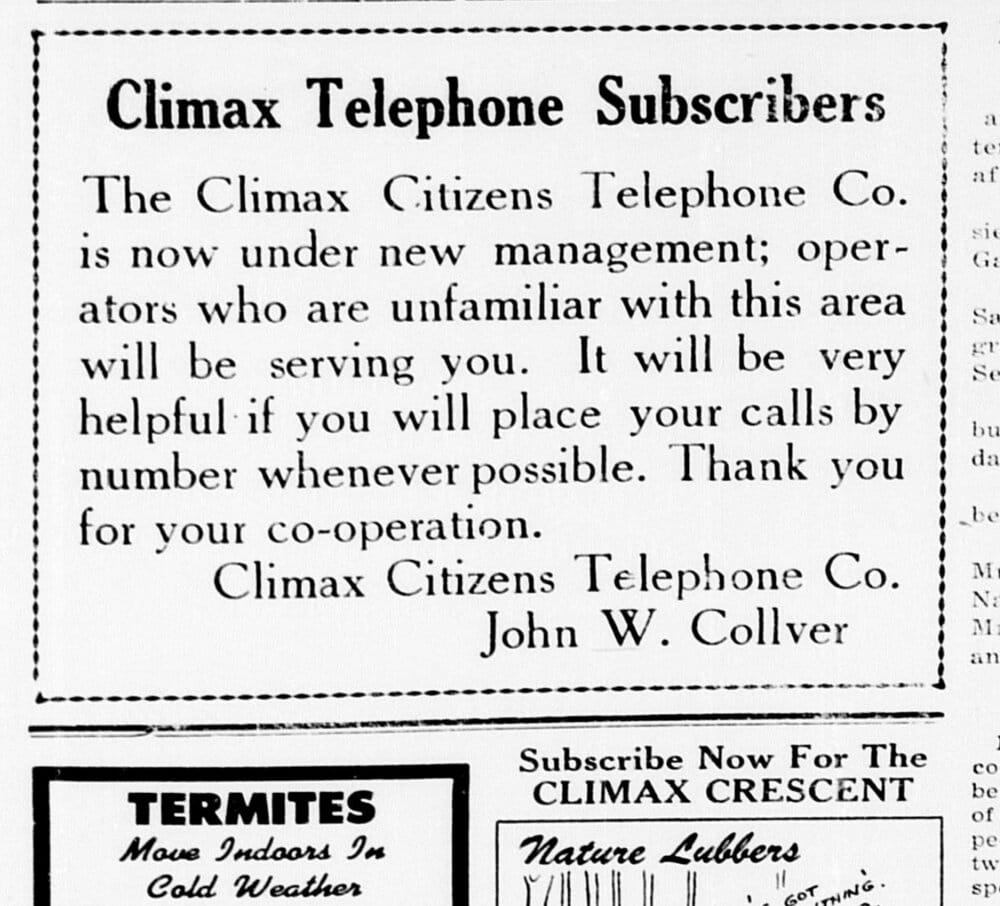
His own first words to his new customers survive. In the Climax Crescent of January 14, 1949 — the same week the deed changed hands — a small boxed notice ran over his signature: "The Climax Citizens Telephone Co. is now under new management; operators who are unfamiliar with this area will be serving you. It will be very helpful if you will place your calls by number whenever possible. Thank you for your co-operation. — Climax Citizens Telephone Co., John W. Collver." It is a modest thing, a courtesy extended to strangers on a party line, and it is the earliest trace of a Collver at the head of the company he would run for the next thirty-four years.
The courage was tested in two weeks. On the night of January 27, freezing rain came down across southern Michigan, and on the morning of the 28th the Enquirer's banner headline read "ICE STORM DISRUPTS POWER AND PHONE SERVICE." Thirteen communities in five counties lost power; four to five hundred telephones went dead in Battle Creek alone; and at Climax more than half the new owners' stations went silent. Telephone poles, John remembered, lay everywhere. Stringing wire "on anything handy" — low-level construction, the trade called it — the Collvers had service back in eighteen days, and began a five-year modernization program more or less on the spot.

The same front page carried one quiet sentence from Bay County's corner of the world: "Rural mail carriers were able to cover their routes as usual today." The father's mail went through the morning the son's wires came down.
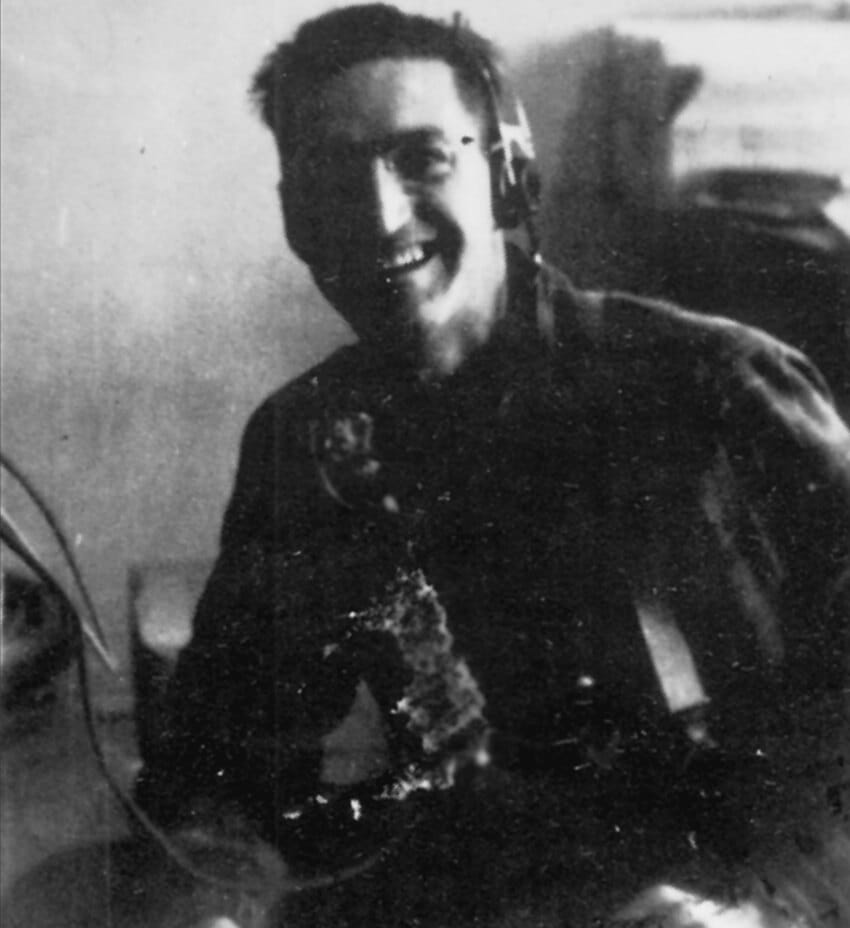
For the first years the calls still passed through a human being. A young operator named Esther Roe, fresh out of Climax High School, sat at the switchboard in the front room of the Collvers' own house; when a fire broke out there was no number to dial but hers, and she would ring the firemen and tell them where to run. "I got so I knew people's voices," she remembered. "Mrs. Simmons lived on North Church Street — she just screamed as she was calling in, she said fire, and she just hung up, without telling me who she was or where she lived." The board ran around the clock, and if John and Mary had to be away, Esther would mind it and babysit the children besides. It was Mary who pressed for the change, her son remembers — the old magneto board given up for an automatic system. Trading all that for a dial system in 1954 took money the family did not have, and here the story turns on a stranger's faith: Stromberg-Carlson, which built the switching equipment, had formed a lending arm, and — Gilbert would tell it years later — Climax was the very first telephone company in the country it agreed to bankroll. A finance man named Phil Lucir came out from Rochester, New York, sat at the Collvers' kitchen table, and shook hands on the loan the local banks had refused.
The two family companies then went their separate ways. At Munger the exchange had passed to Daniel's second son, Dan Jr., who by 1949 was running the little board his father had bought. He sold it on May 21, 1951, with its 122 customers, to Robert Stuhler, a thirty-year-old lineman who had been demoted from a construction-foreman's job for letting his men stop for coffee on cold days, and who decided he would rather own a telephone company than apologize for the coffee. Dan Jr. lived until 1970, when a heart attack took him. At Climax the Collvers converted the system from magneto — the crank-the-handle-and-ask-the-operator arrangement — to common battery by 1952, to full dial by 1954, and moved the switchboard out of their own house in 1955. By the late sixties Climax was the largest toll-free exchange in Michigan, and the first in the state with automatic number identification for party lines. Mary was the company's secretary and treasurer, and had been for years — the books, the correspondence, the business affairs, the switchboard when it wanted watching, and a seat at the meetings and conventions around the state where the independents argued their case. She belonged to the Telephone Association of Michigan in her own right, as her husband did. When her own newspaper came to write her life it gave her the front page and a headline with no ornament on it at all: she had been an integral part in the growth of the Climax Telephone Company. John climbed the poles. "It isn't difficult to get to the top man here," he liked to say, "but he may be on top of a pole."
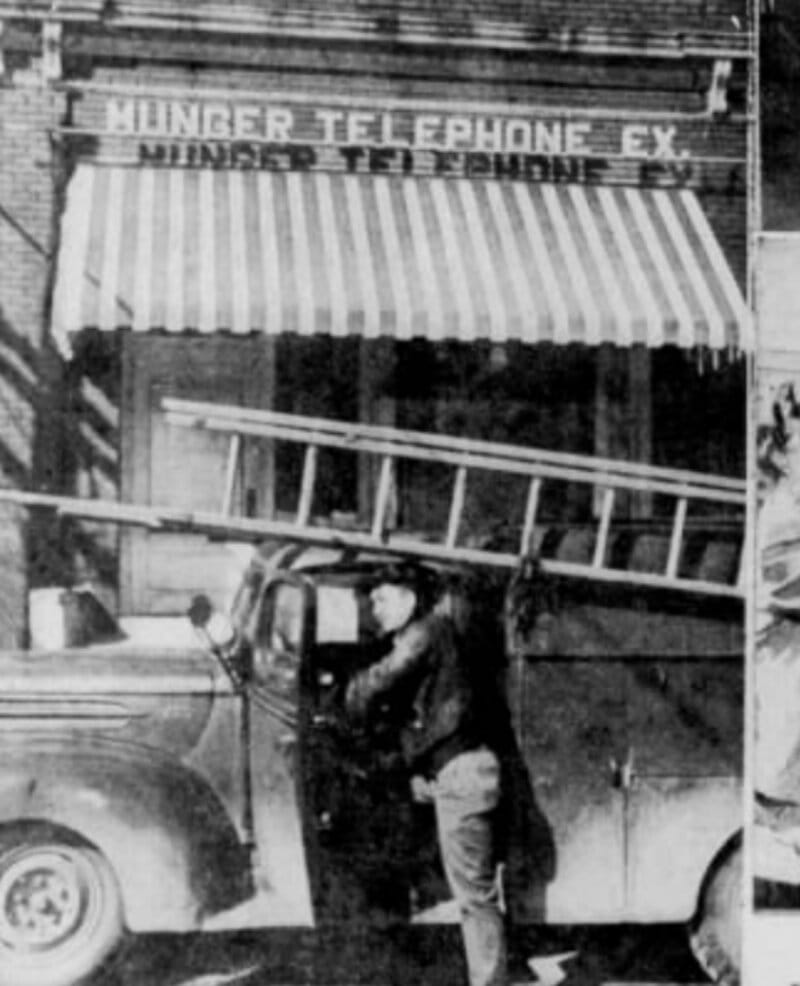
The third generation arrived by way of the Air Force, as the second had come by way of the Army airfield. Gilbert Collver served three and a half years as a communications officer and joined the family company in 1972, at twenty-eight, sharing the planning and operation with his father. When John retired in 1983 — thirty-four years after the ice storm — Gilbert carried the company into a world its founders could not have dialed: as CTS Telecom, it became in 1996 the first licensed independent in Michigan permitted to compete in Bell territory, offering the villages of Climax and Scotts their first taste of ISDN. A family that once begged Lansing for an extra dollar a month now held a license to challenge Ameritech.
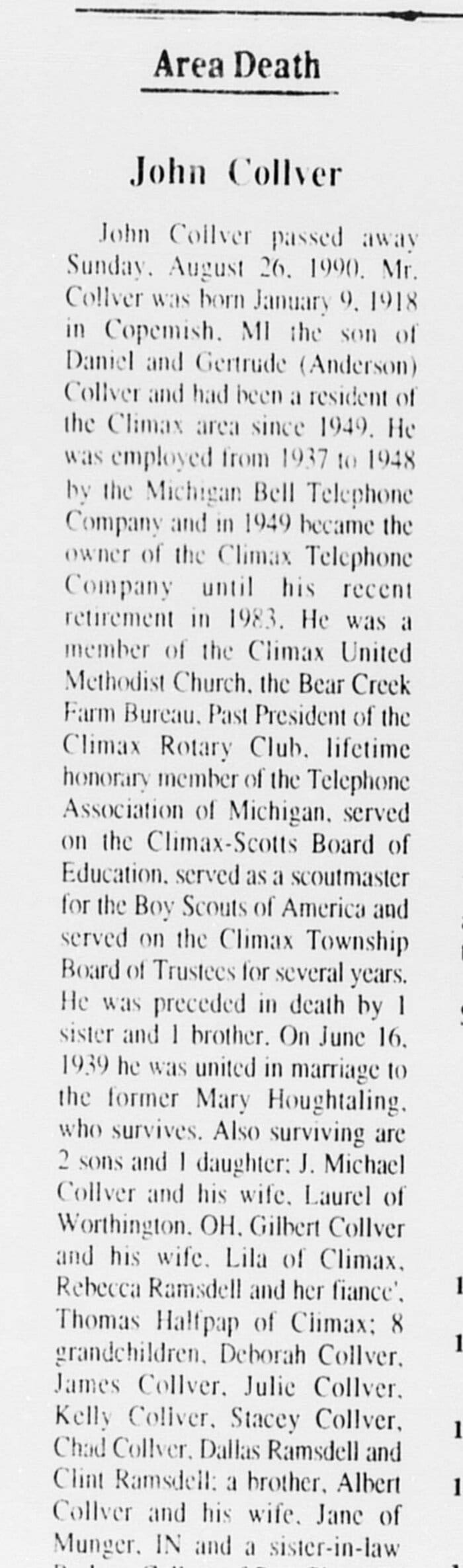
When John Collver died on August 26, 1990, the Climax Crescent set his life down in a single dense paragraph under the heading "Area Death": born at Copemish in 1918, a son of Daniel and Gertrude; Michigan Bell from 1937 to 1948; owner of the Climax Telephone Company from 1949 until his retirement in 1983; a lifetime honorary member of the Telephone Association of Michigan; past president of the Rotary, scoutmaster, school-board member, township trustee. Among the survivors it named "a brother, Albert Collver and his wife, Jane, of Munger" — the electrical engineer who had helped with the wires, and the branch from which this writer descends.
There is a coda, and it is airborne. For years Gilbert has flown his own Turbo Commander for Wings of Mercy, carrying patients of limited means to distant hospitals at no charge — a communications officer become a carrier of people. It is hard not to hear the whole family in that: Jabez carried the Word, Daniel carried the mail, John and Gilbert carried the human voice, and the doves, as ever, sit on the wire.
Sources: "Munger Telephone Rate Under Study," Bay City Times, 13 Nov. 1937; "Climax Phone Line Changes Ownership," Battle Creek Enquirer, 13 Jan. 1949; "Ice Storm Disrupts Power and Phone Service," Battle Creek Enquirer, 28 Jan. 1949; "Born of a Cup of Coffee — Munger Will Have Dial Phone Service April 1," Bay City Times, 8 Mar. 1953; John W. Collver's "Climax Telephone Subscribers" notice, Climax Crescent, 14 Jan. 1949; "Climax Telephone Company … New Dial System 50 Years Ago," by Bruce Rolfe, Climax Crescent, 13 Feb. 2004 (switchboard photograph courtesy of Gilbert Collver); John W. Collver obituary, Climax Crescent, 31 Aug. 1990; profiles of the Climax Telephone Company by Ardyce Czuchna, Battle Creek Enquirer, 17 Feb. 1974, and Kalamazoo Gazette, 31 Mar. 1974; "Climax adds new phone services," Kalamazoo Gazette, 11 Nov. 1996; "When it comes to helping, Climax man soars," Kalamazoo Gazette, 24 Feb. 2003; obituaries of John W. Collver, Kalamazoo Gazette, 28 Aug. 1990, and Battle Creek Enquirer, 1 Sep. 1990; “Mary Collver Was Integral Part In Growth Of Climax Telephone Company,” by Bruce Rolfe, and “Area Death: Mary Rebecca Collver,” both Climax Crescent, 5 Apr. 1996; the undated Bay City Times feature on the mail route, photographs by Darwin C. Smith, courtesy of Gilbert Collver; U.S. censuses of 1930 and 1950 (Merritt Township, Bay County) and the 1942 draft registration of Daniel William Collver. Family memory from conversations with cousins of the Climax branch, gratefully received.
Adapted from the forthcoming book, We Are Doves: Four Centuries of the Collver–Culver Family.
© 2026 Albert B. Collver III · The Collver Family History Project. Original historical documents reproduced here are in the public domain; the research, text, and annotations are the author's. Please cite or link rather than republish.