The County's First Deed
Tioga County's land records open with a deed to Jabez Colver — a convicted Loyalist. The five vanished Chemung years, and one evening at Wynkoop's fireside.
On the twentieth of December, 1788, at the far southern edge of New York State, a man named Jacob Stull signed away a hundred and fifty acres of riverbank. The parcel was lot 55 of the old town of Chemung — bottomland running down across Seeley Creek toward the lower end of Big Island, in the district the maps then still called Newtown, across the water from the future Elmira. The buyer was newly arrived out of New Jersey. Ninety years later, the county historian, working page by page through the record books, noted the instrument with the dry precision of his trade: it is, he wrote, "the earliest dated deed on the records of Tioga County."
Read that fact slowly, because no one who witnessed the signing could have read it whole. The land records of an American county — the founding paper of a new republic's newest ground — begin with a conveyance to Jabez Colver: a man who, eleven years earlier, had stood in a New Jersey courtroom and pleaded guilty to sedition against the American cause. He had been fined, committed to gaol until he paid, and stripped of what his own later petition called "considerable property," all for keeping faith with George III. The Revolution's New Jersey had taken his farm at the pond under Minisink Mountain. The Revolution's New York, a decade on and asking no questions, sold him another. The first name in the county's first deed book is a Loyalist's — and in two hundred years the county has never once noticed.
Not broken but liquid
The family did not drift onto the Chemung the way refugees drift. It took up land there the way it had taken up Schooley's Mountain a generation before — by the bookful. New York's own surveyor general, certifying the Chemung town lots in the late summer of 1788, entered them in a single run of the roll: Jabez Culver to lots 54 and 56, two hundred and fifty-one acres in his own right; Jabez Culver and his son John to lot 124, three hundred more; and Stull's lot 55, the hundred and fifty of that December deed. His son Aaron, about twenty-four, held lot 134 separately — six hundred and sixteen acres by a survey certificate of that same November. However you count the parcels, the shape is unmistakable. Very nearly seven hundred acres, assembled in a single season by a man of sixty who had every reason to arrive with nothing.
That is the detail the family's own memory lost, and it is worth pausing on. The convicted Loyalist did not come out of New Jersey broken. He came out liquid — his estate converted, his losses cut, enough left to buy a small county's worth of river flats at the first legal moment. The migration everyone remembers is the walk to Canada, five years later, told as an epic of exile. Between the war's New Jersey and the family's Canada, though, there were these five years on the Chemung: a whole built life — seven hundred acres, a scattered congregation, a Pennsylvania county's first church — that the compilers flattened into a blank. They compressed it so completely that when a son died during those years, the old family chronicler, not knowing the family had ever left New Jersey, relocated the death to fit. An entire world went missing between two better-remembered ones.
One evening at Wynkoop's
For the texture of those years we have something better than deed books. In the late winter of 1791, Colonel Thomas Proctor — Continental artillerist, veteran of the Sullivan expedition, now a United States commissioner riding west on a peace mission to the Six Nations — came up the Susquehanna trail through weather he recorded with a quartermaster's exactness. Fifteen inches of snow under thunderstorms. A settler's cabin where the coffee was parched rye, "made fine with the pole of an axe on a smooth stone," sweetened with maple sugar the colonel judged "as bright and as well tasted as the best 8d sugar in Philadelphia." Horses so worn that "to save our horses, we travelled on foot more than half of the way from the town of Reading."
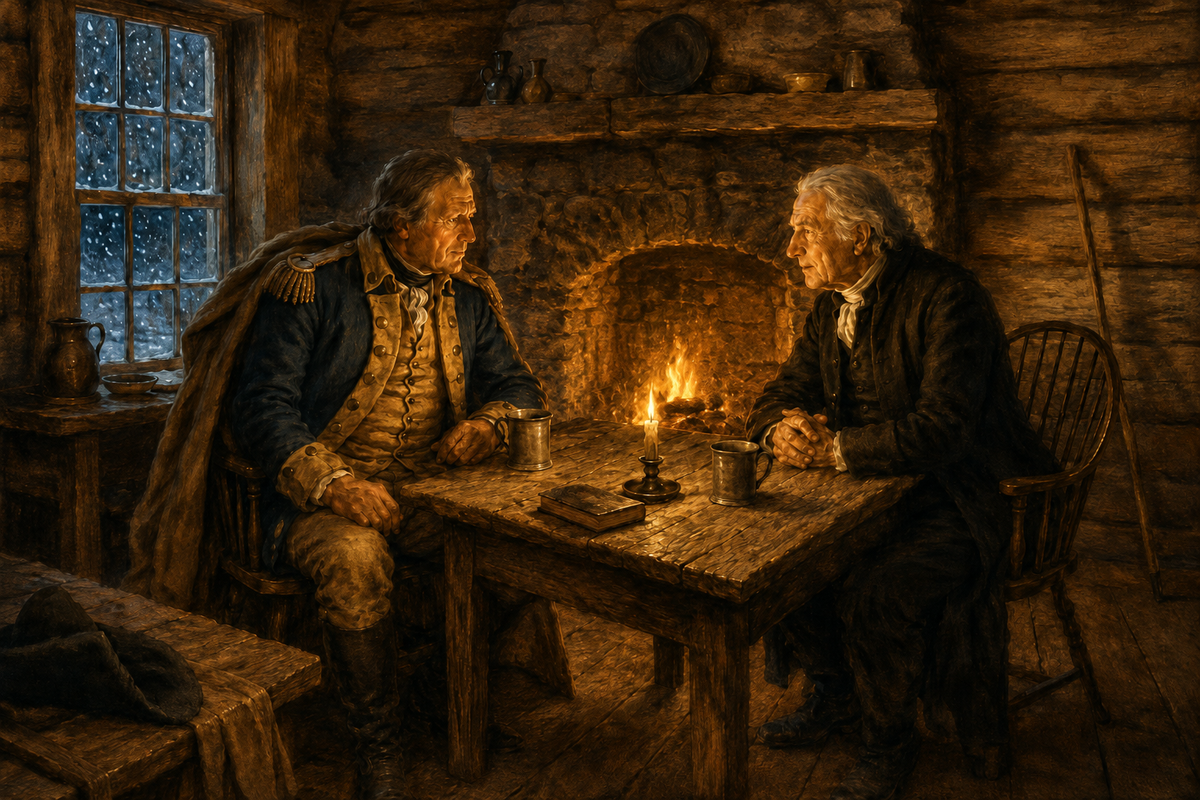
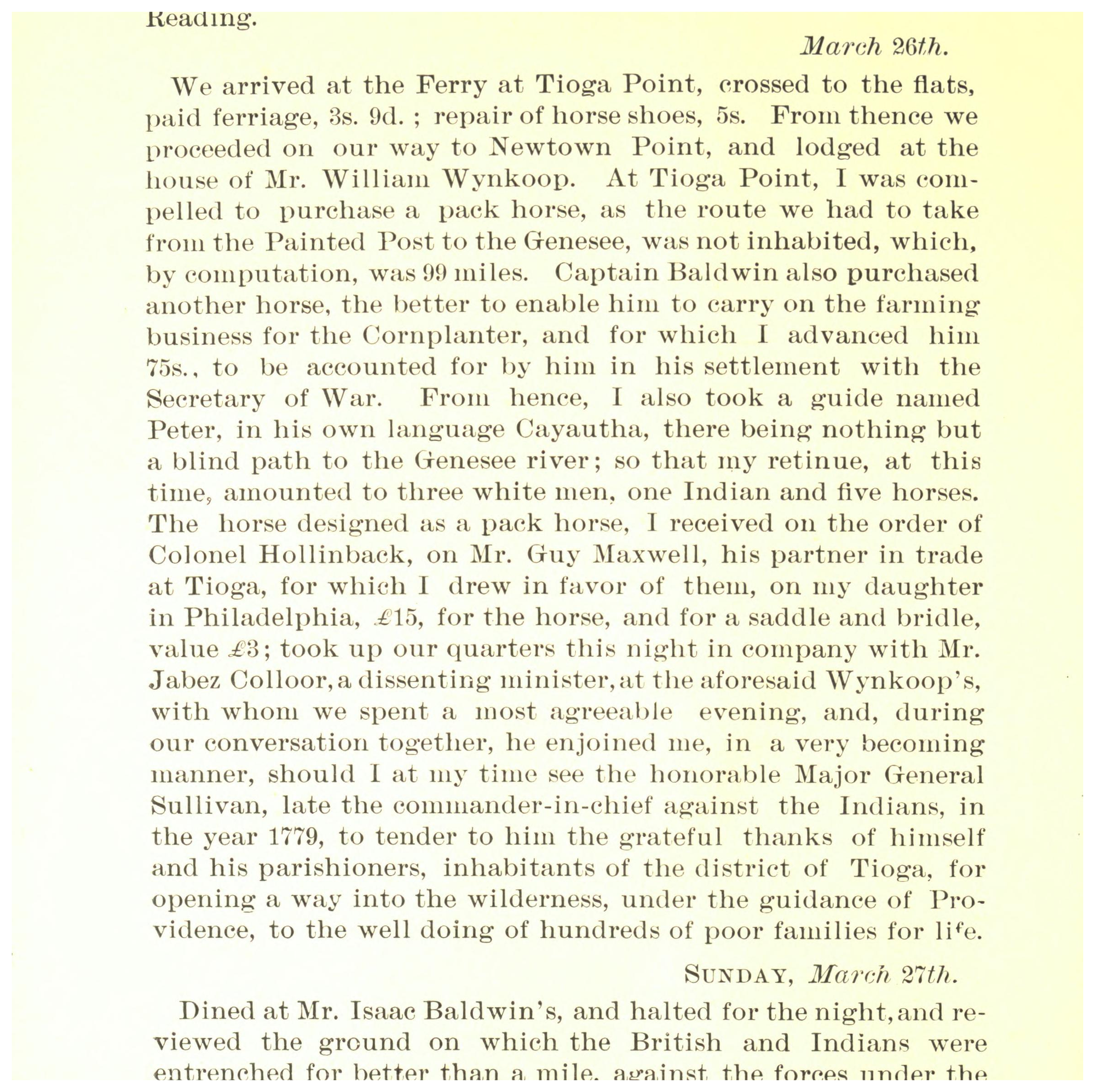
On the twenty-sixth of March he crossed the ferry at Tioga Point, bought a pack horse for the ninety-nine uninhabited miles ahead, hired a guide, and rode on to Newtown Point, where he lodged at the house of a Mr. William Wynkoop. And there, in the entry for that day, a federal officer set down the only portrait of Jabez Colver ever drawn by an outsider:
took up our quarters this night in company with Mr. Jabez Colloor, a dissenting minister, at the aforesaid Wynkoop's, with whom we spent a most agreeable evening, and, during our conversation together, he enjoined me, in a very becoming manner, should I at [any] time see the honorable Major General Sullivan, late the commander-in-chief against the Indians, in the year 1779, to tender to him the grateful thanks of himself and his parishioners, inhabitants of the district of Tioga, for opening a way into the wilderness, under the guidance of Providence, to the well doing of hundreds of poor families for life.
Weigh what that message is asked to carry. The man sending his thanks had been indicted, fined, and imprisoned by the Revolution. The man he was thanking was the Revolution's general — commander of the very campaign that had burned the Iroquois towns and cut the road these settlers now farmed beside. Jabez had lost his property to the cause Sullivan served. And there he sits, at a stranger's fireside, a "dissenting minister" a long way from any pulpit, asking only that the general be told his road had done Providence's work for hundreds of poor families. He could not bless the rebellion. He would not curse the road it cut.
Three small things finish the scene. Dissenting minister — a minister outside the established church, in the British sense — is the colonel's own phrase, and it is truer than he could have known: every clerk who ever met Jabez reached for the wrong shelf, and this soldier, guessing, happened onto the one label that fit an entire career spent outside everyone's establishment. The spelling "Colloor" is the journal's own, a federal officer's honest phonetics, and it joins the family's long museum of misspelled names. And the next morning — you can read it a few lines down in the same journal — Proctor rode out and spent his Sunday walking the old Newtown battlefield, inspecting the mile of British and Indian entrenchments and picking up "a large collection of pieces of 5½ inch shells, which I had the pleasure of formerly causing to be exploded, amongst them." The evening's companion had thanked Sullivan for the road; the morning's ground still held the shrapnel that built it. The two entries sit a page apart, and everything a divided family means is folded into the gap between them.
The very first to blow the gospel trumpet
What was a dissenting minister doing on the Chemung in the first place? What he had done on every frontier of his life: gathering the scattered. Connecticut ministers and missionary riders were already moving into the new settlements — years before the Missionary Society of Connecticut formalized that work in 1798 — and Jabez, sixty years old, landed, and incurable, served the whole district as its first resident man of the cloth. On the third of October, 1791, he organized a church at Wysox with fourteen members, "a church in the wilderness, separated by a distance of at least eighty miles from any organization of Christian people." The Bradford County historian, a clergyman himself, gave the verdict I am glad to carry whole: "Mr. Culver is the pioneer preacher into this region, 'the very first to blow the gospel trumpet.'"
Then, having built the whole of it — the acres, the congregation, the county's first church, and the only outsider's portrait that survives — he gave it away. Through 1791 he "conveyed all his property, real and personal, to his sons." Aaron's six hundred acres were assigned off; and on the twenty-ninth of February, 1792, the state's land calendar files the closing line, a receipt to "Aaron McCulver, for £47 4s." — the family name misspelled one last time on the way out the door. The exile was not a flight. It was a liquidation: orderly, receipted, every acre conveyed and every consideration acknowledged, the estate of the between years turned into money and movables against the road north.
Tioga County's land records still begin where they began — with a deed to Jabez Colver, dated the twentieth of December, 1788. Two centuries of paper have grown on top of it, and the first name under all of it is still the minister who was only passing through, the man who built three lives in three jurisdictions and treated each of them, when the time came, as luggage. His descendants keep the habit of asking where home finally was, and the Chemung years give the answer he would have given at Wynkoop's fire: home was never the register you were written in. It was the company you kept covenant with — and the covenant traveled.
© 2026 Albert B. Collver III · The Collver Family History Project. Original historical documents reproduced here are in the public domain; the research, text, and annotations are the author's. Please cite or link rather than republish.
Adapted from the forthcoming book We Are Doves: A Collver Family History (2026), chapter eight, "The Between Years."