Pull Down All Other Persuasions
At his 1777 sedition trial, Rev. Jabez Colver warned that a victorious America would let the Presbyterians “pull down all other Persuasions.” Who was in the room that day, what he meant, and why the fear still echoes.
A Loyalist’s warning about the Presbyterians — and the room it was spoken in
And if America overcome, the Presbyterians will pull down all other Persuasions.
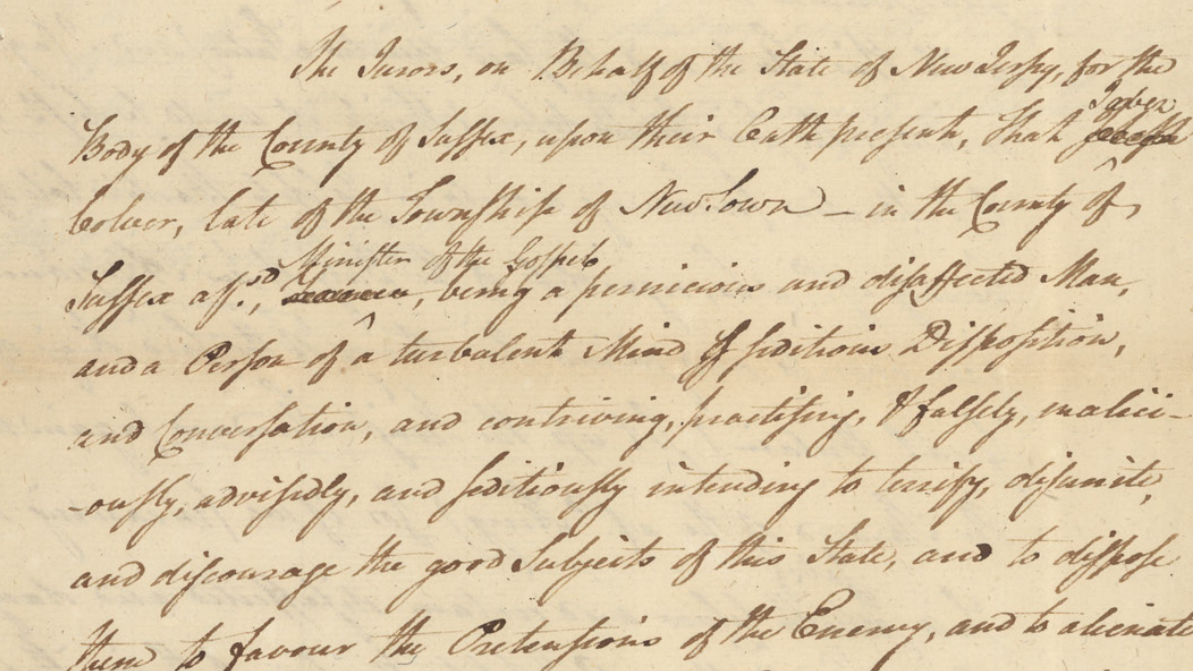
Those are my sixth great-grandfather’s words, or near enough to them — the reported speech of Rev. Jabez Colver of Wantage, written into the indictment a Sussex County grand jury returned against him in the spring of 1777, and now, two hundred and fifty years on, freely readable in the clerk’s own hand.1 He was charged with seditious words. He pleaded guilty, paid five pounds, and was committed until it was paid. Readers who have followed this project already know the shape of that story: the land he stood to lose, the January 1776 enrollment “under John Pettit,” the flight to Canada that came at the end of it. I have told it twice — once in Set Up the King’s Standard, and again, from the jailhouse end, in The Judge, the Preacher, and the Log Gaol.
Both of those posts set one clause of his sentence aside for later. This is later.
The sentence nobody quite explains
The words the indictment records are three, run together as men run words together in conversation. The first two are a Loyalist’s practical calculation — set up the King’s Standard, and set it up before the Regulars come, and we shall save our estates. That much the family’s memory could have predicted. It is the third sentence that stops a reader, because no one in the family ever carried it, and because it is not about land at all:
And if America overcome, the Presbyterians will pull down all other Persuasions.
Set beside the talk of standards and estates, it is a strange thing for a frightened man to have said on the road to a guilty plea. It is not throne-and-altar sentiment. It names no grievance of Jabez’s own. It is a prophecy — a claim about what the winning side would do to religion once it had won — and it is aimed with unusual precision at a single denomination. Why would a Loyalist preacher, of all the fears available to him in April of 1777, reach for that one?
The honest first answer is that I do not entirely know. What I can do — what the newly digitized records now let anyone do — is reconstruct the room he said it in, and the county around the room, and the long Protestant memory behind it, and let the reasons show themselves. There turn out to be several, and they do not cancel each other. A remark can be theological and political and personal all at once, and I have come to think this one was.
The room
Start with who was actually listening.
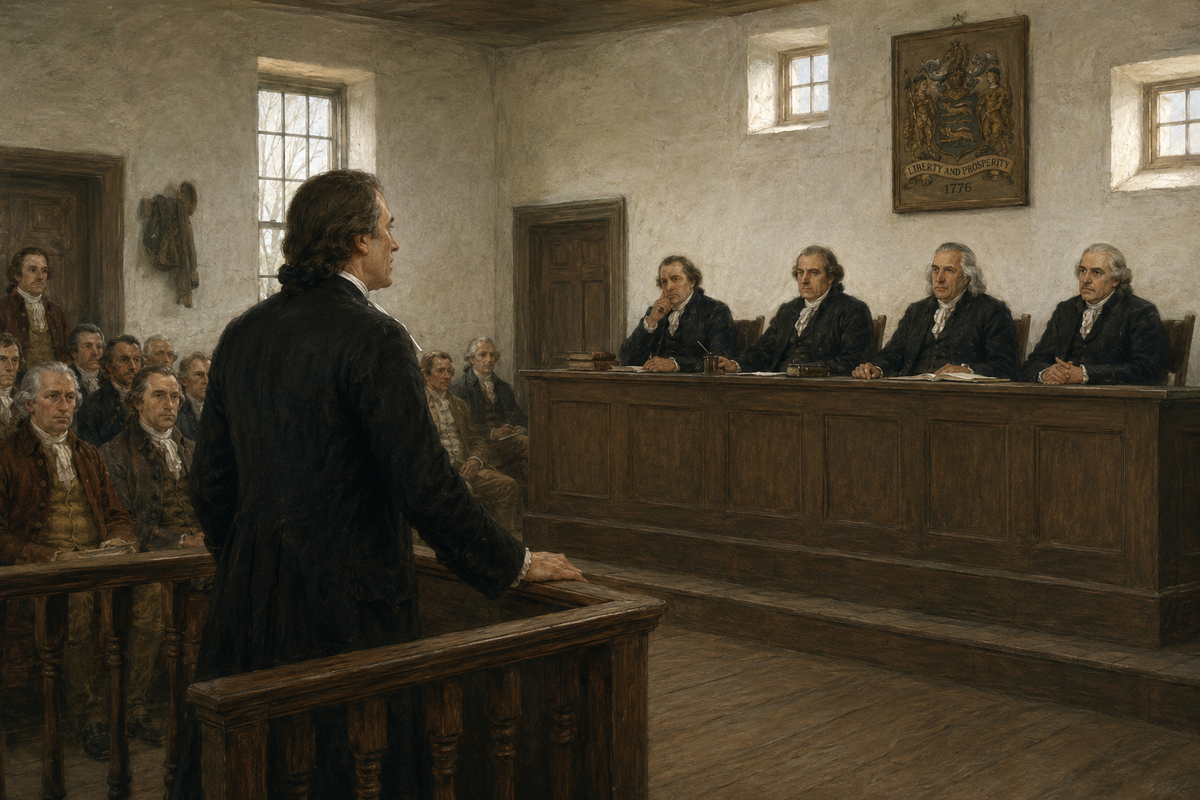
Because Jabez pleaded guilty, no trial jury ever weighed his case; the only jury that acted was the grand jury that handed up the indictment, and its foreman was John McMurtrie. The bench that term was no rural commission. It seated Robert Morris, chief justice of the new state; John Cleves Symmes of the Supreme Court; Mark Thomson presiding among the county justices; and the prosecution was conducted by the attorney general of New Jersey himself, William Paterson — a future framer of the Constitution and a future justice of the United States Supreme Court, then thirty-one and building the caseload that made his name.2 The state sent its first lawyers to Newton that spring because Sussex was exactly where the Revolution felt least secure.
So I went looking for the religion of those five men, and what came back is worth setting down plainly, with its uncertainties intact, because it complicates the story in the right direction rather than the tidy one.
Several of the men who mattered most that day appear to have come out of Presbyterian families. William Paterson, who signed the indictment, was of an Ulster Scots-Irish family, a graduate and later a trustee of the College of New Jersey — the Presbyterian college at Princeton — and when he died his memorial sermon was preached in the Presbyterian church of New Brunswick, by that congregation’s own pastor.3 The foreman who returned the “true bill” — almost certainly Capt. John McMurtrie of Oxford Township, though the record gives us the name and leaves us to infer the man — came of the McMurtry family whom the county’s own historian names among the “Scotch-Irish Presbyterians” who built the first Presbyterian church in those parts; he lies buried in its churchyard.4 And Mark Thomson, who presided among the county justices — a judge, not an accuser — came of a Pennsylvania family the church histories call “old stock Presbyterians.”5 None of these is a session roll — I am reading family, burial, and college, not a membership book, and I hold each as probable, not proven. But the direction is consistent: the side that accused Jabez, and the local justice who sat over it, came out of the Presbyterian interest.
And then the complication, which I like better than I would like a clean answer. The man at the head of the bench was not a Presbyterian at all. Chief Justice Robert Morris was an Episcopalian — buried in the churchyard of Christ Church, New Brunswick, out of a family that had been Church of England for three generations.6 And John Cleves Symmes, beside him, came out of the New England Congregational world — his father a minister who moved between Congregational and Presbyterian pulpits, his own faith, by his later letters, a tolerant and roving thing.7 Symmes, in other words, stood in more or less the same tradition Jabez himself did.
Which is the first thing worth saying about the sentence. If Jabez, pleading guilty before that bench, meant his warning for the room — and a preacher knows his audience even at the bar — then it was a warning uttered to a mixed house: to Presbyterian prosecutors, and past them to an Anglican chief justice, that the interest now ascendant would not stop with Tories. The old alliance of throne and altar had a mirror image, and he was naming it: an altar that meant to do without a throne, and to keep the throne’s power for itself.
The county
Now widen the frame to the county, because the sentence makes a different kind of sense once you see the ground.
Sussex in the 1770s was a religious patchwork, and Jabez stood in a thin corner of it. The oldest settlements along the Delaware were Dutch Reformed, the Minisink congregations; much of the rest of the county was German and English farming stock. Wantage itself, Jabez’s own township, was mostly Dutch and Huguenot by descent, with a German minority — and, threaded through it, “several families,” the county historian says, “descended from the Pilgrim Fathers.” That New England thread was Jabez’s. A colony out of New England had brought its Congregational church government with it and raised the Beemer Meeting-House, “the first and only Congregational Church in the county of Sussex.”8 It was a minority institution in a Dutch township, and it did not last as one; a lifetime after Jabez left, the congregation gave itself up and merged into the Presbyterians. He was a New England Congregationalist in a county that had almost none.
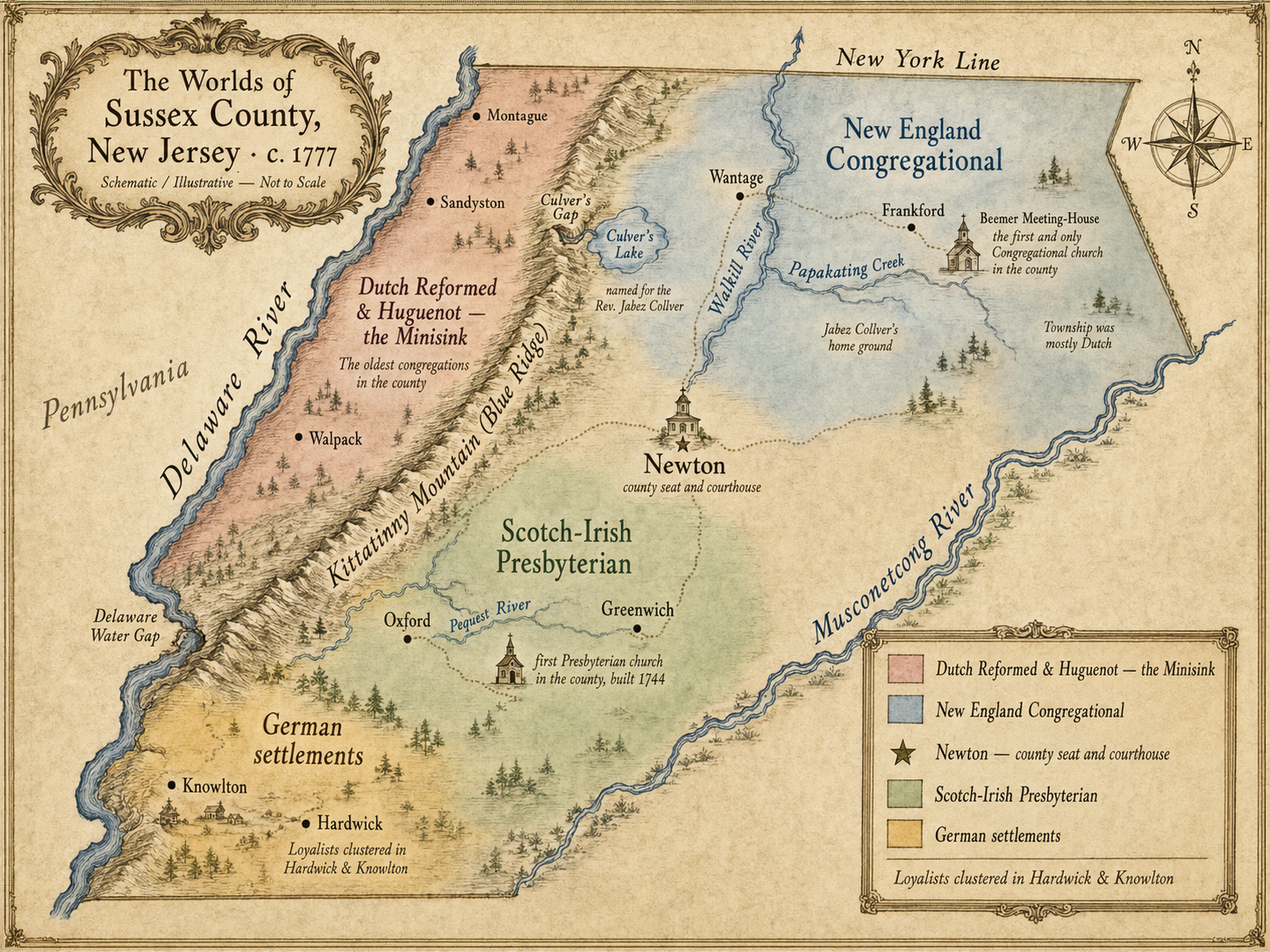
The Presbyterians proper were the other Calvinists over the hill. In the Oxford and Greenwich country — the Warren County side now — the Scotch-Irish had settled thickly enough to raise the first Presbyterian church in the two counties as early as 1744, in a neighborhood whose name still carries the labors of David Brainerd, the missionary to the Delawares.9 These were not Jabez’s congregation, but they were his neighbors and his rivals in the same Reformed vineyard, and by 1776 they were something else besides: they were, very largely, for the Revolution.
And here the ground refuses to sort itself as neatly as a thesis would like, which is exactly why I trust what it shows. If you look for Sussex’s Loyalists on the map, you do not find them clustered among the Congregationalists, or opposite the Presbyterians. When the Council of Safety drew up its 1777 list of the county’s disaffected, twenty-three of the twenty-eight men named lived in the frontier townships of Hardwick and Knowlton, mixed Dutch-and-German country; the solidly Scotch-Irish Presbyterian townships barely appear, and neither does Wantage.10 In fact Jabez’s own township had gone almost to a man for the Revolution: when the county returned who had signed the Continental Association in 1775, Wantage “all agreed except Joseph Havens and one or two more Quakers” — and even those refusers, the report is careful to add, “are Whigs and are willing to contribute.” Jabez, in other words, was not the voice of a Loyalist neighborhood. He was very nearly the only Tory in a Patriot town. Which does not soften the strangeness of his sentence; it sharpens it. A man who was already an outlier, already convicted in the court of his own community, chose for his defiant last word not a defense of the King but a warning about the Presbyterians. That is not the reflex of a frightened Tory. It is the considered judgment of a man who had thought about it.
The Presbyterians’ Whiggery, on the other hand, was no Sussex peculiarity at all. Across the colonies the Scotch-Irish Presbyterians were so nearly unanimous for the Patriot cause that the British and their allies took to calling the whole war a Presbyterian one. A Hessian captain wrote home, in words a careful historian can actually source, “call it not an American rebellion, it is nothing more nor less than an Irish-Scotch Presbyterian rebellion.”11 Ambrose Serle, secretary to General Howe, judged that the revolt “could not be sustained in America if it were not for the Presbyterian ministers.” The Loyalist William Jones called it “a Presbyterian war from the beginning.” The phrase was loose — when King George asked of the New England rebels “are they not Presbyterians?” his exiled governor Thomas Hutchinson had to correct him that most were Congregationalists — but loose in a way that is itself the point: to a frightened Crown, Congregationalist and Presbyterian and Calvinist and republican were one hostile thing, and the name that thing went by was Presbyterian.12
Jabez knew the difference his neighbors blurred. And he had a nearer illustration than any pamphlet. The Presbyterian minister of the Greenwich and Oxford and Mansfield churches, a few years before, had been the Rev. John Rosbrugh — an Ulster-born man who took the field as a chaplain and was killed by Hessian troops at Trenton on the second of January, 1777, cut down, the tradition says, when they learned he was a Presbyterian preacher.13 Three months later Jabez fell into the conversation that undid him; ten weeks after that he stood at the bar at Newton and paid his five pounds. The two men were the same kind of Calvinist and the exact opposites of that war — one dead for the cause before the spring, the other fined in June for having spoken against it, in the same year and the same corner of New Jersey. If you want to know why a Congregationalist in Sussex County would think hard, and bitterly, about what Presbyterian victory might mean, you do not have to go back to Scotland. You can stand at Trenton.
Why a Congregationalist feared the Presbyterians
Start nearer than England. In 1770 — seven years before he fell into conversation with Benjamin Hull — a company of his own kin walked into the Presbyterian church at Mendham and disturbed the service by knitting through it and passing remarks about the hireling in the pulpit. They were thrown out. They did it again at Basking Ridge, and there they were fined and flogged for it.14 These were the Rogerenes of Schooley’s Mountain — the neighbors called them the Colverites, having decided, reasonably enough, that the simplest name for the strange Sabbath-less clan on the mountainside was the family’s own. Jabez was not among them; he was a settled minister to the north in Sussex County by then, and had been for nine years. But they were his people. Five years before Lexington, in enlightened New Jersey, the church that had his family whipped was a Presbyterian one.
That is worth setting beside the other half of the ledger, because this family took it from both directions: whipped and jailed by Congregationalist magistrates in Connecticut, fined and flogged by Presbyterians in New Jersey. His own grandmother, Sarah Long, had stood before a Connecticut bench in 1719 and been sentenced to fifteen stripes on the naked body for telling the justices they were an adulterous generation.15 So when he told a neighbor that the Presbyterians would pull down all other persuasions, he was not reaching for a theory. He was saying what, in his family, had lately happened.
He did go back to England, too — to a memory every educated Protestant of his generation carried in the marrow.
Look again at the sentence he was fined for, and notice its first words: set up the King’s Standard. That is not a phrase a man invents. King Charles I raised his royal standard at Nottingham on the twenty-second of August, 1642, and by that act declared his enemies rebels and began the English Civil War.16 To “set up the King’s standard” was, for a hundred and thirty years afterward, the very idiom of declaring for the Crown against a rebellion; British officers were still using it in 1780 of Benedict Arnold. When Jabez reached for those words in 1777 he was not being quaint. He was reading the American rebellion through the one precedent his century agreed it resembled — the last time English-speaking Protestants had raised armies against their king, killed him, and remade the church. And on the far side of that memory stood the figure every Loyalist invoked as the end of the road rebellion runs: Oliver Cromwell, the regicide, the man of God with an army — “a brave bad man,” the standard history in every colonial library called him.17 This was not Jabez’s private analogy; it was the common Loyalist one. A pamphleteer answering Thomas Paine cast him as “the new Cromwell”; Peter Oliver, the last royal chief justice of Massachusetts, opened his history of the rebellion by reaching back to “the Year 1641”; a London satire of 1776 labeled the Yankee entrenchments “Old Oliver’s Cause.”18 To an educated Loyalist, 1776 was 1642 coming around again, and everyone knew how 1642 had ended.
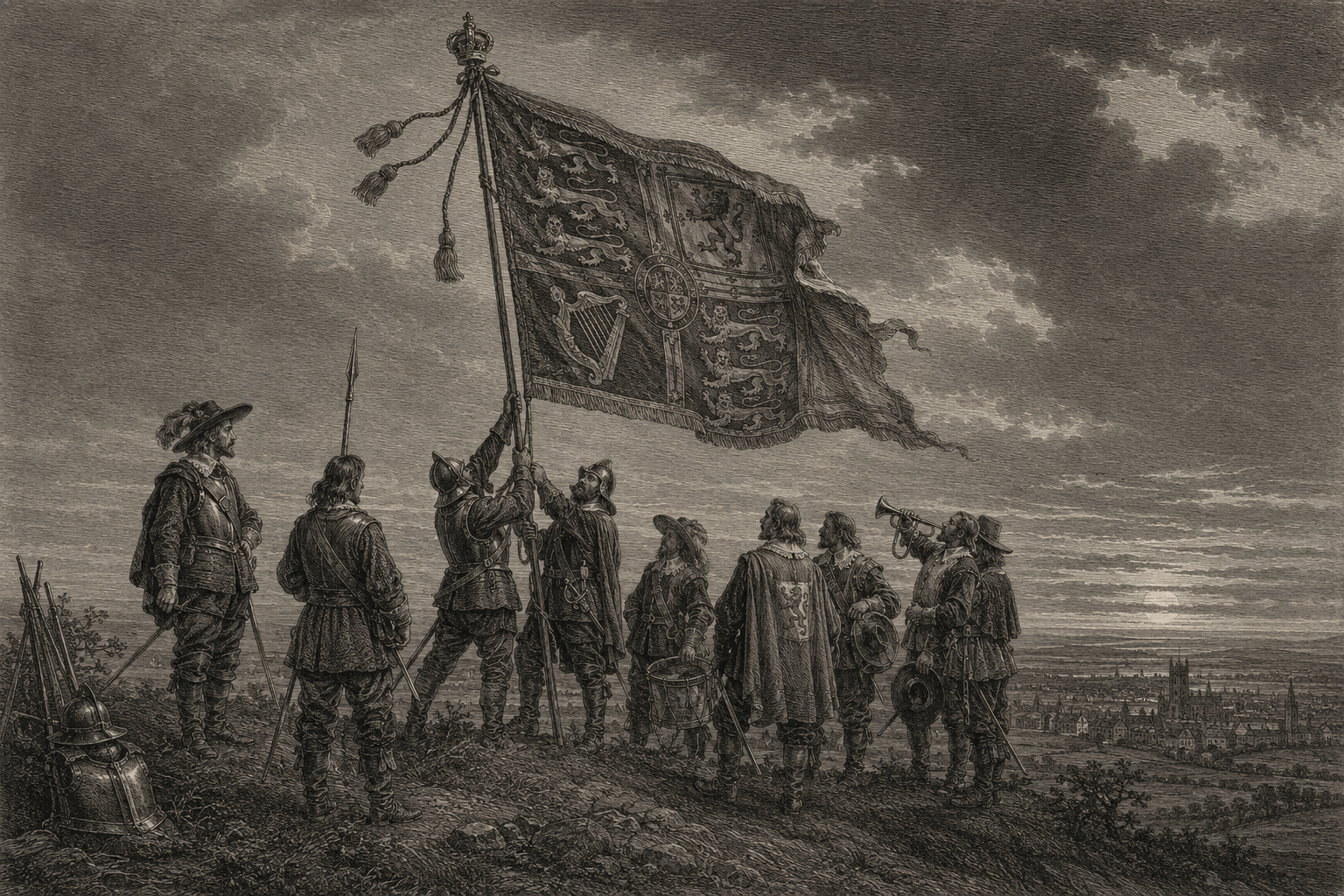
Here is where the third sentence stops being strange.
In the 1640s — the war Jabez’s phrase summoned — it was precisely the Presbyterians who were the party of a single, compulsory, established church. The Solemn League and Covenant of 1643 bound England and Scotland to “the extirpation of prelacy” and to uniformity in religion across three kingdoms; the Westminster Assembly drew up a Presbyterian government to be imposed on all of England.19 The party that resisted that imposition — that argued for leaving gathered congregations to themselves — were the Independents, which is the old name for the Congregationalists. Cromwell’s party. Jabez’s own polity. When the New Model Army purged Parliament in 1648, the members it threw down the stairs were the Presbyterians.20 Cromwell himself, whatever else he was, wrote that “from brethren, in things of the mind we look for no compulsion but that of light and reason.” And John Milton — Independent, republican, the great poet of the Puritan cause — had by then already written the couplet that says the whole thing in six words, watching the Presbyterians of the Assembly reach for the coercive machinery the bishops had just laid down:
New Presbyter is but Old Priest writ Large.21
That is Jabez’s sentence, near enough, a hundred and thirty years early. The Presbyterians will pull down all other Persuasions. He was not saying something eccentric. He was saying something an Independent had every historical reason to believe, because within living Protestant memory the Presbyterian interest, given the power, had tried to do exactly that.
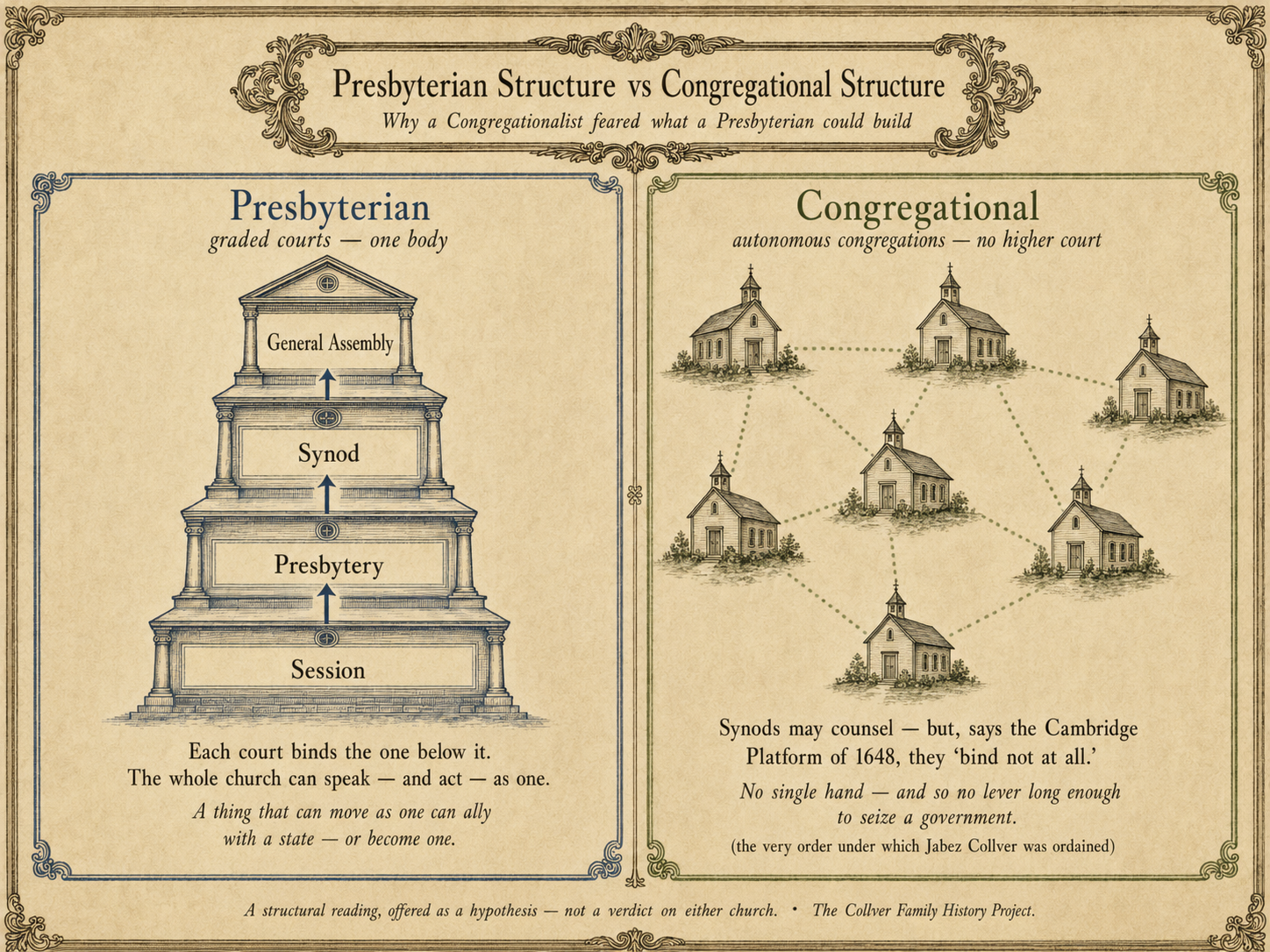
And there is a structural reason underneath the historical one, which I will offer as my own reading rather than dress up as settled scholarship, because I could find no historian who has argued it in quite these terms. A Presbyterian church is built to act as one body. Its graded courts — session, presbytery, synod, general assembly — are joined into a single structure, review and appeal running upward through them and the decisions of the higher courts binding the lower, so that the whole church can, in principle, speak and move as one thing; and a thing that can move as one can ally with a state, or become one. A Congregational church cannot do this, and by design. Its own founding charter, the Cambridge Platform of 1648 — the very order under which Jabez himself was ordained — says of synods that they may counsel but “bind not at all.” A communion of independent congregations has no lever long enough to seize a government, because it has no single hand.22 Jabez, warning against Presbyterian dominion, was warning against a machine his own tradition had deliberately declined to build.
I want to be careful here, because this is exactly the place where a family historian’s affection can turn into a sermon, and the record will not bear a sermon. Congregationalism was no innocent. In New England it was itself the established, tax-supported church, and it was the last establishment to fall in America, holding on in Massachusetts until 1833. It whipped Baptists and hanged Quakers on Boston Common. And — the detail that ought to keep a Colver honest — the Rogerenes of Connecticut, the whipped and jailed dissenting sect from whom this very family descends, were whipped and jailed by Congregationalist magistrates.23 The arch-regicide Cromwell was an Independent. So the true shape of the thing is not tolerant Congregationalists against tyrannical Presbyterians; every Calvinist establishment of that age coerced when it held the sword. The difference Jabez was pointing at is narrower and, I think, real: it is a difference of structure — of which kind of church is even capable of becoming a national instrument — and a difference of the moment, of who, in Sussex County in 1777, actually held the machinery. On both counts the answer was the same, and he named it.
There is a small justice to be done the man, before leaving all this. The one nineteenth-century historian who troubled to describe Jabez — the Presbyterian church-chronicler William Gregg — called him “not an educated man,” a devoted Christian of “great force of character,” but no scholar.24 It is a verdict worth weighing against the sentence itself. A remark that reaches for the vocabulary of 1642, that fears the Presbyterian interest for what, within living Protestant memory, it had actually tried to do, and that draws the line between an established church and a free one as cleanly as this one does, is not the work of an unlettered man. It is the work of a self-taught one — which is a different thing. And the proof outlasted him: in his eighties, in the Canadian bush, Jabez sat and hand-stitched a booklet of some thirty-eight pages of close trinitarian argument, “The Doctrine of Christ, or Pure Divinity,” the last page signed three days before his eighty-sixth birthday.25 Whatever the court meant to take from him that June, it accidentally preserved the best short evidence we have that the preacher of Wantage had read more, and thought harder, than even his admirers remembered.
The Scots in the room
There is a third strand, and it is the one most easily overstated, so let me handle it with care.
The Presbyterians in that courtroom were not only Presbyterians. They were, many of them, Scots or the children of the Ulster Scots, and the Scots came to America carrying a grievance against the Crown and its bishops that was three or four generations deep. It was not a romantic tartan quarrel — and here the popular version has to be resisted, because the honest history is better. The Presbyterian Scots were not Jacobites; they had no love for the exiled Stuarts. Just the reverse: their own tradition had been hunted by the Stuart kings. The Scottish Covenanters had signed their National Covenant in 1638 against a king’s attempt to force bishops and a prayer book on their Kirk; under Charles II and James VII the dragoons had run them down in the “Killing Time”; and their grandchildren in Ulster had been shut out of office by a Test Act that required Anglican communion of anyone who would serve the Crown.26 “No bishop, no king,” James I had said, meaning it as praise of episcopacy — that bishops were the props of monarchy. The Presbyterians had spent a century agreeing with him, and drawing the opposite conclusion.
So the grievance the Scots carried into that Sussex courtroom was real and live, but it was religious and political before it was ethnic: a settled conviction, watered in blood, that a king’s church was an instrument of tyranny over conscience, and that they would not live under one again. To such men, a Loyalist minister urging his neighbors to set up the King’s standard was not merely a political enemy. He was the old enemy in a new country — the man who would call the bishops back. That his warning turned the accusation around, and made them the coming persecutors, would not have softened it. The deeper Anglo-Scottish story — the centuries of border war, the resented Union of 1707 — was by 1777 a distant and much-refracted thing, several generations and an ocean removed, and I will not lean on it. But the nearer grievance, the Covenanter’s grievance against a crown-controlled church, was close enough to touch, and it sat on the grand jury.
The long echo
Here I have to step across two hundred and fifty years, and I want to do it slowly, because the ground is live and easy to burn.
A reader in 2026 cannot hear “the Presbyterians will pull down all other Persuasions” without something modern stirring — the movement that has come to be called Christian Nationalism, the argument that a nation ought to be formally, governmentally Christian, with the machinery of the state behind one confession. And there is a genuine and documentable thread here, though it is not the crude one. The mass of American Christian Nationalism is not Presbyterian at all; by the surveys it is broadly evangelical — Baptist, Pentecostal, nondenominational — and Presbyterians are barely two percent of the country, too few for the pollsters to break out.27 But its intellectual architecture is another matter. The theonomy and “Christian Reconstruction” of R. J. Rushdoony and Greg Bahnsen, which supplied the movement much of its scaffolding, were Reformed and Presbyterian projects; the most cited recent book making the case is by a member of a Presbyterian church; its most energetic publisher is a Reformed house in Idaho.28 The idea that a covenanted nation should enforce one form of faith, and not “suffer any denomination to worship God in any other way than they shall prescribe” — those last words are the prosecutor’s own gloss on Jabez’s sentence, written in 1777 — is a Reformed idea before it is anyone else’s, and it draws, self-consciously, on exactly the covenant theology the Solemn League once ran on.29
So I will put the question the way Jabez’s sentence puts it to me, as a hypothesis and not a verdict, because it deserves no more than that. Is there something in the Presbyterian system — the very thing that makes it strong, its capacity to act as one ordered body — that makes it more available than others to the ambition of governing? No assembly’s resolution binds a nation by itself; what an assembly can do is settle on one national programme and put a whole church’s weight behind it, and then, if the state will lend its arm, that programme acquires the force of law. The arm of the state is the necessary ingredient, and always was. But a scatter of independent congregations has no floor from which to do even the first part — nothing that can resolve on behalf of them all, and so nothing for a state to take up. Congregationalism, whatever its sins, would have a hard time organizing a comprehensive movement, because it is not organized comprehensively at all. That is not a charge; it is a structural observation, and I hold it as a guess worth testing, not a thing proven.
And it comes with the same complication the courtroom did, which is why I trust it. Today’s Presbyterian world is not marching in one direction any more than that 1777 bench was. The mainline Presbyterian Church (U.S.A.) voted in 2026, by four hundred and fifty-eight to eighteen, to name white Christian nationalism a theological error. The conservative Presbyterian Church in America has a committee of its own studying the thing and has already said that any Christian nationalism resting on ethnic partiality is “contrary to Scripture, the Westminster Standards and the Gospel.” The Reformed house in Idaho is a small body the larger Presbyterian churches hold at arm’s length.30 There is no monolith now, and there was none then. Jabez could not have foreseen any of this; Christian Nationalism as a named movement was two centuries past his horizon. The most I would claim for him is that he may have felt, in the frame of his own bones, a structural tendency in a system he had reason to watch closely, and named it in one sentence before a court that embodied it.
The sentence, again
I began with his words, and I will end with them, because after all the reconstructing they read differently than they did at the top of the page.
And if America overcome, the Presbyterians will pull down all other Persuasions.
It was, I think, three things at once. It was a theological judgment — a Congregationalist’s conviction, grounded in a century of Protestant memory, that of all the churches the Presbyterian was the one built to govern. It was a political warning in the idiom of 1642 — that a rebellion which set up its own standard against a king would end, as the last one had, in a man of God with an army and a church that brooked no rivals. And it was a word to the room — a preacher’s shot, aimed past his Presbyterian prosecutors at the Anglican judge above them, that the interest now winning would not stop at Tories, and that the men enforcing this new order might live to be measured by it themselves.
He was wrong about the war. America overcame, and the Presbyterians pulled down nothing; the federal republic that followed did the one thing no side in the old English quarrel had thought to try, and established no church at all. The states were slower — they kept the establishments they had, and those fell away one by one, the Congregational ones last of all, until Massachusetts let go the final establishment in America in 1833. Jabez lived out his years preaching, unpulled-down, in a Canadian forest. The prophecy failed.
But a failed prophecy can still be a true reading of a fear, and the fear it read is not a dead one. Whether a church that can act as one body will, given the chance, use the state to pull down all other persuasions — that is not a question the eighteenth century closed. It is on the docket still. My sixth great-grandfather paid five pounds for putting it there, in a sentence sharp enough that two hundred and fifty years later I am still turning it over, trying to decide how much of it he meant, and how much of it was right.
Sources and notes
The indictment: New Jersey State Archives, Supreme Court Case Files, SSV00001 no. 34547 (Sussex Oyer & Terminer), in the clerk’s hand and signed by Attorney General William Paterson; read for this project from the archive’s own scan and transcribed whole in the book’s appendix. The reported words are given here continuously; the indictment interleaves them with the prosecutor’s formal glosses (“meaning the said Jabez Colver,” and so on). The New Jersey State Library’s public exhibit, “Seditious Words: Jabez Collver and Freedom of Speech in the American Revolution,” reproduces and annotates the case: https://www.njstatelib.org/exhibits/nj250/1776era/seditious-words/.↩︎
The session and its officers — Chief Justice Robert Morris; John Cleves Symmes of the Supreme Court; Mark Thomson presiding among the county justices; Attorney General William Paterson prosecuting; John McMurtrie foreman of the grand jury; indictment 28 May 1777, guilty plea 12 June 1777, sentence of five pounds and committal until paid — all as recorded in the Sussex Oyer and Terminer rough minutes (New Jersey State Archives, SOY00001) and the case file (SSV00001 no. 34547).
William Paterson (1745–1806): born of an Ulster family in County Antrim; A.B. 1763 and trustee (1787–1802) of the College of New Jersey; his memorial sermon was preached in the Presbyterian Church of New Brunswick by its pastor, the Rev. Joseph Clark, in 1806. The direct evidence is family, college, and funeral rather than a membership roll, and the identification is offered as probable. (A “confirmed” answer would want the New Brunswick session minutes or O’Connor’s 1979 biography.)
John McMurtrie: almost certainly Capt. John McMurtrie of Oxford Township (1738–1792), Committee of Safety organizer and later county judge. James P. Snell, History of Sussex and Warren Counties, New Jersey (1881), names the McMurtrys among the settlers “all of whom were Scotch-Irish Presbyterians,” who raised “the first Presbyterian church in the two counties … in 1744” (Greenwich/Oxford), served in time by David Brainerd; McMurtrie was buried in the Old Oxford church graveyard. The identification of which John McMurtrie is by civic profile; the Presbyterian affiliation is documented at the level of family and township.
Mark Thomson (1739–1803): his father’s line at Norriton, Pennsylvania, is described in Collins, Norriton Presbyterian Church (1894), as “old stock Presbyterians”; he was later buried in what became the Marksboro Presbyterian cemetery (a congregation organized after his death, so the burial does not by itself prove membership). Probable by family; not personally documented.↩︎
Robert Morris (1745–1815), first chief justice of New Jersey and later the first U.S. district judge for New Jersey — not to be confused with the Philadelphia financier of the same name. Buried in the churchyard of Christ Church (Episcopal), New Brunswick; grandfather Gov. Lewis Morris was a Trinity Church vestryman and an early member of the Society for the Propagation of the Gospel. Probable Episcopalian.↩︎
John Cleves Symmes (1742–1814): son of the Rev. Timothy Symmes, a Harvard-trained minister who served both Congregational and (New Side) Presbyterian pulpits and sat in the Synod of New York; descended from the Rev. Zechariah Symmes of Charlestown. His own later correspondence (Bond, ed., The Correspondence of John Cleves Symmes, 1926) shows a broad, tolerant, unsettled churchmanship — by 1809 he kept “no steady meeting” — rather than a firm denominational membership. He is best described as standing in the New England Congregational-Presbyterian tradition, which is to say near Jabez’s own.
Snell, History of Sussex and Warren Counties (1881), on the Beemer Meeting-House, “the Congregational Church of Wantage and Frankford … the first and only Congregational Church in the county of Sussex,” and naming Rev. Jabez Collver among its early pastors. Jabez’s own churchmanship: he was ordained, per the Dictionary of Canadian Biography and the Rev. William Gregg’s History of the Presbyterian Church in the Dominion of Canada (1885), “according to the Cambridge Presbyterian order, which was a Congregational platform” — Congregational polity under a hybrid name. The era often called such ministers “Presbyterian” loosely; he stood in the Congregational tradition, which is precisely what makes his warning against the Presbyterians worth a second look.
Snell, as above: the Scotch-Irish Presbyterian settlement of the Oxford/Greenwich country and the 1744 church, “the first Presbyterian church in the two counties,” whose first pastor was the Rev. James Campbell. Snell adds that Campbell “was followed by David Brainerd” — but says in the same breath that Brainerd was “the celebrated missionary to the Indians, whose labors called him frequently into the vicinity,” which is the safer way to put it and the way it is put above: Brainerd was ordained a missionary to the Delawares, not called as the settled pastor of a settler congregation, and I do not lean on Snell’s “followed” as though it made him one. A caution on proportion: the dominant eighteenth-century ethnic story of Sussex proper is Dutch and German; the Scotch-Irish Presbyterians were a thinner and somewhat later layer, concentrated on the Warren-county side.
The return itself, and not a summary of it: on Wednesday, 9 July 1777, Major Samuel Meeker, Samuel Kirkendall, Isaac Martin, Jacob McCollom, and George Allen “appeared before the Board & gave in the names of the following persons as disaffected & dangerous to the present Gov’t” — fifteen in Hardwick (Gabriel Wilson Sen., Simeon Boiles, Samuel Lundy, Nathaniel Hart, Thomas Lundy, John Green, Jacob Lundy, Charles Pettit, John Collins, Adam Green, Edmund Thatcher, Simpson Howell, James Hannah, Ralph Hunt, and Capt. John Shaw); eight in Knowlton; one in Wantage (Solomon Cartwright); three in Newton; and one in Oxford. Twenty-eight in all. Minutes of the Council of Safety of the State of New Jersey (Jersey City, 1872), 79–80. A note on the arithmetic, since it cost me a correction: Snell’s county history reports this same return and gives the same total — “a list of twenty-eight names” — but his township breakdown puts sixteen in Hardwick, which makes his own figures add to twenty-nine. Counted against the Council’s own list, the total of twenty-eight is right and the Hardwick number is fifteen. The likeliest culprit is the printer rather than the historian: “Edmund Thatcher” falls across a page break in the minutes, and the catchword “Thatcher” repeats at the head of the next page — enough to turn one man into two for anyone counting in a hurry. I had followed Snell, and had it wrong by one until I went and counted the names. Readers of The Judge, the Preacher, and the Log Gaol will recognize Adam Green among the Hardwick names — the same man whose 1808 declaration puts him in the Log Gaol alongside Judge Pettit. The August 1775 Continental Association returns (“in Wantage all agreed except Joseph Havens and one or two more Quakers, ‘who are Whigs and are willing to contribute’”) are in Snell, History of Sussex and Warren Counties (1881), ch. VIII; Snell, writing expressly to rebut a reputation for Sussex disaffection, is a partisan witness on the county’s overall loyalty, and his “one in fourteen” tally should be read as his own counter-argument rather than a neutral count. Note too that six or seven of those named were Quakers who objected to the oath on conscience and were bound by surety rather than punished as Tories — a caution against reading the list as a straight map of Loyalism.
Capt. Johann Heinrichs of the Hessian Jäger Corps, letter of 18 January 1778, printed as “Extracts from the Letter-Book of Captain Johann Heinrichs,” Pennsylvania Magazine of History and Biography 22 (1898): 137. The Serle and Jones quotations following are gathered, with their citations, in Richard J. Gardiner, “The Presbyterian Rebellion?”, Journal of the American Revolution (3 September 2013): Serle to Dartmouth, 8 Nov. 1776; William Jones, Works (1801), vol. 12, p. 356.
George III’s “are they not Presbyterians?” and Hutchinson’s correction are recorded in Hutchinson’s own diary (The Diary and Letters of His Excellency Thomas Hutchinson, 1884, vol. 1, p. 168). The much-quoted Horace Walpole quip — “Cousin America has run off with a Presbyterian parson” — is not used here: it traces to no primary source, and the retellings that call Walpole a prime minister who spoke it in Parliament are doubly wrong (he was never prime minister and had left the Commons by 1768). A vivid line, but an unverified one.
Rev. John Rosbrugh (or Rosbrough), Ulster-born Presbyterian minister who had served the Greenwich, Oxford, and Mansfield Woodhouse churches in New Jersey before removing to Pennsylvania; killed by Hessian troops near Trenton, 2 January 1777. The detail that he was killed specifically as a recognized Presbyterian minister rests on strong traditional accounts rather than a contemporary eyewitness document; the core facts of his pastorate and death are well attested.
A hedge that matters: the 1770 disturbances come from Henry C. Pitney’s History of Morris County (1914), and he gives them as tradition, not record — a company of Rogerenes “from Schooley’s Mountain” entered the Presbyterian church at Mendham and disturbed the service “by sewing and knitting and by disparaging comments on ‘the hireling preacher,’” were forcibly ejected, then “repeated the misdemeanor at Basking Ridge and suffered by fines and flogging.” I have no document behind it, and I do not claim Jabez was present — only that these were his kin and his sect, and that this is what the word Presbyterian had lately meant in his family. Pitney is also the source for the nickname: the Schooley’s Mountain company was “composed chiefly of the Colver family and the families with which it had intermarried … and were usually called Colverites by other settlers.”↩︎
Sarah Long, wife of John Colver — Jabez’s father’s mother, which makes the fifteen stripes a matter of two generations, not ancient history. The sentence is in the New London County Court record of November 1719, through John Rogers Bolles and Anna B. Williams, The Rogerenes (1904), 249: she “indignantly exclaims in court: ‘You are an adulterous generation and I hope God will find you out’ … for which the court sentences her to receive fifteen stripes on the naked body.” “On the naked body” is the court’s own formula, not an embellishment. Note sentenced: the same historians suspect the midnight prison-yard rescue of that November carried Sarah beyond reach of the lash as well (ibid., 250), so whether the stripes were ever laid on is not known, and I decline to say she took them.
Charles I raised his standard at Nottingham on 22 August 1642, opening the First English Civil War (Clarendon, History of the Rebellion; and the standard reference works). The idiom’s survival into the American war: Sir Henry Clinton described Benedict Arnold in 1780 as having “joined the King’s standard.”
The “brave bad man” is Clarendon’s summing-up of Cromwell’s character (History of the Rebellion, Bk. XV); David Hume’s near-equally standard verdict called him “a frantic enthusiast” and “the most dangerous of hypocrites” (History of England). Both works — the royalist and the Whig histories of the Civil War — were in nearly every substantial colonial library, Clarendon’s copy shelved at the College of New Jersey by 1760; the eighteenth-century American picture of Cromwell was the usurper-regicide, not the liberator.↩︎
James Chalmers, Plain Truth (1776), answering Paine, cast him as a would-be “Cromwell”; Peter Oliver opened his Origin and Progress of the American Rebellion (1781) by placing the American crisis in a line of English convulsion running back to “the Year 1641”; the London satirical print “The Yankie Doodles Intrenchments Near Boston” (1776) labeled the rebel works with Cromwell’s “Old Oliver’s Cause.” Modern scholarship treats the Loyalist “this is the Great Rebellion again” trope as a recognized theme: James C. Spalding, “Loyalist as Royalist, Patriot as Puritan,” Church History 45 (1976); Thomas N. Ingersoll, The Loyalist Problem in Revolutionary New England (2016), ch. “Loyalists and Oliver Cromwell’s Ghost.” (Exact wordings of the Oliver and print captions are drawn from secondary description and should be checked against the originals before they are quoted as verbatim in the book.)
The Solemn League and Covenant (1643), Article II, bound the parties to “the extirpation of Popery, Prelacy … Superstition, Heresy, Schism,” and Article I to “uniformity in religion” across the three kingdoms; the Westminster Assembly (1643–49) drew up the Presbyterian Form of Church Government intended for England. Historians note the Covenant’s text was deliberately ambiguous enough to keep the English Independents on side — it did not name Presbyterianism outright — but its practical aim was a single established Presbyterian church.↩︎
Pride’s Purge, 6 December 1648: Colonel Thomas Pride’s soldiers excluded from the Commons the Presbyterian and moderate members who favored continued treaty with the king, leaving the Independent-dominated “Rump” that tried and executed Charles I. See the History of Parliament Trust’s account.
John Milton, “On the New Forcers of Conscience under the Long Parliament” (c. 1646), closing line: “New Presbyter is but Old Priest writ Large.” Milton, himself of the Independent/tolerationist party, wrote it against the Westminster Assembly Presbyterians’ drive for a compulsory national church. Cromwell’s “no compulsion but that of light and reason” is from his own correspondence.
The Cambridge Platform (1648), the founding constitution of New England Congregationalism, holds that synods may counsel but their determinations “bind not at all” apart from their agreement with Scripture — the explicit renunciation of binding higher courts that defines Congregational from Presbyterian polity. Jabez was ordained under this “Cambridge order.” The structural inference drawn here — that a connectional polity is more capable of acting as a single national body, and so more available to alliance with the state, than a congregational one — is my own reading offered as a hypothesis; I have not found it argued as such in the scholarly literature, and it should be weighed as an argument, not cited as a finding.
On Congregational establishment and its coercions: Massachusetts and Connecticut maintained tax-supported Congregational establishments, the last of which (Massachusetts) fell only in 1833; the Boston executions of Quakers (1659–61) and the whippings of Baptists are well documented; and the Rogerenes of New London — this family’s own dissenting kin — were fined, whipped, and jailed by Connecticut’s Congregationalist authorities (Bolles and Williams, The Rogerenes, 1904). The point is deliberately made at the family’s expense: coercion in that age was a property of establishment, not of one polity alone.
The Rev. William Gregg, History of the Presbyterian Church in the Dominion of Canada (1885), 182: Jabez “was not an educated man, but was a devoted Christian, and had great force of character.” Gregg, writing from the Presbyterian side and with evident goodwill, meant it as fair praise; set beside Jabez’s own words it reads more like an underestimate. “Self-taught” is the juster word than “uneducated.”
Jabez Collver, “The Doctrine of Christ, or Pure Divinity,” an autograph booklet of roughly thirty-eight pages, dated 1811–1817 (Norfolk Historical Society / Eva Brook Donly Museum, Simcoe, Ontario). A sustained, formally structured, explicitly anti-Unitarian trinitarian argument in his own hand; the last page is signed “Jabez Collver — 16th June 1817,” three days before his eighty-sixth birthday and about eighteen months before his death.
The National Covenant (1638), the Solemn League (1643), the “Killing Time” of the 1680s under Charles II and James VII, and the Irish Test Act of 1704 (barring Presbyterians who would not take Anglican communion from office) are standard Covenanter and Ulster-Scots history. James VI and I’s “No bishop, no king” (Hampton Court, 1604) tied episcopacy to monarchy in the era’s own logic — a link the Presbyterians accepted and inverted. A necessary caution: the Presbyterian Scots were generally anti-Jacobite and pro-Hanoverian; their quarrel with the Crown was the Covenanter’s quarrel over a king’s control of the church, not the Jacobite’s over the Stuart succession. The two must not be confused.
Survey data: PRRI’s 2025 American Values Atlas measures Christian-nationalist sympathy highest among white evangelical Protestants (about two-thirds adherent-or-sympathetic) and does not break out Presbyterians as a category at all; Pew’s figures put all Presbyterian bodies together at roughly two percent of U.S. adults. The mass base of the movement is broadly evangelical — Baptist, Pentecostal, nondenominational — not Presbyterian.
R. J. Rushdoony (ordained in the Presbyterian Church, U.S.A., in 1944; later received into the Orthodox Presbyterian Church) and Greg Bahnsen (an OPC minister) built the “Christian Reconstruction” and theonomy frameworks on Reformed covenant theology and postmillennial eschatology; Stephen Wolfe, author of The Case for Christian Nationalism (2022), has stated membership in the Presbyterian Church in America; his publisher, Canon Press, is the Reformed house founded by Douglas Wilson in Moscow, Idaho. It should be said plainly that theonomy was always a minority and contested position even within the conservative Presbyterian bodies, never an institutional endorsement.
The prosecutor’s gloss — that the Presbyterians would “establish their own Form of Church Government, in Exclusion of that of all other religious Professions, and … not suffer any Denomination of Christians to worship God in any other Way than they shall prescribe and allow” — is written into the 1777 indictment itself (note 1), the clerk spelling out for the jury what Jabez’s phrase “pull down all other Persuasions” was taken to mean. That the eighteenth-century court and the twenty-first-century movement reach for the same logic is the whole reason this post exists.
The Presbyterian Church (U.S.A.) General Assembly voted 458–18 in 2026 to add language to its Book of Order rejecting ideologies that would “establish Christianity as a privileged or dominant force through the power of the state” (ratification by the presbyteries pending). The Presbyterian Church in America’s ad interim committee’s partial report (2026) states that any Christian nationalism incorporating “ethnic partiality, racial superiority or a conflation of national identity with the kingdom of God is … contrary to Scripture, the Westminster Standards and the Gospel.” The Communion of Reformed Evangelical Churches (CREC), Wilson’s body, is organizationally separate from both the PCA and the OPC. The modern Presbyterian world, like the 1777 bench, is divided against itself on exactly this question.↩︎
© 2026 Albert B. Collver III · The Collver Family History Project. Original historical documents reproduced here are in the public domain; the research, text, and annotations are the author’s. Please cite or link rather than republish.