The 68th Name
The Dedham covenant of 1636, the sixty-eighth name on its roll, and the wheelwright grant that capitalized an ancestor - a family's American record verified, one counted column at a time.
In 1636, a clerk in a new plantation on the Charles River ruled a fresh page and wrote a title across it in a careful hand: "Dedham, Towne Booke, for the Entering, and Recording, of all such Orders as ar or shall be for the Gouerment there of as followeth."
The book is real. You can hold it — or, as I did, hold the 1892 printing of it, made when the town of Dedham, Massachusetts, engaged its town clerk to publish its earliest records entire. And on its opening pages, before any order of government, before a single acre is granted or a single rate assessed, stands the agreement that made the town a town. The clerk headed it simply THE COVENANT.
This is the story of the sixty-eighth name on that covenant's roll, and of how I came to be sure it was the sixty-eighth.
Everlasting love and a fence
The covenant runs to five articles, and the first two carry the theology of the whole:
1. We whose names ar here vnto subscribed. doe. in the feare and Reuerence of our Allmightie God, Mutually: and seuerally pmise amongst our selues and each to other to pffesse and practice one trueth according to that most pfect rule. the foundacion where of is Euerlasting Loue:
2. That we shall by all meanes Laboure to keepe of from vs all such. as ar contrarye minded. And receaue onely such vnto vs as be such as may be pbably of one harte, with vs...
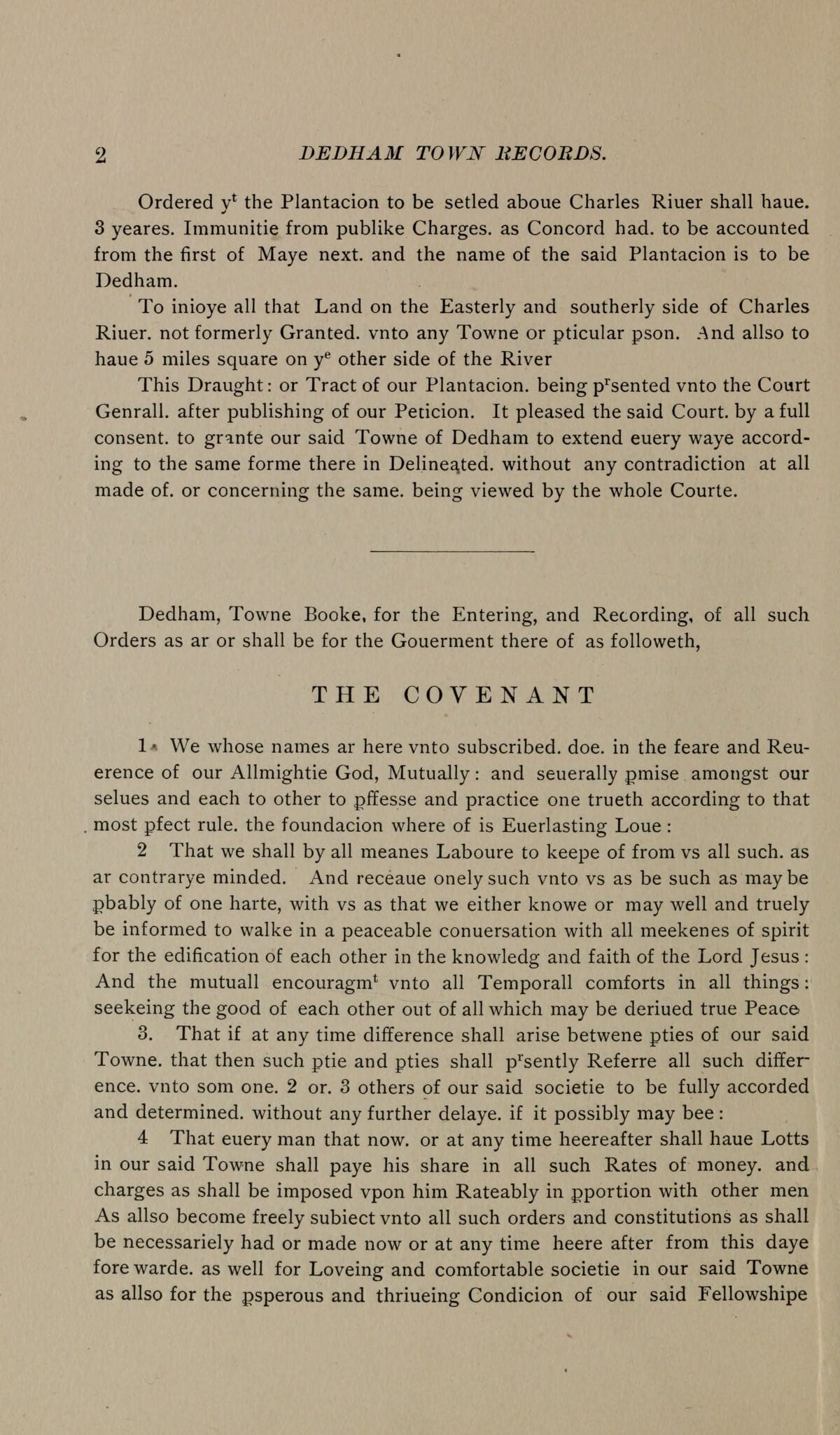
A note on the spelling, because the reader deserves to sound this out correctly. The clerk wrote with the standard scribal abbreviation of a crossed p for per, pro, or pre, which the 1892 edition renders by simply dropping the syllable — so "pmise" is promise, "pffesse" is professe, "pfect" is perfect, "pbably" is probably. Read it aloud with the syllables restored and you are reading exactly what the clerk's hand intended.
Euerlasting Loue as a foundation, and a fence against the contrarye minded: the two clauses sit side by side without any sense of tension, and the whole history of Puritan New England is in the fact that they could. The remaining articles are practical — disputes to be referred to one, two, or three neighbors "without any further delaye"; every man with lots in the town to pay his rates and submit to all orders made "for Loveing and comfortable societie in our said Towne." And then the fifth article, which is the reason this post exists:
And for the better manefestation of our true resolution heere in. euery man so receaued: to subscribe heere vnto his name. there by obligeing both himself and his successors after him for euer. as we haue done.
And his successors after him for euer. Beneath that sentence the clerk wrote a heading — "Names subscribed to the Couenant as followeth" — and then the names.
The count
The roll, as Hill printed it in 1892, runs to roughly a hundred and twenty-five names in three columns on a single page, from Robert Feke and Edward Alleyn at the head down through the years of later admissions. The family's trees and the genealogy websites have long carried a claim about it: that our immigrant ancestor stands "68th of 124 signers." I have met that claim for years, always in the same condition — repeated confidently, cited nowhere. It is exactly the kind of statement this project was built to test, because for once the test is not a matter of archives and orders and interlibrary loans. The roll survives. It is printed. Anyone can count.
So, on the night of July third, 2026 — with the two hundred fiftieth anniversary of a very different July document a day away — I opened Hill's edition to the covenant roll and ran my finger down the columns the way you would count anything. The first column carries forty-two names and ends with Thomas Fisher. The second opens with Joseph Kingsberye. Twenty-six names into it, between Samuell Milles and Thomas Bayes, stands the sixty-eighth subscriber:
Edward Colver.
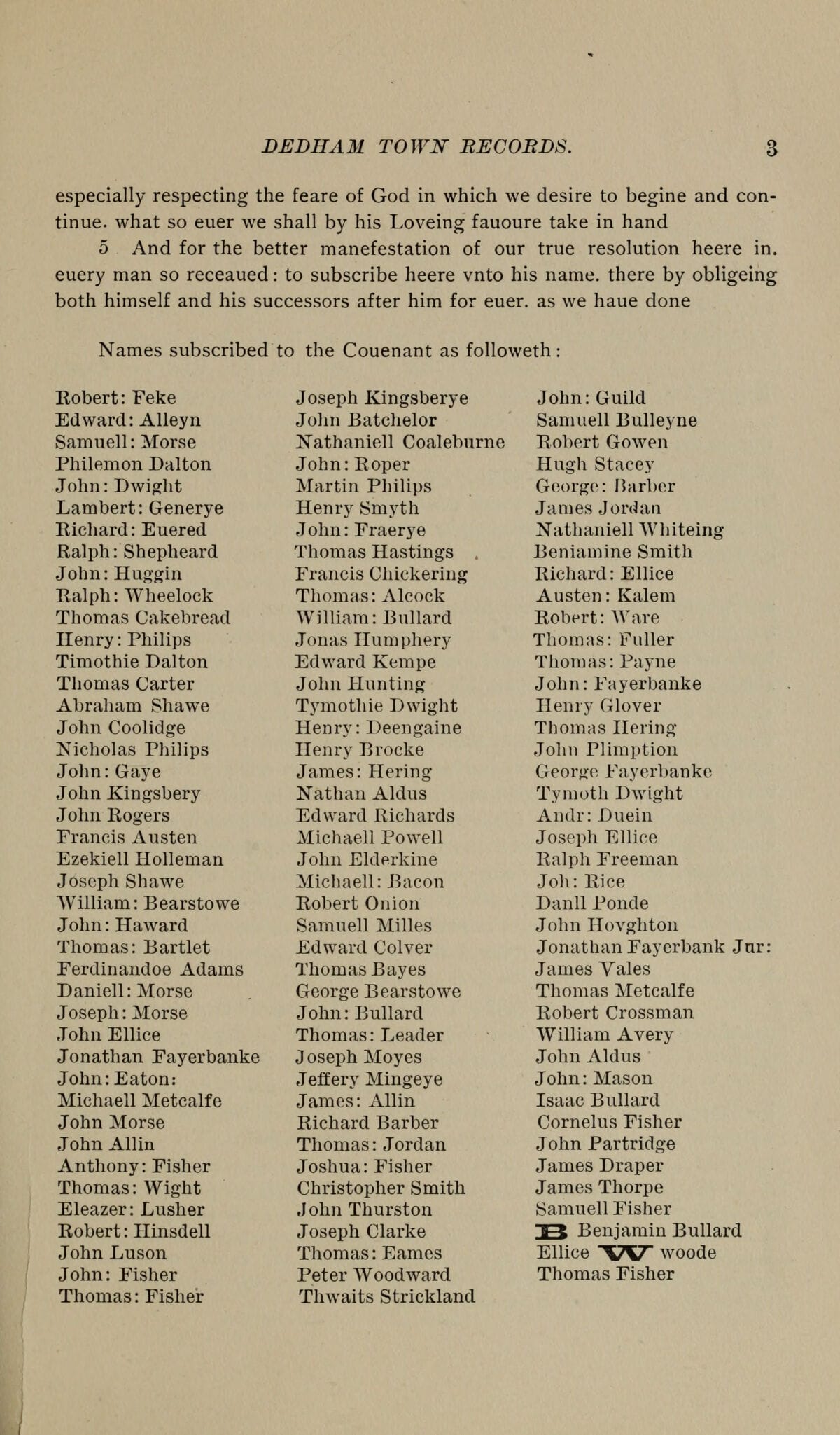
The old claim verifies — with two honest wobbles worth recording. "Tymothie Dwight" appears in the second column and "Tymoth Dwight" in the third, almost certainly the same man entered twice; while the two Thomas Fishers, in the first column and the last, were genuinely two different men — Dedham had both, and a reader who "corrects" that duplicate away is subtracting a real townsman. So the full roll is a hundred and twenty-five names as printed, the true count of men wobbles by one or two, and Edward stands sixty-eighth however you resolve it. "Roughly 125, Edward 68th" is the honest and defensible statement, and it is pleasant, for once, to report that the family tradition was arithmetically sound.
That name is my first documented ancestor. Not a birth, not a baptism, not a landing — a name set down among the subscribers to a covenant of everlasting love and careful exclusion, in a Massachusetts town book, by a man about whom the honest genealogist can say, at that moment, precisely nothing else. Where he was born, what ship carried him, who his parents were — the record is silent, and the story of that silence, and of what the family's older books did to fill it, was told here two weeks ago in "The Ship That Never Was." One caution belongs with the count: the roll itself is undated. It gathered the town's subscribers across years as men were admitted, so the sixty-eighth position tells us roughly where Edward fell in the town's sequence of admissions — not the day he took up the pen. His earliest dated record comes a year or so into the town's life, and we will arrive at it in a moment, because it is the best thing in this story.
A name on a list is a small thing. This one obliged his successors after him for ever. The covenant meant the town's successors, of course — the men who would hold those lots after them and be bound by the same articles. Four centuries later, a descendant may be forgiven for hearing the word another way.
The town that wished to be Contentment
What kind of company was he joining? Dedham was gathered in 1636 by a company with its roots in the eastern counties of England; its minister, John Allin, came out of the Puritan clergy of East Anglia, and the town's very name was taken, probably, from Dedham in Essex, a wool town on the Suffolk border whose lecturers had helped make that corner of England the seedbed of the emigration. But the settlers' first choice of name was better than the one they got. The founders petitioned the General Court to call their plantation Contentment — the word is written over the records of their first several meetings — and the Court gave them Dedham instead. The town's first historian, Erastus Worthington, thought "Contentment" expressed "the leading motives of the first twenty-four settlers," and I have never read a better one-word summary of what a covenanted town was for.
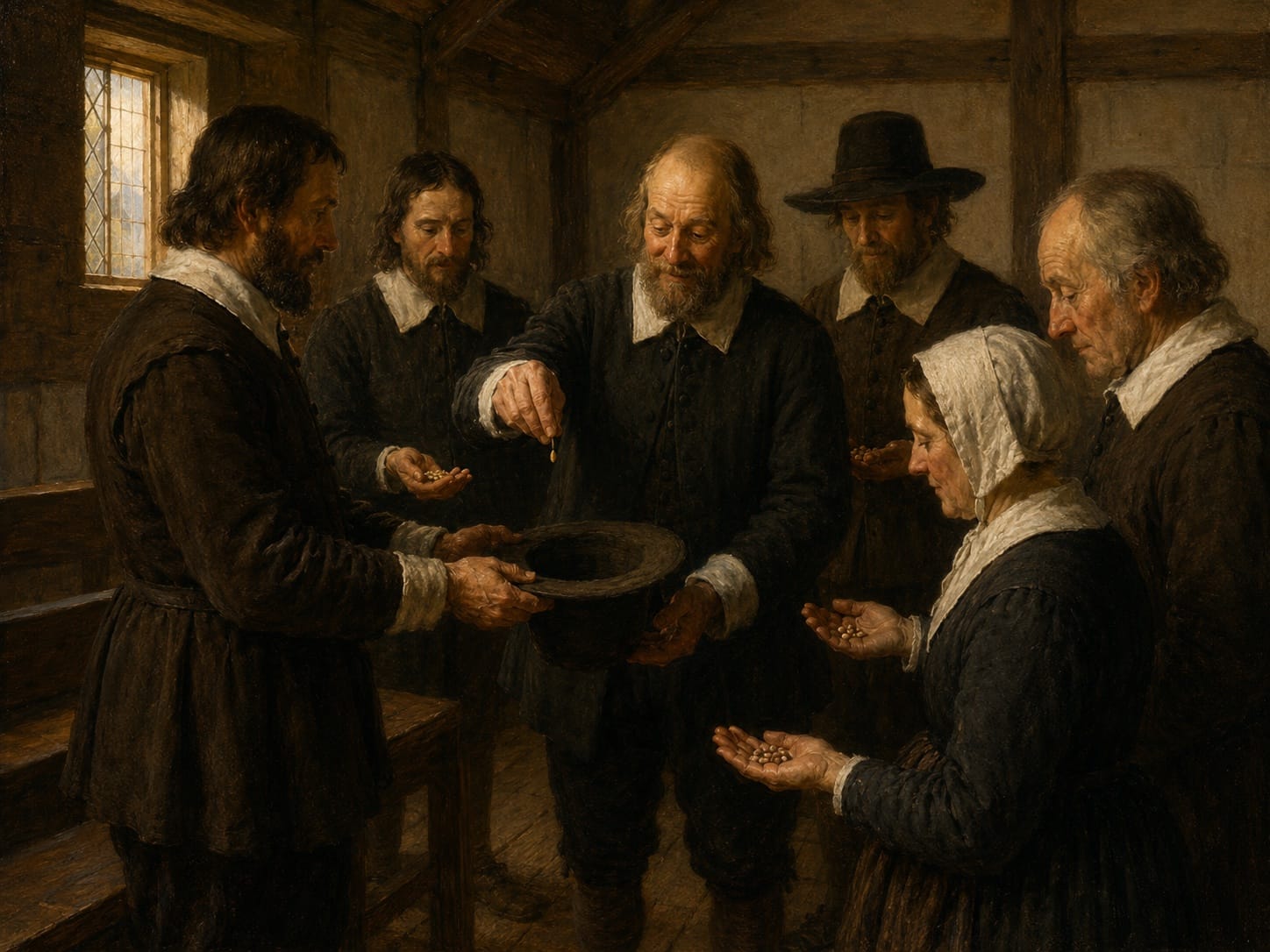
Worthington preserves one more detail that I cannot leave in the footnotes, where it has been sitting since 1827. Admission to the town was by vote of the townsmen, and for the better part of the town's first century the vote was taken in kind: "the people voted by wheat and beans on the question of admitting townsmen, wheat denoting the affirmative, and beans the negative." Hold that picture a moment. Before Edward Colver's name ever went on the covenant roll, a room full of Massachusetts farmers passed a hat, or something like one, and each man dropped in a kernel of wheat or a bean. Our family's admission to America was counted out in grain. He was chosen by his neighbors first, and bound to them second — the order matters, and the covenant's fifth article assumes it: euery man so receaued subscribes his name. First the wheat, then the pen.
The wheelwright
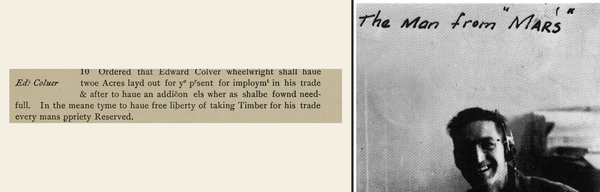
And why did the wheat outnumber the beans? The town book answers that question on the twenty-eighth of November, 1637, in the tenth order of that day's meeting, with the marginal note "Ed: Coluer" beside it:
Ordered that Edward Colver wheelwright shall haue twoe Acres layd out for yᵉ prsent for imploymᵗ in his trade & after to haue an addicon els wher as shalbe fownd needfull. In the meane tyme to haue free liberty of taking Timber for his trade every mans ppriety Reserved.
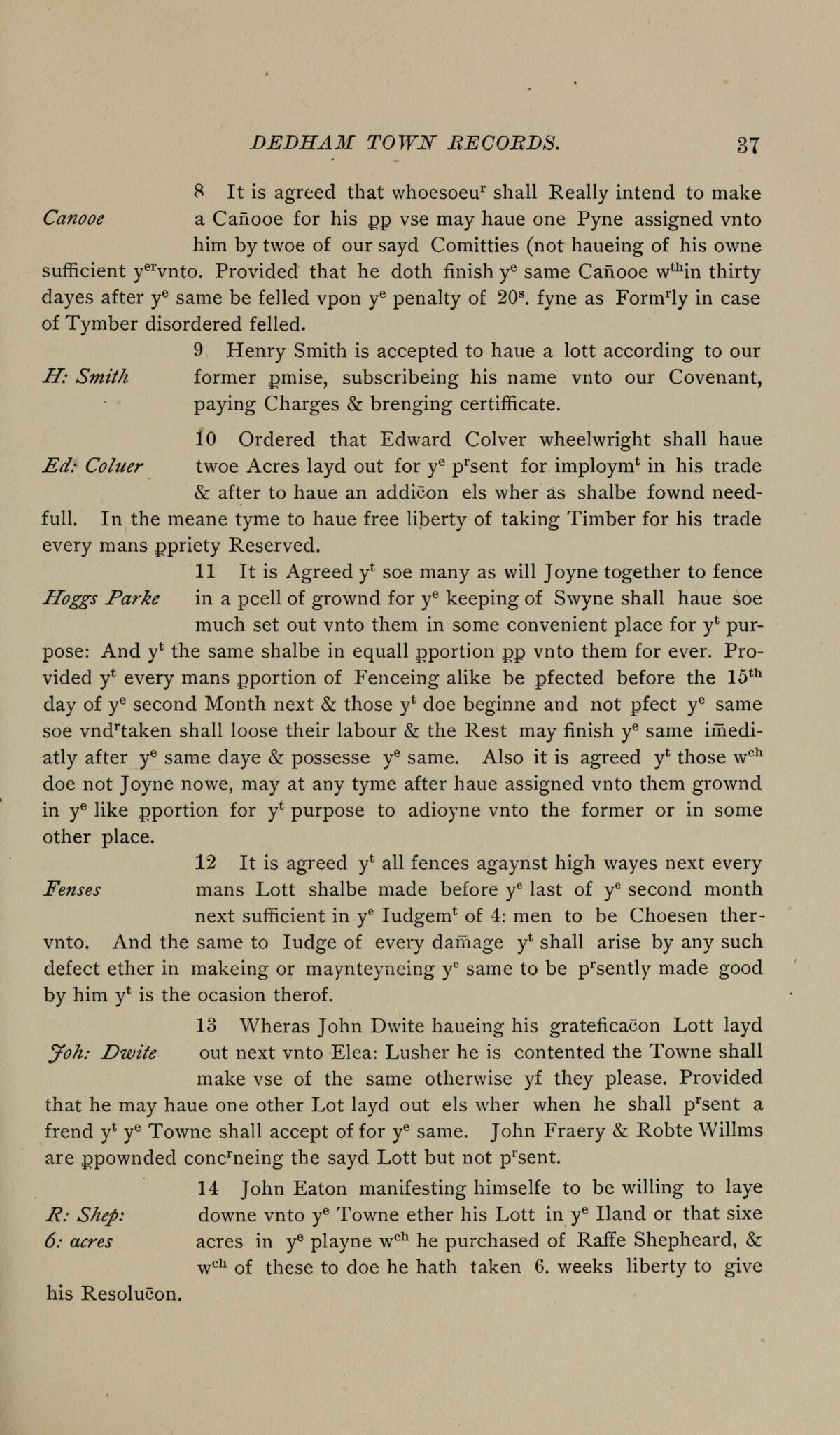
This is the earliest dated record of the man yet found, anywhere — in either hemisphere — and nearly every word of it is about his usefulness. Two acres, not as a settler's portion but "for imploym't in his trade"; more land promised "as shalbe fownd needfull"; and, the clause that would have mattered most to him, free liberty of taking Timber, every man's property reserved — which is to say, the run of the town's common woods for his raw material. The town did not merely admit a wheelwright. It capitalized one.
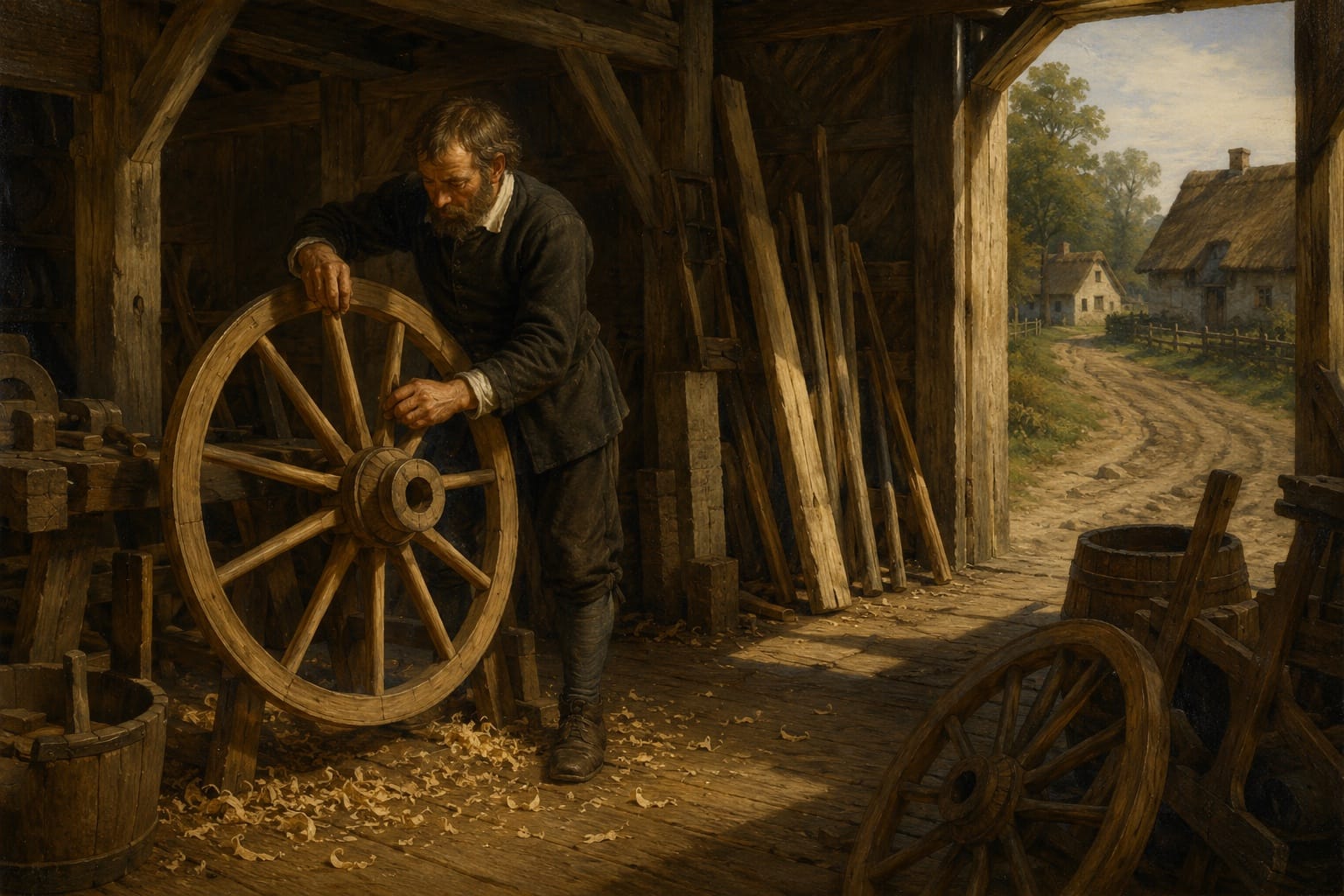
A wheelwright, since the trade has been gone from common memory for a century, was the craftsman who built and repaired wheels — and by extension the carts, wains, and plough-gear that ran on them, the whole rolling stock of a farming town. It was among the most exacting of the wood trades. A wheel is a structure in compression, dished and angled so that it tightens under load, and the wright had to work three woods to their strengths — commonly elm for the hub because it will not split, oak for the spokes because it will not bend, ash for the felloes because it springs. (A felloe: one of the curved wooden segments forming the wheel's rim, into which the spokes are set.) He had to get the geometry right by eye and rule, because a wheel wrong by a little is a wheel that fails in the middle of a harvest. Worthington, cataloguing Dedham's timber two centuries later, singled out the white oak, "the favourite of the soil," yielding "such a strong heavy and durable material for the works of the wheelwright and ship-builder." When the town granted Edward the freedom of its woods, it was granting him some of the best wheel timber in New England.
And Dedham needed him more than a modern reader would guess. The town in 1637 was a plantation of perhaps thirty or forty families at the edge of a wilderness it had not yet subdued — a place where the wolf-howl carried into the village from the cedar swamps, and where a town order of that very year required every householder to keep a ladder to his chimney, on pain of five shillings, because the roofs were thatch. Worthington records that skilled mechanics were scarce in the first years and stayed near Boston, where the wages were; Dedham's earliest houses "were chiefly built without them," and showed it. The acres they cleared, the loads of hay, the timber for their houses — nearly all of it depended on carts, hauled over stump-field tracks that broke them. A town could pray itself into being, and Dedham very nearly had; but it could not roll anywhere without a wheelwright. When the founders voted Edward Colver his two acres and his timber rights, they were not being generous. They were installing infrastructure that happened to have a name.
Ten months later the town book's companion registers give him a family. On the nineteenth of September, 1638, Edward Colver married Ann Ellis at Dedham. Of her the record tells us even less than it tells of him — no origin, no parents, no age. I note, without building anything on it, that the covenant roll Edward's name stands on carries a John Ellice, a Richard Ellice, and a Joseph Ellice among the subscribers. Whether the bride was kin to any of them, no surviving record says, and I set the coincidence down here as a coincidence.
The blank in the church book
There is one more list in Dedham, and Edward's relationship to it is the quietest fact in this whole story. The town kept its book; the gathered church kept another. And in the church's surviving records, Edward Colver's name does not appear as a member. When his son Samuel was carried to the font in January of 1644/5, the church book entered the baptism this way: "Samuell yᵉ sone of our sister Culver & hir husband —— Culver was baptised." Our sister Culver — the membership that carried the children to baptism was Ann's. Her husband is a blank in the middle of his own son's baptismal entry, a dash where a name should be.
Mind the method here, because this is the place where a careless genealogist would build a castle. Absence of a record is not absence of the thing: church admission lists survive imperfectly, and a man could stand in good repute with his neighbors without appearing in the fragment of paper that happens to reach us. The 1922 family historian looked at the same silence and concluded that Edward's religious character was "left to conjecture," which is exactly right. What the surviving record shapes, though, is worth stating plainly: in the town's book Edward is a subscriber, a grantee, a townsman in full standing; in the church's book he is his wife's unnamed husband. The covenant he demonstrably set his name to was the civil one.
I will only add that a family whose American record opens with the father standing outside the surviving membership roll, while his wife and children are inscribed within it, has begun a theme it will spend the next century elaborating. Two generations on, this family's relationship to the established churches of New England becomes the central fact of its story — the jailings, the interrupted meetings, the registers deliberately refused. That story has its own posts coming. The children at the font will carry it.
A number is not a rank
Now for the correction, because a post about verifying a count had better be willing to audit its own arithmetic, and this one comes at my expense.
The town book, as the years go on, tracks Edward the way it tracked everything — parcel by parcel. An allotment list of the early 1640s carries the entry "Edward Culuer 3 acres 1 roode" (a rood is a quarter-acre; the pastor, John Allin, drew twenty-three acres in the same division). For a while, our working file gave that entry as "3 acres" even — because the digitized text of Hill's edition drops the final column, and I had trusted the transcription. A careful reader of the book draft queried the figure; the page image, when I finally pulled it up, plainly reads "3 acres 1 roode." The lesson has now earned its place as a standing rule of this project: the columnar lists of a seventeenth-century town book are exactly where a machine transcription silently loses a column, and any figure taken from one must be verified against the photograph of the page, not the text file. It is a small error. Small errors in acreage are how a 1,000-acre grant becomes 3,000 in a family's memory — regular readers will remember that one — and the discipline that catches the quarter-acre is the same discipline that catches the thousand.

The second correction is more instructive. Another of Hill's lists — a numbered division roll of seventy-one names — carries the entry "55 Edw. Coluer," and for a while I read that number the way you are probably reading it now: as a position, a standing, a place in the town's pecking order. It is nothing of the kind. On the allotment page every entry carries such a number, and they are lot numbers — tags on parcels, not ranks of men. The proof is delicious: in the woodland roll, Eleazer Lusher — the leading man of early Dedham, the one name in the book everyone defers to — stands at number 38, while number 68 belongs to "mr Wheelocke." If the numbers were rankings, the town would have some explaining to do.
I linger on this because it disciplines the very count this post began with. The 68 in my title is meaningful for one reason only: the covenant roll is a sequence of subscriptions, an ordered record of men setting down their names one after another, so a position in it tells you something true — roughly when, in the town's life, your man was received. The 55 in the division roll is a label on a parcel and tells you nothing about the man at all. Two numbers, two documents, and only one of them bears weight. Half of genealogy is learning to read what a record says; the other half is learning what kind of number you are looking at.
The long goodbye
Edward's Dedham decade ends the way it began — in the town book, parcel by parcel. The town, which granted land the way a careful lender grants credit, had attached a telling condition to one of his later parcels: "vpon condition that if he shall depart yᵉ towne it shall returne into yᵉ townes dispose againe." The town saw the departure coming before the record states it. In time one Josuah Kent "is admitted Townsman & hath libertie to purchace Edward Culuers Lott," and the family's trail bends away south, through Roxbury, toward the Connecticut country where Edward would hold land on a scale Dedham never offered a wheelwright, and where the rest of this family's seventeenth century would be spent.
But the very last Dedham entry is my favorite in the whole town book. In February of 1651/2 — years after he had left — "Ed Coluer" appears once more, promising to complete an old conveyance and "subscribe a deed thereof" to Sergeant Daniel Fisher. A man who had been gone for years rode back to say that he would sign what he had said he would sign. The record that opened with his name on a covenant closes with his name on a promise. It is a tidy man's last entry, and four centuries of his descendants — a people who, as this blog has had several occasions to document, kept their promises to kings at ruinous cost — would recognize him at once.
Count it yourself
The book that recorded all of this survives. The town of Dedham printed it in 1892, and the printed volume sits on the Internet Archive now, free to anyone — which is a kind of afterlife the covenanters did not foresee but would, I think, have approved: the record still testifying, the names still subscribed. If you descend from a New England town — and if your people were in Massachusetts or Connecticut before 1700, you almost certainly do — the odds are good that your own family's Edward is standing in some printed town book at some countable position, waiting for a finger to run down the columns. Do not take the genealogy website's word for it. The count is an evening's work, it costs nothing, and there is no substitute for the small shock of arriving at the name yourself.
One hundred and fifty-five years after Edward set his name to a covenant of the New England pattern, a great-great-grandson of his would stand in a log house on the Susquehanna and officiate while six more settlers signed one — the same instrument, the same theology, the same act of subscription, carried a century and a half from the banks of the Charles to the wilderness of Pennsylvania. That extraordinary symmetry gets its own telling here at the end of August, in a post called "The Covenant, Signed Twice." Watch for it.
For now it is enough that everything this project traces — the dissenters and the loyalists, the New Jersey mountain and the Ontario grant, the mail carrier on the Munger road — descends from the sixty-eighth line of a list in a town book, where a wheelwright of unknown origin subscribed himself, and his successors after him for ever.
Sources: Don Gleason Hill, ed., The Early Records of the Town of Dedham, Massachusetts, 1636–1659 (Dedham, 1892) — the covenant at pp. 2–3, the signer roll entire at p. 3, the wheelwright grant at p. 37, the allotment and division rolls at pp. 95 and 109–10; freely readable at archive.org. Erastus Worthington, The History of Dedham (Boston, 1827) — Contentment at p. 31, wheat and beans at p. 39, the white oak at p. 138. Robert Charles Anderson, The Great Migration Directory (2015), for the "Unknown; 1637" verdict on Edward's origin. All quotations collated against the page images of the printed volumes. The covenant and the complete roll of subscribers will appear, transcribed in full, in an appendix to the book.
© 2026 Albert B. Collver III · The Collver Family History Project. Original historical documents reproduced here are in the public domain; the research, text, and annotations are the author's. Please cite or link rather than republish.
Adapted from the forthcoming book We Are Doves: A Collver Family History (2026), chapter two, "An Unknown Ship."