The Captain of the Dove
A dove-named man, a ship called Dove, and the historian who caught them both before the tide went out.
A dove-named man, a ship called Dove, and the historian who caught them both before the tide went out
On Friday I told you about a ship that never was — my immigrant ancestor's crossing, the one the old genealogy filled in with a governor's son and a famous year and a port, all of it invented to cover a stretch of empty water no record can cross. The family could not name its first ship. It is one of the honest holes at the base of the whole story.
So it is only fair that today I tell you about the opposite kind of trouble: a ship whose name we know almost too well.
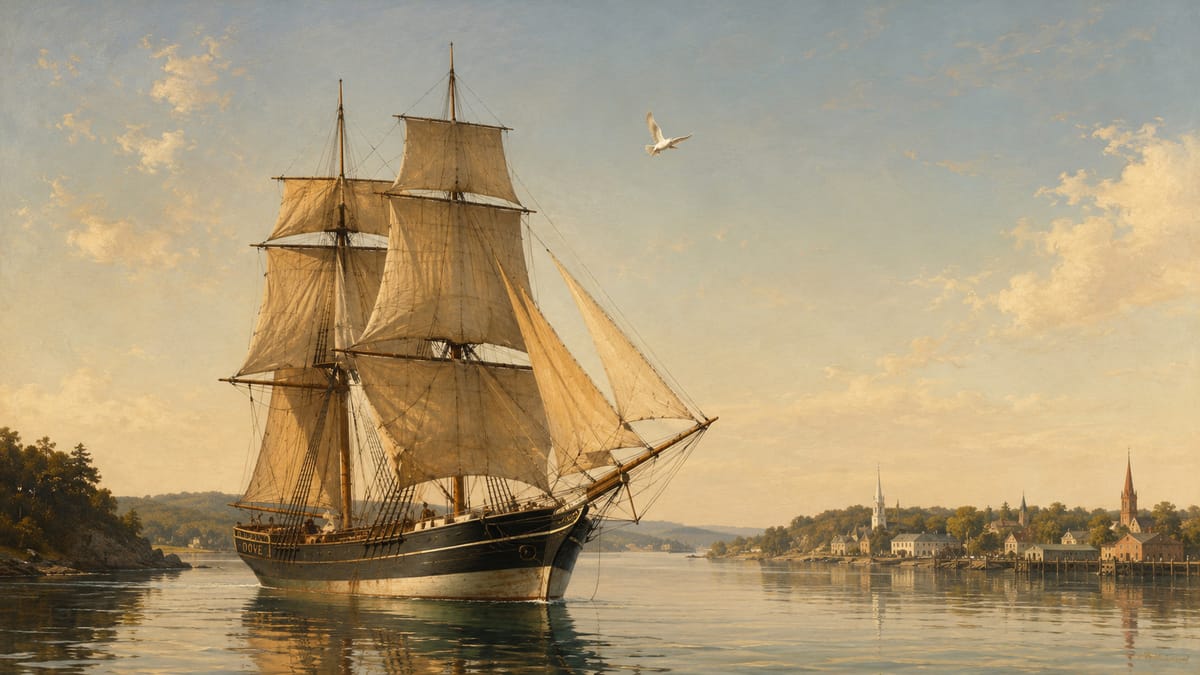
On the third of August, 1811, the brig Dove came up the Thames to New London, sixty-three days out of Liverpool. There is nothing remarkable in that — hundreds of brigs made that run — except for the words the record adds after the ship's name. Arrived brig Dove, Colver, 63 days from Liverpool, passenger Roger Huntington.1
A man whose surname is the Old English word for dove had just brought a ship named Dove home across the Atlantic. The name that this book's first chapter chases up six centuries of respellings — culfre, the pigeon of Culver Cliff, the bird the antiquarians kept confusing with a snake-shaped cannon — the name that drifted across the landscape and got mangled in every clerk's hand it passed through, had for once come to rest exactly where it belonged: painted on a transom, under a Colver's command.2 Anyone who has spent years watching this family's name slip its moorings will understand why I find that small collision of words worth a whole essay.
The man on the quarterdeck
His name was Christopher Colver, and he was, by trade, exactly what the Dove's arrival makes him sound: a working shipmaster of the early American republic. He was born — the date is worth having, because so few in this book come with one — on the eighth of June, 1775, at New London, the family's old Connecticut ground, the Pequot harbor where Edward the wheelwright had held his farm a century before — Edward Colver, the immigrant at the head of my own line, and of his. That makes the captain a cousin of mine: a distant one, some third-to-fifth cousin many times removed, off the New London branch that stayed in Connecticut while mine turned Rogerene and left for the New Jersey hills — but a cousin, and the kinship is part of why a ship named Dove under a Colver stops me at all.3 He came up the river to Norwich in 1790; by the August of 1797, at twenty-two, he had taken out a federal Seaman's Protection certificate at New London — the slip of paper meant to keep an American sailor from being pressed into the British navy — and by 1802 he had a ship of his own to command.45
After that he was, in Caulkins' phrase, "constantly engaged for nearly thirty years" in the European carrying trade, and the ports he named to her make a small atlas of the age of sail: all the noted West India ports and the northern coast of South America; the Western Isles and Madeira; Tangier and Cadiz and Gibraltar; Alicante, Lisbon, Le Havre, Bayonne; London and Liverpool and several Irish harbors; and, at the cold top of the world, Archangel, on the White Sea above the Arctic Circle, which he reached in the barque Sarah Louisa in 1820.6 Tangier to Archangel, the Barbary coast to the Russian ice, all worked by one Norwich man out of one small river. When Caulkins wrote him up he was, she said, "the oldest ship-master in Norwich, and the only one whose voyages reach back to the last century."7
He was, in these years, a Norwich man with a household as well as a quarterdeck — and the record catches the household too, once, and sorrowfully. In the autumn of 1805, only a few years into his career as a master, the county's newspapers carried among their death notices a single unnamed line: a daughter of Capt. Christopher Colver, of Norwich, dead that October.8 It is the earliest record in which the title Captain settles on his name, and it settles there over a grief. The man who would work his way from Tangier to Archangel had, at home, a small grave to come back to.
I want to be careful here, because this book has made a discipline of being careful. I cannot show you the Dove in a newspaper. I looked — the New London and Norwich marine lists for that summer are thinly preserved, and the digitized record does not hold the third of August, 1811. There is a particular irony in the failure, because Caulkins tells us that the old captain, in his green old age, spent his days "furnishing occasional marine reports for the newspapers." The man supplied the very kind of notice I went hunting for and could not find. The same county papers had found room, six years before, for the death of his infant daughter; they simply did not keep the day his ship came home. His own arrivals slipped through the net that was supposed to catch them, exactly as this family's names have always done.
The bond, the list, and eight men
And yet the sea kept two records of him after all — not the kind he wrote, but the kind he had to sign.
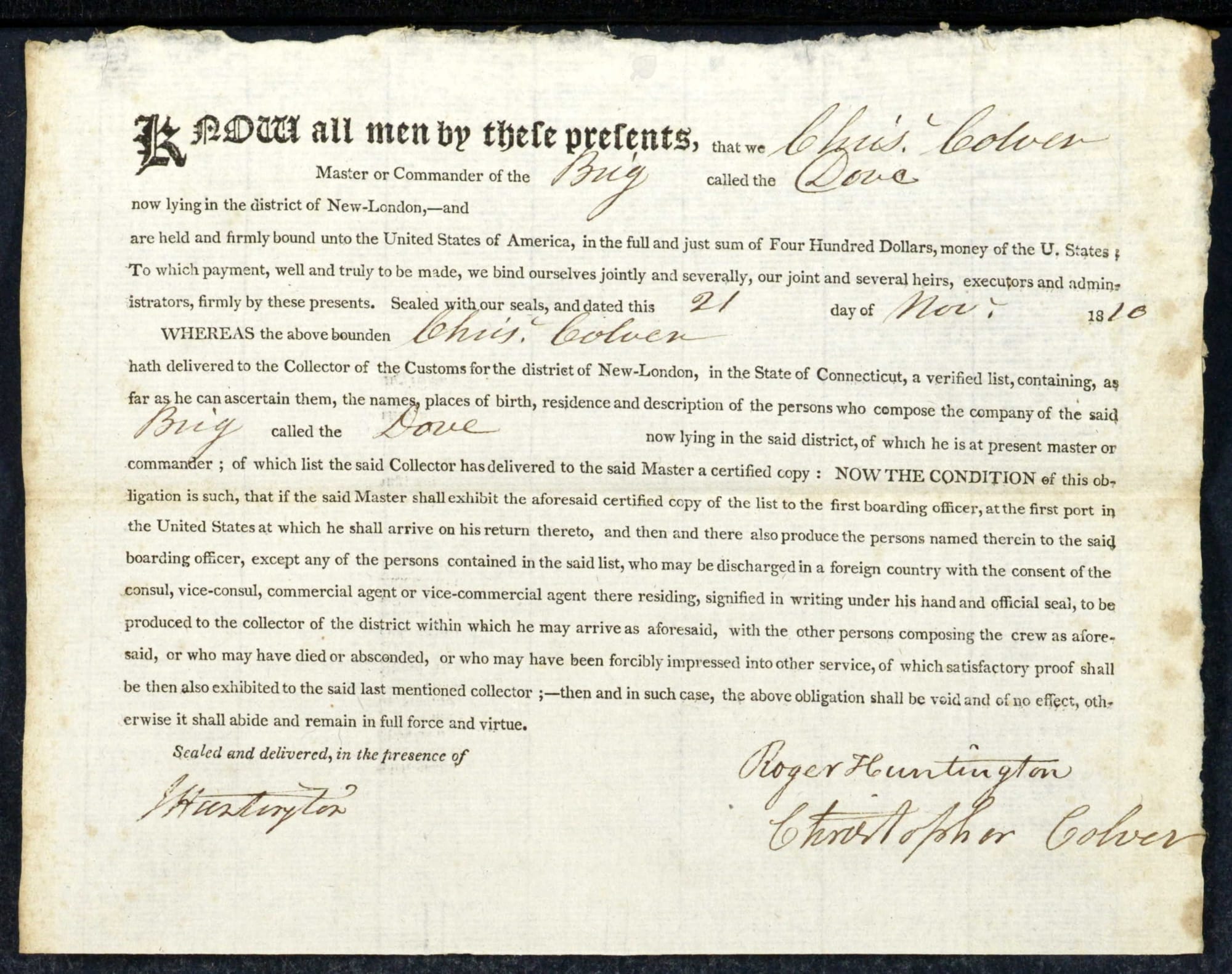
On the twenty-first of November, 1810 — the winter before the Dove would come home from Liverpool — Christopher Colver stood in the custom-house at New London and did what federal law had required of every foreign-bound master since 1803: he handed the collector a sworn list of his crew and posted a four-hundred-dollar bond that he would produce those same men — alive, dead, discharged, or accounted for — on his return. Both papers survive.
The bond is the dry half. Its printed form opens in heavy black-letter — Know all men by these presents, that we — and fills in, in a clerk's practiced hand, Chris. Colver, Master or Commander of the Brig called the Dove, now lying in the district of New-London. At its foot the captain signed his name in full — Christopher Colver — spelling it, for the record, with the o and the v this family spent six centuries fighting for. Above his, as surety, signs Roger Huntington — the same Roger Huntington who would sail home as the captain's passenger the following August, staking his own four hundred dollars on the captain's word the winter before.9
The list is the living half: A List of the Company of the Brig Dove, Christopher Colver Master, 124 tons, bound to Liverpool, England — and under it, ruled off in six columns, eight men. A mate from East Haddam. Seamen out of Preston and Lebanon and Plainfield and Norwich, down to a boy of fifteen. A cook of twenty-one from Lebanon, marked in the frank shorthand of the age as a man of color. This is the crew the bond was pledged for; somewhere on the far side of an ocean and a summer, the captain would have to answer for every one of them.10
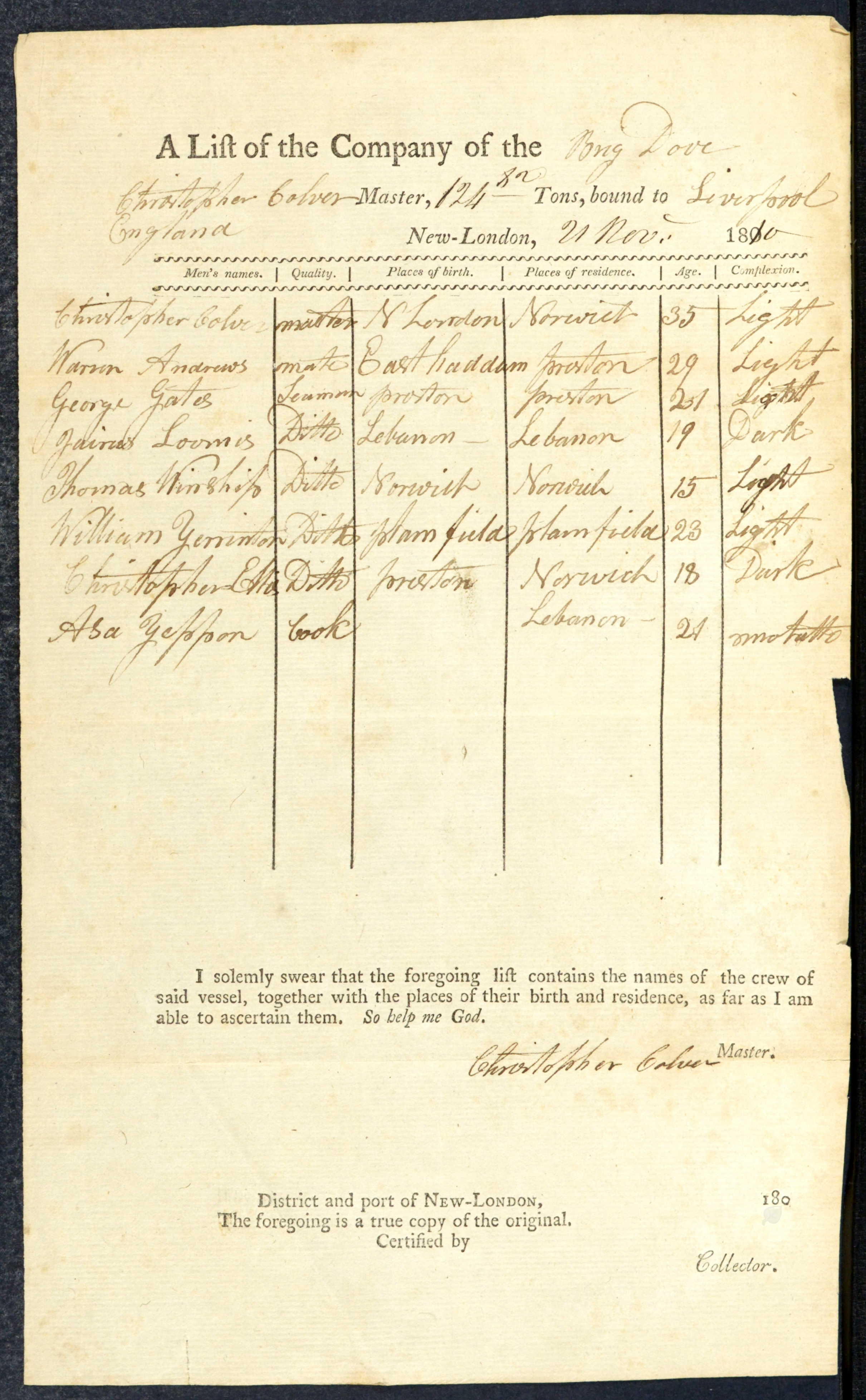
And the list does one thing, quietly, that no interview could. Against Colver's own name it swears a single number — aged 35, in November of 1810. Frances Caulkins, taking the old man's life from his lips fifty-five years later, set his birth at the eighth of June, 1775. Subtract, and the arithmetic closes to the year. For once in this book the record and the memory were made to face each other across half a century — the custom-house clerk and the ninety-year-old captain, working from opposite ends of one life — and they wrote down the same man.
The historian at his knee
The arrival survives in one place, and it survives there in the best possible way.
Frances Manwaring Caulkins was the finest local historian Connecticut produced in the nineteenth century — a woman who wrote the standard histories of both New London and Norwich with a rigor the professional men of her day rarely matched, and who was elected the first woman member of the Massachusetts Historical Society on the strength of the work.11 When she came to write up the Colvers of Norwich, she did not copy the shipping details out of some earlier book. She got them from the captain himself.
These facts are derived from Capt. Colver — who, she adds, "at the age of 90, in the possession of a good degree of health and mental vigor, is still to be seen almost daily, taking his accustomed walks and lingering upon the wharfage by the river."12
Sit with that, because it is the quiet heart of this piece. This book has spent chapter after chapter correcting things the family misremembered — the chaplain who was no chaplain, the three thousand acres that were one thousand, the hat and belt that were a beaver hat and a Bible. Memory drifts; that is nearly this book's motto. And here, against the current, is a Colver whose life was caught before it could drift, because a careful woman sat down with a ninety-year-old sailor and took his voyages down from his own mouth while he could still name them — a man still walking to the wharves each morning to stand where his ships had been. Alicante, Archangel, the Dove from Liverpool: these are not sediment ground fine by retelling. They are an old man's own account of where he had been, kept by someone who knew how to listen. It is the rarest thing in this whole project — a memory that reached the page intact.
And the Dove herself was no accident of a single voyage. She was a Norwich brig of some standing. In 1804 she had cleared the New London custom-house under a Captain John McGowty, one of a little fleet of Norwich vessels that sailed together for the West Indies. And after the War of 1812, when the British blockade that had frozen the river finally lifted, it was the Dove — this same brig — that led Norwich back to sea: "the first merchant vessel to start on a voyage," Caulkins records, and "the first to arrive from a foreign port," though by then another master, Walter Lester, had her wheel.13
The war that froze the Dove at her moorings did not spare her sometime master. The same custom-house books hold Colver clearing New London as a master in 1806 and again in 1807 — and then, in February of 1813, with the blockade shutting the deep-water trade down to nothing, signing the crew list of the little schooner Wealthy not as master but as mate: a shipmaster of twenty years' standing taking a mate's berth on a coaster because there was no better one to be had.14 When the blockade lifted, the Dove led the river back out to sea; in the dark middle of it, her old captain had come down to second in a schooner.
Between those two chapters of her life, in the summer before the war, she came up the river under a Colver. The family did not own the Dove. But for one bright passage, the dove had her.
The other Culver, and the machine he did not remember inventing
Caulkins gives us one more Norwich Culver, and his story turns out to be the strangest thing in this whole essay — and, I have come to think, the truest to the book's argument about what memory does when we are not watching it.
His name was Stephen Culver. He had followed the sea from boyhood, and settled in Norwich as a jack of useful trades: a packet-master, a bridge-builder, a machine-maker. He was, in his own lifetime, a small celebrity for exactly that last trade. In 1799 a New Hampshire paper relayed word from Savannah of a "Capt. Stephen Colver," a Norwich native and "the inventor of the machines for cleaning docks, rivers," who had contracted to raise the ships the British sank in the Savannah River during the Revolution and had just lifted the largest of them clear of the channel — "one of the first mechanical geniuses in this country," the writer added, for all that the locals had "ridiculed his undertaking."15 When the Norwich Channel Company was incorporated in 1805 to deepen the Thames so that loaded vessels could reach the head of the river, the machine that did the digging — the dredging apparatus that scooped the silt from the channel — was Stephen Culver's own patent.16
Then a suit was brought against the company for infringing his rights, and the patent did not survive it. It was proved in court, Caulkins writes, to be "a machine formed on the same principle with one that had been used in France, and especially in the harbor of L'Orient, forty years before." By the time the case was decided, "the patentee was then dead. He had been a packet-master, bridge-builder, and machine-maker, and no doubt honestly considered himself the originator of the patented machine."17
Here most tellings would stop, with a tidy moral about American ingenuity beaten by older European art. But Caulkins was a better historian than that, and she went one step further — the step that turns a patent dispute into a parable I could not have invented. She asked how Stephen Culver came to build, in good faith, a machine that already existed. And the answer she found was this: as a boy, "from early youth he had followed the seas," he had been "carried a prisoner to France, and left for a while at this very harbor of L'Orient" — the very port where the dredging machine had been working forty years before. He had seen it, or seen something like it, as a captive child. And then he had forgotten that he had seen it. He "probably retained some vague idea in his mind of the principle of the machine," Caulkins concludes, "which in after life he worked out and put into operation."18
Read that again, because it is extraordinary. Stephen Culver did not steal the machine. He did not copy it. He remembered it without knowing he remembered — carried its principle out of a childhood prison across the whole of a seafaring life, and decades later reeled it up out of himself convinced it was his own invention. He was, the record gently insists, honest. He simply could not tell the difference between a thing he had thought of and a thing he had once seen. Neither, this book has argued for fourteen chapters, could his family, about the chaplaincy and the acres and the hat. Neither, if I am honest, can I. The dredging machine of L'Orient is the whole thesis of this project rendered in iron and silt: memory is the hidden author of half of what we are sure we invented.
The ship that found us
So here are the two ships, and the two kinds of memory, set side by side, which is how I meant you to see them.
Friday's ship has no name, no port, no year that will bear weight — an honest blank at the beginning of everything, which the family could not stand to leave blank and so filled with a legend. Monday's ship has all of it: a name we can hardly believe our luck to own, a master of our own blood, a day, a passage of sixty-three days, and a ninety-year-old man who remembered every league of it clearly and told it true. Between the two of them stands Stephen Culver, who remembered something perfectly and could not tell that he was remembering at all. Invented memory, intact memory, and memory working in the dark — the family kept a specimen of each.
The name means what it has always meant, since before the Conquest, on the chalk of Culver Cliff and in Chaucer's line and in the Kentish parishes where it began: not the hawk, not the cannon, but the dove — the bird that homes. On the third of August, 1811, one came home to the Thames, sixty-three days from Liverpool, with a Colver at the helm. The newspapers kept no marine note of us that Friday's essay could find. But once, on one bright summer afternoon, it sent a Colver up our own river in a ship named for the family's own soul — and a historian was there, half a century later, to catch it from the captain's own lips, on the wharf, before the tide took it out for good.
Some ships you have to invent. This one you only have to remember — and, this family being what it is, even that is not as simple as it sounds.
Adapted from a chapter of the forthcoming book on the Collver family.
© 2026 Albert B. Collver III · The Collver Family History Project. Original historical documents reproduced here are in the public domain; the research, text, and annotations are the author's. Please cite or link rather than republish.
Sources and footnotes
- Frances Manwaring Caulkins, History of Norwich, Connecticut (Norwich, 1866): "Aug. 3, 1811, arrived brig Dove, Colver, 63 days from Liverpool, passenger Roger Huntington." No corroborating marine-list entry has been found in the digitized newspaper record for August 1811; the New London and Norwich papers of that summer are sparsely preserved online, and the arrival survives in Caulkins alone — from her interview with the captain (n. 7). ↩
- For the name — Old English culfre, "dove"; Culver Cliff; the confusion with the serpent-named culverin — see chapter one of the forthcoming book, and the essay "Why We're Collver, Not Culver." ↩
- Both the captain and the author descend from the immigrant Edward Colver of New London (d. 1685); the author's line runs through Edward's son John² (the Rogerene) and grandson John³, who led the family's migration to New Jersey about 1734, while the captain belongs to the New London Culvers who stayed in Connecticut. His exact descent is not documented to this book's standard: the surviving New London men named Christopher are conflated in the compiled family trees, which also carry the disproved "Winthrop" marriage this book corrects (F. W. Jacobus, The American Genealogist 22 [1945]: 107–10). The cousin degree given here — a third-to-fifth cousin, several times removed — is therefore an estimate offered as one, not a computed ordinal; pinning it would require the captain's own parentage from a New London vital or church record. See Appendix G, the Groton/New London branch. ↩
- Caulkins, Norwich: Christopher Colver, a native of New London, "came to Norwich in 1790, and became master of a ship in 1802"; born 8 June 1775 (she notes his ninetieth birthday, 8 June 1865). On the family's New London origins under Edward Colver (d. 1685), see chapter three. ↩
- New England Seamen's Protection Certificate Index, 1796–1871: Christopher Colver, New London, 15 August 1797, born about 1775 at New London (Ancestry.com, indexing certificates registered under the Act of 28 May 1796 "for the relief and protection of American seamen"). The certificate — a sailor's proof of United States citizenship, carried against impressment into the Royal Navy — independently fixes the captain's birth year and birthplace, and predates the Dove bond by thirteen years. ↩
- Caulkins, Norwich, from the captain's own account of his voyages (the port list is hers); the Chelsea to Alicante (1810, Asa Fitch passenger) and the barque Sarah Louisa to Archangel (1820) are recorded there. ↩
- Caulkins, Norwich: "the oldest ship-master in Norwich, and the only one whose voyages reach back to the last century"; "furnishing occasional marine reports for the newspapers." ↩
- Connecticut Newspaper Notices, vol. 56, October 1805, as abstracted in the Charles R. Hale Collection: "Colver, —— (Dau.), Norwich — Dau. of Capt. Christopher Colver." No given name or age is recorded. Connecticut State Library, Hartford; Ancestry.com, Connecticut, U.S., Hale Collection of Cemetery Inscriptions and Newspaper Notices, 1629–1934 (database on-line, 2012). This notice is the earliest record located in which Colver is styled "Captain." ↩
- Crew-list bond, brig Dove, Christopher Colver master, District of New London, Connecticut, 21 Nov. 1810 — $400 bond, Roger Huntington surety, Christopher Colver principal, witnessed "J. Huntington." Filed under the Act of 28 Feb. 1803, "An Act supplementary to the act concerning consuls and vice-consuls, and for the further protection of American seamen" (2 Stat. 203, §2), which required the master of any foreign-bound vessel to deliver the collector a verified crew list and post a bond to produce the crew on his return. Ancestry.com, U.S., Select Crew Lists and Manifests, 1803–1998 (database on-line, 2013); original records, National Archives at Boston, Waltham, Mass. — "Records Relating to Crew Lists, 1792–1924," Record Group 26. ↩
- "A List of the Company of the Brig Dove, Christopher Colver Master, 124 82/95 tons, bound to Liverpool, England," New London, 21 Nov. 1810 — sworn and signed by Colver ("I solemnly swear that the foregoing list contains the names of the crew of said vessel… So help me God"), certified a true copy by the New London Collector. The eight-man company: Christopher Colver (master, b. New London, of Norwich, 35, light); Warren Andrews (mate, East Haddam, of Preston, 29); George Gates (seaman, Preston, 21); Jairus Loomis (seaman, Lebanon, 19); Thomas Winship (seaman, Norwich, 15); William Yerrinton (seaman, Plainfield, 23); Christopher Ellis (seaman, Preston, of Norwich, 18); Asa Jepson (cook, of Lebanon, 21). The sworn age of 35 in Nov. 1810 independently corroborates Caulkins' birthdate of 8 June 1775. Ancestry.com, U.S., Select Crew Lists and Manifests, 1803–1998 (database on-line, 2013); original records, National Archives at Boston, Waltham, Mass. — "Records Relating to Crew Lists, 1792–1924," Record Group 26. ↩
- On Caulkins (1795–1869), author of the History of New London (1852) and History of Norwich (1866), first woman elected to the Massachusetts Historical Society: standard biographical accounts. Her New London history is a principal source for chapters two and three of this book. ↩
- Caulkins, Norwich: "These facts are derived from Capt. Colver, who, at the age of 90, in the possession of a good degree of health and mental vigor, is still to be seen almost daily, taking his accustomed walks and lingering upon the wharfage by the river." ↩
- Caulkins, Norwich: the brig Dove under John McGowty among the Norwich vessels clearing in July 1804; and, after the War of 1812, "The brig Dove, Walter Lester, was the first merchant vessel to start on a voyage… The Dove was also the first to arrive from a foreign port." ↩
- Ancestry.com, U.S., Select Crew Lists and Manifests, 1803–1998 (originals, National Archives at Boston, Record Group 26): Christopher Colver, master out of New London, departures 14 Apr. 1806 and 12 Jan. 1807; and, as mate of the schooner Wealthy, departure 13 Feb. 1813 (sworn age 37), during the War of 1812. With the 1810 Dove bond and crew list, these span in the federal record the career Caulkins describes as "constantly engaged for nearly thirty years." ↩
- Farmer's Museum, or Literary Gazette (Walpole, N.H.), 29 April 1799, p. 3 — an "Extract of a letter from a gentleman at Savannah to his friend in New York, dated April 2," with an editorial footnote: "Capt. Stephen Colver is a native of Norwich, Connecticut, and is the inventor of the machines for cleaning docks, rivers, &c. &c. which have been used in this place with success… one of the first mechanical geniuses in this country. These wrecks were sunk by the British during the late war, and were a great obstruction to the navigation of Savannah river." A contemporary, primary confirmation — from the man's own lifetime, sixty-seven years before Caulkins wrote — of both the Norwich origin and the dredging machines; the L'Orient backstory that follows remains Caulkins' alone. (Newspapers.com image 845916261.) ↩
- Caulkins, Norwich: the Norwich Channel Company, incorporated 1805 "for improving the Channel of the river Thames"; "The dredging machine used by the Channel Company was the patent of Stephen Culver." ↩
- Caulkins, Norwich: the infringement suit; "the patent could not be sustained… a machine formed on the same principle with one that had been used in France, and especially in the harbor of L'Orient, forty years before. The patentee was then dead. He had been a packet-master, bridge-builder, and machine-maker, and no doubt honestly considered himself the originator of the patented machine." ↩
- Caulkins, Norwich: "from early youth he had followed the seas, and it was shown that in his boyhood he had been carried a prisoner to France, and left for a while at this very harbor of L'Orient, and probably retained some vague idea in his mind of the principle of the machine, which in after life he worked out and put into operation." ↩