Fifteen Stripes
Seventeen words to four magistrates of Connecticut, and a sentence of fifteen stripes on the naked body — the woman the family forgot while it chased a governor.

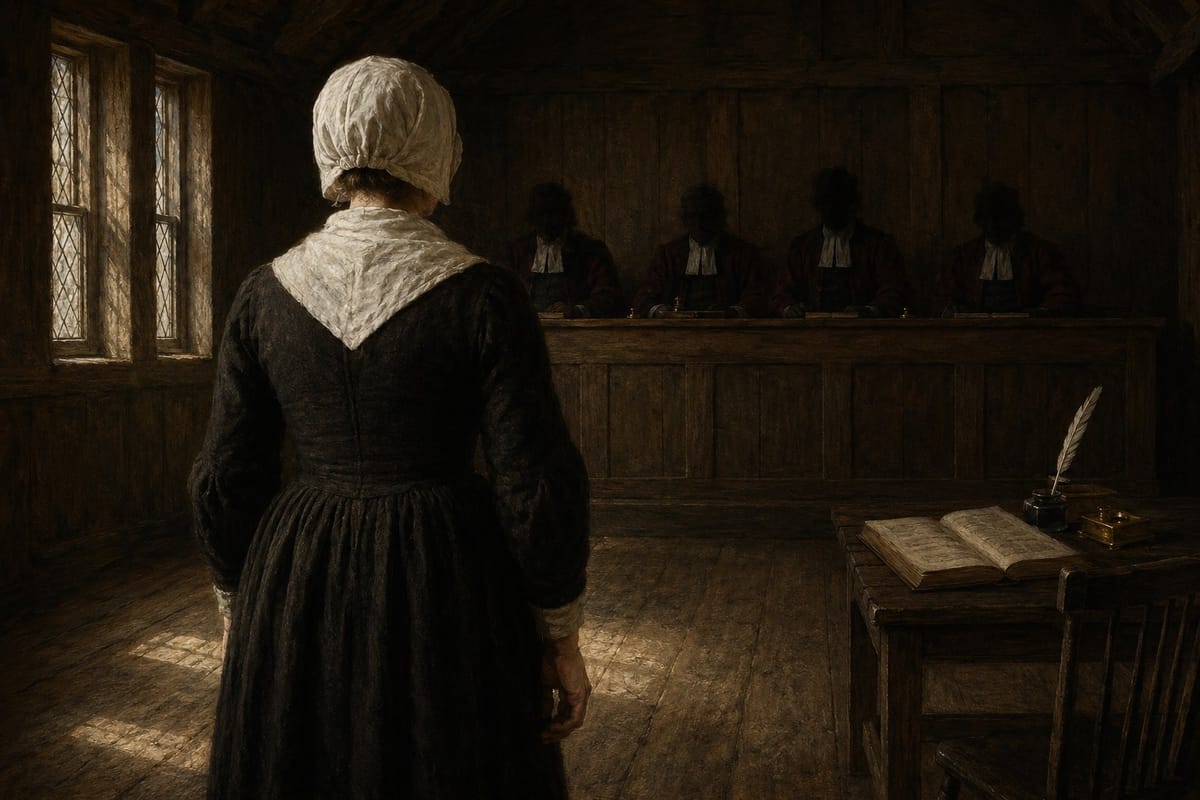
The verdicts had all been handed down. It was November of 1719, in the county court at New London, and the season's business against the Rogerenes was finished: the fines assessed, the prison terms served or still standing. There was nothing left to do but rise.
A woman of about forty-six, from across the river at Groton, spoke instead.
"You are an adulterous generation, and I hope God will find you out."
And the clerk wrote it down, which is the only reason we have it. And the court, for those seventeen words, sentenced her to receive fifteen stripes upon the naked body, and to pay the charges for the same.
That last phrase is not mine and it is not an embellishment. On the naked body is the court's own formula — the standard wording of a New England whipping sentence — and it sits in the record because it was written by men who saw nothing remarkable in it.
Her name was Sarah Culver. She was my eighth-great-grandmother.
The sect that let a woman speak
None of what follows makes sense without the sect, and most readers have never heard of it, so let me put it plainly before we go back into the courtroom.
The Rogerenes were a Connecticut dissenting movement founded by John Rogers of New London in the 1670s. They were Baptist in their view of the ordinance, Sabbatarian in their reckoning of the week, and absolutely immovable on one proposition: that the civil magistrate had no authority whatever over the worship of God. From that single conviction everything else followed, and everything else got them arrested.
They would not pay the minister's rate, on the ground that a tax to support preaching made the state a bishop. They would not keep the colony's Sabbath, which they held to be a human invention laid over the Lord's own day, and — this is the part that made them intolerable rather than merely wrong — they made a point of working on it in public view. A Rogerene did not quietly stay home and mend a harness. A Rogerene carried the harness out where the congregation would pass it on their way to meeting. They travelled on Sundays in open defiance of the law that fixed everyone at home. They interrupted sermons.
For a hundred years the colony fined them, jailed them, and flogged them, and they kept doing it. That is the fact the magistrates never absorbed. Persecution was not an obstacle to Rogerene practice; it was, in a sense the colony was theologically unequipped to grasp, the practice itself. A faith that holds the magistrate has no jurisdiction proves the point every time the magistrate reaches for it.
And they let their women preach.
From the first, women were encouraged to speak in Rogerene meetings — some of them, the founder wrote, "being qualified by the gift of the Spirit." In a colony where the Apostle's injunction to silence was read as settled municipal law, this was not a minor eccentricity. It was the sharpest edge of the whole heresy, and the women knew it, and they went where it cost them: not into a private meeting among friends, but up the aisle of the established meeting-house on a Sunday morning.
That is where Sarah Culver was on the sixth of September, 1719.
The morning in the meeting-house
She walked into the New London meeting-house during divine service and interrupted the Reverend Eliphalet Adams in the middle of the exercise — "by speaking several words in a loud voice," as the presentment has it. The record does not preserve the words. It preserves that they were loud, and that they stopped the sermon, which was the point.
She was not alone. The wife of John Rogers himself did the same thing on the same morning and drew the identical charge, the identical fine and the identical term of imprisonment. Sarah's own daughter Esther, who was twenty-one, was charged that morning too — "behaving in a profane manner both by word & action" — and fined at the same November court where her mother was sentenced to the lash.
A mother and a daughter, in one meeting-house, on one Sunday, with the founder's wife beside them.
The two older women lay two months in prison waiting for the court to sit. Two months, September into November, in a New England jail with winter coming on. And when the court finally sat and the verdicts came in, Sarah Culver — who had by then had sixty days to think about exactly what the colony's justice was worth — told the bench what she thought of it.
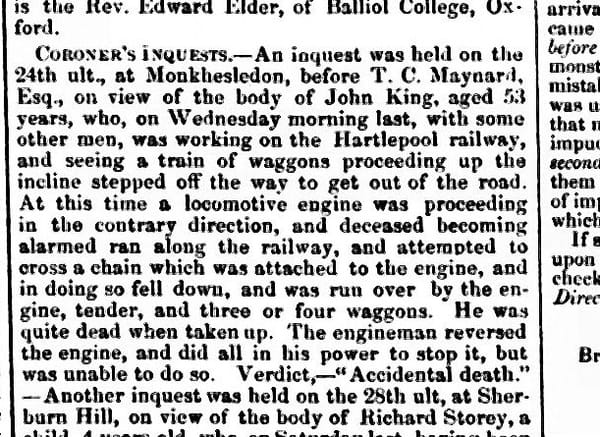
It is worth being clear about what she was risking, because we have lost the physical sense of it. A whipping sentence in colonial Connecticut was not a formality. It was carried out at a post, in public, by the constable, with the back bared; fifteen stripes was a serious number, well above the routine; and there was no appeal. She was a woman in her middle forties who had just spent two months in a cell. She said it anyway. And the court, which had the option of treating an outburst as the understandable temper of a prisoner, chose instead to add the post to the sentence.
No recantation is recorded. Nobody in this story ever takes anything back.
Midnight, the twenty-sixth of November
Here the story acquires a fence.
Another Rogerene woman, Sarah Bolles — wife of John Bolles — was dying in the inner prison at New London. She had been offered release and had refused it, which tells you most of what you need to know about the temper of these people.
On the midnights of the twenty-sixth and twenty-seventh of November, in that same court term, four people came for her: John Culver, John Culver Jr., Bathsheba Rogers (the younger, wife of John Rogers, Jr.) and Mary Rogers. Sarah Culver's husband and Sarah Culver's son, and two women of the founder's family.
The prison-keeper's complaint records what they did in five words. They "staved down part of the prison yard" — tore out a section of the palisade — and carried the dying woman out into the air.
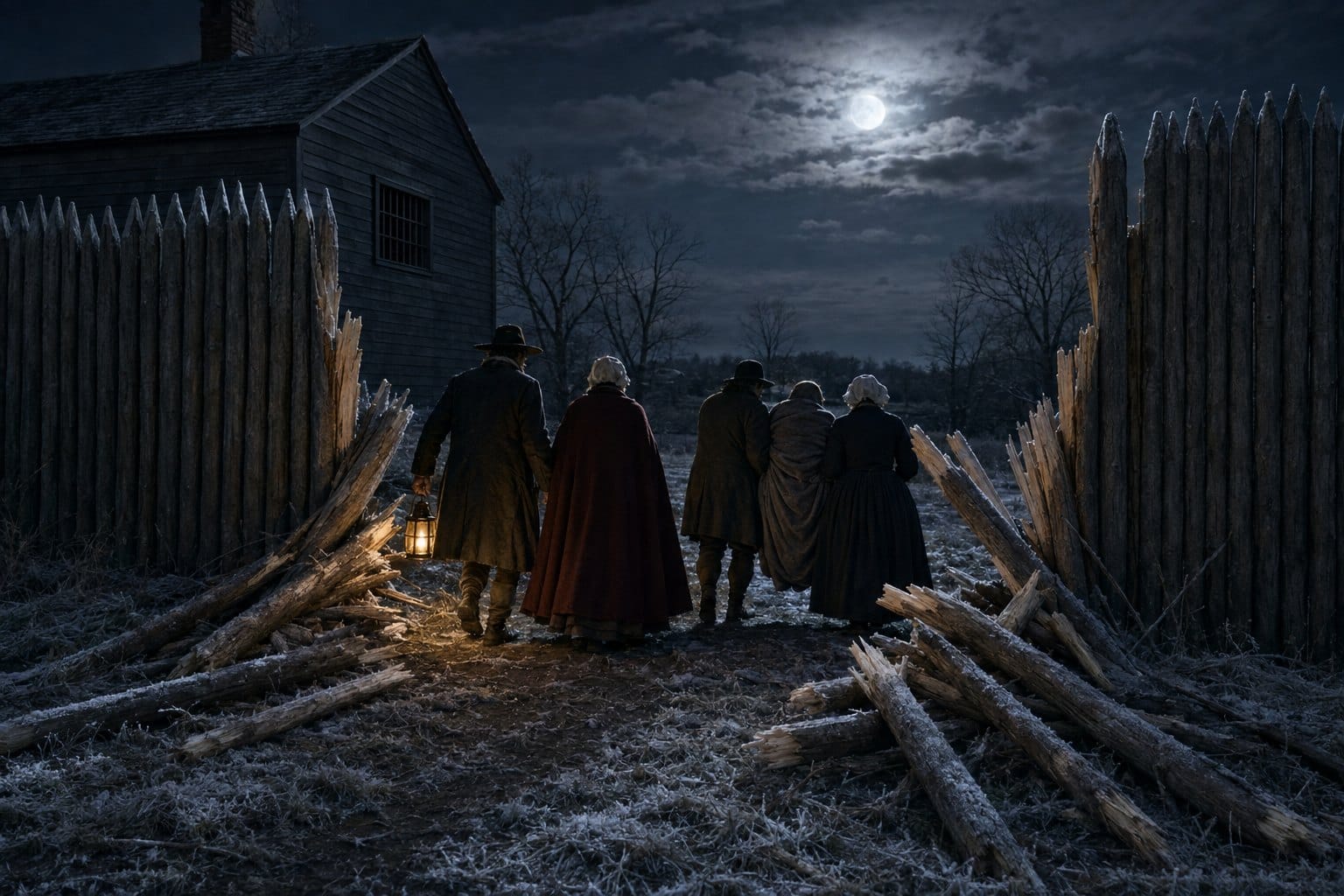
For demolishing part of a colonial jail at midnight, the two Culver men were fined ten shillings and charges.
Ten shillings. Read that beside fifteen stripes for a sentence spoken aloud. The sect's own historians, working through the file a century and a half later, took the smallness of the fine as a measure of how much public sympathy the dying woman's case had aroused — the town, they thought, had turned. The court gave no reason at all, and a bench that has just ordered a woman to the post is not otherwise a lenient bench. Something moved in New London that November, and the record shows only its effect.
And those same historians noticed something else, which I will hand you exactly as they framed it, because it is a guess and it should remain one. It is not unlikely, they wrote, that the raid carried off not only the dying Sarah Bolles but Sarah Culver as well, out of reach of her stripes. Their entire argument for it is one observation: her husband and her son were in the party.
The record never says whether the fifteen stripes were laid on.
So there are two endings available here, and the honest thing is to hold both open. Either a woman in her forties was stripped and whipped at a post in a Connecticut November for telling four magistrates that God would find them out — or her husband and her son pulled down the jail wall and took her out into the dark before the constable could. The paper permits either. I know which one I would choose; I also know that choosing is not the historian's job, and the reason this blog exists is that the family literature spent two centuries choosing.
What is certain is the sentence. What is certain is that nobody apologized.
The singing sister
She was not finished.
Six years later, in August of 1725, John and Sarah Culver rode out with the Rogerene party. It went from Groton over to Lebanon, to baptize converts. Read that sentence slowly. She was not carried along on her husband's errand; she was on the errand. She was past fifty.
And in the country around Norwich they had a name for her. Sarah Culver was the singing sister.
It is the only nickname this project has recovered for any Collver woman in four hundred years, and it was not given her by her family. It was given her by neighbors, for the sound she made praising God in places where she had been told not to be. The sect's women travelled on the Sabbath in defiance of the law that fixed them at home, in order to worship where they pleased, and they were whipped for the travelling. The singing sister was among the women scourged at Norwich in those years — in a flogging so plainly cruel that the deputy governor of Rhode Island had handbills printed and sent across the colony line to condemn it. It takes a certain quality of public brutality to make a neighboring government print leaflets about you.
Set the whole record of her in one line and see what you have.
A woman convicted for speaking in church. Sentenced to fifteen stripes for what she then said to the bench. Riding out past fifty to baptize converts in another town. Whipped at Norwich for making the journey. And known to the countryside by the sound of her singing.
Whatever word the reader prefers for that, preacher is not a stretch.
The family chose this twice
There is a detail here that changes the shape of the whole story, and it took two of the twentieth century's best genealogists to find it.
The Culvers did not drift into the Rogerenes the way a family drifts into a neighborhood. Sarah's husband, John, was baptized as an adult at the First Church of Stonington on the thirtieth of June, 1695, at twenty-five years old, standing beside his nineteen-year-old sister. Both of them were unbaptized because their father had already left the church. Then, for the next seven years, John and Sarah had five children christened at that same church.
And then, in August of 1702, the entries stop. By April of 1716 he was in jail as a Rogerene.
Read that sequence again. The father went out. The son came back in, conformed for the better part of a decade, and had his children entered in the register like anybody else — and then went out again, and took his household with him. The dissent in this family is not an inheritance anybody was stuck with. It was chosen, abandoned, and chosen a second time by a man who knew exactly what it was going to cost, because he had watched it cost his father.
Sarah married into that, and then she out-dissented all of them.
What it cost the people who came after
Now the part that stings, and it is the reason this piece belongs to this project rather than to somebody else's.
A church that will not baptize infants, will not marry before a minister, and will not enter its people in a parish register leaves almost no paper. That is not an accident of survival; it is a doctrine with an archival consequence. And the consequence lands on the descendants.
The grandson of the singing sister is the man this whole book is built around — Jabez Collver, born at Groton on the nineteenth of June, 1731. The town clerk entered him: Jabez, s. John & Freelove. And that is all. He was carried to no font, and no church register anywhere records him. The boy who would preach for sixty years on two sides of an international border enters the record as a line in a town book, because his family had walked out of the church's books for the love of God.
Multiply that by four generations and you have the reason a century of well-meaning compilers got this family wrong — invented a phantom generation, merged two men named Timothy into one, and married a Culver to a Winthrop who never existed. Where there is no register, there is guesswork; and guesswork, printed and reprinted, hardens into fact.
The absence of a record is not the absence of a life. This project says that a dozen times, and Sarah Culver is where it was learned.
What the family did with her
And here is the thing that I cannot quite get over.
For most of the twentieth century the published Collver genealogies were busy establishing that the family had married into the Winthrops — the governors of Connecticut, the first family of the colony. The claim appears in three different forms across the family literature. Somebody had it notarized in a lineage registration in 1920. It is, beginning to end, false; the marriage never happened, and the correction was published in 1945 by two of the finest genealogists this country has produced.
So the family spent a hundred years trying to attach itself to the magistrates of Connecticut.
It already had somebody in that courtroom. She was standing on the other side of the bar, telling those magistrates that they were an adulterous generation and that God would find them out, and taking a sentence for it.
Of the two lineages, I know which one I would rather descend from, and it is not the one with the governor in it.
There is a last turn, and the family supplies it, a century and a border downstream. On a summer day in 1820, in Woodhouse Township in Upper Canada, a justice of the peace convicted a shoemaker of doing ordinary labour — the drawing of grain — on the Sabbath. The grain had been drawn, of all the barns in the province, into "one Jabish Culver farm."
Be careful with that, because it is the kind of irony that will lie to you if you let it. The document establishes where the grain was drawn. It does not say that the Culver of that farm laid the complaint, or testified, or sat on the case, or approved of it; the justice was another man entirely, and the record assigns the family no part in the enforcing at all. The quieter version is strange enough. In four generations the descendants of a woman flogged for Sabbath travel had come to hold the sort of farm where Sabbath labor was now the offense — respectable, Methodist, magistrate-adjacent, and standing on the far side of a law their great-grandmother took stripes to defy.
Families do that. They arrive, and then they forget what arriving cost, and then they go looking for a governor.
The remnant
The Rogerenes are nearly gone, but "nearly" has been doing work for three hundred years.
A scholar who went looking for the remnant in 1942 found them still gathering on a wooded hill above Mystic, a few miles from the Groton ground where the Culvers were jailed, and wrote that to be a Rogerene in 1942 meant personal responsibility — and that descendants three thousand miles from New London would still say I am a Rogerene, with a pride she found tinged by both awe and solemnity. In Morris County, New Jersey, where this family went next, there is to this day a Lake Rogerene, the sect's name settled onto the water the way, a century later and three hundred miles north, a Colver's name would settle onto a mountain gap and refuse to come off. The meeting-house the sect raised at Quakertown in 1815 burned in the 1930s and the congregation is gone; the conviction it housed outlived the men who first suffered for it, which is the only sort of victory a persecuted church is ever promised.
The thing to take away
Here is what I would keep, if I could keep one thing out of the whole four hundred years.
Somewhere in your family there is a person the records mention only when they were in trouble. Court files, jail lists, fines, a complaint from a neighbor, a name in a docket. It is very easy to read those pages as a record of failure. It is easier still to leave them out of the family story — which is exactly what the compilers did, dropping Sarah while chasing a Winthrop who was never there.
Read them again. The colony wrote Sarah Culver down four times: when she interrupted the minister, when she insulted the bench, when her family tore down the jail, and when they whipped her at Norwich for going to a meeting. Four entries, every one of them a punishment. Together they are the fullest portrait of a woman this project holds from the whole of the eighteenth century — fuller than we have of any Collver wife who kept the law and stayed home.
The establishment recorded this family only where it collided with the establishment. So the collisions are where she is.
Go and find your own.
Sources and notes: John Rogers Bolles and Anna B. Williams, The Rogerenes: Some Hitherto Unpublished Annals Belonging to the Colonial History of Connecticut (Boston, 1904), 248–250 — the September 1719 meeting-house presentments, the November county court, the "adulterous generation" outburst and its sentence, the prison-yard breach of 26–27 November with its ten-shilling fine, and the authors' own suggestion that the same raid may have carried Sarah Culver beyond the reach of her stripes. The identification of this Sarah as Sarah (Long) Culver, wife of John³, and as the "singing sister" of the Norwich country, follows Donald Lines Jacobus and Ralph D. Wood, "Additions and Corrections to the Colver-Culver Genealogy," The American Genealogist 31 (1955): 141, citing Frances Manwaring Caulkins, History of Norwich (1866), 291–92; the adult baptism at Stonington in 1695 and the Stonington christenings of 1696–1702 are theirs also, at 140–42. The 1726 handbills of Deputy Governor Joseph Jenks of Rhode Island are noted in Brinton's study of the sect. Jabez Collver's 1731 town entry is Groton Vital Records 1|127. The Winthrop marriage is disposed of in The American Genealogist 22 (1945): 107–10. The 1820 Sabbath conviction is from the Woodhouse Township records.
Adapted from the forthcoming book — We Are Doves: Four Centuries of the Collver–Culver Family.
© 2026 Albert B. Collver III · The Collver Family History Project. Original historical documents reproduced here are in the public domain; the research, text, and annotations are the author's. Please cite or link rather than republish.