Lost at Sea, Twice
A Hartlepool gravestone remembers Henry Anderson, master mariner, who died at sea in 1839; his son and namesake died at sea in 1865. The records a seaman's death leaves behind give the father a ship and a birthplace: Lerwick, in Shetland.

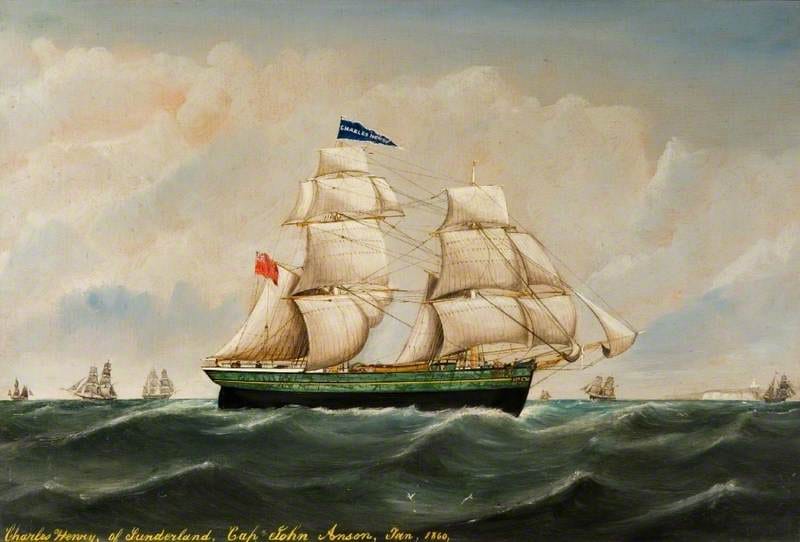
A master mariner was not a man who had mastered the sea. The phrase is plainer and older than that. A master was the man in command of a merchant ship, the one aboard who answered for ship, crew, and cargo; a mariner was anyone who followed the sea. Put together, the words named a rank and a trade, and on the north-east coast of England in the 1830s and 1840s they were common enough to fill a churchyard. The ground around St Hilda’s on the Hartlepool headland is full of them: pilots drowned in the bay, a mate who fell from the maintop into the hold, a fisherman who died of cholera, and, on the north side of the church, one stone that begins in letters still sharp after a hundred and eighty years:
To the Memory of HENRY ANDERSON, MASTER MARINER, who died at Sea December 5th 1839, Aged 55 Years.
He was my fourth-great-grandfather. His son, also Henry, also a master mariner, also died at sea. Neither came home to be buried.
What the family remembered
Very little, and none of it about the sea. Our English line reaches Michigan through Gertrude Anderson, who came over in 1910 and married into the Collvers in 1917. Her father, John Henry Anderson, was a Teesside weighman who stayed in England. Behind him the family remembered nothing. The records had to do it.
They began, as they usually do, with a census. In 1851 the enumerator at Hartlepool found Ann Anderson keeping house with her widowed mother, a small daughter, and an infant son, John Henry. He wrote her down as a Mariner’s Wife. In 1861 she was on Hart Street with five children. In neither year was her husband at home, and in 1871 she was a widow.
The son
Her husband was Henry Anderson, born at Sunderland in 1823. In July 1850 he passed the examination for master at Shields, and that December, under the new Mercantile Marine Act, the Board of Trade exchanged his pass for one of its own Certificates of Competency as Master, number 2,684, made out to him at 5 Everill Street, Hartlepool. The Act made a certificated master compulsory on every British ship going foreign, so the certificate was his livelihood. It is also the only document in which he describes himself.
For a long time the trail stopped there. The civil death index, which in England begins in 1837, has no Henry Anderson of the right age dying anywhere near Hartlepool in the 1860s. The absence of a record is not the absence of the event. A man who dies at sea is not registered in the district where his wife lives. His death goes to a different office, if it is recorded at all, and his family learns of it from the owners, or from the newspaper’s shipping column, or from the men who came home without him.
The answer was in the probate calendar for 1866:
ANDERSON Henry. Effects under £300. 12 February. Letters of Administration of the Personal estate and effects of Henry Anderson late of Hartlepool in the County of Durham Master Mariner deceased who died 25 November 1865 at Sea were granted at Durham to Ann Anderson of Hartlepool ...
He was forty-two. The calendar does not name his ship, and I have not yet found it. What it does say is enough: a Hartlepool master, lost at sea in late November, and a widow left to settle what he had, under three hundred pounds, with children still at home.
The father
The son’s baptism pointed back a generation. Henry was born on 16 October 1823 and baptised at the Robinson Lane chapel in Sunderland, a Presbyterian congregation, the son of Henry Anderson and Ann Donkin. They had married at Holy Trinity, Sunderland, on 27 October 1817, by banns: Henry of that parish, Ann of Houghton-le-Spring, a few miles inland.
By 1839 the family had moved down the coast to Hartlepool, and that December the elder Henry was lost at sea. It was a bad month to be on that coast. The shipping columns for the first week of December 1839 report a gale along the whole of the east of England: ships wrecked at Filey Bay and in Leith Roads, colliers running into Hartlepool for shelter, a man washed overboard on the second. Henry died on the fifth. No newspaper I have read gives him a notice.
His ship has a name now. Lloyd’s Register shows a snow, the Castle Eden, built at Hartlepool in 1837 and owned at Stockton, with a master named Anderson from 1838 until the winter of 1839. Lloyd’s never gives a master’s first name, so for a while that was only a fit. Then the National Archives at Kew sent a copy of her crew list for the autumn of 1839, London to St Petersburg and back. At its head: "Ship Castle Eden of Hartlepool, whereof H. Anderson was Master." On the first line, "Henry Anderson, 52, Lerwick, Master." On the last, among the apprentices, "Henry Anderson, 15, Sunderland." The son was at sea with his father at fifteen. At the foot, dated 18 October 1839, the master signed it himself. Another Henry Anderson commanded a Sunderland ship that year, the Radical, but her crew list at Kew shows a man of twenty-three, born at Newcastle, and of another family.

So the elder Henry was a Shetlander, born at Lerwick, who had come south to the colliers and timber ships of the Wear. Seven weeks after he signed that list, the stone says, he was lost at sea. The shipping columns show the Castle Eden reaching Hartlepool from London on 8 December under Anderson and clearing again on the 21st under a new master, Harrison. That he died aboard her is not yet proven. The list for that last voyage, if it survives, is in the same box at Kew, and a second page check is on order.
Two Anns
The stone does not stop with Henry. It goes on:
Also ANN, Wife of the above, who died July 30th 1845. After a long and painful illness which she bore with fortitude and resignation. Aged 60 Years.
Below her are a daughter, Maria, who died at Sunderland in 1834, aged fourteen, and a son-in-law, Thomas Newbegin, who had married their daughter Ann four years before and died in January 1845, aged twenty-nine. Ann Donkin buried a daughter, lost a husband to the sea, buried a son-in-law, and died herself six months after him. Whoever paid the mason chose the epitaph for her husband from the thirty-seventh Psalm: Mark the perfect man, and behold the upright: for the end of that man is peace.
Her son’s wife was also an Ann, Ann King, and the sea was not the first thing that took a man from her. Her father, John King, was the plate layer run over on the Hartlepool railway in October 1844, five years after her father-in-law was lost and three years before she married. In 1865 the sea took her husband too. Between the railway and the sea, the two men who stood behind her son, his grandfathers, both died at work within five years of each other, and then his father followed.
What it means now
For the book, chapter twelve now says what it could not say a week ago: that Henry Anderson died at sea on the twenty-fifth of November, 1865, and that his father had done the same in 1839. For the method, the lesson is the one the plate layer taught. When the index is silent where you expect the event, ask where else the event would have been written down. A seaman’s death is in the probate calendar, the crew agreement, and the shipping column, not the parish register at home. And when a stone says died at sea, believe it, and go and look for the sea.
For the family, the Andersons now have a shape. They were Sunderland and Hartlepool seafaring people, two generations of masters, who sailed the colliers and timber ships out of the Tees and the Wear and did not always come back. The women kept the houses ashore and raised the children who did come back. One of those children was John Henry Anderson, the gas works clerk and weighman, who stayed on land. His daughter crossed an ocean in 1910, and the family she founded has lived a thousand miles from salt water ever since.
Sources
- Gravestone, St Hilda’s churchyard, Hartlepool, north side (church plan no. 44), read from a photograph (Find a Grave memorial 169304061, photographed 2015); transcribed also in Durham Records Online and the church’s own graves index (which misreads the age as 35).
- National Probate Calendar (Index of Wills and Administrations), 1866, Administrations, p. 187 (read from the image).
- UK and Ireland, Masters and Mates Certificates, 1850–1927, certificate no. 2,684 (National Maritime Museum; read from the image).
- Censuses, Hartlepool: 1851 (HO 107/2384), 1861 (RG 9/3701), 1871 (RG 10/4914).
- Baptism of Henry Anderson, Robinson Lane chapel, Sunderland, 1823, and marriage of Henry Anderson × Ann Donkin, Holy Trinity, Sunderland, 27 Oct. 1817 (Durham Records Online transcripts).
- Crew list, Castle Eden of Hartlepool, London–St Petersburg, 1839, signed 18 Oct. 1839 (The National Archives, BT 98/475; read from the image).
- Crew lists, Radical of Sunderland, Sunderland–Miramichi–Chepstow and Bridgwater–Quebec–Sunderland, 1839 (The National Archives, BT 98/500; read from the images).
- Lloyd’s Register, 1838–1841, "Castle Eden" (archive.org scans); Shipping and Mercantile Gazette, 11 and 23 Dec. 1839, p. 2; Durham Chronicle, 14 Dec. 1839, p. 3 (shipping and disaster columns).
© 2026 Albert B. Collver III. Written for the Collver Family History Project.