The Bride Goes Home
In 1958 a Michigan widow sailed home to England on the Queen Elizabeth. The records give her back a Yorkshire village, two forgotten weddings (father and son to mother and daughter), a grandmother who signed her name in 1818, and an English cousin found by DNA.
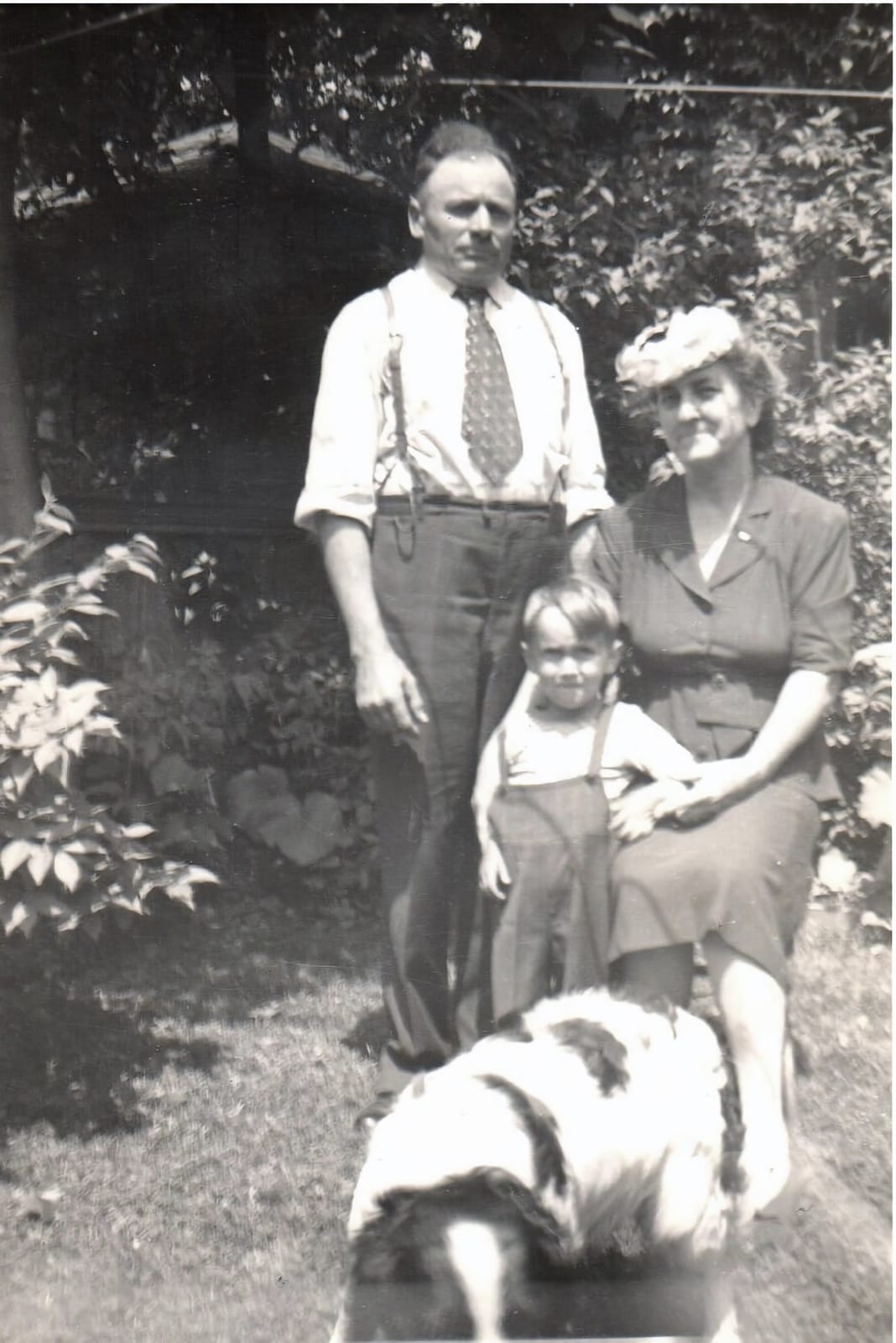
On the eleventh of November, 1958, the Cunard liner Queen Elizabeth came into Southampton from New York. Among her passengers, the incoming list records, was Gertrude Collver, aged sixty-five, born the thirtieth of March, 1893. She was my great-grandmother, a widow of three years from Munger, Michigan, and she was going home.
The family remembered the ship. As I have always had it, the English brides who married into our Michigan line "came by ship," on the Queen Mary or the Queen Elizabeth. The memory has the right ship and the wrong direction. Gertrude did not come to America on the Queen Elizabeth. She came in 1910, as a girl of seventeen, before that ship was built. The Queen Elizabeth carried her the other way, back to England, forty-eight years after she left it.
To see what she was going home to, start with the village.
The merchants’ village
Copmanthorpe is an Old Norse name. It is usually explained as kaupmanna-thorp, "the merchants’ outlying settlement," a trading hamlet of the Danish age on the road into York. The Knights Templar held the manor until 1312, and in 1890 carved stones from their house were still built into the cottages and gardens of the village. The fields kept the name, Temple Field and Temple Garth.
By the time Gertrude knew it, Copmanthorpe was a farming village of about three hundred people, 299 at the census of 1901, four miles south-south-west of York. It had a small medieval chapel, St Giles, seating about a hundred and twenty; a Wesleyan chapel; and a railway station, the first stop out of York on the line to Leeds, rebuilt in 1904 while she lived there. It also had a one-room Church of England school, which through the 1890s was the scene of a long quarrel between the vicar and a newly elected School Board. The school was closed for six months, and in 1898, the village’s own history records, the vicar "removed the log book." Gertrude was five that year and eight in 1901. No register puts her at that school, but a girl of her age living in the village would almost certainly have sat in that one room.
The census of 1901 finds her there, in the household of her mother, Alice Anderson, forty-three, head of the house, with her brothers Christopher, ten, and John, four. No husband is in the house. The census gives Gertrude’s birthplace as Featherstone, a colliery town in the West Riding, near Pontefract. Her obituary, seventy-five years later, says she was born at "Copmanthorph." The two documents disagree, and each has its reason: the census-taker wrote down where she was born, and the family wrote down the place they remembered as home.
Why Copmanthorpe? Because it was her mother’s people’s village. The census indexes place Alice’s father, Christopher Woodward, a shoemaker, at Copmanthorpe in 1881 and again in 1891. When Alice found herself raising three children alone, she brought them to the village where her father had lived. The family’s Copmanthorpe was the Woodwards’ Copmanthorpe.
Two Englands
Gertrude’s parents came from two different Englands, one of the sea and one of the land.
Her father, John Henry Anderson, was born at Hartlepool in 1851, the son of a sea captain. In 1871, at nineteen, he was a clerk at the gas works, living with his widowed mother, Ann, at 22 Milbank Crescent. On the twenty-sixth of October, 1889, at Holy Trinity, Ripon, he married Alice Woodward. The register gives him as thirty-eight, a widower, a weighman of Thornaby, and names his father: Henry Anderson, master mariner. Gertrude was born four years later. Where and when John Henry died, I have not yet found; he is simply absent from the house in 1901.
Her mother’s people were country people of the North Riding. On the sixteenth of November, 1818, at Middleton Tyas, near Richmond, John Wilson of the chapelry of Forcett married Alice Dakers of the parish. Both were under age, and the register says they married "with Consent of Parents." She was seventeen. The groom made his mark. The bride signed her name. Forty years later, on the second of January, 1858, their daughter Isabell, still a minor, married Christopher Woodward, shoemaker, in the same church, and that year a daughter was born to them. They named her Alice, for the grandmother who could write.
By 1861 the shoemaker had taken his young family to West Hartlepool. The Anderson boy and the Woodward girl who would marry at Ripon in 1889 were small children in the same port.
What a master mariner was
The phrase on the Ripon register deserves a moment, because it is easy to misread. A master mariner was not a man who had mastered the sea. A master was the captain of a merchant ship, the one man aboard answerable in law for ship, crew, and cargo. A mariner was anyone who followed the sea. Together the words named a rank and a trade, and they were the title such a man carried ashore.
In 1850 the title became a matter of paper. The Mercantile Marine Act of that year made a Board of Trade certificate compulsory for the master of every British ship going foreign, and the Merchant Shipping Act of 1854 extended the rule to the home trade. The examination asked for a legible hand, arithmetic, navigation, and practical seamanship. Gertrude’s grandfather, Henry Anderson, born at Sunderland in 1823, passed it at Shields in July 1850, and that December the Board of Trade issued him Certificate of Competency as Master number 2,684, made out to him at 5 Everill Street, Hartlepool. He was twenty-seven. Four months later the census found his wife Ann at Hartlepool, entered as a "Mariner’s Wife."
As Monday’s post told, he died at sea on the twenty-fifth of November, 1865, as his own father had done in 1839. The sea took the men, and the women kept the houses ashore. Henry’s son went to the gas works, and then to the weighbridge, and stayed on land.
The widow and the widower
Gertrude’s obituary says that she "came to America in 1910." For a long time that sentence stood alone. It no longer does, because her mother came too, and married first.
On the twenty-seventh of June, 1910, at Standish, Arenac County, Michigan, Joshua Bacon, the Methodist Episcopal pastor, married Milton Collver, forty-eight, a farmer and a widower, to Alice Anderson, fifty-two, born in England. The register gives both of them as "of Melita," a hamlet in Arenac County near the Collver farm in Clayton Township. The census taken that April had found Milton at home with five children, the youngest three of them small, and no wife in the house. How a Yorkshire widow came to be living at Melita by that June, and how she met him, no record I have found explains. I leave the question open rather than invent an answer.
How Gertrude crossed is also not settled. A Canadian passenger list of May 1910 carries a Gertrude Anderson, seventeen, English and Presbyterian, landing at Quebec, but the row bears marks that do not fit a girl emigrating for the first time, and I cannot yet say she is ours. What is certain is the year. Her "came to America in 1910" is the year of her mother’s wedding.
Alice may have gone home once herself. Passenger lists for the winter of 1912 carry a farmer named "Milton Coalver," fifty-one, sailing from New York to Liverpool a few days before Christmas, and in February 1913 an "M Colver," farmer, and a "Mrs Colver" sailing back on the Baltic. No first names, no addresses, and one age that fits nobody. I count it a probable voyage home, not a proven one.
In November 1916 Milton and Alice crossed into Ontario together at Sault Ste. Marie, bound for the Saskatchewan prairie, and Alice gave her last address as Copemish, Michigan. Four months later, on the twenty-ninth of March, 1917, at Cadillac, Daniel William Collver, twenty-three, of Buckley, married Gertrude Alice Anderson, twenty-three, of Buckley, "at home." His brother Clark stood witness. The register names the groom’s mother as Mary Durham and the bride’s parents as John Anderson and Alice Woodward.
So the son of the groom married the daughter of the bride. Father and son had married mother and daughter. Daniel and Gertrude were step-brother and step-sister, with no blood between them: his line ran through his father’s first wife, Mary Durham, and hers through John Henry Anderson. And so two of my great-great-grandparents on this line, Milton and Alice, were husband and wife, though their blood reaches me only through their first marriages.
Munger
The young couple settled in Bay County. By 1930 the census finds them on Munger Road in Merritt Township, Daniel a rural mail carrier, with four children, the youngest a boy of four named Albert, who would be my grandfather. Alice had come to live near them. She died on the third of February, 1929, in Merritt Township, aged seventy, a grandmother at one door of the house and a step-grandmother at the other. My grandfather was three.
Daniel carried the Munger mail for the rest of his life. At noon on the twenty-fourth of January, 1955, his jeep skidded on a snow-covered road and went into a deep ditch on Russell Road, and he was killed. Gertrude was sixty-one.
Three years and ten months later she was on the Queen Elizabeth, crossing to Southampton. The list does not say why she went, or whom she went to see, or whether anyone was left at Copmanthorpe to meet her. Her brother Christopher was in Saginaw, and her mother was buried in Michigan. The westbound voyage that brought her back has not been found; perhaps that is the Queen Mary of the family’s memory. The record gives one ship, one direction, and one date. The family gave the ship a reason to be remembered.
An English cousin
The last thread runs through a test tube. When my father’s DNA was tested, one of his matches was John Stephenson, an English-born Lutheran theologian and a former colleague of mine. The two share sixteen centimorgans, the unit in which genetic testing measures a shared stretch of chromosome, on a single segment, and the match falls on my father’s paternal side. Ancestry calls the relationship "4th cousin or half 3rd cousin 1x removed."
On that side of the family, every line but one has been in North America since the 1630s, and a British-born man is very unlikely to share a segment of that size with my father through a line that left England three hundred and ninety years ago. The one exception is Gertrude. Two descendants of her brother Christopher also match John, which points to her family rather than to her husband’s. That is an argument from the evidence, not yet an ancestor with a name. The shared couple has not been identified.
The estimate can still be stated. Fourth cousins share third-great-grandparents. Counting back from my father, his third-great-grandparents on Gertrude’s side, her great-grandparents, are the couples who married around 1815 to 1818: John Wilson and Alice Dakers among them, John King and Margaret Benson, Henry Anderson and Ann Donkin. A single segment of sixteen centimorgans is just as often found between fifth and sixth cousins, which reaches a generation or two further back. The plain statement is this: John and my father most likely descend from a couple who married somewhere between about 1780 and 1820, somewhere among Gertrude’s English forebears. It is a statistical estimate, and a segment that size can come from further back still. The search goes on, in the registers and in the replies of cousins.
What she left
Gertrude died on the seventeenth of October, 1976, at Samaritan Hospital in Bay City, aged eighty-three. She was a member of Trinity Episcopal Church and a past treasurer of the Bay City Garden Club. Her obituary counts thirteen grandchildren and twenty-two great-grandchildren.
I am one of the twenty-two. In the last years of her life she lived in a little house on my grandfather’s place at Munger, in front of the barn, inside the U-shaped drive, and when I was three or perhaps four she gave me tea there. It is the only memory I have of her, and until this year I did not know that she had once gone home on the ship my father remembered, or that her own mother had crossed before her and married into the family first.
The registers have given her back a village, a grandmother who signed her name in 1818, a grandfather with a master’s certificate, and an English cousin. The family kept something the registers could not: the name of the village, the name of the ship, and a cup of tea in a little house. Neither would be enough alone. Between them, the bride has come home.
Sources
- UK and Ireland, Incoming Passenger Lists, 1878–1960 (TNA BT 26/1416/66): Gertrude Collver, 65, b. 30 Mar. 1893, New York to Southampton, arr. 11 Nov. 1958, RMS Queen Elizabeth.
- 1901 census, Copmanthorpe (RG 13/4444, fo. 45, p. 12); 1871 census, Throston, Hartlepool (RG 10/4914); 1851 census, Hartlepool (HO 107/2384); 1841 and 1851 censuses, Middleton Tyas (HO 107/1244; HO 107/2381). Christopher Woodward at Copmanthorpe, 1881 and 1891 (FamilySearch census indexes).
- Marriage registers (read from the images): Holy Trinity, Ripon, 26 Oct. 1889 (North Yorkshire CoE registers, PR/RI(HT) 1/4); Middleton Tyas, 16 Nov. 1818 and 2 Jan. 1858 (North Yorkshire CoE Marriages and Banns).
- UK and Ireland, Masters and Mates Certificates, 1850–1927 (National Maritime Museum), certificate no. 2,684; National Probate Calendar, Administrations, 1866, p. 187.
- Michigan marriage registers: Arenac Co., rec. 31 (Standish, 27 June 1910); Wexford Co., rec. 36 (Cadillac, 29 Mar. 1917). Michigan death record, file 001605 (Alice Collver, 3 Feb. 1929). 1910 census, Clayton Twp., Arenac Co.; 1930 census, Merritt Twp., Bay Co.
- Library and Archives Canada, Border Entries, Sault Ste. Marie, Nov. 1916.
- Passenger lists, Cedric (New York–Liverpool, Dec. 1912) and Baltic (Liverpool–New York, Feb. 1913), as read; identification probable only.
- Detroit Free Press, 25 Jan. 1955, p. 25; Bay City Times, 25 Jan. 1955, p. 1, and 18 Oct. 1976, p. 23.
- Bulmer’s History and Directory of North Yorkshire (1890), Copmanthorpe; The Copmanthorpe Story (Copmanthorpe Village Trust / Parish Council), pp. 31, 53.
- Royal Museums Greenwich, research guide C2, "Merchant Navy: master mariners, mates and engineers."
- AncestryDNA match list, kit of the author’s father (viewed Aug.–Oct. 2026).
Adapted from the forthcoming book We Are Doves. © 2026 Albert B. Collver III.