The Collvers Go West
A message from Oregon began with a recitation of five generations. Setting it beside the records took a day — and turned up Gabriel Collver's probate file, a letter from the Coos River folded inside it, and an inheritance routed through Wall Street to a young man with no permanent address.
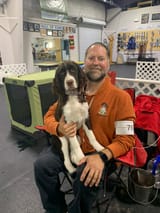
This week a message arrived from Oregon, and it began the way the oldest family documents begin — with a recitation:
"From AB Collver my great great grandfather, Arthur Howard Collver my great grandfather, Ellis Roy Collver my grandfather, Dale Norris Collver my father, Robert Douglas Collver myself, Robert Douglas Collver Jr. and Dale Gene Collver my sons, and eight grandchildren and one great grandson."
Robert Collver of Oregon was giving me his line, five generations in a single breath, the way Hebrew genealogies run and the way our own family Bibles do. He added a detail no census would ever record: his grandfather Ellis, a thirty-two-year-old bachelor, met an eighteen-year-old cook and babysitter named Viva in a logging camp near Yoncalla, and married her. Dale Norris Collver, Robert's father, carried her maiden name — Norris — for the rest of his life.
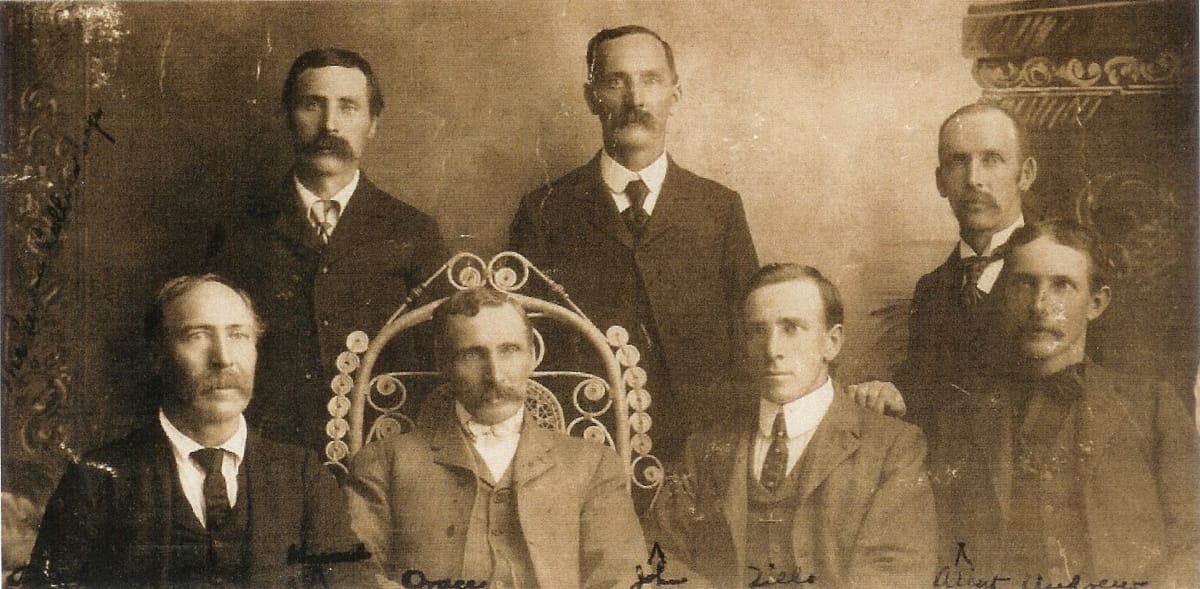
I knew the initials at the head of that recitation. "A. B. Collver" is Alfred Bainbridge Collver, and his branch is the one this project's readers have not yet met: the Collvers who went west. Setting Robert's message beside the records took about a day, and the records, as they tend to do, gave back more than was asked of them. Here is the story they tell.
The son who turned south.
Readers of this blog know the family's great compass heading. In the 1790s Rev. Jabez Collver and the wider household went north, out of a republic that had convicted the old man of sedition, into Upper Canada. The quartette marriages — four of Jabez's sons to four of Timothy Collver's daughters — bound the two Loyalist houses together on the Norfolk frontier, and there, for a generation, the family stayed.
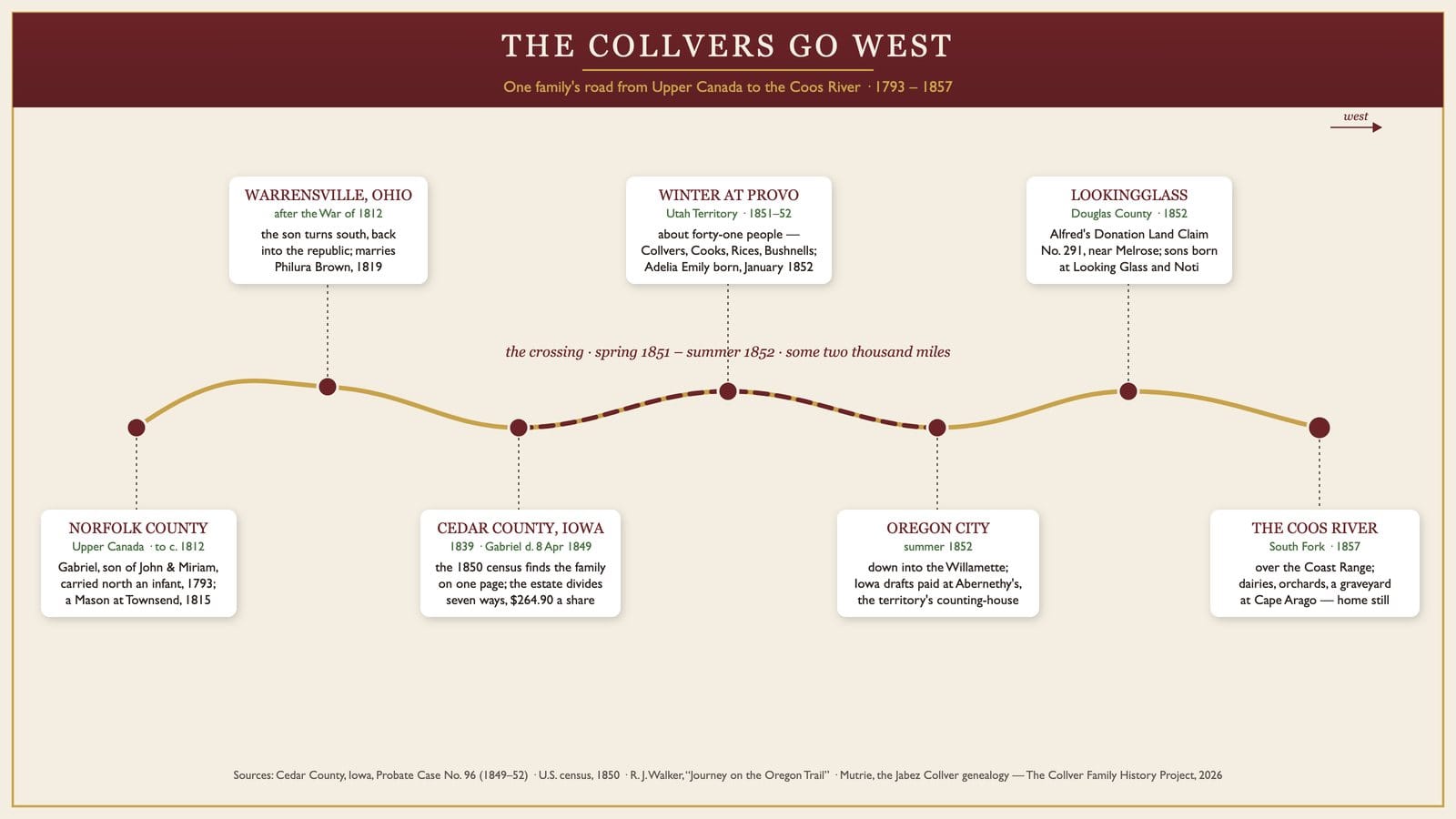
Gabriel Collver was a child of that binding twice over: son of John Collver and Miriam, John's wife and Timothy's daughter. He was born in New Jersey about 1793, in the last seasons before the migration, and was — the branch's own phrase — "carried to Canada in his mother's arms." The record finds him grown, a Mason at Townsend in 1815. And then he did what nobody else of his generation did. He turned around.
After the War of 1812, Gabriel went south to Warrensville, Ohio, near Cleveland, and married Philura Brown there in 1819. In 1839 he moved again, west this time, to Cedar County, Iowa. His grandparents' generation had fled the United States; Gabriel spent his adult life walking back into it, one remove at a time. He died at fifty-six, on the eighth of April, 1849, and was buried in Virginia Grove Cemetery near Tipton. He never saw Oregon. Nearly everyone he raised did.
One page of a census.
The 1850 federal census catches the family in the year between the death and the departure, and it catches them all on a single enumerator's page in Center Township, Cedar County. At dwelling 306, Orace Michael Collver, twenty-seven, farming. Next door at 307, his brother Alfred Bainbridge, thirty, with his wife Ruth — a Rice, of whom more shortly — and their two-year-old Henrietta. Three doors down at 310, their father's widow Berzilda with the younger children: Darius, Charles, Orrin, and little Cornelia. A family in one column of a government ledger, waiting.
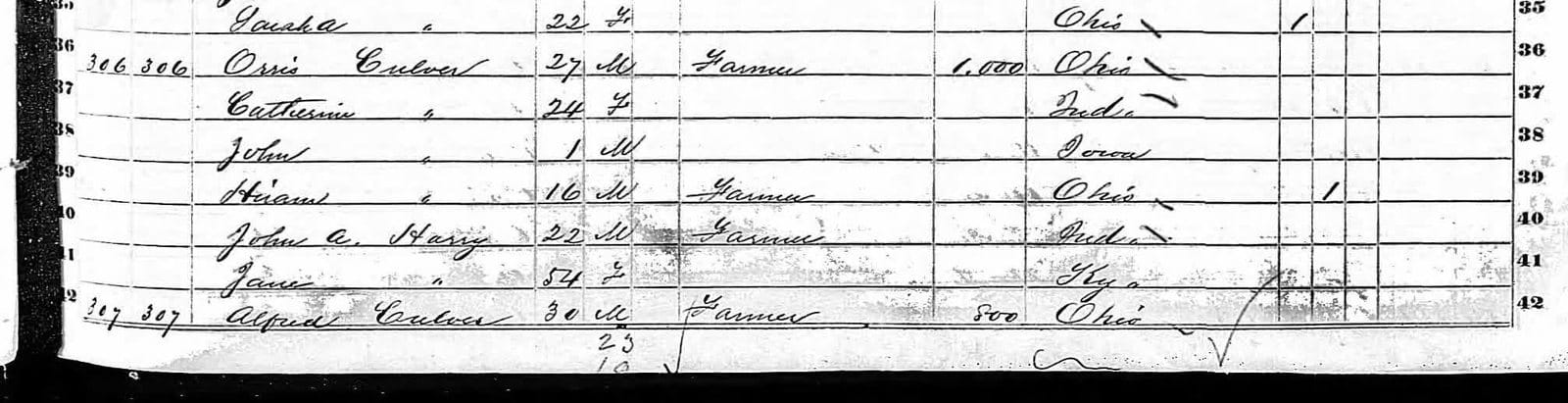
That October the widow remarried, to a neighbor named Luther Bradley. When Gabriel's land was sold to settle the estate, the principal buyer was the same Luther Bradley. The farm passed out of the Collver name, and the family was already looking past it.
The crossing.
In the spring of 1851 a train of about forty-one people left the Tipton neighborhood for Oregon. It was less a wagon train than a related household on wheels: Collvers travelling with the Cooks, Rices, Bushnells, and Harrys they had married and would marry. They wintered among the Latter-day Saints at Provo, in the Utah Territory, where Alfred and Ruth's daughter Adelia Emily was born in January of 1852, and they came down into the Willamette country that summer.
Alfred took a Donation Land Claim near Melrose and Lookingglass in Douglas County — his middle sons were born at places with names like Looking Glass and Noti — and in 1857 he moved the family a last time, over the Coast Range to the South Fork of the Coos River. There the branch put down the roots it keeps still. By its own telling, this family brought the first dairy cattle to the South Coos and helped raise the county's first church and first school; a generation later, two of the sons ran creameries whose cheeses sold in San Francisco, and another son, Orace Gabriel Collver, founded the town of Culver, Oregon — and when the railroad passed it by in 1911, moved the whole town, his own house included, to meet the tracks. I grade those firsts as the branch's tradition, and I tell them with the affection tradition deserves. The town-moving, I am happy to report, is documented.
The estate that chased them.
Now the part the branch's own historians did not have.
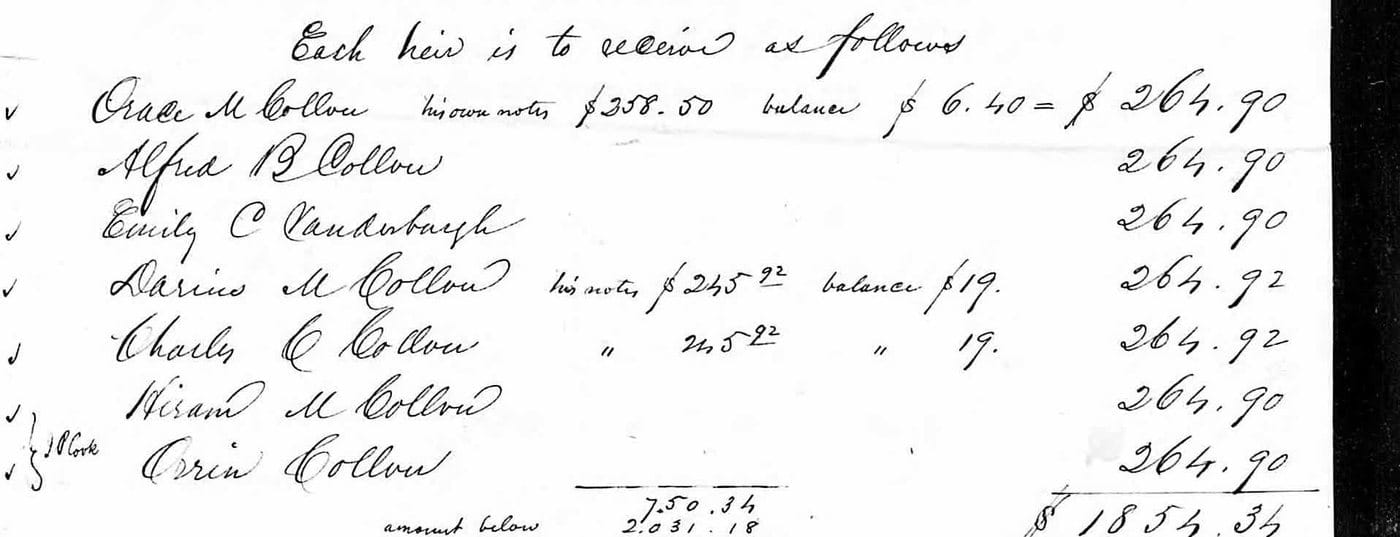
Back in Iowa, Gabriel's estate was still open. In September of 1852 — while the wagons were still rolling — the Cedar County district court divided the proceeds of his land: $2,877.25 gross, a third to the widow as her dower, and the remaining two-thirds split seven ways, $264.90 to each heir. The distribution page survives in the court file, and it names them: Orace M., Alfred B., Emily C. Vandenburgh, Darius M., Charles C., Hiram M., and Orrin. Alfred's share was awarded to a man two thousand miles away who did not yet have a permanent address.
How do you pay an heir who has gone to Oregon? The court file answers that too, because folded among the guardianship papers is a letter from Hiram M. Collver himself, written in June of 1857 from the Long Tom country of Lane County, Oregon Territory, to the Hon. John P. Cook back in Tipton. Hiram directs his money to be deposited "with Ross, Falconer & Co., Wall Street, New York City, subject to the order of G. Abernathy, Oregon City, Oregon Territory," and closes: "Mail to Empire City, Coos River, Coos County, Oregon T."
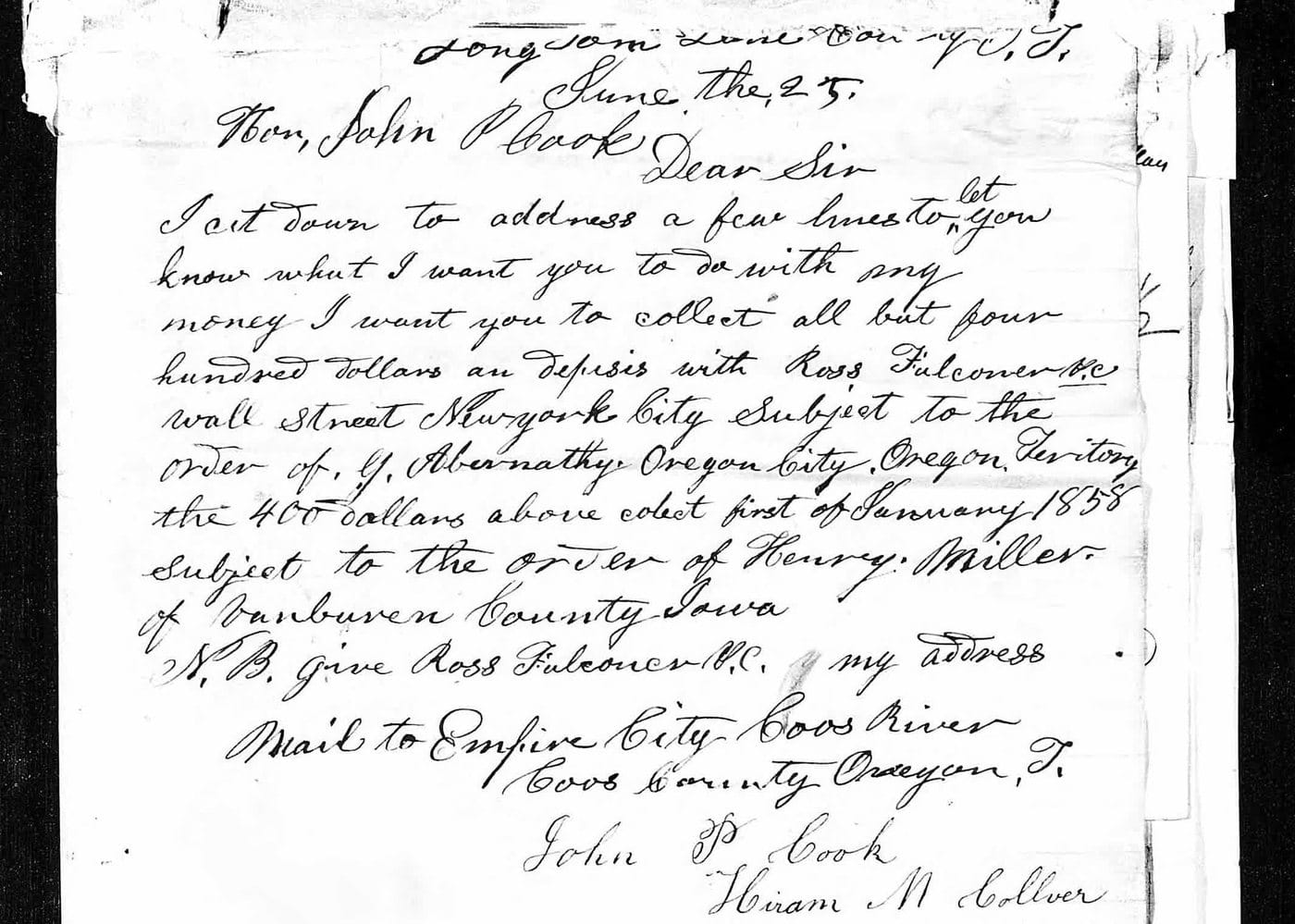
Read that routing again. An Iowa farm sale, converted to a draft on a Wall Street house, payable to the order of George Abernethy — lately the provisional governor of Oregon, whose store at Oregon City served the territory as its bank — for the benefit of a young man on the Coos River. The marginal dates on the distribution show the last of the minors' shares still being paid out in 1858, nine years after Gabriel died. The court settled the estate; nothing on record ever settled the family.
The letters home.
We can follow the branch so closely because one daughter kept everything. Adelia — the baby born at Provo — married Isaac J. Powell in 1876 and moved to Wasco County, and for forty years her parents and siblings wrote to her. Her Powell descendants preserved the letters; her cousins Gordon Ross and Barbara Sytsma transcribed them; Greg Collver indexed and retyped them and gave the whole archive to the family's website, where anyone may read it. It is a model of what a family does right.
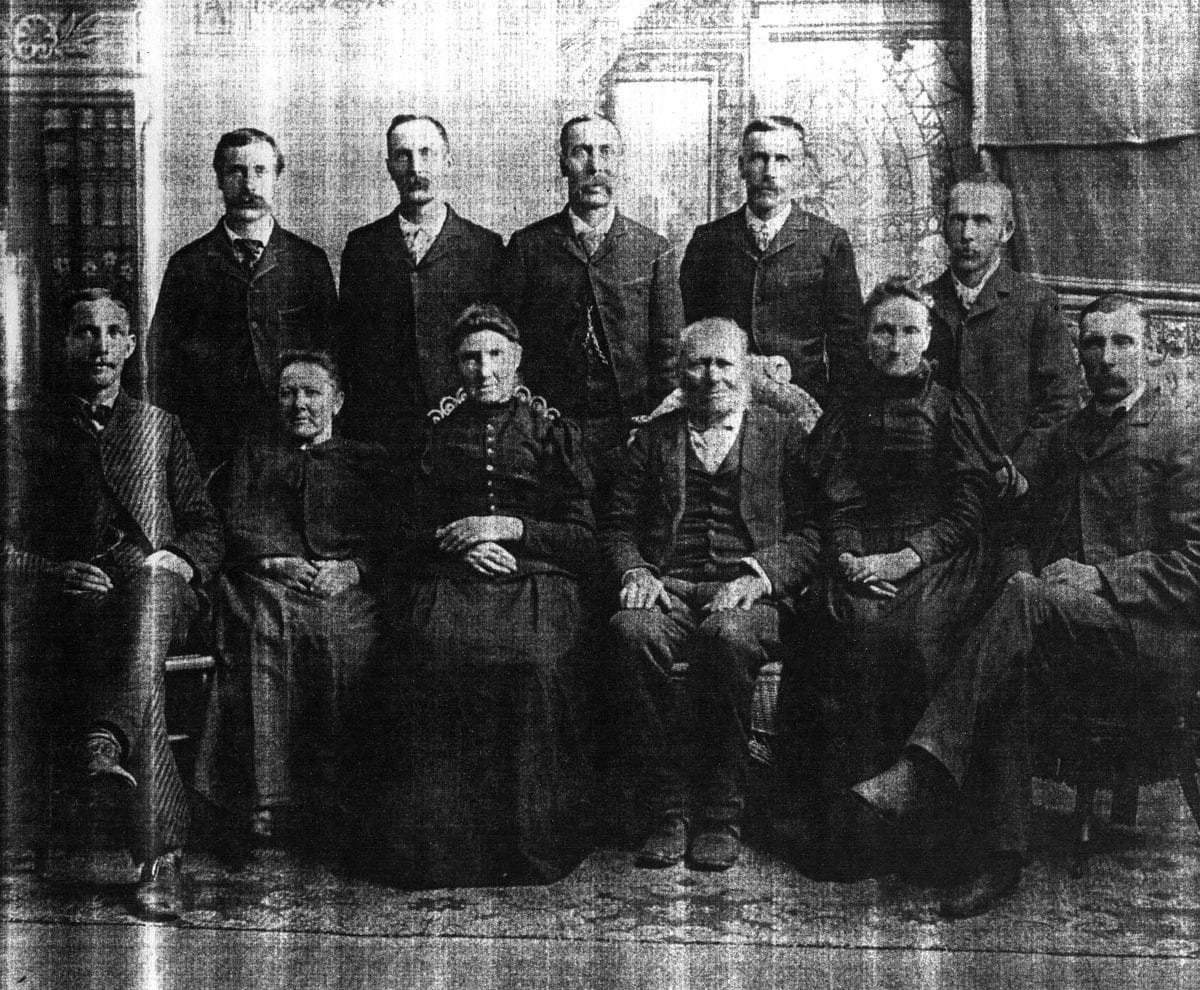
In those letters Alfred ages from homesteader to patriarch, hoeing potatoes at four in the afternoon, watching railroad men level the sand hills below Empire, reporting which orchard bore. And on the eighth of May, 1890, he sat down and gave Adelia the news that, one hundred and thirty-six years later, would let a correspondent's message be proven in a day:
"Arthur Howard has a boy, born the 23rd of April, and calls him Ellis Roy, my fine boy. And Rosa hops and jumps around, and says, 'He is my pretty, sweet brother.'"
The State of Oregon's birth index says the same thing in a clerk's hand: Ellis Roy Collver, born 23 April 1890 at Fairview, Coos County; father Arthur Howard Collver; mother Nancy Elizabeth Benham. When a grandfather's letter and a state register agree to the day, a genealogist may be permitted to rest. Ellis Roy is the man who, forty years on, would meet a young cook named Viva in a logging camp. He is Robert's grandfather.

What the records gave back.
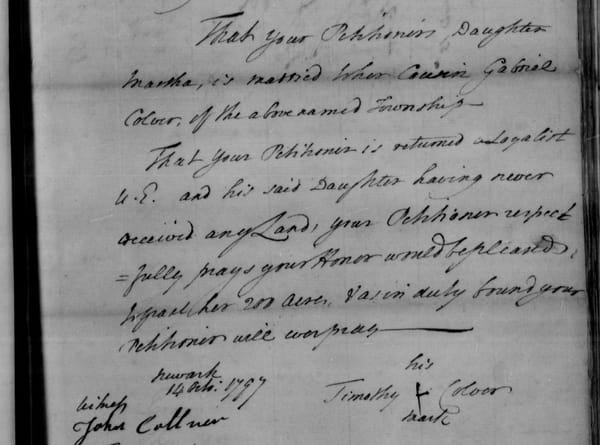
The exchange between our documented spine and the Oregon branch has run both ways this week, as such exchanges should. Their historians gave this project the trail narrative and the letters. The records return a few things their compilations did not have: Gabriel's probate file entire, with Hiram's letter folded inside it; the name of Arthur Howard's wife, Nancy Elizabeth Benham, which even the Norfolk genealogists lacked; and one correction I offer in the friendliest possible spirit. The branch's narrative has Jabez riding "to Newark" to consult Governor Simcoe, and glosses it as Newark, New Jersey. It was Newark, Upper Canada — Niagara-on-the-Lake, Simcoe's own capital — and read rightly, the family's tradition does not need correcting so much as promoting: it corroborates Jabez's petition claim that he had encouragement from His Excellency in person. The tradition was sound. Only the map beneath it had drifted.
As for Robert: setting his recitation beside the records yields a chain documented at every step but one — Gabriel's parentage rests on two secondary compilations that agree — and a computed kinship. Robert Collver of Oregon and I are sixth cousins once removed, through Rev. Jabez. Through Miriam, Robert descends from both Loyalist cousins at once, which is one more than I can claim.
He subscribes to this blog, so he may be reading this. The letters home travel by email now, and they still arrive from the same river.