The Family Business
Run a finger down the records asking what they did for a living: bread, beer, wheels, shoes, land, flour, cheese, shirts, and the telephone — three centuries of the licensed trade a town cannot do without.
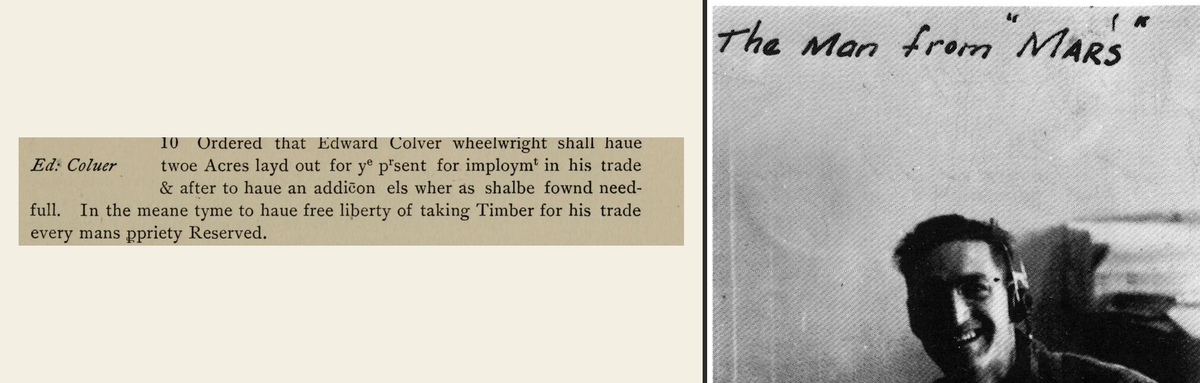
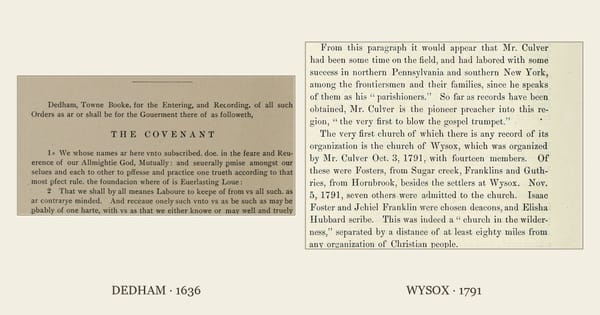
On the twenty-eighth of November, 1637, the town meeting of Dedham, in the Massachusetts Bay Colony, took up its tenth order of business:
Ordered that Edward Colver wheelwright shall haue twoe Acres layd out for ye prsent for imploym't in his trade & after to haue an addicon els wher as shalbe fownd needfull. In the meane tyme to haue free liberty of taking Timber for his trade every mans ppriety Reserved.

It is the earliest dated record of our immigrant ancestor yet found anywhere, and nearly every word of it is about his usefulness. Two acres, not as a settler's portion but "for imploym't in his trade"; more promised as needful; and the clause that would have mattered most to him — free liberty of taking timber, every man's property reserved, which is to say the run of the town's common woods for his raw material. A wheelwright, since the trade has been gone from common memory for a century, was the craftsman who built and repaired wheels, and with them the carts and plough-gear that were a farming town's whole rolling stock. A plantation of thirty or forty families at the edge of the wilderness could pray itself into being, and Dedham very nearly had; but it could not roll anywhere without him. The town did not merely admit a wheelwright. It capitalized one.
The family's histories, mine included, have mostly followed the pulpits and the battlefields, because that is where the drama is. But run a finger down the records with a different question — not what did they believe or which side did they take, but what did they do for a living — and a quieter story assembles itself, three hundred and ninety years long and surprisingly consistent. This is a post about the family business.
Bread and beer for the public good
The word that keeps appearing beside the family's name in the early records is some form of license — from the Latin licentia, "leave, permission," from licet, "it is permitted." A licensed trade was one the town regulated because the town could not do without it; permission and obligation came in the same breath. Edward collected such permissions in two colonies.
By 1662 he had been some years at New London, in Connecticut, and on the fifth of May the town made its choice:
Goodman Culver is chosen and allowed of by the towne for the making of bread and bruing of beere for the publicke good.
Goodman, again, is the honorific of the ordinary householder in good standing — below Mister, above nobody. A town chose its baker and its brewer the way it chose its minister: publicly, and with conditions. The conditions arrived in the deep winter of 1664/5, when the town enlarged his franchise to the selling of liquors, "provided he shall brew also, ells not," and bound him to keep what the age called an ordinary — a licensed public house — engaging always to have "good beere and good dyet and lodging for man and horse." Bread, beer, a bed, and stabling: the whole hospitality of a seventeenth-century town, gathered under one roof at the edge of the rocky hills where the path ran toward Culver's.
The trade traveled. In 1739 one Jeremiah Culver — of the Southampton branch on Long Island, which the local historian Howell traced back to Edward of Dedham — bought the property at Canoe Place, on the lonely neck between the bays, and kept house there so singularly that Howell could write, "Until the revolution his house was the only habitation between Riverhead and Southampton." An innkeeper on the emptiest road in the county: a century after the New London license, and across a Sound, the family was still in the business of good diet and lodging for man and horse.
The shoemaker's inventory
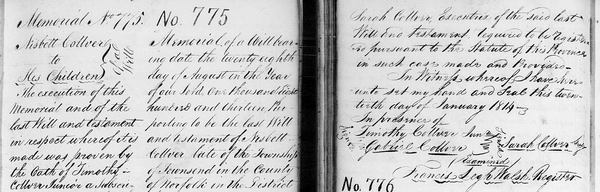
Not every shop prospered long enough to leave a sign. On the second of December, 1732, at Black River in New Jersey, John Colver — grandson of the brewer's son, and father of an infant the will's clerk spelled "Jabsh" — made his will as a "cordwinder, being sick." A cordwainer was a shoemaker, the word worn down from cordwain, the Cordovan leather he worked; the trade ranked above the cobbler, who only repaired. He was dead within the year, and the inventory of his whole estate came to £95 11s., "including beaver hat, felt hat and Bible."
I have written before about that Bible, and about the orphaned Jabsh. What belongs to this post is the hat. A beaver hat was the respectable article of the age, and a shoemaker who owned one, plus a felt for working days, was a tradesman keeping up appearances on the frontier of settlement. The shop died with the man; the family's memory kept the minister his son became and let the shoemaker go. Trades are like records that way — the absence of a surviving signboard is not the absence of the shop.
The land man
That orphan, Rev. Jabez Collver, is remembered as a preacher, a Loyalist, and a founder of townships. The deed books remember something the family's books never quite said aloud: he was also, by any modern definition, the family's most considerable speculator, and his commodity was land.
In August 1774 he bought 163.98 acres in Sussex County, "on the East side of the Minisink Mountain at the North East end of the great pond" — the water that took his name, and later gave it to Culvers Gap. He mortgaged it the same season, which is what a man does when he is buying position rather than parking savings. Conviction for sedition, a £5 fine, and a lost war intervened; and still the tract was not confiscated but sold, on the fourteenth of December, 1787, his wife Anna signing with him — the farm turned into the means of leaving. The following December, at the far edge of New York State, he bought lot 55 of the old town of Chemung — one hundred fifty acres for £115, by an instrument the county historian would salute a century later as "the earliest dated deed on the records of Tioga County." With lots 54 and 56 in his own right and lot 124 jointly with his son John, he stood at very nearly seven hundred acres by the year's end. He came out of New Jersey, as the forthcoming book puts it, not broken but liquid.
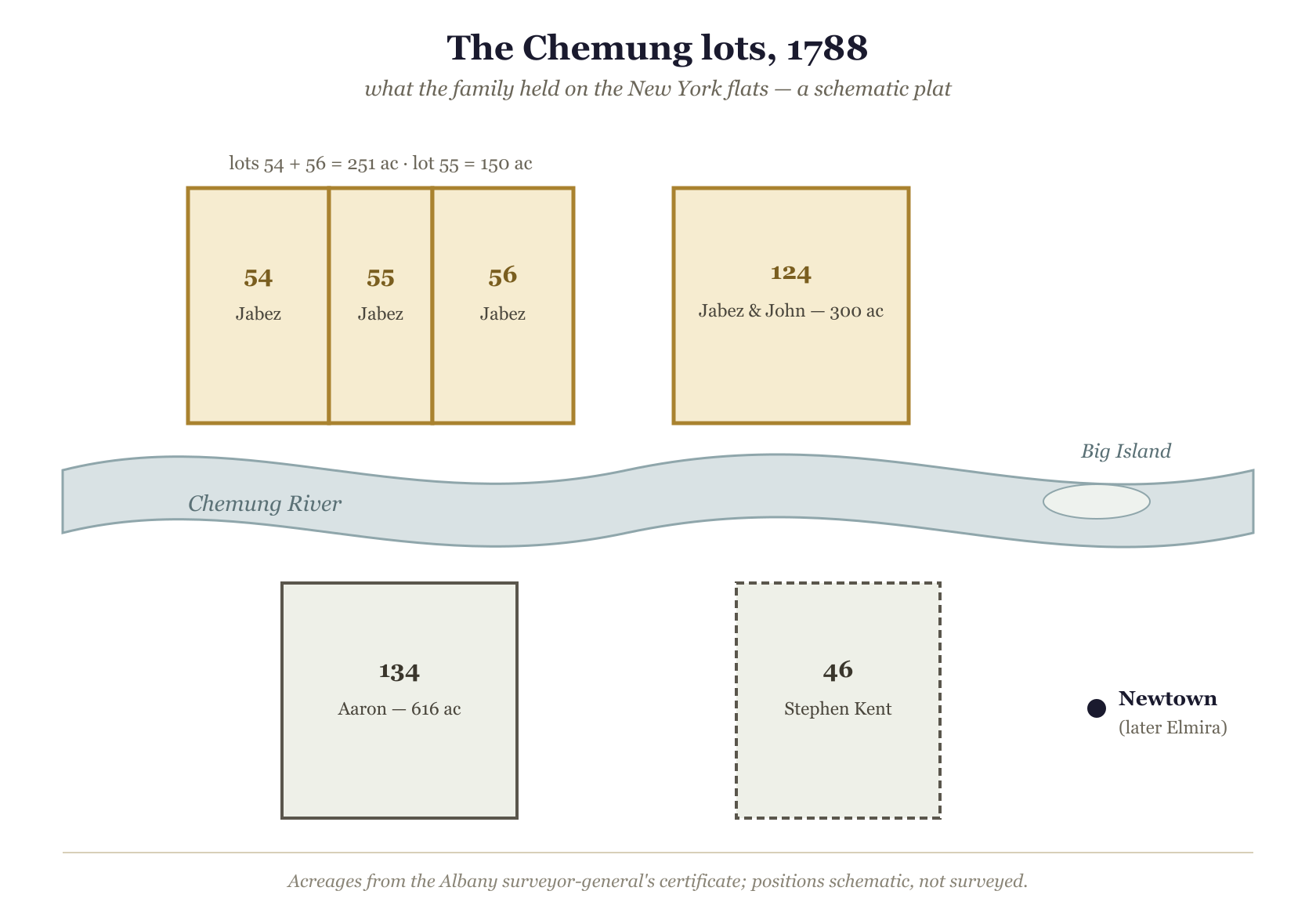
And then, deliberately, he wound the position up: on the tenth of January, 1791, he conveyed the Chemung land to four sons by name — Jabez Jr., Aaron, John, and Gabriel — and the state's calendar closes the account on the twenty-ninth of February, 1792, with a clerk's flourish worthy of the family's whole orthographic history: "Receipt to Aaron McCulver, for £47 4s., being the consideration money for lot 134." Every acre conveyed, every consideration acknowledged, and the proceeds walking north to Canada in the family's pockets. The family's biggest business never had a signboard. It was land, bought ahead of the country and sold to the next arrival.
Even the pulpit, in the new province, turned out to be a licensed trade. The London District court journal for the spring term of 1801 records that "Daniel Freeman and Jabez Culver, sen., came into court and prayed for licenses to marry — both refused." The license — leave for a dissenting minister to solemnize marriages — came only after the old Loyalist swore, one more time, his allegiance. He had been jailed once for keeping that allegiance; now he affirmed it to keep his trade. It is permitted, said the court, at length. Licentia.
The mill on Patterson's Creek
For the first Long Point settlers the nearest flouring mill was at Niagara Falls, a hundred miles away; families without a hand mill pounded corn in a hominy block and simply went without wheat bread. Into that hunger stepped Jabez's son Aaron. In 1795, during the lieutenant governor's visit to Turkey Point, Simcoe personally granted him water privileges on Patterson's Creek, and the mill built there grew into what the district historian called one of the most important in the Long Point country — by the War of 1812 owned jointly by Aaron Culver and E. Woodruff.
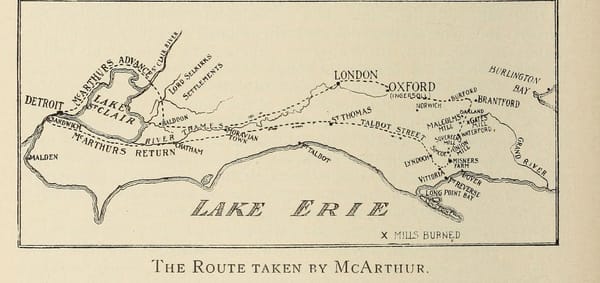
In November 1814 the war came to the millpond. McArthur's American raiders burned the district's flouring mills — five of them, the Culver-Woodruff mill among them — and the Loyal and Patriotic Society's relief report priced the partners' loss at £1,751 5s. Decades on, an aged Aaron was still petitioning the government in the matter, and his own words carry the whole weight of what a mill meant: "36 years past I brought mill irons in to Canady." A mill was infrastructure, and its owner knew it; so, evidently, did the army that burned it.
Cheese, shirts, and a dredging machine
The nineteenth century diversified the line. In 1855 the schoolteacher John Earl, walking every concession of Norfolk County for his survey, set down "James and Lodor Culver" on Lot 2 of Townsend's twelfth concession; twenty-two years later the county atlas still found Loder there, styled "farmer; cheese manufacturer." He was Loder Collver, born 1823 and christened for the family his grand-aunt Anna had married into — a dairyman putting a New Jersey surname on Upper Canadian cheese.
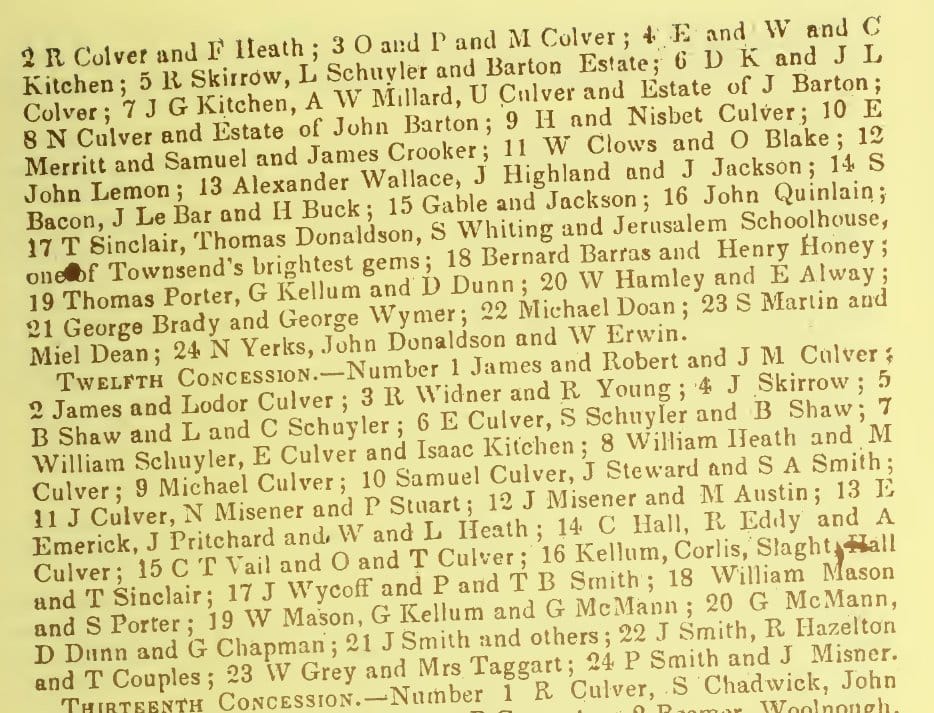
At Norwich, Connecticut, a collateral Stephen Culver — "a packet-master, bridge-builder, and machine-maker," Miss Caulkins reports — patented the dredging machine the Norwich Channel Company used to deepen the Thames. An infringement suit failed when the defense showed the same principle at work in the harbor of L'Orient, in France, forty years before. The coda is pure family history: as a boy Stephen had been carried a prisoner to France and kept a while at that very harbor, and Caulkins concludes he "no doubt honestly considered himself the originator" — a man who reinvented, in good faith, his own buried memory. Readers of this blog will recognize the mechanism; it builds legends the same way it builds dredges.
Michigan added its trades as the family moved west. Family memory put a shirt maker in Bay City; the R. L. Polk state gazetteer, which pays no attention to family memory, prints him at the capital instead — "Collver Frank T, shirt mnfr, 113 Ottawa e.," Lansing, cross-listed among the shirt manufacturers of the whole state. Memory kept the trade and misplaced the town, which is about par for memory. And a Cleveland newspaper of 1943 carries an obituary naming a Collver widow of the founder of a travel bureau — the family travel agent, so far only a lead, not yet run to ground. I flag it now so that a future post can either claim him or let him go honestly.
The exchange
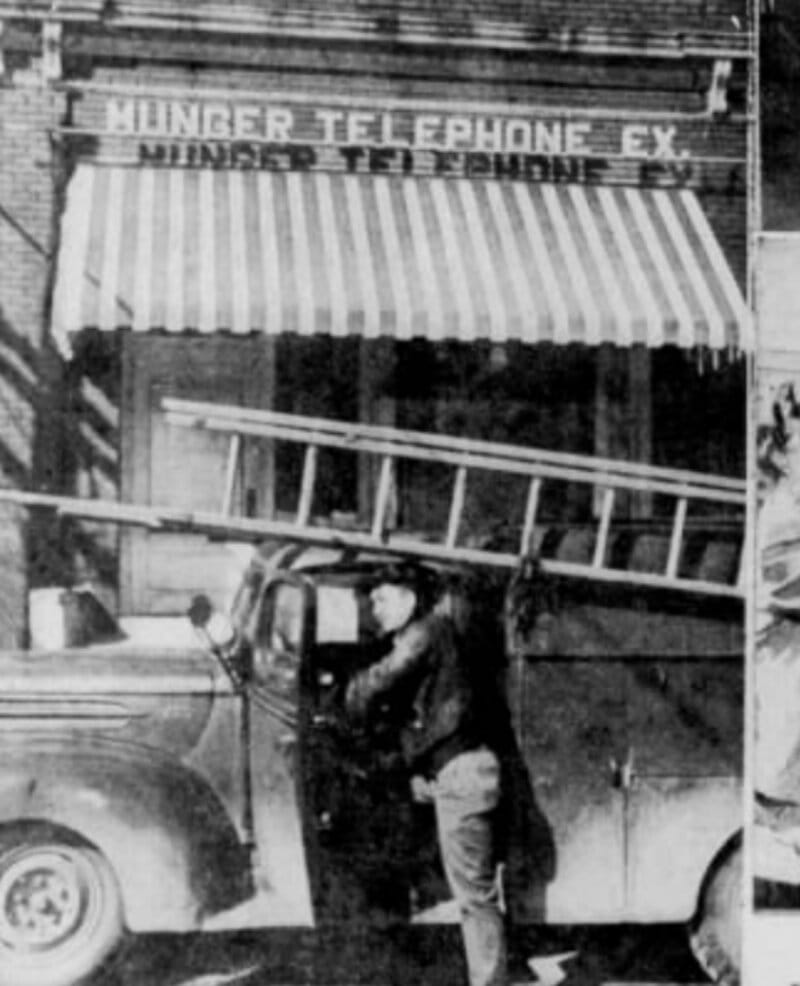
The trade the family is proudest of, in living memory, ran on wire. Daniel W. Collver kept the Munger telephone exchange in Bay County — a rural carrier by day, a rate case with the state in 1937 — and his sons carried the business across the Michigan map: John W. from the East Tawas exchange to Climax, which he bought in January 1949 and got to keep through the great ice storm that arrived two weeks later; Dan Jr. at Munger until 1951. And in the front room at Climax, for some thirty years, sat the company's secretary-treasurer, Mary Rebecca Collver, who kept the books, sat the board, and pressed the company toward the dial system it adopted in 1954. A telephone exchange is the seventeenth-century license in twentieth-century dress: the franchise a town grants, the service it cannot do without, the family that answers at all hours. Good wire and good diet, so to speak, for man and horse.
Brewhouse to brewery
Count the ledger: bread, beer, beds, wheels, shoes, land, flour, cheese, shirts, a dredge, a travel desk, and the telephone. No empire anywhere in it — no railroad, no bank, no fortune that survived three generations. What repeats instead is a shape: the licensed, necessary trade, the shop a settlement needs next, taken up early and handed on. We never kept an empire. We kept the shop the town could not do without.
And the oldest line of business never closed. Three hundred and sixty-odd years after a New London town meeting chose Goodman Culver "for the making of bread and bruing of beere for the publicke good," a cousin of mine — a tenth-great-grandson of that brewer — keeps a brewery and taproom in a Michigan town, having no more idea, until this project told him, that the trade was hereditary than Edward had that it would be. The license hangs on the wall, as licenses now do. The town, as towns still do, comes in for what it cannot do without. Some businesses are family businesses because a father teaches a son; this one seems to be a family business the way the doves on our name are — by homing.
Sources and notes: The Dedham wheelwright order (28 November 1637, margin "Ed: Coluer") is in Don Gleason Hill, ed., The Early Records of the Town of Dedham, Massachusetts, 1636–1659 (Dedham, 1892), 37. The New London bread-and-beer election of 5 May 1662 and the liquor license of the winter of 1664/5 ("provided he shall brew also, ells not"; "good beere and good dyet and lodging for man and horse") are from the town votes as printed in Frances Manwaring Caulkins, History of New London (1852), 134, 137, and D. H. Hurd, History of New London County (1882), 146–47. Jeremiah Culver at Canoe Place, 1739, is George Rogers Howell, The Early History of Southampton, L.I. (2nd ed., 1887), whose derivation of the Southampton Culvers from Edward of Dedham this project grades probable rather than proven. John Colver's 1732 will ("cordwinder, being sick") and the £95 11s. inventory with its "beaver hat, felt hat and Bible" are abstracted in the Calendar of New Jersey Wills II (1918), 105. Rev. Jabez Collver's 1774 Sussex County purchase at the great pond, its mortgage, and the sale of 14 December 1787 are from the Sussex conveyances as abstracted in Frank Grant Lewis's 1940 typescript; the Chemung acreage, the 10 January 1791 conveyance to his four sons, and the 1792 "Aaron McCulver" receipt are from the New York Calendar of Land Papers and the 1879 Tioga County history, which calls the Stull instrument "the earliest dated deed on the records of Tioga County." The 1801 marriage-license refusal is the London District court journal as reproduced in E. A. Owen, Pioneer Sketches of Long Point Settlement (1898); Aaron Collver's mill-irons petition of 1830 ("36 years past I brought mill irons in to Canady") is quoted in R. Robert Mutrie's Jabez Collver genealogy; the Patterson's Creek mill, Simcoe's 1795 water-privilege grant, the hundred-mile flour problem, and the £1,751 5s. McArthur's Raid loss are W. E. Tasker's Long Point history (1900), 56–57 and the genealogical chapters. "James and Lodor Culver" is John Earl's 1855 survey of Norfolk; "farmer; cheese manufacturer" is the 1877 county atlas; his identity as Loder Collver (b. 1823) was established on this blog on 22 August 2026. Stephen Culver's dredging machine and its defeat at L'Orient are Frances Manwaring Caulkins, History of Norwich (1866), 565–66. "Collver Frank T, shirt mnfr, 113 Ottawa e." is R. L. Polk & Co.'s Michigan State Gazetteer and Business Directory (first years of the twentieth century; edition to be pinned). The Cleveland travel-bureau obituary (Plain Dealer, 12 November 1943) is an unexamined lead and is presented as such. The telephone chapter is documented in this blog's "Doves on the Wire" and "Mary Kept the Books" (July–August 2026) from the Climax Crescent, the Bay City Times, and the 1937 Michigan rate case. The living cousin of the closing paragraph is not named, per this project's standing rule on living persons.
Adapted from the forthcoming book — We Are Doves: Four Centuries of the Collver–Culver Family.
© 2026 Albert B. Collver III · The Collver Family History Project. Original historical documents reproduced here are in the public domain; the research, text, and annotations are the author's. Please cite or link rather than republish.