The Schoolteacher's Census
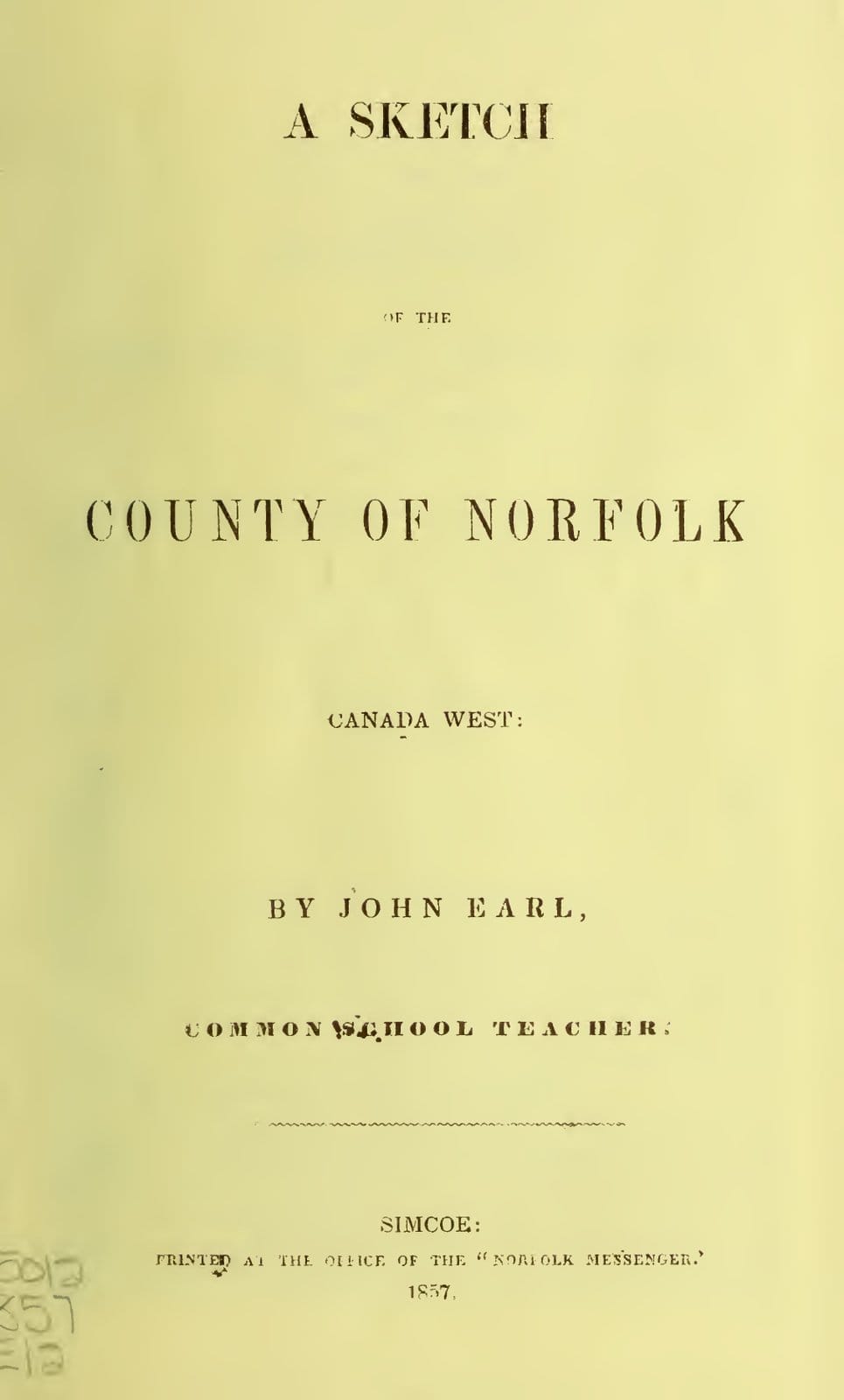
In 1857 the office of the Norfolk Messenger, the newspaper at Simcoe, printed a slim pamphlet with an immodest scope and a modest author. The scope was everything: A Sketch of the County of Norfolk, Canada West — Canada West being what Ontario was called between 1841 and Confederation — undertook to record, township by township, concession by concession, lot by lot, the name of every landholder in the county. The author identified himself on the title page in three words that serve at once as credential and as apology: "By John Earl, Common School Teacher."
A common school was the free public school of the day, and its teacher stood nowhere near the top of the county's professional ladder — the pamphlet's front matter finds room for the county's professional men, in the manner of the age. But it was the schoolteacher who counted everybody. His numbers all speak from 1855 — the assessment year he worked from, and the year the county's historians have always used to date the book, two years ahead of its own title page; a census, like a pamphlet, takes longer to finish than the year it describes. Norfolk in 1855 was 385,000 acres and about twenty-five thousand people, in seven townships: Windham, Townsend, Middleton, Woodhouse, Charlotteville, Walsingham, and Houghton. Through all of them Earl went, concession by concession — a concession being the long parallel strip into which an Ontario township is surveyed, each strip cut into numbered lots, so that a farm had an address the way a town house does: Lot 9, Concession 12. And on every lot he set down who was there.
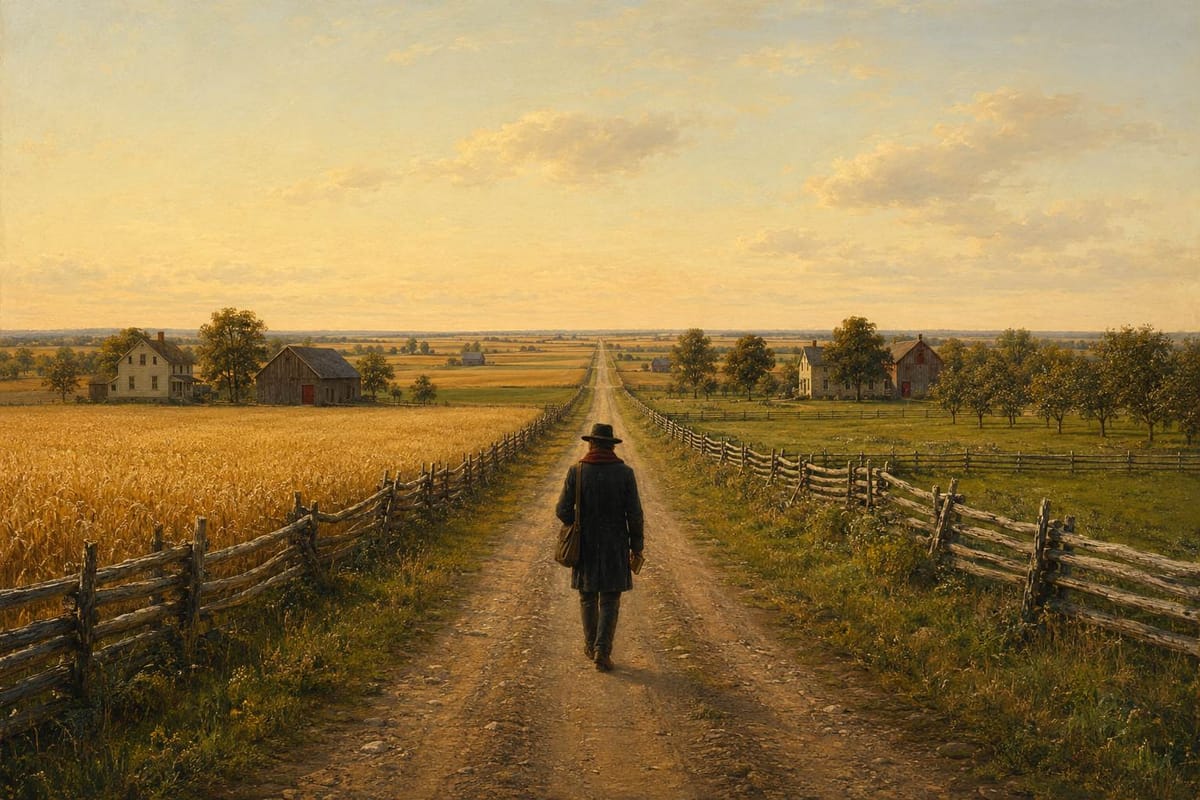
I do not actually know how he made his census — whether he walked the concession roads, or worked from the assessment rolls, or asked at the fence lines, or, most likely, all three. He offers his own hedge, and it is the honest kind: the lists give "the names of the owners or occupants, as far as can be ascertained." Every genealogist should be made to write that clause out a hundred times. It is the correct epistemology for a county, and for a family.
My family is the reason I care. By 1855 the Colvers had been in Norfolk for sixty years — Rev. Jabez Collver⁵ brought his household up from the Susquehanna country in the early 1790s, and the Crown grants of 1794–97 planted his sons in a block across the Windham–Townsend line. Some forty-five years later the family began leaving for Michigan. Between the planting and the leaving lies half a century the family's own literature mostly skips — no diaries have come down, few letters, a paper trail that runs thin exactly where the family was most settled. Chapter eight of the book calls these the between years. And at almost the exact midpoint of them, a schoolteacher wrote down where everybody was.
Forty-three entries
Go through Earl's lists with a pencil and the family appears forty-three times, in six of the seven townships. (Houghton, the seventh, has none — the family never did take to the far southwest.) Forty-three entries is not forty-three men; one John M. Colver, whoever precisely he was, holds five or six lots by himself. But it is a census of a clan at high tide, and it comes with a small orthographic comedy that anyone who has followed this project will recognize: Earl prints Colver for the cluster in Windham and Culver nearly everywhere else — the same families, sorted by neighborhood — and in forty-three entries never once prints Collver, the double-L spelling our own branch eventually settled on. The name was still deciding what to be, and the county's enumerator, sensibly, wrote down what each neighborhood said.
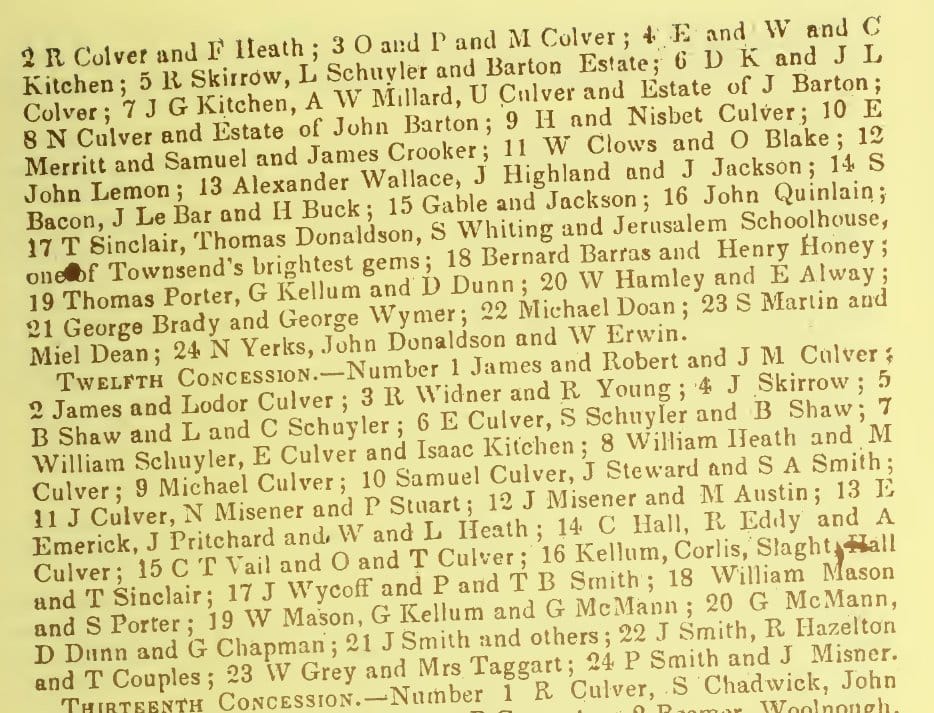
The map holds a better joke than the spelling. Windham's lots number from east to west, so that Lot 1 lies against the Townsend line; Townsend's number from west to east, so that Lot 1 lies against Windham. The two townships count toward each other, and where they meet, Lot 1 faces Lot 1. That meeting place is precisely where the 1794–97 grants sat. Which means the old grant country — Windham's eleventh and twelfth concessions, Townsend's eleventh through thirteenth — reads in Earl's lists as one continuous Colver neighborhood some two miles wide, straddling the town line. Sixty years after the grants, the block the grants made was still a block. The family had not scattered across the county; it had thickened in place.
The lots that held
Three entries in the block are worth the whole pamphlet.
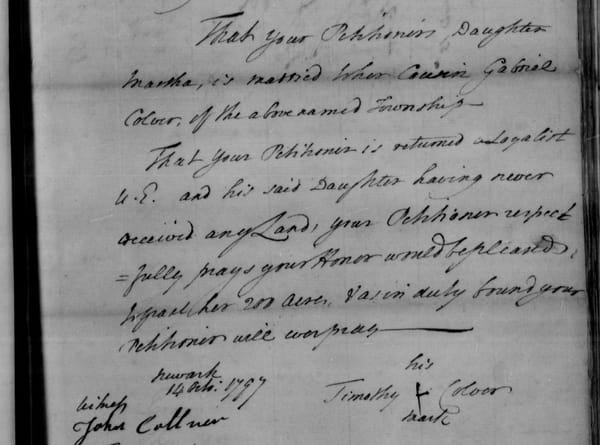
On Lot 1 of Windham's twelfth concession Earl found Nelson Colver. That lot is the homestead — Jabez⁵ took his deed in 1797, and it passed to his son Gabriel⁶ in 1806; Gabriel's will of 1840 singled out his son Nelson Cyrenius⁷, and here he is, fifteen years later, farming it. Third generation, same ground. The Old Windham Church, built on the homestead in 1820, stood on Nelson's lot; so did — and does — Jabez's grave. When Earl's enumeration reached Lot 1 of the twelfth, it recorded, without knowing it, the one parcel in Upper Canada where the family's founder, his meeting-house, and his heir all sat within a fence line.
On Lot 9 of Townsend's twelfth concession Earl found Michael Culver, alone, no co-holders. That lot was granted on the fourth of July, 1796, not to a man but in right of his wife — the grant rolls record it for "John Colver's wife," Miriam. Fifty-nine years later her son Michael⁷ farms it. Of all forty-three entries this is the cleanest single sentence the census speaks: a son on his mother's land, the grant still doing in 1855 exactly what it was made to do in 1796.
And on Lot 1 of Townsend's thirteenth, among four co-holders with other names, Earl found an R Culver. That is the half-lot Jabez⁵ bought from Jonathan Pettit on the twentieth of April, 1807 — and I must be honest that the family register cannot yet say which R this was; Robert, by a matching entry one concession over, and there candor has to stop. But note the seller's name, because it is the longest thread in this post. Jabez first appears beside a Pettit in the records of Sussex County, New Jersey, in 1776. Thirty-one years later he was buying Townsend land from one. And in 1855 Earl's lists still show Pettits salting the very concessions the Colvers sat in — an E Pettit on the lot immediately beside two Culvers in Windham's ninth, an A Pettit co-holding with a Culver in Woodhouse. Two families that left New Jersey entangled were still fence-line neighbors in Canada eighty years on. Nobody plans that. It is simply what neighborhoods do when nobody moves.
One more entry from the block, for what it says about how families keep books without keeping books: on Lot 9 of Townsend's eleventh sit H and Nisbet Culver. Nesbit⁶, of the family's Loyalist branch, died in 1813; and here, a generation later, is his name worn as a given name by a younger kinsman. A family that wrote almost nothing down in these years still recorded its dead — in its children.
Against the holdings, the lettings-go, which the census records just as impartially. Jabez's own first grant — Lot 4 of Windham's tenth, patented 1796 — reads Force, Shaver, Freeman in 1855; his 1801 Townsend purchase reads Cline, Barber, Olmstead. The pattern across all forty-three entries is plain: the family held what it lived on and let the outlying parcels drift. A land list has no memory of anyone's intentions; it records outcomes only, and that is its value.
The entry with no name
The most eloquent entry in the pamphlet is the one where the enumerator gave up.
In Woodhouse township, on Lot 1 of the Broken Front — the irregular lakeshore range where the survey's neat strips break against Lake Erie — Earl wrote: "Culver Family and others." No initial, no given name. He could not name a single owner, because there was none to name. Jabez B.⁷, of my direct line, had died at Woodhouse in 1841; the assessment of 1850 shows his widow Hannah on the north part of the lot, fifty acres cultivated, a frame house; Hannah died that June. What Earl's census found five years later was an estate still undivided among their eleven heirs — a farm owned, for the moment, by a family rather than by anybody in it.

One of those eleven was a young man of twenty-five named William Valentine⁸, my own direct ancestor, who held no land of his own in 1855 and appears nowhere else in the book. Which means that three flat words a schoolteacher wrote for want of better information — Culver Family and others — are the closest thing we possess to William's address that year. Genealogy is mostly the art of reading entries like that one: the census could not ascertain a name, and in failing, told us exactly where the family stood — together, unsorted, between generations. Absence of a name is not absence of the people; sometimes it is the most precise record of them there is.
The cheese manufacturer
And one entry I include purely because I cannot resolve it, and would like to. On Lot 2 of Townsend's twelfth Earl lists James and Lodor Culver. Lodor is a distinctive thing to name a child, and the family had a habit — see Nisbet, above — of wearing surnames from the family's marriages as given names, so Lodor's mother or grandmother may be hiding in plain sight in his first name. He is no passing entry: the county atlas of 1877 shows him still on the same ground twenty-two years later, spelled Loder now, with an occupation attached — "farmer; cheese manufacturer." Somewhere between Earl's census and the atlas, a Culver of the grant country went into cheese. I cannot yet place Lodor on the family register, and I will not guess. But he is a findable man, and if any reader descends from the cheese manufacturer of Townsend, my inbox is open and my questions are many.
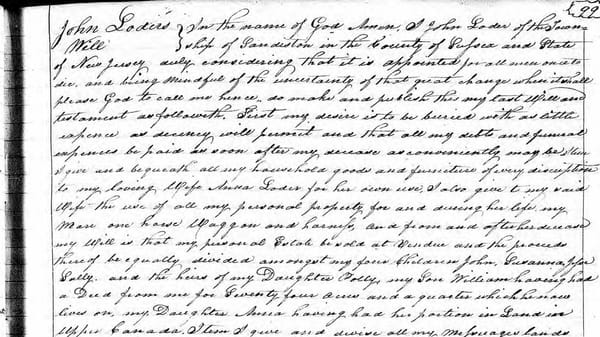
[Correction, 22 August 2026.] I wrote the paragraph above on Friday and was answered on Saturday, though not by a reader. The answer was in a register I already owned. R. Robert Mutrie's genealogy of the Reverend Jabez Collver's family places Loder Collver exactly: born in Townsend on 4 November 1823, the second son of Moses Culver and Sarah Merritt, grandson of Aaron, great-grandson of Jabez. Moses died young in 1835, and his will left Loder the east half of Lot 13 in the fifth concession; by the assessment of 1850 Loder had moved onto the east half of Lot 2 in the twelfth, sixty-five acres cultivated and fourteen not, which is the farm Earl found him on five years later. He married Rebecca Schuyler in 1847, buried her in 1892, married again at seventy-five, and died on the same ground on 3 July 1902, "a prominent farmer of the township of Townsend," as the British Canadian put it. The name was a surname after all, and I now know whose. Jabez's daughter Anna, born 1759, the one child of his on the register with no record after Owen's mention of her, married a John Loder of Sandyston in Sussex County, New Jersey, about 1780. A grandnephew in Upper Canada named for that marriage forty years later is a family that had not lost touch. I have Jonathan Dembling — a descendant of that Anna, and a seventh cousin once removed I did not know I had — to thank for the rest, and the moral stands, with its edge turned on the writer: search is not reading, and a register one has not re-read is a register one does not own.
The midpoint
Why does a lot list matter? Because of what it sits between.
Set Earl's 1855 lists beside the illustrated county atlas of 1877 — the only comparable snapshot on the other side — and the shape of the story changes in one generation. In 1855 the grant block is essentially intact: the core concessions read Colver and Culver lot after lot, the homestead is in the third generation, Michael is on his mother's grant. By 1877 the count of entries is similar but the shape has begun to decay — the old lots subdividing into fragments among more names, the block's edges sloughing off, Windham's eighth and ninth gone entirely, the Pettit half-lot out of the family, Aaron⁶'s old estate lands absorbed into the growing town of Simcoe. And the departures had begun. Nathan⁸ died in Michigan about 1874. An Asa Colver holds Lot 3 of Windham's eleventh in Earl's list; an Asa Colver of this family died at Bay City, Michigan, in 1879 — whether the same man or a cousin of the same name, the register cannot yet swear, and I flag it accordingly. Descum Colver died at Bay City in 1884.
Bay City sits in Bay County, Michigan. Readers of the earlier Michigan posts will feel the floor shift here: Bay County is where Daniel William¹⁰, of the family's telephone branch, later carried the rural mail for a career, and where he is buried. The road out of Norfolk had a family anchor at its far end a full generation before my own direct line — William Valentine's son John Milton⁹ — took it around 1900. Earl's census is the before photograph of all of that: the family at its Canadian high-water mark, two miles wide and holding, with no visible sign that within twenty years the tide would turn.
Come away
Earl did not end his pamphlet with the mills tally or the streams of Norfolk. He ended it — and I confess this is why I have come to love the man — with poetry. Seven stanzas of his own composition, headed "CANADA: Verses composed by John Earl, the Compiler of this Work," recruiting settlers to the county he had just counted:
Wealth by Industry, here is sure,
For many are rich, who once were poor;
Would you be wealthy, come away,
And make a fortune in Canada.
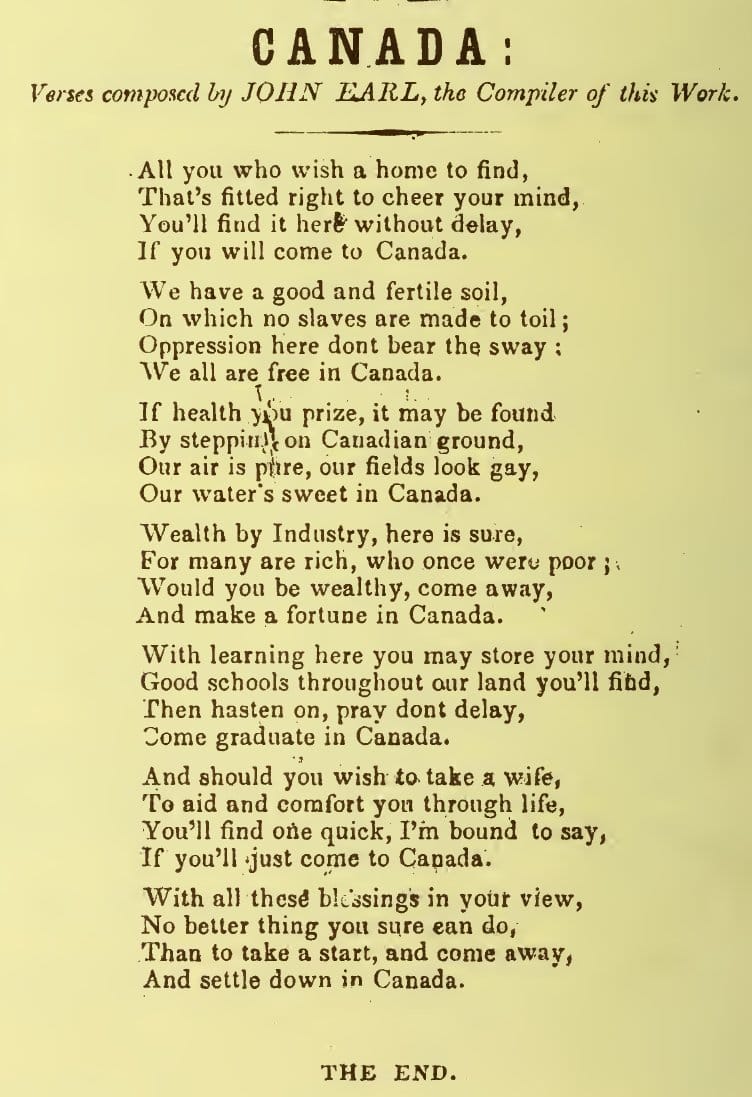
There is even a stanza for his own trade — good schools throughout the land, "Come graduate in Canada" — a schoolteacher's advertisement, earnest as a copybook exercise, and in 1855, on the evidence of his own lists, perfectly true. The county was full; the family was landed; many were rich who once were poor.
The irony is gentle and it took a generation to arrive. The next Colvers to act on Earl's logic — would you be wealthy, come away — obeyed the verse and reversed the direction. They came away from Canada: to Bay City, to the Thumb, to the Michigan counties where the family's next century happened. The schoolteacher's poem was right about everything except which way the wagons would face.
The pamphlet itself never quite died. The Norfolk Historical Society reprinted it in 1975 at the Eva Brook Donly Museum in Simcoe — the same museum, I note with some satisfaction, that keeps the family Bible of Michael⁷, the son the census found on his mother's lot. The 1855 original is scanned and free to anyone at the Internet Archive. And so a hundred and seventy-one years later, a family that Earl counted at its high tide reads his lists from the far side of the exodus he could not foresee, for the purpose he intended all along: to find out where everybody was, as far as can be ascertained. Forty-three entries later, we can still find our way home by it.
Sources and notes: John Earl, Sketch of the County of Norfolk, Canada West (Simcoe: Norfolk Messenger, 1857 imprint — the statistics within are given as of 1855, the assessment year by which the book is conventionally dated; reprinted by the Norfolk Historical Society, Eva Brook Donly Museum, 1975); the scan is on the Internet Archive. A note on method: the scan's machine-readable text layer is badly garbled, and a first pass by text search missed about a dozen of the family's entries outright — the forty-three-entry count comes from reading every enumeration page visually, at high magnification, entry by entry. The moral is the usual one: search is not reading. The grant and deed history — the 1797 homestead deed, the 1796 grant in right of Miriam, the 1807 Pettit purchase, the 1801 Townsend deed — follows the abstracts compiled in R. Robert Mutrie's genealogy of the Rev. Jabez Collver family; Gabriel's will of 1840 names Nelson Cyrenius; the Woodhouse assessment of 1850 places Hannah on the Broken Front lot. The 1877 comparisons are from the illustrated historical atlas of Norfolk County (1877), including Loder Culver, "farmer; cheese manufacturer." Identifications of initialed entries follow the family register where confidence is high (Nelson, Michael) and are flagged as unresolved where it is not (R, Asa); corrections from readers with better evidence are welcome, and expected. Michael Collver's family Bible is held at the Eva Brook Donly Museum, Simcoe.
Adapted from the forthcoming book — We Are Doves: Four Centuries of the Collver–Culver Family.
© 2026 Albert B. Collver III · The Collver Family History Project. Original historical documents reproduced here are in the public domain; the research, text, and annotations are the author's. Please cite or link rather than republish.