Twenty Moheags
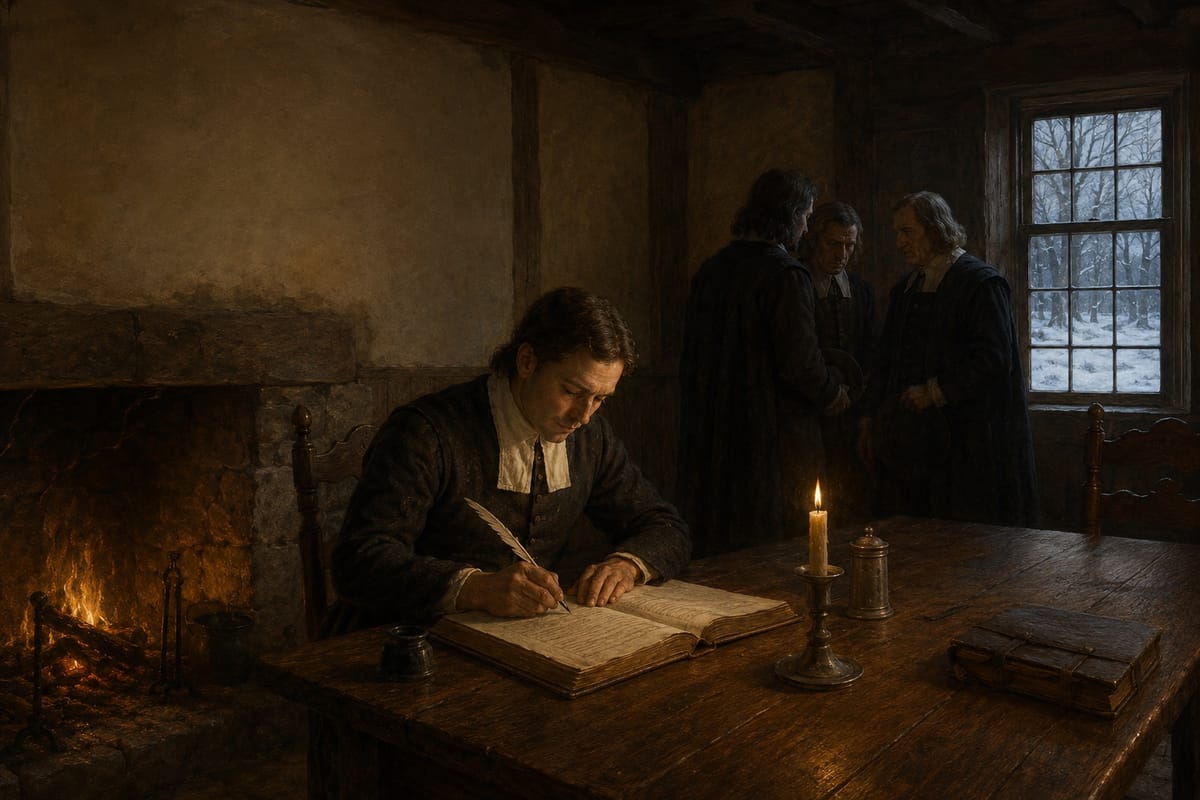
In March of 1676 — March 1675/6 by the reckoning then in use, when the year turned in late March and a winter month carried two dates — the Council of Connecticut sat at Hartford answering letters from a colony on fire. King Philip's War had burned through the interior all winter: Lancaster sacked in February, Medfield in flames ten days later, the Massachusetts frontier folding back toward Boston town by town. Norwich, at the head of the Thames, was now frontier. Its minister, the Reverend James Fitch, wrote to Hartford on the thirteenth of March, and among the Council's replies, entered in the colony's record book, stands this minute:
...an advice to send home o'r garrison souldiers at Norwich; that Edward Culver, w'th about 20 Moheags and Pequots, com up to Hartford forthwith, &c: as p'r the letter on file will more at large appeare.
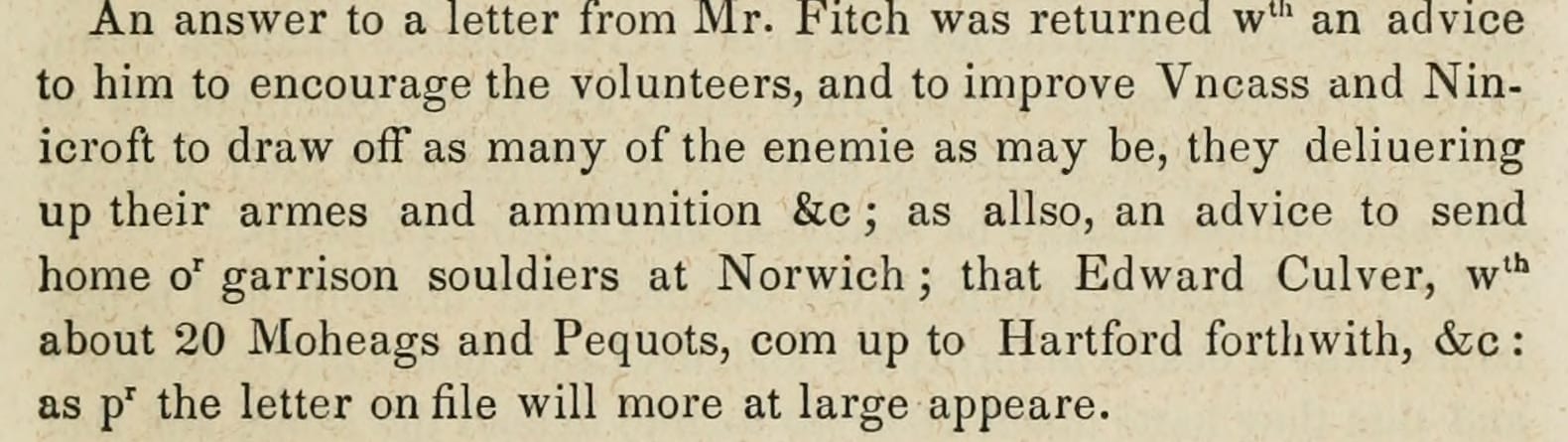
Strip the clerk's abbreviations and read what the sentence is actually asking. In the darkest weeks of the most destructive war ever fought in New England, the government of Connecticut wanted one particular old man — a wheelwright by trade, a townsman of no rank the record anywhere names — to come to the capital forthwith, and to bring with him about twenty Mohegan and Pequot fighting men, who would apparently come because he asked them to.
Moheags is the clerk's spelling of Mohegan, and it is worth a moment, because the spelling is the tell. He was writing a word he had heard far more often than he had read it. On the same page of the record the Council is arranging for Uncas and Ninigret — the Mohegan and Niantic sachems themselves — to be "improved," which in the period's usage means employed, put to use, in drawing off the enemy. That is the company in which Hartford, in its worst month, thought of my ancestor.
I have spent four years with this family's paper, and no other sentence in it has cost me as much argument with myself as that one. This post is the argument, in the open.
Which Edward?
Begin with the problem, not the payoff.
The clerk wrote the name and nothing else. No Senior, no of Mystic, no trade. And there were two men in the colony who could answer to it: Edward Colver the immigrant — the sixty-eighth name on the Dedham covenant, the man of the unknown ship, by 1676 an old man at the head of the Mystic River — and a younger Edward, later of Norwich, whom this project grades a probable son of the first.
Both were very likely in this war, doing different things. The 1910 family genealogy, which is no friend of caution, says so itself: King Philip's War is the one "in which the Edward under discussion earned his rank as Lieutenant, and in which his father and three brothers, Samuel, Joseph and Ephraim all served." A colony at that pitch used everyone it had. A war is not a stage with one Colver on it, and this family's habit, then as later, was to turn out in numbers.
So the dispute is not whether the old man served. Frances Manwaring Caulkins — writing in 1852, closer to the New London records than anyone since — set this minute squarely inside the immigrant's life, between his removal to Chepadaso and the deed still calling him "wheel-right of Mystic" in 1681, and cited these exact pages for it. She knew perfectly well that there was another Edward; she introduces him separately, and cautiously. No source I have found puts the younger man in these orders.
I follow her, and I would rather show the reasoning than ask for trust — because the argument that persuades me is not documentary at all.
What the Council wanted was not a strong young man. The colony had those, and was running out of uses for them. It wanted someone twenty Mohegan and Pequot men would ride to Hartford with, in the fourth winter of a war being fought against people they knew. That is not a qualification a man of twenty-two possesses. It is the work of years, and — this is the part that matters — it was not in Edward's gift to award himself. Among the Mohegans and Pequots, as among most of their neighbors, standing ran with age and with a long record of dealing. They had no reason to extend to a young farmer what they might extend to an old one they had lived beside for a dozen years at the head of the Mystic.
The judgment is mine, and it is a judgment: probable, not proven, with the alternative named wherever it bears. If you would like to watch me disagree with the family's own genealogists in print, that is what the sentence above is.
The receipts
What kind of man was he, on the evidence that survives? The answer is embarrassingly consistent, and it has nothing to do with muskets.
In November of 1653 the plantation at Pequot — soon to rename itself New London — made "grants... to Edward Culver of a farm at Mystic and a house lot in town." Look at the company that grant keeps in the town book: a house lot to a millwright, another to a shoemaker out of Dorchester, one to Nehemiah Smith's brother, six acres to Goodman Harris's son, who was about to marry. That is a plantation handing land to useful men.
Nine years later the town did with him exactly what Dedham had done. From the votes of the fifth of May, 1662:
Goodman Culver is chosen and allowed of by the towne for the making of bread and bruing of beere for the publicke good.
Goodman, since this project glosses everything old, is the honorific of the ordinary householder — below Mister, above nobody; the seventeenth century's plain "citizen in good standing." Two winters later the town enlarged his franchise, licensing him to sell liquors, with the wonderfully specific proviso "provided he shall brew also, ells not," and to keep entertainment: "good beere and good dyet and lodging for man and horse."
Set the two colonies' records side by side. Dedham, 1637: two acres and free timber, for imploym't in his trade. New London, 1662–64: bread, beer, and lodging, for the publicke good. Two different towns, three decades apart, each formally voted this man into its infrastructure. Nothing in either record is glamorous, and that is precisely the point. A frontier town chose its baker-brewer the way it chose its ferryman and its drummer — by asking who could be trusted with a thing everybody needed every day.
The family legends, when they came, would reach for governors' daughters and famous ships. The records reach, every single time, for competence. Of the two kinds of distinction, it is the second that summons twenty Mohegans.
The farm that kept its name
One detail from those years deserves to be lifted out, because it did not have to survive.
"Edward Culver's farm," Caulkins records from the old books, "was called by the Indians Chepadaso" — in one entry Chepados Hill. The English were vigorous renamers; the town books of that coast are full of Cedar Swamps and Rocky Hills. That Edward's farm kept its Pequot name in the English records for a generation says, at minimum, that the neighborhood — English and Native alike — went on calling the place what it had always been called, and Edward with them. A second parcel of his is recorded as lying "at a place called in Indian Wontobish." Two Indian place-names on one family's land, kept the same way.
And in a grant to James Morgan of the same period, the town fixes six acres "where the wigwams were in the path that goes from his house towards Culver's among the rocky hills." The farm had become a landmark — a place other men's deeds steered by, on a path that still remembered whose houses had stood along it.
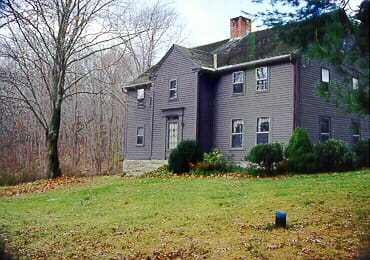
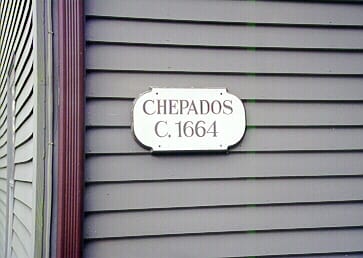
None of that proves anything about the summons. It is the sort of evidence that cannot be cashed. But it is what the record has instead of the story we would rather have.
The story I had to give up
Here I have to commit a small act of family heresy, and it is at my own expense as much as anyone's.
Family tradition, the 1910 genealogy, and the compilers after it all state that Edward served in the Pequot War of 1637 — the war in which the English and their Mohegan and Narragansett allies stormed and burned the Pequot fort above the Mystic, on the very river where he would later farm. The later generations read their Groton acres as his payment for it. And you can see, can't you, the arc that makes: the young man who came up the Mystic in 1637 as their enemy, returning thirty-nine years later as the Englishman the Pequots would ride with. Enemy to ally. Sword to summons. It is a magnificent story, and I wanted it.
The land will not support it — and the land was the tradition's only evidence.
In 1671 Connecticut settled up with its Pequot War soldiers, the General Court granting bounties of land to men who had been engaged in that war. Three of the names were New London's: John Gallop took a hundred acres, James Rogers fifty, Peter Blatchford's heirs fifty. Edward Culver is not among them. He was alive, in the town, a licensed man of standing, and the colony's reach was long enough to pay a dead man's heirs. It did not pay him. Meanwhile his own 1653 grant sits, as we have seen, among the shoemakers and millwrights.
An earlier draft of the book's third chapter graded this service probable and argued that Edward's 1653 land was "of the class the colony used to pay its Pequot War men." That argument does not survive its own sources. The class of grant the colony used for that purpose is visible, dated, and named, and Edward is not in it. I have withdrawn the argument in print rather than quietly deleting it, because a reader who has been asked to watch for compilers dressing tradition as evidence is entitled to watch me too.
What is left is the family's belief, recorded as belief — and something better in its place. Edward got his farm at Mystic the way he got his two acres at Dedham, and the way New London's millwright and shoemaker got theirs. Not for his musket. For his hands.
Which means the arc I wanted is gone, and what replaces it is smaller and stranger: only a farm that kept its Pequot name, a path that ran toward Culver's, and a colony that, needing twenty Mohegan and Pequot men in the worst month of its worst war, sent for a wheelwright.
The word friendly
Hinman, surveying these same records in 1852, compressed them into one editorial sentence: "Culver had great influence with the friendly Indians."
That phrase deserves a careful paragraph, because 1852 wrote it complacently and 2026 cannot.
The alliance was real. The Mohegans under Uncas and the surviving Pequots fought through King Philip's War on the English side, for reasons entirely their own: old enmities with the Narragansetts and Wampanoags, calculated survival in a country whose balance had broken, obligations and opportunities that Native leaders weighed as shrewdly as any Hartford councilman. It was not sentiment and it was not subservience. It was politics, conducted by nations.
What the record says about Edward is exactly this much: that the Council expected about twenty men of those nations to travel to Hartford with him, and built an order around the expectation. It does not say who chose them, who commanded them, whether they came willingly, or what Edward was to them — guide, liaison, quartermaster, neighbor. Whatever stood between them, it was theirs to give and not his to claim, and the record preserves only its shadow: that in March of 1676, when Hartford wanted twenty of them, it wrote down his name.
And I will not let the word friendly smooth that alliance the way this project keeps catching legends smooth the past. On the page facing the summons, entered at the same day's sitting, stands a declaration that volunteers going out under Denison, Avery, Minor, and Leffingwell — "whether Indians or English" — should have "all such plunder as they shall seize, both of persons and corn or other estate, to be dissposed by them in way of sale," the captives sold at the market price and the proceeds divided among the men, each alike.
Both of persons. The policy treated captured people as plunder to be valued and sold, English and allied fighters sharing the proceeds. One march that June sent "27 women and children, prisoners," down to Norwich itself, and what became of each of them the record does not say. The government that wanted Edward and his twenty at Hartford forthwith was, in the same sitting, setting the terms of that market.
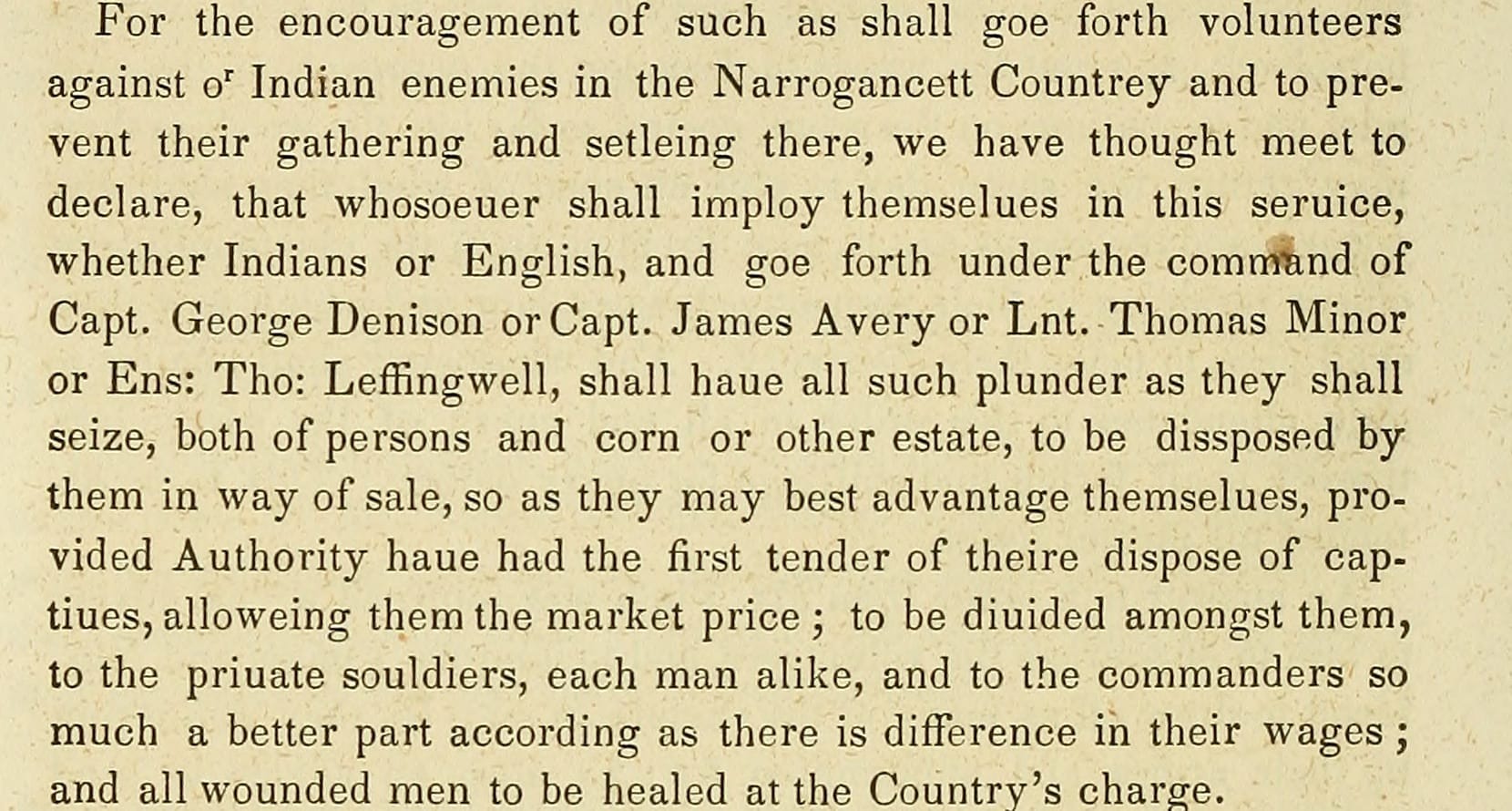
No surviving record lays any part of that to a wheelwright, and I do not lay it to him. I set it down because a history that quoted the summons and skipped the sale would be practicing the exact forgetting this whole project was written to resist.
Voluntown
The war ended; the paying, as usual, took longer.
Connecticut discharged its debt to the Narragansett-country volunteers the way colonies discharged most debts — in land. The plantation of Voluntown was granted to the war's veterans and their heirs, and the name says it plainly: the volunteers' town. It is the only town in New England, so far as I know, whose name is a payroll.
The town's preserved rolls, certified out of its records nearly two centuries later, carry this family three times. From "A list of the Names of the English Volunteers in the late Narraganset War," headed by Major Palmes and Captain Denison, with that same Reverend James Fitch whose letter had summoned Edward standing fifth: at No. 13, Ephraim Colver; at No. 15, Edward Colver; at No. 160, Joseph Colver. The companion list of volunteers who drew cedar-swamp lots repeats them at Nos. 2, 48, and 174.
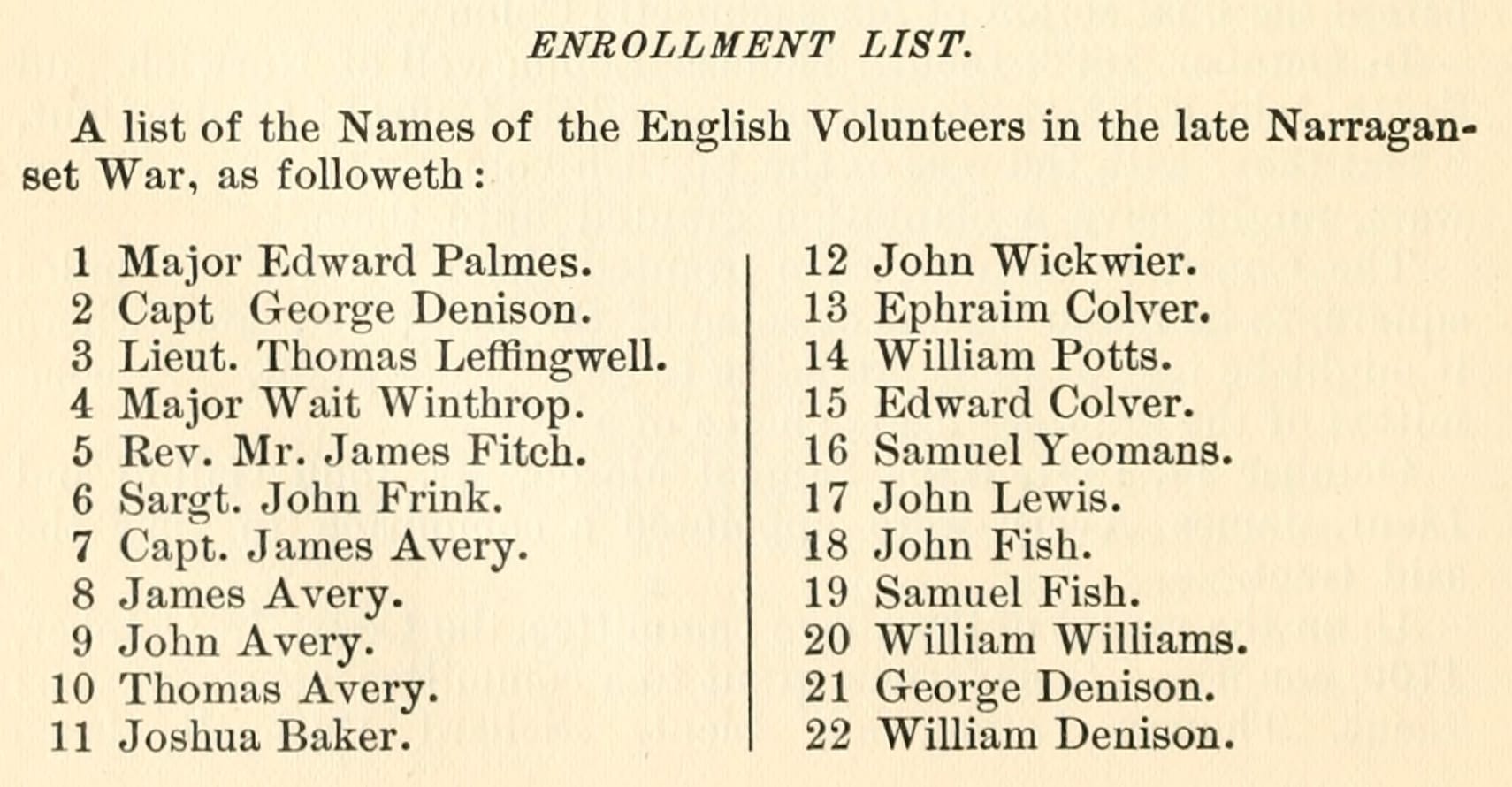
Three notes, in ascending order of interest.
First, the caveat that governs everything on that roll. The Voluntown enrollments were compiled from the 1690s onward — the grant first moved in 1696, a clerk was chosen in 1701 "to make a list of the names of those who were volunteers," a committee sat to decide the correctness of the claims presented, and deceased volunteers' heirs stood in for them. The roll therefore proves the family was credited with Narragansett War service. It does not prove that any particular name stood a particular muster. It is a land record wearing a war record's clothes, and this project cites it as the town wrote it: credited, never mustered.
Second, which Edward — and here I reverse myself. Having argued above that the Council's scout was the old man, I think this record is likelier the young one's. The elder was past sixty and had a summons to answer; his probable son was about the right age for a volunteer, and the 1910 compilers, who put him on this very list, are for once well placed to be right — a land grant for volunteer service is a young man's reward.
Notice what happens if both readings stand. A war large enough to take a whole family takes it at different ranks and for different reasons, and two Edwards leave two kinds of record: one summoned to Hartford with twenty Mohegans and Pequots because the colony needed what only long acquaintance could supply, one drawing a lot at Voluntown because he was young enough to march. The compilers' instinct to merge them is the error. The records were never speaking about one man.
Third: Ephraim — and here I reverse myself a second time.
When I drafted this post, no proven table of Edward's children contained an Ephraim, and yet there he stood, thirteenth on the volunteers' roll, ahead of Edward himself. An "Ephraim Culver's estate" drew land among the family's lot-drawings at Groton a generation later, and the Groton Baptist petition of 1704 carries an Ephraim Culver among its signers. I wrote that no surviving record named his father, carried him in this project's register as unplaced, and commended him to some future researcher as the earliest genuine puzzle in the American line.
The future researcher turned out to be me, four days later, at a library terminal in St. Louis County.
The 1910 genealogy asserts a record that would place him — a deed of 1678 by which Edward and Ann conveyed the Chepadaso farm ("Chepadas," in its spelling) "to their sons, Joseph and Ephraim." I have still not found that deed. Its only cited source, Caulkins, contains nothing of the kind, and the same book credits the farm to Edward's "services in the Indian wars," a tradition withdrawn a few sections above. What I found instead was a different deed, twenty-two years later, doing the work the 1678 deed was supposed to do.
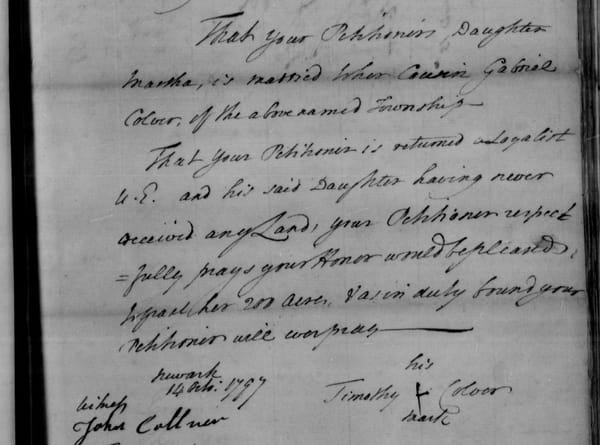
On the twenty-seventh of December, 1700, Ephraim Coulver of New London made over eight acres "lying near the head of Mistick River" — the Chepadaso ground — to, in his own words, "my brother Joseph Coulver."

The instrument stands in the first book of Groton deeds at folio 316, where the book's own index files it under Joseph Colver, grantee.
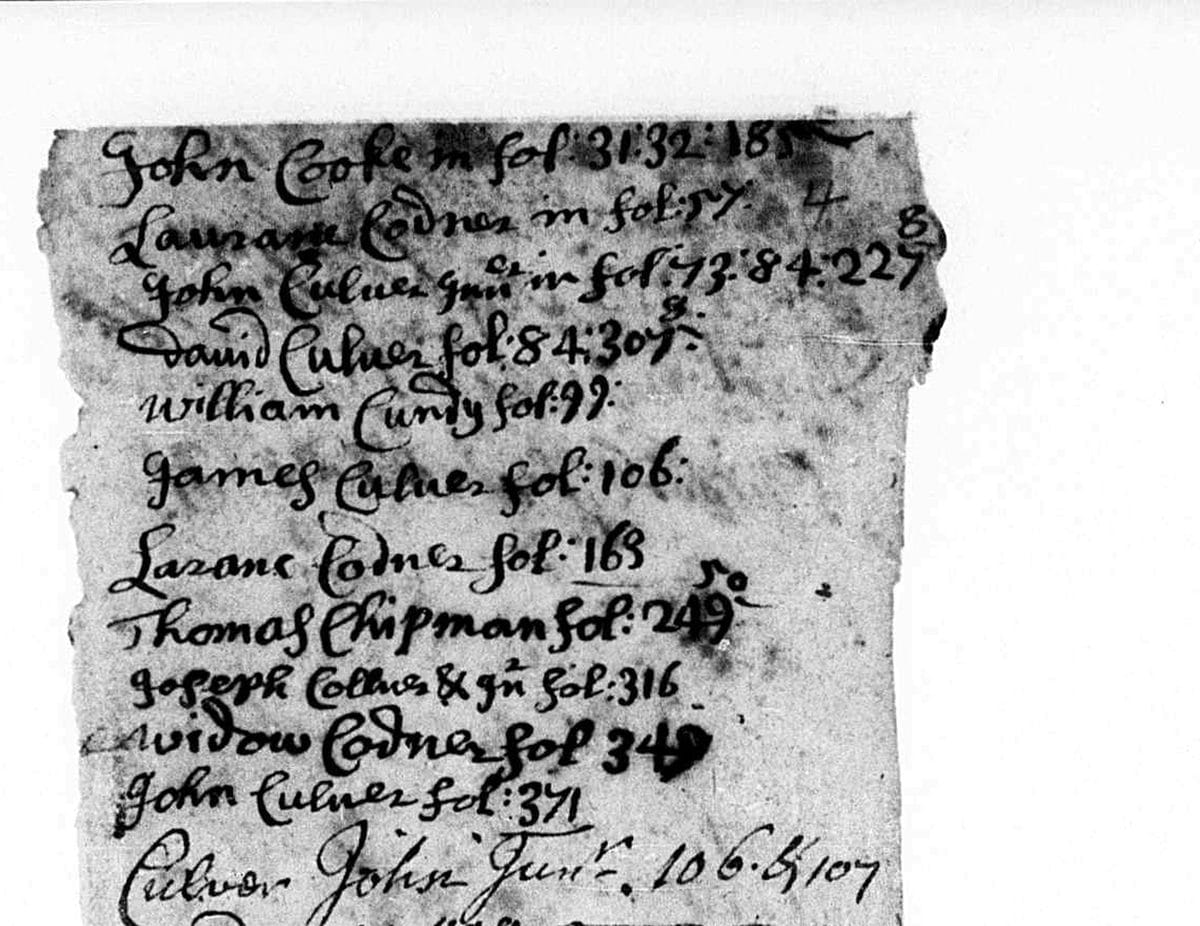
Wood and Jacobus cited that deed in 1955 in The American Genealogist. I had not read their section on Ephraim when I wrote the paragraph above, and the failure was mine, not theirs.
Notice what the deed does and does not say. It does not name Ephraim's father. No record I have found does. What it names is his brother — and Joseph is in the proven table, one of the four sons Caulkins herself sets down. A man's brother's father is his father. The chain is two links long, and both of them hold.
So Ephraim comes off the unplaced list, and the rest of his life is recoverable now that we know whose son he was. He married Mary Packer about 1687. He died at Groton in the late summer of 1716, holding a hundred and seventeen acres "being the homested," a right in the volunteers' town he had helped earn, and a right at Nawayank. His widow Mary swore to the inventory at New London on the ninth of October. When the farm was divided in April 1721 it was cut into strips running east to Joseph's line — Jeremiah, Miriam, Lydia, Peter, Simon, Marcy, and a younger Ephraim, who took the Voluntown lot his father had drawn.
There were eight children, not seven. A daughter, Mary, had sold her share to her brother Ephraim on the eleventh of December, 1719, for twelve pounds, while the land "yett lyeth without pertion among the heirs" — before the court ever ordered a division. She signed with a mark. No printed account of this family has her, and she is in this one because a clerk at Groton wrote down that she was Ephraim's daughter and Ephraim's sister in the same sentence.
The earliest genuine puzzle in the American line survived four days past my announcing it, which is the proper fate for a sentence like that. What undid it was not a new argument. It was a clerk writing down what one man called another, and — this is the part I want to keep — a machine reading that clerk's hand three centuries later as "Cornelison Connection," so that the sentence had to be read the old way, slowly, off the page, by eye. The transcription would have sent me past it. The handwriting did not. Every family with a puzzle in it has a folio 316 somewhere, and the work is still going and looking.
One more thing about that roll, small and human. At the fourth name stands Major Wait Winthrop — a real Winthrop, eleven lines above a real Colver on a genuine document, which is as close as those two families verifiably ever got. Readers who remember the governor's daughter this family spent two centuries marrying may pause there as long as they need.
And three names below Edward stands John Fish — the man whose wife had run off with Edward's son Samuel two years before the war. The same war, the same town, the same list, a neighbor's width from the father of the man who wronged him. The list's ordering is nowhere explained, and a veterans' roll compiled from later claims is not a marching order; three names' distance may mean everything or nothing. What it does show is the size of the world they lived in — that a small colony had no room for its feuds, and the same few hundred men turn up on the same few lists whatever their households had done to each other.
What did not survive
Edward Colver died in 1685, "near the head of Mistick, on Groton side." Ann's death the records do not fix at all.
And the one document that would answer every question this post has raised is gone. "As p'r the letter on file will more at large appeare," the clerk wrote — pointing to the Council's own letter to Norwich, which would tell us what Edward was asked to do and in what capacity. Trumbull's editors noted its absence when they printed the records in 1852, and it has not turned up since. Everything anyone can say about the twenty Mohegan and Pequot men rests on the single sentence that acknowledges the letter's existence.
This is the ordinary condition of the work, and it is worth naming plainly: absence of the record is not absence of the event. Something happened between a wheelwright at the head of the Mystic and his Mohegan and Pequot neighbors — happened over years, in a language most of it was probably conducted in — and the total surviving documentation of it is one clause in a clerk's minute, in a book about somebody else's war.
The nations in that minute did not go anywhere. The Mohegan Tribe and the Mashantucket Pequot Tribal Nation are federally recognized nations in Connecticut today, on their own ground in the same river country, keeping their own records and telling their own history — which is the correction this post's 1852 sources most need, and the one they could least have imagined. The clerk who wrote Moheags because he had heard the word more often than he had read it was writing about neighbors, and they are still the neighbors.
What the family has out of all this is a great deal less than the legend and a good deal more than nothing: not a war hero, but a baker; not a conqueror of the Pequot fort, but a man whose farm kept its Pequot name for a generation because the people around him went on saying it. When the colony needed twenty of their fighting men in the worst month of its worst war, it did not send a captain. It sent for the wheelwright, and asked him to bring them.
I would rather have that man than the one in the legend. It took me four years and one withdrawn argument to be able to say so.
Sources and notes: the photographs of the Chepados house — which still stands on Colonel Ledyard Highway in Groton, publicly identified as the Joseph Culver House — are by David Collver (1997), reproduced courtesy of the Collver family site, collver.org; the house's later history under the Lamb family, including Samuel S. Lamb's 1883 teaching jubilee held at Chepadas, is documented at Quakertown Online. The 1678 deed assertion and the "services in the Indian wars" tradition are from the Colver-Culver Genealogy (1910). The Council minutes are from J. Hammond Trumbull, ed., The Public Records of the Colony of Connecticut, 1665–1678 (Hartford, 1852) — the scout order of 10 February 1675/6 at p. 408, the summons of 16 March at p. 417 (with Uncas and Ninigret on the same page), the plunder declaration of the same sitting at p. 418, and the Talcott letter of 8 June 1676 reporting 27 women and children sent prisoners to Norwich at p. 453. Public domain. Frances Manwaring Caulkins, History of New London, Connecticut (1852), supplies the 1653 grants (p. 86), the 1662 baker-brewer vote and the 1664/5 license (pp. 134, 137), Chepadaso and the "noted soldier and partisan" characterization (pp. 96, 309, 311), and the 1671 Pequot War bounties to Gallop, Rogers, and Blatchford's heirs (p. 98 n. 2); her History of Norwich (1866), p. 110, follows the scouts toward the Connecticut River. R. R. Hinman, Catalogue of the Names of the Early Puritan Settlers of the Colony of Connecticut (1852), 773–74, is the source of "great influence with the friendly Indians." The Voluntown rolls, the compilation history, and the English-volunteers-only restriction are from George Madison Bodge, Soldiers in King Philip's War, 3rd ed. (1906), 442–46. The deed that places Ephraim is Groton (Connecticut) land records, vol. 1, fol. 316, dated 27 December 1700, read from the record at a FamilySearch affiliate library on 18 August 2026 (FamilySearch, “Groton, New London, Connecticut, United States records,” Image Group Number 008199648, image 198 of 477; the grantee index at image 9); it was first cited by Wood and Jacobus, The American Genealogist 31 (1955): 139–40. Ephraim’s estate — the inventory of 2 October 1716 and the distribution of 28 April 1721 — is in the New London probate records, 4th Book of Wills, folios 35 and 202; his daughter Mary’s quitclaim of 11 December 1719 is at Groton Deeds, images 269–70 of the same film. The withdrawn Pequot War argument is recorded in ch. 3, n. 5 of the forthcoming book rather than deleted. The modern scholarship against which this post's account of the captive trade is measured is Margaret Ellen Newell, Brethren by Nature (Cornell, 2015), chs. 4–5, and Wendy Warren, New England Bound (Liveright, 2016). The identification of the Edward in the 1675/6 orders is graded probable, not proven, and the alternative is stated above rather than buried.
Adapted from the forthcoming book — We Are Doves: Four Centuries of the Collver–Culver Family.
© 2026 Albert B. Collver III · The Collver Family History Project. Original historical documents reproduced here are in the public domain; the research, text, and annotations are the author's. Please cite or link rather than republish.