The Historian Was One of Them
Last week I told the story of Sarah Culver, who stood up in the county court at New London in November of 1719 and told four magistrates that they were an adulterous generation and that God would find them out, and was sentenced to fifteen stripes upon the naked body for saying so.
Within a day a reader wrote in. She was born in Maine, she said, but has lived most of her life in New London County, and she knows the church at Stonington — has driven past it more times than she can count. Then she added, the way people do when they are being friendly rather than making a point: Frances Manwaring Caulkins is my fifth cousin.
I read that and went very still, because Frances Manwaring Caulkins is the reason I have a name for the woman in that story at all.
The authority
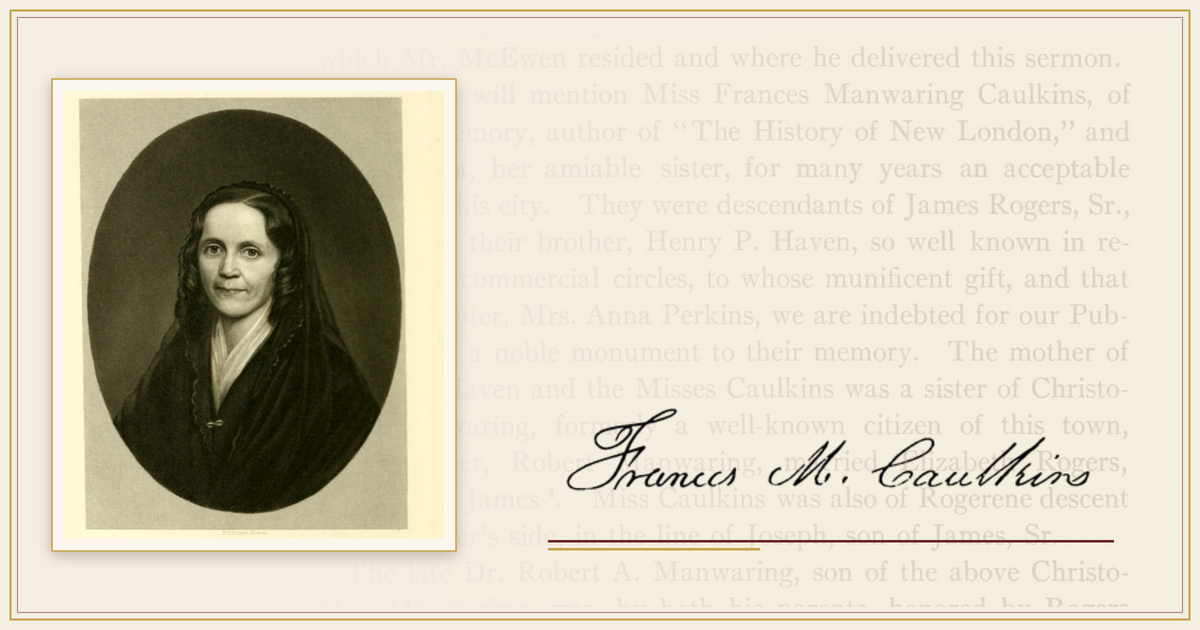
Every family that traces itself into southeastern Connecticut ends up standing on her books. Caulkins published her History of Norwich in 1845 and enlarged it in 1866; her History of New London came in 1852. They are the foundation under everything written about that country since, and they are still the first thing a careful researcher reaches for, a hundred and eighty years on.
For my own family she is not merely useful. She is load-bearing. The woman the court whipped was a Sarah Culver, and the New London records give a great many Sarah Culvers. The identification of that Sarah as Sarah (Long) Culver, wife of John — and the recovery of the name the Norwich countryside gave her, the singing sister — runs back through Donald Lines Jacobus to Caulkins’ History of Norwich, pages 291 and 292. Take her away and I have a court record with a common name in it and no woman attached.
She touched this family a second time, too, which I wrote about in The Captain of the Dove. In that same 1866 volume she sat down with Captain Christopher Colver of Norwich, then ninety years old, the oldest shipmaster in the town and the only one whose voyages reached back into the previous century, and took down his recollections. He gave her the brig Dove, arriving on the third of August, 1811, sixty-three days out of Liverpool. I have since gone looking for a newspaper notice of that arrival and there is none to be found. Caulkins, writing from the old man’s own mouth, is the entire record.
So she has always stood in my mind where the disinterested authority stands: outside the story, above it, writing it down.
That is the part I had wrong.
A minister, and the answer to him
In 1904 the Rogerenes finally got a book of their own. The Rogerenes: Some Hitherto Unpublished Annals Belonging to the Colonial History of Connecticut was published in Boston, the first part a vindication by John R. Bolles, the second a history by Anna B. Williams. Both were of the sect’s stock and neither pretended otherwise. It is a partisan book, and it is also the best book on the subject, which happens more often than the tidy-minded would like.
Much of Bolles’ first part is a long, patient, occasionally sharp answer to the Rev. Abel McEwen, who had preached a half-century sermon from the pulpit of the First Church in New London and used part of it on the Rogerenes. McEwen had allowed that the sect’s people were “men and women of low minds, in regions of darkness,” and had disposed of their descendants in a phrase: “a small remnant of their posterity, almost unknown, in a neighboring town.”
Bolles took that last remark personally, and answered it in the way a man answers when he has the receipts. He would show, he wrote, “how numerous and well known are descendants of James Rogers, Sr., and his son John Rogers, founders of this sect, in the town in which Mr. McEwen resided and where he delivered this sermon.”
Then he starts his list. It is on page 102, and this is how it opens:
First, we will mention Miss Frances Manwaring Caulkins, of pleasant memory, author of “The History of New London,” and also Pamela, her amiable sister, for many years an acceptable teacher in this city. They were descendants of James Rogers, Sr.
He keeps going. The mother of Frances and Pamela, he says, was a sister of Christopher Manwaring, “formerly a well-known citizen of this town, whose father, Robert Manwaring, married Elizabeth Rogers, daughter of James.” And then, for good measure: “Miss Caulkins was also of Rogerene descent on her father’s side, in the line of Joseph, son of James, Sr.”
The historian of New London was of the sect’s own blood. Bolles names her first — before the ex-lieutenant-governor, before the Yale professor of astronomy, before the Baptist minister — because she was the most distinguished answer he had to a minister who had called her people almost unknown.
Not on a partisan’s word
Bolles is an interested witness in an argument he is losing his temper in. I did not want to take him at his word, so I went to the records, one link at a time.
They hold. Every one of them.
The Barbour Collection of Connecticut town records has an Elizabeth Rogers born at New London on the twelfth of November, 1749, daughter of James. When she married she was living at Hog Neck — which is to say in the Rogers family’s own corner of the town, not somewhere across the county with a common surname.
She married Robert Manwaring at New London in October of 1772. The Barbour marriage entry dates it the eighth of October; the compilation called Early Connecticut Marriages puts it in November and names the pair outright. Two clerks, one wedding, a month apart, which is ordinary.
The Barbour births then give their children: Christopher Manwaring, born the thirteenth of December, 1774, and Fanny Manwaring, born the sixth of November, 1776, both to a father named Robert. And the New London church register catches the two of them together — Christopher and Fanny Manwaring, baptized the same day, the ninth of September, 1787, father Robert, mother Elizabeth.
That single line is the joint the whole thing turns on. It puts brother and sister in one household with one named father and one named mother, exactly as Bolles said.
Fanny Manwaring married Joshua Caulkins in 1792. He was born in January of 1772 and he died in 1795 — the year their daughter was born.
And the Connecticut death index gives the daughter: Frances Manwaring Caulkins, born the twenty-sixth of April, 1795, father Joshua Caulkins, mother Fanny.
So the chain runs whole, from a Rogers household at Hog Neck to the woman who would write the town’s history: James Rogers, to Elizabeth, to Fanny, to Frances. She was the great-granddaughter of the family whose name is on the sect.
The family knew it, too, and kept it where families keep such things. Her brother went through life as Christopher Rogers Manwaring, and she is carried in more than one family record as Frances Rogers Manwaring Caulkins. The name was not lost. It was worn.
The tilt
Here is where it becomes interesting rather than merely tidy.
She did not write as an advocate. Bolles, who plainly admired her, says so in the same breath as the compliment. She was, he writes, “that gifted and honored historian,” and “the first historian to attempt careful and intelligent search in this obscure direction” — and she was “inclined to favor the ecclesiastical side.”
He then spends a good part of a chapter correcting her. She had been taken in by Peter Pratt’s scandalous book and repeated some of its inventions. She wrote that a Rogerene woman was fined for pouring scalding water on the rate collector’s head, where the court record says only that she had threatened to. She read a single boundary suit as a general “contention” among James Rogers’ children, and later writers copied the error out of her.
These are not the mistakes of a partisan. They are the mistakes of someone working fast through a hostile record and giving the establishment the benefit of the doubt — someone who has, without perhaps ever quite deciding to, taken the other side.
And yet. Read what she actually wrote about the persecutions, and you find her conceding the ground:
The offences of the Rogerenes were multiplied and exaggerated, both by prejudice and rumor. Doubtless a sober mind would not now give so harsh a name to expressions which our ancestors deemed blasphemous.
And, plainer still:
It was certainly a great error in the early planters of New England to endeavor to produce uniformity in doctrine by the strong arm of physical force.
That is a woman of Rogers blood, writing at the establishment’s elbow, in a town that had spent a century fining and jailing and flogging her mother’s people — declining to say they were right, and refusing to say the colony was.
Why it matters here
Which brings me back to my own eighth-great-grandmother.
Sarah Culver’s name reaches me because Frances Manwaring Caulkins wrote it down. Not the sentence — the sentence is in the court file, and the court file would have kept it whether anyone cared or not. The name. The identification. The nickname the neighbors gave her, the singing sister, which is the only nickname this project has recovered for any Collver woman in four hundred years.
That came from a woman who was, at several removes, of the same stock as the people doing the singing — and who did not much approve of them.
She had every reason to leave it alone. There is no glory in a great-grandmother’s cousins being whipped at a post, and a nineteenth-century lady of New London writing the town’s official history had a hundred graceful ways to let that go quiet. She did not let it go quiet. She wrote it down, filed it, footnoted it, and let it stand where the next person could find it.
A historian who is fair to the people she disagrees with is worth ten who are fair to their own.
What I cannot prove
Two honest gaps, because this blog exists on account of the ones my family papered over.
Which James. The Barbour entry says only that Elizabeth was the daughter of James, and that family ran to a great many Jameses across four generations. Bolles pins her to James the fourth. He may well be right and I have not been able to confirm it, so I will say only that she was a daughter of James Rogers of New London and leave the generation open.
The father’s side. Bolles says she came of the same stock through her father as well, in the line of Joseph, son of James, Sr. I can find nothing to confirm that, and I am not going to assert it because it makes a better story. The mother’s line is documented end to end. The father’s line is, for now, one man’s sentence.
The library is still there
The reader who set this going descends from Caulkins through Elder William Brewster, by way of Jonathan Brewster, whose people lie in the Brewster ground at Preston — a few miles up the same river. She asked, in effect, whether her family and mine ever touched. So far as I can find, they did not: there is no Caulkins marriage into my line anywhere, and the one Brewster marriage I can document is a Long Island one I cannot yet run back to the Mayflower. I would rather tell her that plainly than hand her a connection I would have to withdraw.
But something touched. In the autumn of 1719 a woman from Groton went to jail for two months, told a court what she thought of it, and was sentenced to the post. A hundred and thirty years later a woman in New London, descended from the same sect’s founding family and inclined to think it had all been rather unfortunate, sat down and wrote her name into a book.
Frances Manwaring Caulkins died in 1869. Her half-brother, Henry P. Haven, gave New London its public library; the 1874 edition of her History of Norwich carries his name on it as publisher. The library is still open. Her books are still the first thing you pick up. And in a Facebook group full of people descended from New England’s founders, her fifth cousin reads a post about a whipping in 1719 and writes in to say that she knows the road past the church.
We are all still standing on her work. It seems worth knowing, at last, whose side she came from.
Sources and notes: The passage naming Caulkins is John Rogers Bolles and Anna B. Williams, The Rogerenes: Some Hitherto Unpublished Annals Belonging to the Colonial History of Connecticut (Boston, 1904), 102 — in the chapter answering the half-century sermon of the Rev. Abel McEwen; the assessments of Caulkins as historian (“gifted and honored,” “inclined to favor the ecclesiastical side”), the Peter Pratt material, the “pouring” for “threatening” correction, and the reading of a single boundary suit as general contention are Bolles’ also, at 22–23, 197, and 162–63. The genealogical chain is from Connecticut, Town Birth Records, pre-1870 and Town Marriage Records, pre-1870 (the Barbour Collection), Early Connecticut Marriages, the Connecticut Church Record Abstracts, 1630–1920, and the Connecticut Deaths and Burials Index, 1650–1934. Caulkins’ own concessions are from her History of New London (1852). The identification of Sarah (Long) Culver as the singing sister follows Donald Lines Jacobus and Ralph D. Wood, “Additions and Corrections to the Colver-Culver Genealogy,” The American Genealogist 31 (1955): 141, citing Caulkins, History of Norwich (1866), 291–92. The portrait and signature are the frontispiece of Caulkins, History of New London (1895 edition).