The Hundred Rolls
John Culverd of Oxford held a cellar with a solar in 1279, and the jury that recorded it admitted three times over that it did not know how. An early bearer of the family name, honestly unconnected - and why that distinction is the whole method.

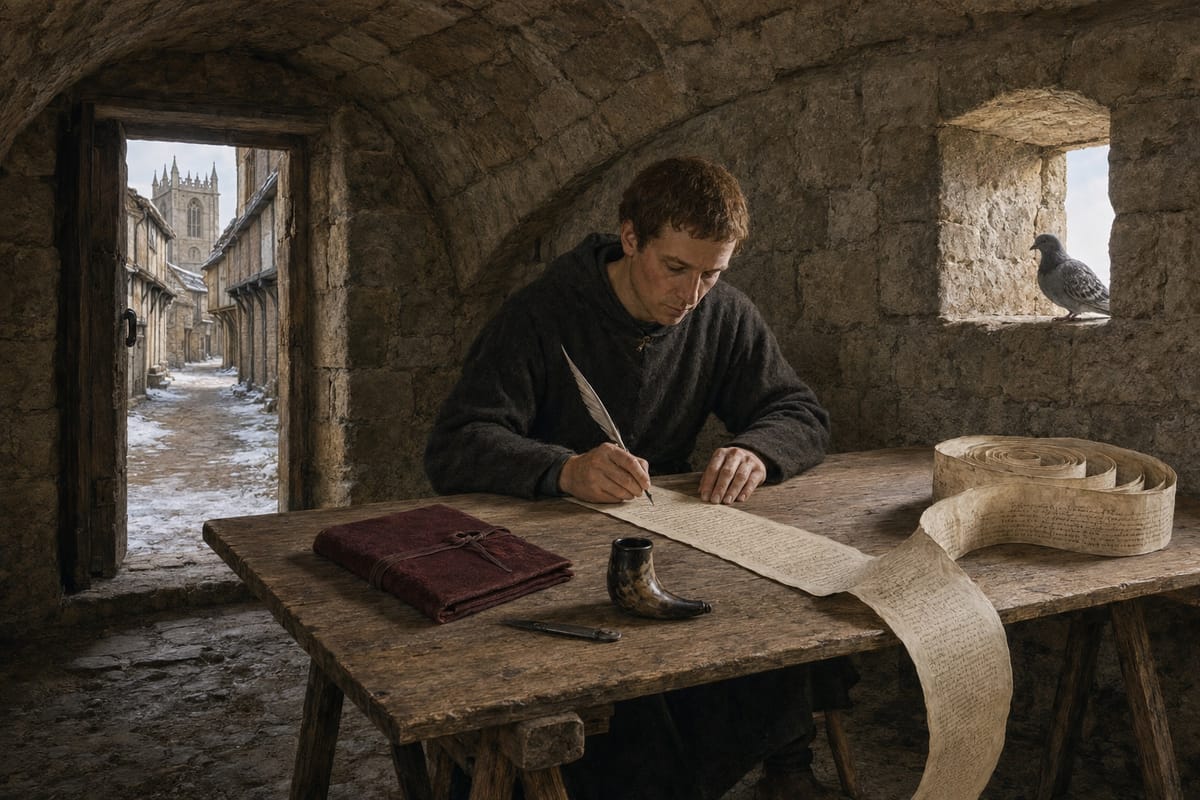
In the seventh year of his reign, Edward I sent commissioners into every county of England to ask his subjects a question that no Englishman enjoys being asked.
The question was quo warranto — by what warrant? By what right do you hold this house, this cellar, this strip of ground; who granted it to you, what do you render for it, and to whom? Juries of local men were empanelled hundred by hundred — a hundred being the old subdivision of an English county, a district notionally of a hundred households — and made to answer under oath, tenement by tenement, down the length of every street. The clerks wrote the answers onto membranes of parchment and sewed them head to tail into rolls. A later age, impressed by the scale of the thing, nicknamed the survey the Second Domesday. Its proper name is the one the clerks used: the Hundred Rolls.
Nobody undertakes a survey like that out of curiosity. Edward wanted to know what the Crown had lost — what rights and rents had drifted, in the disorder of his father’s reign, into the hands of barons and abbeys and towns. It was an audit, and like all audits it was resented. What it produced, by accident, is one of the finest street-level photographs of thirteenth-century England ever taken: not the great men and their charters, but the ordinary holders of ordinary property, named, with their rents beside them.
On page 794 of the second volume, in the returns for the city of Oxford, a man of my name is written down twice.
Two entries in an abbreviated hand
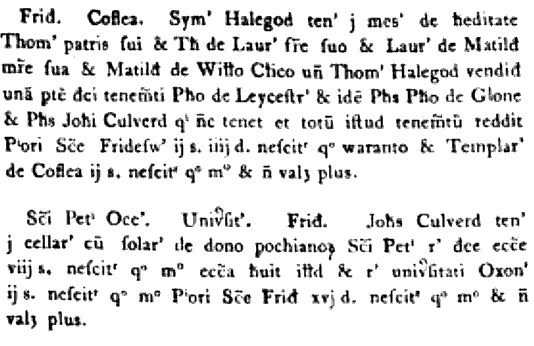
The rolls were printed in 1818 by the Record Commission, in a type cut to imitate the medieval hand — abbreviations, suspensions, and all. Here are the two entries as they stand on the page:
…& Phs Johi Culverd qi nc tenet et totu istud tenemtu reddit P’ori Sce Fridesw’ ij s. iiij d. nescit’ quo waranto & Templar’ de Coslea ij s. nescit’ quo mo & non valt plus.
Sci Pet’. Univsit’. Frid. Johs Culverd ten’ j cellar’ cu solar’ de dono pochianor Sci Pet’ r’ dce ecce viij s. … & r’ univsitati Oxon’ ij s. … P’ori Sce Frid xvj d.
Expanded and Englished, the first says that a messuage — a dwelling house with its yard and outbuildings — had come down through the Halegod family, been sold by Thomas Halegod to Philip de Leycester, by Philip to Philip de Gloucester, and by Philip to John Culverd, who now holds it; and that the whole tenement renders two shillings and fourpence to the Prior of St. Frideswide’s and two shillings to the Templars.
The second says that John Culverd holds one cellar with a solar — a storeroom with an upper chamber over it, the standard shape of a medieval town property, trade below and living above — by the gift of the parishioners of St. Peter’s, rendering eight shillings to that church, two shillings to the University of Oxford, and sixteen pence to the Prior of St. Frideswide’s.1
That is the whole of it. A man, two properties, five rents. It is not much, and it is a great deal more than the record usually gives at that depth of time.
What the entries actually tell us
Read them for what they are and a person assembles himself out of the abbreviations.
John Culverd was a burgess of Oxford: a property-holding townsman inside the walls, not a countryman. He held by purchase and by gift, not by inheritance — the messuage reached him at the end of a chain of three named sales, which is the profile of a man buying his way into the town’s property rather than being born to it. And he was threaded into the rents of the great institutions on all sides. The Prior of St. Frideswide’s took from him twice. The Knights Templar took from him once.2 The parish of St. Peter’s had given him the cellar and took eight shillings a year for it. And the University of Oxford — which had been teaching in one form or another for the better part of two centuries, and had been a corporation for less than fifty years — collected two shillings from a dove-named tenant, and had a clerk of Edward I write it down.
There is a small pleasure in that last line that I want to name and then set aside. The oldest thing my family can put its hand on in England is a rent receipt owed to a university that is still standing, still collecting, and still, on the whole, resented at audit time.
The rents themselves are worth pausing over. Twelve shillings and eightpence a year, all told, across the two holdings — something on the order of two months’ wages for a skilled craftsman of that decade, when a carpenter or mason might take three or four pence a day. This is a man of the middling, solid, taxable sort: not a magnate, not a pauper, but exactly the kind of townsman a survey like this was designed to find, and exactly the kind who almost never gets named anywhere else.
Whether he was more than that is a question the Oxford civic records answer a good deal more boldly than I am willing to.
Following Anthony Wood, the antiquary who catalogued the city in the seventeenth century, those records carry a John Culvert — spelled with a final t where the rolls give a final d — as a bailiff of Oxford in 1270 and again in 1284, as coroner and juror in 1285, as alderman of the South-West ward, and twice as mayor of the city, in 1285 and again in 1293. He succeeded Nicholas de Kingston, who was mayor thirteen times over twenty-two years and who appears on this very page of the rolls, a few lines above our man.
If Culvert with a t and Culverd with a d are one person — and on date, on place, and on the rarity of the name I think they probably are — then the dove-named tenant of that cellar went on to govern the city that was collecting his rent. I would like that to be true. I am not able to say that it is. The civic list I have it from carries no citation to any primary text, and the two works that would settle it, Wood’s own survey of the city and Salter’s re-edition of these very Oxford returns, are on my list and not yet in my hands.3
The record admits what it does not know
And then there is the phrase that made me sit up, which is the sort of thing this project exists to notice.
Three times in those few lines the clerk writes nescit — he does not know. He does not know by what warrant the rent is owed to the Prior. He does not know by what means the Templars have their two shillings. He does not know how the church came by the property it gave away.
That is a sworn jury of Oxford men, at the sharp end of a royal audit, with the king’s commissioner in front of them, declining to invent an answer. They could have guessed. Guessing would have been safer and would certainly have been quicker. Instead the finest administrative record England had produced in two centuries stops, three times on one line, and says in the plainest available Latin that the thing is not known.
I have been reading records of my family for a long time now, and I have watched the family’s own historians do the opposite of that at every opportunity — supply a father where there is a gap, promote a coincidence to a descent, give an immigrant a ship because a book looks unfinished without one. It is a strange and bracing thing to be corrected on the point by a clerk who died in the reign of Edward I. The oldest document in this whole project is also the most honest one in it.
The name the machines cannot see
There is a second lesson on that page, and it is about how the entries were found.
I have been working on this family, on and off, for something close to thirty years — since before the censuses were online, when a lookup meant a letter to a county clerk and a wait of some weeks for a photocopy. In all that time I had never heard of the Hundred Rolls. They came into this project only in the last five years. That is worth stating plainly, because the rolls were not hiding: they were printed in 1818, and have sat on library shelves in that edition for longer than my family has been in Michigan. Nothing about the record changed. What changed was my ability to reach it.
And even then, the reaching could not be done the modern way.
The 1818 volume has been scanned and is freely readable online. It is also, for practical purposes, unsearchable. Optical character recognition — the software that turns a page image into text a search box can look through — is defeated utterly by medieval abbreviated Latin, by the suspension marks, the crossed letters, the superscript contractions, the long s. Search that book for Culver and you will be told, with perfect confidence, that the word does not occur. Search it for Culverd and you will be told the same.
The word is printed there. Twice. In bold clear type on page 794.
So the entries were found the only way they could be found: by a research session for this project working through the Oxford returns page by page, with the eye rather than the search box. And the whole method of this blog is in that small failure. Absence of the search result is not absence of the thing. A negative from a search engine is not a negative from the archive; it is a report about the search engine. The parish register that was never filmed, the deed the index misspells, the surname the transcriber read as Colloor — none of them have stopped existing because a database cannot see them. A great deal of what this project has turned up has been sitting in places the machines reported as empty.
And now the part that matters
Here is where I have to do the thing this project will do again and again, and I would rather do it plainly than let a reader assume what I have not proven.
John Culverd of Oxford is not my ancestor.
I cannot draw a line from him to me, or from him to Edward Colver the Dedham wheelwright, or to anyone in the New England family. I do not believe such a line can be drawn from the surviving records. The generations between are not thin; they are absent. Three and a half centuries separate that cellar in Oxford from the covenant roll in Massachusetts, and I have nothing whatever to lay across the gap.
He is not even, so far as I can honestly claim, the first bearer of the name. The Victorian surname scholar Charles Bardsley, working the same rolls, lists a William Culver of Herefordshire alongside a John Culvard of Oxfordshire — the latter almost certainly this man under a different spelling and a conventional date.4 Two counties at once. The name does not surface in the record at a point; it surfaces across a country, the way a name does when it has already been in use for generations before anybody thought to write it down.
So he is an early bearer, located, named, and correctly dated. That is all he is, and I am going to leave him that way.
I labor the point because the temptation runs the other direction so hard. The whole gravitational pull of a family history is to press every early bearer of the name into service as a forefather — to run a rope from 1279 straight down to the present and call it a pedigree. Somebody, I promise you, has already done it; there is a version of this family circulating with a medieval Oxford burgess wired directly into the top of it, and the wiring is imaginary. That rope is always a fiction. A reader deserves to be told exactly where the documented ground ends and the wishful ground begins, and for the medieval name it ends here, at a cellar with a solar in Oxford: a real man, correctly named, honestly unconnected.
What he gives us instead
Not descent. Antiquity, which is a different thing and worth having on its own terms.
By the reign of the first Edward, culver — the Old English culfre, the dove of the chalk cliff, the bird Chaucer would reach for a century later as the emblem of the helpless under the cruel — had already stopped being a word and become a family name. Not a nickname a neighbor might use, but a name substantial enough that a royal commission had to spell it, twice, in a legal instrument, attached to a man who paid rent to a priory, an order of crusading knights, a parish, and a university.
The word had left the poem and the cliff, and become something a tax roll was obliged to write down.
That is the fact the two entries establish, and it costs nothing in honesty to hold it. The dove was in the English record, borne by an ordinary substantial townsman, in 1279. Everything my family has since been called — Coluer, Colver, Colloor, Culver, McCulver, and the doubled form my own branch settled into and kept — is a variation played on a name that was already old when John Culverd signed for his cellar.
Where it stands now
You can go and look at nearly all of it, which is more than can be said for most of what I write about here.
Page 794 is online, in a scan no search engine can read, waiting for anyone patient enough to go through it with their eyes. St. Frideswide’s Priory, which took two rents a year off John Culverd’s holdings, was dissolved under Henry VIII and its church made the cathedral of the new Christ Church — so the institution he paid is gone and the building he paid it to is open daily, with a choir in it. The University he owed two shillings has not missed a year since. The Templars were suppressed in 1312, thirty-odd years after that entry was written, and their two shillings went elsewhere.
The cellar with the solar is gone, and no one can now say which street it stood on.
What survives is the sentence. A jury of his neighbors, put on oath and pressed for an answer, said that John Culverd holds this, and renders that, and as for how the whole arrangement came about — nescit, they do not know. Seven hundred and forty-seven years later a man carrying a doubled spelling of the same name sat down to read their answer, and found that the most useful thing on the page was not the name at all.
It was the honesty.
Next week: Sarah Culver before the court — “You are an adulterous generation…” — and the fifteen stripes she took for saying so.
Adapted from the forthcoming book We Are Doves: Four Centuries of the Collver–Culver Family.
© 2026 Albert B. Collver III · The Collver Family History Project. Original historical documents reproduced here are in the public domain; the research, text, and annotations are the author’s. Please cite or link rather than republish.
Notes
Rotuli Hundredorum, temp. Henr. III. & Edw. I.: in Turr’ Lond’ et in Curia Receptæ Scaccarij Westm. asservati, ed. William Illingworth, vol. 2 (London: Record Commission, 1818), p. 794 — the Oxford city returns, headed Com. Oxon. Public domain; digitized by Google Books (vol. 2, id
wBtDAAAAcAAJ). The Oxfordshire returns in this volume are the great survey of 1279. Expansions of the abbreviated Latin are mine; the transcription above was made from the page image, not from a text extraction, for reasons the post explains.The printed form of the Templar holding is Coslea, which is most probably Cowley, on Oxford’s eastern edge, where the order held a preceptory — the origin of the modern place-name Temple Cowley. I mark the identification as probable rather than certain: I have read the abbreviation, not a scholarly edition of it.
The civic career comes from Stephanie Jenkins’s Oxford History (oxfordhistory.org.uk, consulted 16 July 2026), which follows Anthony Wood: John Culvert as bailiff in 1270 and 1284, coroner and juror in 1285, alderman of the South-West ward, and mayor for 1285/6 and 1293/4, succeeding Nicholas de Kingston, mayor thirteen times between 1262 and 1284, whom Wood conjectured died in office. The site carries no inline citation to a primary text, which is why the identification is graded a probability above rather than asserted. The records that would settle both the office and the identification are H. E. Salter, Survey of Oxford, Oxford Historical Society, new ser. 14 and 20 — which re-edits the 1279 Oxford returns with a full name index — and Wood’s Survey of the Antiquities of the City of Oxford. Neither has been consulted. The detail of a charter witnessed beside the mayor rests on this project’s own reading of the civic records and has no citation firmer than that.
Charles Wareing Bardsley, A Dictionary of English and Welsh Surnames, s.v. “Culver,” listing William Culver (or Culvert) of Herefordshire and John Culvard (or Culverd) of Oxfordshire, both under the conventional Hundred Rolls date of 1273. The rolls were in fact compiled between 1274 and 1280; Bardsley dates the whole body of returns to 1273 as a matter of convention, so his John Culvard of Oxfordshire is very probably the John Culverd of these entries, differently dated, rather than an earlier man. William of Herefordshire is a genuinely separate bearer and may be as early or earlier.