The Jabez Staff
The oldest thing this family owns that you can still pick up is a walking stick, and it corrected me.
The oldest thing this family is known to own that you can still pick up is a walking stick.
Not a Bible, not a deed, not a piece of granite in an Ontario churchyard — a stick, about the height of a man’s shoulder, with a dark head worn smooth by hands and a pale collar of bone below it, inscribed in pricked dotted lettering with COLLVER names, one beneath another. It is in Michigan. My cousin Jeff Collver has it. The family calls it the Jabez staff.
This post is about that object, and about the mistake I made with it — a mistake that took me most of a chapter to catch, and that I caught only because the thing itself refused to cooperate.
What Owen saw
Start where the paper starts.
E. A. Owen married Eliza Jane Culver, and so wrote his Pioneer Sketches of Long Point Settlement (1898) partly as a son-in-law. He preserved a great deal that no land book holds, and among it this: that Timothy Culver’s walking staff was still in the family’s keeping when he wrote.
His description is unusually precise for a family reminiscence, and precision will turn out to be the whole point of this post. Nearly five feet of rare New Jersey shrub wood. A large brass head, globular in form. Some six inches of steel at the tip. It was the companion of the thousand-mile walk Timothy is said to have made from New Jersey to Norfolk and back, to visit his married daughters — and it is the stick the family says he once turned on a wolf. In 1898 it was held by another Timothy Culver, at Waterford, Ontario.
Objects like that do not usually survive. Wills scatter them; fires take them; a grandchild who does not know what a thing is lets it go for the wood. Owen’s page was for a long time the last clear sight of it — until the summer of 1941, when the Timothy branch produced it once more. It lay beside a new cairn the Collver and Culver families raised on Timothy’s old homestead north of Simcoe, brought out for the day with the family’s other relics.
After that the trail goes cold. It went down Timothy’s own line, and where it rests today — in whose Norfolk attic or Michigan closet — I cannot say. If you are reading this and there is a brass-headed, steel-tipped stick of about five feet in your family, we should talk.
What came down the other way
Now the second stick, which came down the other side of the house entirely.
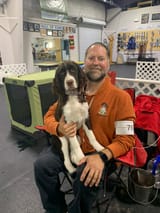
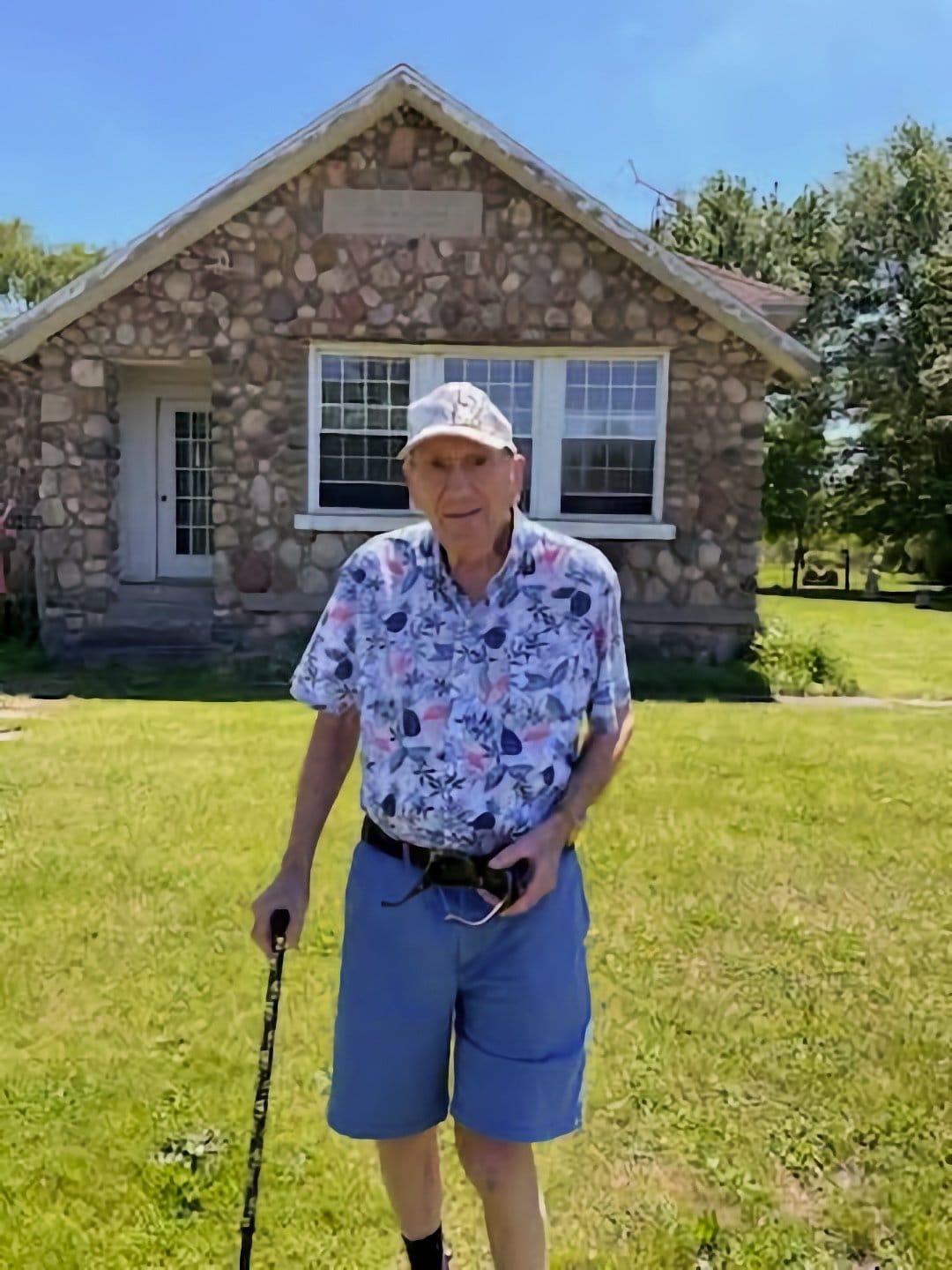
It descended through Jabez’s line — the direct descent this project has followed for four years — into the family’s Michigan branch: to the Reverend Carl Burton Collver, a Free Methodist minister of Clayton Township in Arenac County; then to his son Wendell, who in old age was photographed leaning on it on the lawn of the cobblestone schoolhouse where he had learned to read; then to Wendell’s son Jeff, my half second cousin once removed, who keeps it now, and who sent me the photographs and allowed their use.
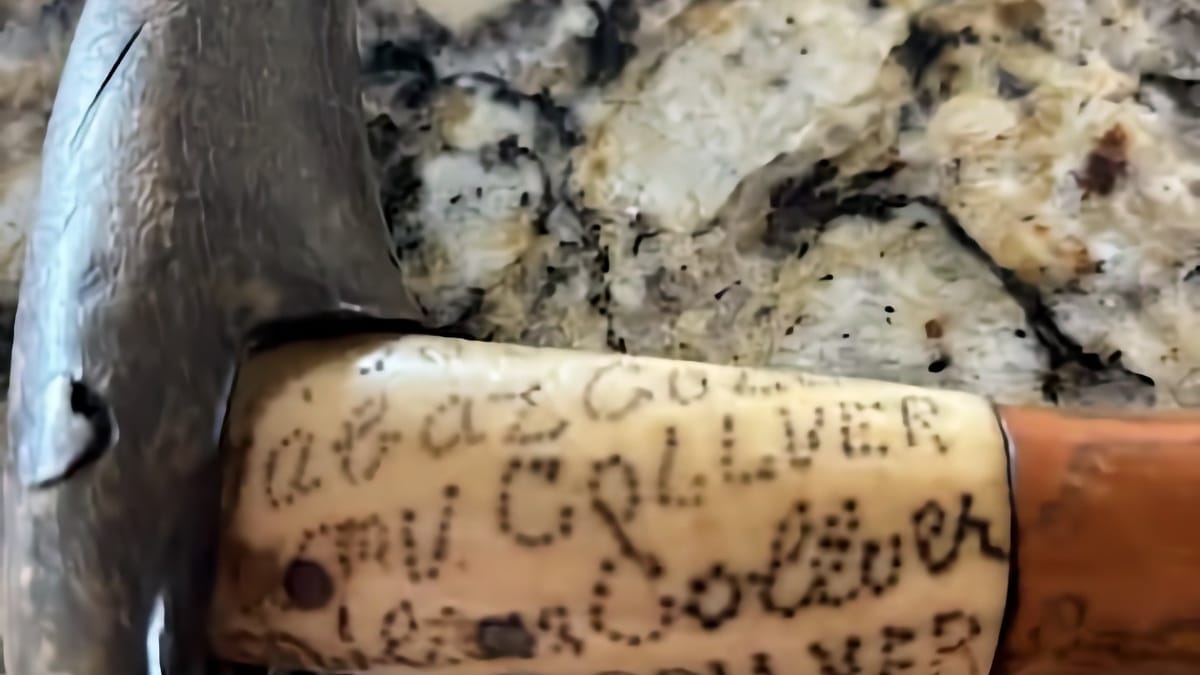
Look at the head of it. Dark, worn, finely cross-hatched — horn, or a dark hardwood. Below it, the collar of pale bone with its column of names, cut in the pointillé manner: not engraved with a graver but pricked, dot by dot, by a patient hand with a sharp point and an evening to spend. There is no brass globe on it. There is no steel at the tip.
Hold those two absences. They are the hinge.
The paragraph I had already written
Here I have to confess something, and it is at my own expense.
For most of a chapter I believed there was only one staff. I believed that Owen’s Timothy staff had come down to Michigan and had its name quietly promoted — over five generations and one international border — from the cousin who actually carried it to the preacher every legend in this family drifts toward.
You have to understand how well that fit. It is exactly the move I had spent thirteen chapters watching this family make. A Bible off a father’s estate becomes the patriarch’s Bible. A ministry becomes a chaplaincy to General Washington. One thousand acres becomes three thousand. An acre of Ontario granite raised over a preacher and his wife becomes, in family memory, a monument to two patriarchs. The pattern is not lying, and it is not stupid. It is what memory does under load: when a family has one name bright enough to hang things on, the things migrate toward the name. Give it a hundred years and the brightest ancestor ends up holding everything the family owns.
So the staff was going to be the chapter’s closing exhibit. The memory-drift thesis, made tangible, in a single object you could photograph. I had the paragraph written.
Then I set the two descriptions side by side — the way this whole book has been begging its readers to — and they do not match.
Owen’s staff: brass head, globular, steel tip, shrub wood, five feet. Jeff’s staff: dark horn or hardwood head, no brass anywhere on it, a bone collar cut with names, no steel at the tip. These are not one object renamed. They are two objects. Two staffs — Timothy’s and Jabez’s — each of which went down its own man’s line and kept its own man’s name.
The family did not drift here. I did.
That is the honest version, and I have left it in the book rather than tidying it away, because the alternative was to publish a graceful thesis that happened to be false. The auditor, three hundred pages into auditing everybody else, reached for the tidiest story on the shelf, and it took the plain absence of a brass globe to stop his hand.
The object signs itself
Which leaves the staff doing stranger and better work than I had assigned it.
The collar has been read now. And among the Collver names pricked into the bone, in the dotted lettering of that patient hand, is Jabez.
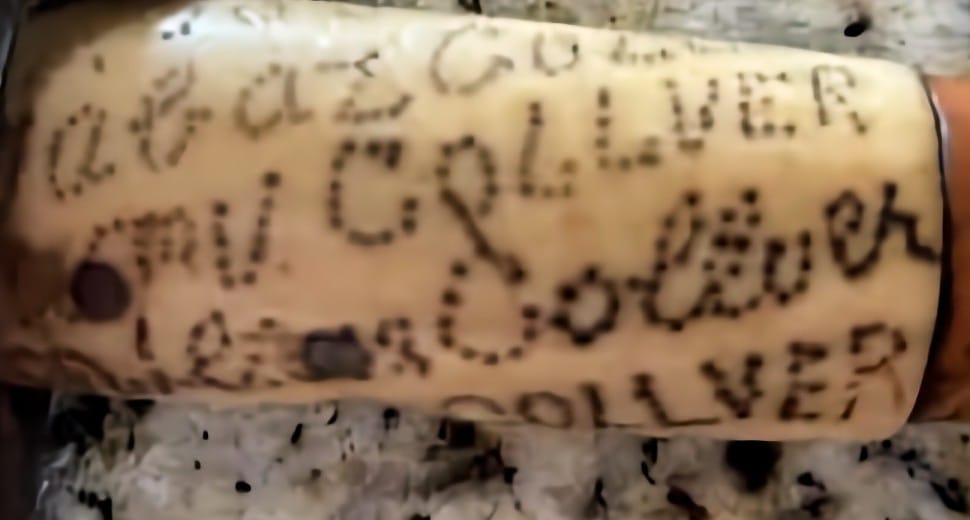
Read that slowly, because of what it does to the evidence. What I had graded, one paragraph earlier, as family tradition — “the family calls it the Jabez staff” — the staff itself had already signed. The attribution is not a guess promoted to the brightest name on the shelf. It is cut into the object, by somebody who had the stick in one hand and a point in the other, and who is very unlikely to have been mistaken about whose it was.
Two honesty flags, because this project runs on them.
The name Jabez recurs in this line: the Reverend Jabez of the fifth generation, and a Jabez B. of the seventh, both in the direct descent. The collar establishes that the stick belonged to a Collver named Jabez; the descent down Jabez’s line, taken with the family’s own name for it, points to the Reverend. That is a strong inference and not a proof, and I will call it what it is.
And the top line is worn. What the photograph shows of it is consistent with what the family reads in the hand, which is the ordinary condition of a bone surface two centuries old and touched by everyone who ever held the stick. What is worn off the object is worn off the object; no better photograph exists, and none is coming.
Still. In four years of this work, I have caught the family’s memory bending a dozen times and corrected it each time from paper. This is the only occasion I know of where the object corrected me.
The minister, the schoolhouse, and the stick
There is a reason the staff ended up in Arenac County, and it is the family’s oldest habit rather than an accident.
Carl Burton Collver was born at Sterling, Michigan, in 1905, the son of John Milton Collver — the man who carried this family out of Ontario — by his second marriage. He lost his mother at three. He became a minister in the Christian and Free Methodist churches for thirty-eight years, pastoring at Maple Ridge, at Hamburg, and at the Roosevelt Avenue church in Flint, and he died at Flint in 1975 at the age of seventy.
Maple Ridge is in Clayton Township, and so is nearly everything else in this story. John Milton is buried in the township, at Clayton Cemetery. The Free Methodist church Carl Burton served is in the township. And the cobblestone schoolhouse in the photograph — a one-room building of glacial fieldstone with its date cut in the gable, Clayton School District No. 2, put up in 1928 to replace an 1871 frame school, now a private house — stands in the same few square miles, and is where Wendell went as a boy.
So the photograph is not merely a man with an heirloom. It is a man in his seventies standing on the lawn of the school he attended as a child, in the township where his grandfather is buried, holding a stick that walked out of New Jersey with a Presbyterian preacher a hundred and forty years before Michigan needed a schoolhouse. Four generations are in that frame, and only one of them is visible.
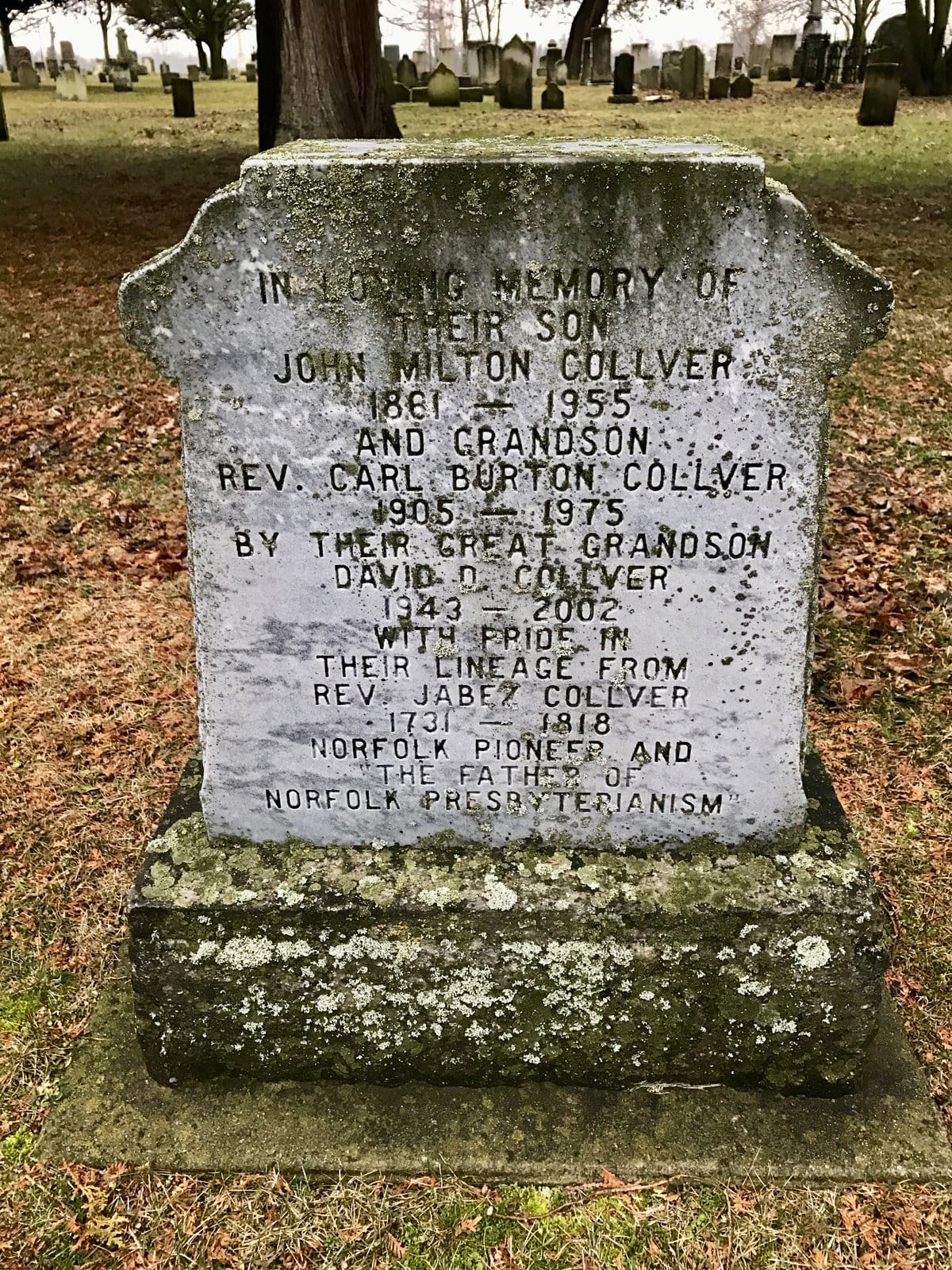
The family also wrote the connection down in stone, which I did not know until I stood in front of it. In the old Woodhouse burying ground in Norfolk County, Ontario, there is a white marble cenotaph — a memorial where the body does not lie, John Milton being buried in Michigan. It reads: in loving memory of their son John Milton Collver, 1861–1955, and grandson Rev. Carl Burton Collver, 1905–1975, erected by their great-grandson David D. Collver, “with pride in their lineage from Rev. Jabez Collver 1731–1818, Norfolk Pioneer and ‘The Father of Norfolk Presbyterianism.’”
The stick and the stone are doing the same work: a Michigan family, several generations and a border away, insisting in bone and in marble on where it came from. One of them was cut by a man with a chisel and a monument budget. The other was pricked, dot by dot, by somebody with a needle and an evening.
What a staff is for
I have handled a good many documents for this book and only photographs of this one object, and the difference is instructive.
A document tells you what somebody wanted recorded. A deed records a transaction, a will records an intention, a petition records a plea shaped for the ear that would hear it. Every one of them is a performance for a reader.
A staff is not a performance. Nobody carried it in order to be remembered carrying it. It is worn where hands wore it, and the wear is the record — the only kind of record this family’s poorer generations were in a position to leave. My people did not commission portraits. Across four centuries this family produced almost no diaries and very few letters, and the paper trail runs thinnest exactly where they were most settled. What they left instead was work: a covenant signed, a road walked, a stick worn smooth at the grip.
And this one was worn on a particular kind of walk. Jabez Collver took his household out of New Jersey in the aftermath of a sedition trial, farmed on the Susquehanna, and in the early 1790s went north into Upper Canada, where he made his rounds as an itinerant preacher into his eighties — on snowshoes in winter, and later in the saddle with, as one memoir has it, a huge cow-bell on the old mare’s neck. If the stick is his, then what it did for a living was hold a very old man upright on bad roads in a cold country, so he could get to the next house and preach.
It is not an ornament. It is a tool of the family trade — a trade that runs from a Presbyterian in the Ontario snow to a Free Methodist in an Arenac County pulpit, and, I will note with only the appropriate amount of self-consciousness, to the Lutheran writing this.
Where it is now
The thing I keep coming back to is not the wolf, or the thousand miles, or even the name in the bone. It is that it is still here.
A wooden stick survived a sedition trial, an exile, a border, a farm, an exodus to Michigan, six or seven households, at least two centuries of moves, and every clean-out and estate sale in between — and it is presently in my cousin’s keeping, because at each of those junctures somebody knew what it was and did not let it go. That is not luck. That is a chain of people, most of whom left no other mark on the record at all, each deciding that this one was worth carrying to the next house.
Which is the whole argument of this project in one object. The records name the men who bought and sold and swore oaths. The keeping was done by everybody, and almost none of them are named anywhere. Somebody pricked those letters into the bone. Somebody’s mother put the stick in the wagon.
If you have such a thing — the stick, the tool, the cup, the unlabeled photograph in the drawer — the practical counsel of this post is short. Write down now, dated, what you have been told about it, before you research a word; your own memory is composing too, and this morning’s version is itself a document. Then photograph it, all of it, including the parts that seem to say nothing. Then look at what it actually is — the material, the wear, the marks — and let the object argue back. It nearly always can, and when it does it outranks everything the family has ever said about it, including everything I have said in this post.
The stick is dark, and worn, and marked with the names of the people who carried it. It came home to a Michigan house and it is still there, waiting for the next hand to take it up.
It is a dove of an object. Homing is the one thing this whole family was ever named to do.
Sources and notes: Timothy Culver’s staff — five feet of rare New Jersey shrub wood, brass globular head, six-inch steel tip, then held by Timothy Culver of Waterford — is described in E. A. Owen, Pioneer Sketches of Long Point Settlement (1898); its reappearance beside the 1941 Collver-Culver cairn north of Simcoe is recorded in the family’s own accounts of that gathering. The Jabez staff and the photographs of it (the staff, the bone collar, and Wendell Collver outside the Clayton School) are used courtesy of Jeff Collver, who holds the staff; the reading of “Jabez” among the pricked names on the collar is Albert B. Collver III’s, in hand, and is corroborated by the detail photograph as far as the worn surface allows. Rev. Carl Burton Collver’s dates and pastorates follow his obituary in The Flint Journal, 1 July 1975, and his wife Hester’s of 3 July 2000; his parentage is confirmed by the 1910 U.S. census for Clayton, Arenac County, Michigan, which shows him in one household with his half-brother Daniel William. The cobblestone school is Maple Ridge School, Clayton School District No. 2, built 1928 to replace an 1871 frame building, and is now a private residence. The Old Woodhouse cenotaph was photographed by the author in Norfolk County, Ontario, in March 2017. The two-staff finding is set out in ch. 14 of the forthcoming book, together with the conflation it corrects — the author’s own, not the family’s.
Adapted from the forthcoming book — We Are Doves: Four Centuries of the Collver–Culver Family.
© 2026 Albert B. Collver III · The Collver Family History Project. Original historical documents reproduced here are in the public domain; the research, text, and annotations are the author’s. Please cite or link rather than republish.