The Names We Kept and the Ancestors We Chased
A form letter, a mail-merge number, and a woman eighteen months dead — and what four hundred years of this family's given names say about where Americans decided they lived.
Sometime in the late summer of 1997, a letter came to a house in Climax, Michigan. It was addressed to Mary Collver, and it began, "Dear Mary."
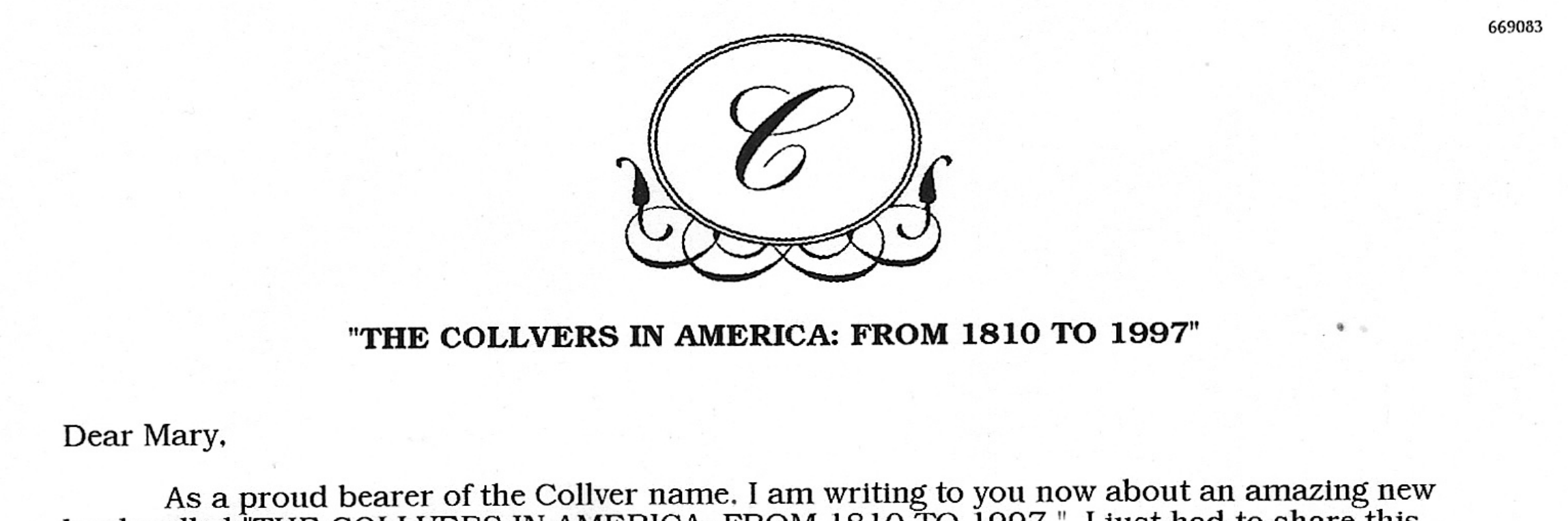
"As a proud bearer of the Collver name, I am writing to you now about an amazing new book called 'THE COLLVERS IN AMERICA: FROM 1810 TO 1997.' I just had to share this news with you."
What the book contained, the letter explained, was census records for eighteen Collvers, a list of the 193 Collver households then in the United States with their addresses — "You, Mary, are listed in this special section" — and chapters on the migration pattern of Collvers across America. It was heirloom quality. It was handmade to order and elaborately illustrated. It was the only publication of its kind in the entire world. She risked nothing: she could reserve her copy and send no money now, though she would have to order by the eighth of October, because the number of books printed would be determined by the number of orders received.
She did not order it. She could not have.
Mary Rebecca Collver died on the evening of Saturday, the thirtieth of March, 1996 — eighteen months before the deadline the letter set her. She had taken meningitis in Florida in February, spent two weeks in a hospital and ten days in a nursing home at Galesburg, come home to Climax for about a week, and been carried back to the hospital with pneumonia on the twenty-ninth. Her own newspaper put her on its front page the following Saturday, under a plain headline: she had been an integral part in the growth of the Climax Telephone Company. She was its secretary and treasurer for many years — the books, the business affairs, the switchboard when it needed watching — and a member of the Telephone Association of Michigan in her own right. She had been married on the sixteenth of June, 1939, and widowed on the twenty-sixth of August, 1990, which was her seventy-fifth birthday.1
None of that was known to the letter, which addressed her by her first name and told her she was listed.
In the top right corner of the page, above the ornamental C, a small number is printed: 669083. It is the merge number — the line on the mailing list where a dead woman's name still sat.
The letter survived anyway, in a son's files, and it came to me this week from a cousin who has been going through his papers on my account.
I have been looking at it for two days, because it does two things at once. It is a piece of junk mail, and a rude one, though nobody meant the rudeness and no one at that end will ever know they gave it. It is also a precise specimen of something this country has been doing for a hundred and fifty years — and it puts the question sharply. The list had the surname. It did not have her. What is the difference between the name you keep and the ancestors you chase?
I. The names we kept
Elsewhere I have written about our surname — why we are Collver and not Culver, and what a dove has to do with it.2 This is the other half: the given names, the ones chosen one child at a time, in a room, by people who had reasons.
Start with the one this whole project is built around. In the first Book of Chronicles there is a man of Judah about whom almost nothing is said, in a chapter that is otherwise a bare list of names — four verses in, four verses out. His mother named him for the circumstances of his birth: "Because I bare him with sorrow." The Hebrew makes the point by wordplay rather than by strict derivation; the name and the word for pain are the same letters, rearranged. He is remembered for a prayer, and for the sentence that follows it: "And God granted him that which he requested."3
A boy born at Groton, Connecticut, on the nineteenth of June, 1731, was given that name. He kept it through a New Jersey pulpit, a sedition indictment, an exile, and eighty-seven years, and the family kept it after him: his son Jabez Jr., his grandson Jabez B., a great-grandson christened Jabez Almeron. It is our most-repeated name. It means sorrow, and it was chosen on purpose by people who could have chosen anything.
Set the early generations side by side and the pattern is not subtle. Edward's children, baptized at Dedham and Roxbury between 1641 and 1653: John, Joshua, Samuel, Joseph, Gershom, Hannah, Edward. Two generations on: Jabez, Esther, Mercy, Timothy, Robert, David. The generation born around the Revolution: Ebenezer, Aaron, Nathan, Anna, Benjamin, Eunice, Hannah, Freelove. That is not a naming fashion. That is a people who read themselves into a book and named their children out of it — a new Israel in a new wilderness, with Hebrew names on the baptismal register to say so out loud. Freelove and Mercy are not exceptions to the rule; they are the same rule speaking English, the Puritan virtue-names that turn a daughter into a small standing sermon.
Then watch it move.
By the generation born in the 1770s and 1790s, two of Jabez's grandsons carry names that are not names at all but other families' surnames — Griffiths, Nesbitt — the mother's people traveling forward in the son. In the next generation the room fills with Darius and Calista, Persia and Greece arriving in Upper Canada by way of the schoolbook. In the one after that, born in the 1820s and 1830s, nearly every child carries two names, and the second is the mother's maiden surname doing the work of a monument: Mahlon Bacon Collver, Christina Swick Collver, Eli Bush Collver. Then a son born in 1861 named John Milton, for the poet. Then Clark Ashton, Laurel Dennis, Doris Ida, Mildred. And then, three times in a row, the same name: Albert Bernard, senior, junior, and the third — who is writing this.
Read down that column and you can watch a family change its mind about where it lives. The early names locate the child in Scripture. The middle names locate him in a lineage — his mother's family, his father's ambitions, the classical education somebody in the house wished he had. The late names locate him in nothing but himself and his immediate affections: a name because it was liked, a name because it was grandfather's.
Sacred, then national, then personal. That arc is not ours alone; it runs through New England's registers generally, and historians who have counted them have found the same three stages. But I would rather make the smaller and more defensible claim, which is that this family did it, in this order, and that the register in the back of my book can be read as a chart of it.
One caution, since this project makes a habit of them. The absence of a word is not the absence of the thing. When the Collvers stopped naming their sons Ebenezer, they did not stop going to church. My own line ran to Free Methodist ministers in Michigan in the very generation that stopped taking names out of Chronicles, and I am a Lutheran pastor with a name that has nothing biblical about it whatever. The Bible did not leave the family when it left the baptismal register. It stopped being the place the family went for its labels, which is a change in the sociology of naming and not a change in belief — and confusing the two is exactly the error a careful reader of records learns to stop making.
Here is what I think the column actually shows: a family stops naming its children out of Scripture at about the moment it starts naming them after itself.
II. The ancestors we chased
Which brings the 1997 letter back, because it is selling the same thing the family had by then begun to want.
Genealogy in America has a shape, and it is not a straight line of steadily increasing interest. It comes in waves, and each wave has a reason.
The first broke after the Civil War and swelled through the Centennial of 1876 — a period when a great many old-stock American families discovered, with some urgency, that they were old stock. Immigration was remaking the cities. Ancestry became a way of holding a position, and the institutions of the period were built to certify it: the Sons of the American Revolution in 1889, the Daughters of the American Revolution in 1890, the Colonial Dames in 1891, the Mayflower Descendants in 1897. The published family genealogies of those decades, ours among them, belong to this weather. So does the impulse that produced our own 1916 pamphlet, and the 1910 Colver-Culver Genealogy whose errors I have spent a year correcting — books written in good faith, in an age that had reasons of its own for wanting the line to run back a long way and run back clean.
The second wave was a trough. Genealogy faded after the Second World War, and for a reason nobody had to explain out loud: Europe had just shown the world what bloodline thinking does when it is given an army. A generation that had gone to fight it came home to build suburbs and face forward. Descent was not a fashionable subject.
The third wave broke in the middle 1970s, and it inverted the whole enterprise. Alex Haley's Roots and the Bicentennial arrived in the same eighteen months, and the tool that a Gilded Age gentleman had used to prove he outranked the newcomers turned into something else: a way for people who had been told they had no papers to find that they did. Then the internet, and then the tests. The question shifted from who am I above to who am I among — and that is a better question, and it is the one this blog is trying to answer.
The 1997 letter sits precisely on the seam. It flatters like the first wave — a proud bearer of the name, the great Collver name — and it delivers like the third: census extracts and a directory. It is the first impulse, industrialized, and sold by the pound to whoever shares a surname. Its actual proposition is that the name is the thing; that 193 households sharing seven letters constitute a family; that being listed is being related.
Readers of last Friday's post will recognize the error, because I spent a thousand words on it. A man named John Culverd held a cellar with a solar at Oxford in 1279. He is the earliest bearer of this name I have ever found. He is not my ancestor, and the honest thing — the whole method, really — is to say so. A shared name is a shared word. It is not a shared grandfather.
And now the part that costs me something to write.
My own footnotes are full of the first impulse. The 1912 Colonial Dames library catalog is in my sources; it is how I found the trail into the Southampton line. DAR record copies sit in my research folder, ordered and paid for, and two of them have settled questions I could not settle any other way. Those papers exist because women of a certain era wanted their descent certified, and the societies that certified it were, at their worst, instruments of exclusion. I am using them to include people. The archive does not care which wave you belong to. It only records what somebody thought worth writing down, and then waits.
The reader who wrote
A few weeks ago a reader wrote to me. He descends — as best the records allow — from a different branch of this family than mine, and he was adopted. He has both facts at once: a documented line back into colonial New England, and a life that began with no papers at all. He wanted to know whether he counted.
I have been turning his letter over ever since, and the 1997 solicitation is the reason I can finally answer it. That letter offered a woman her own name back, for money, on the theory that the name was the valuable thing. It had the transaction exactly backwards. The name is the cheapest part. Anyone can buy a directory of everyone who shares one; that is all the letter was ever selling.
What is not for sale is the other thing — the sorrow-name a mother chose in Judah and a family carried for two hundred years without ever once treating it as an asset; the fence line beside the Winthrops; the German family at the next farm; the whisper about the man who testified. Those came down by being told. They came down to whoever was in the room, which in every generation of this family has included people who married in, and people who were taken in, and people whose connection to Edward Colver of Dedham is a matter of love rather than blood.
So: yes. He counts. The register in the back of my book will grade his line the way it grades everyone's, proven or probable or tradition, because that is the promise this project made. But the grading is a separate question from the belonging, and I would rather be clear about which one I am answering.
The stories you inherited are waiting for the same courtesy. Go get the letter out of the file. Somebody kept it for you.
Adapted from the forthcoming book — We Are Doves: Four Centuries of the Collver–Culver Family.
© 2026 Albert B. Collver III · The Collver Family History Project. Original historical documents reproduced here are in the public domain; the research, text, and annotations are the author's. Please cite or link rather than republish.
Notes
- "Mary Collver Was Integral Part In Growth Of Climax Telephone Company," by Bruce Rolfe, and "Area Death: Mary Rebecca Collver," both Climax Crescent, 5 April 1996, pp. 1–2. She was born at Reese, Michigan, 26 August 1915, a daughter of Will Vernon and Pearl (Hurst) Houghtaling. The solicitation letter is reproduced here by courtesy of her son.
- "Why We're Collver, Not Culver," 2 July 2026 — history.collver.biz/why-were-collver-not-culver/. On the 1279 Oxford bearer and why an early namesake is not an ancestor, see "The Hundred Rolls," 31 July 2026.
- 1 Chronicles 4:9–10. The chapter gives the naming and the prayer and then returns to its list without another word about him.