The Plate Layer
On 23 October 1844 a railway plate layer named John King was run over on the Hartlepool line. The family had forgotten him; a coroner's inquest, two death registrations that disagree, and one word in a burial register brought him back.

A plate layer was a railway labourer who laid and kept the track. The word is older than the railway as we know it. Before the iron rail there was the iron plate, an L-shaped cast-iron strip spiked to stone sleepers, along which colliery waggons ran on plain wheels. The men who laid those plates were plate layers, and when the plates gave way to rails in the 1820s and 1830s the name stayed with the job. By 1844 a plate layer on a Durham coal line spent his days on the track itself, levelling, packing ballast, knocking keys tight, and stepping aside, many times a day, for whatever was coming.
On the morning of Wednesday, 23 October 1844, on an incline of the Hartlepool railway near Castle Eden, one of them did not step aside in time. His name was John King. He was fifty-three, and he was my fourth-great-grandfather.
What the family remembered
Nothing. That is not a complaint against anyone. John King stands three generations behind the point where this family’s memory stops, on the English side of a line that crossed to Michigan only in 1910. What came down to us was a name in a christening register: Ann King, baptized at Norton, near Stockton-on-Tees, in September 1821, daughter of John King and Margaret Benson. Ann married Henry Anderson, a Sunderland master mariner, in 1848; their son John Henry Anderson was born at Hartlepool in 1851; his daughter Gertrude, born in Yorkshire in 1893, came to Michigan with her widowed mother and married Daniel Collver at Cadillac in 1917. Gertrude was my great-grandmother. The book tells that part in chapter twelve.
Of John King himself we had a marriage and a census. He married Margaret Benson at Norton by banns in January 1815, entered as “of the parish of Eston, Yorkshire,” the Cleveland side of the Tees. In 1841 the census found him at Hartlepool, a labourer aged fifty, with Margaret and two of their children. In 1851 Margaret was at Hartlepool again, living with Ann, and the enumerator wrote her down as a widow. Somewhere in those ten years John King had died, and none of us knew where or how.
The first wrong answer
The obvious place to look was the civil death index, which in England begins in 1837. It offered one John King who died in the right district at the right time: Stockton, the spring of 1850. I bought the image. He was one day old, the son of a woman at Cherry Lane, Stockton. Not ours.
What the index did not offer was any adult John King dying in the Stockton district, which then took in Hartlepool, between 1841 and 1850. That silence was the clue. The absence of a record is not the absence of the event. It usually means the event happened somewhere other than where you are looking.
A burial transcription pointed the way: a John King, aged fifty-three, buried at St Mary’s, Norton, on 25 October 1844. Norton was his marriage parish, and fifty-three was the right age. But a burial two days after a death means the death happened close by, and the death index had no John King in Stockton that autumn. It did have two in Easington, the next district north along the coast, in the last quarter of 1844: one aged fifty-three and one aged fifty-eight.
Run over on the incline
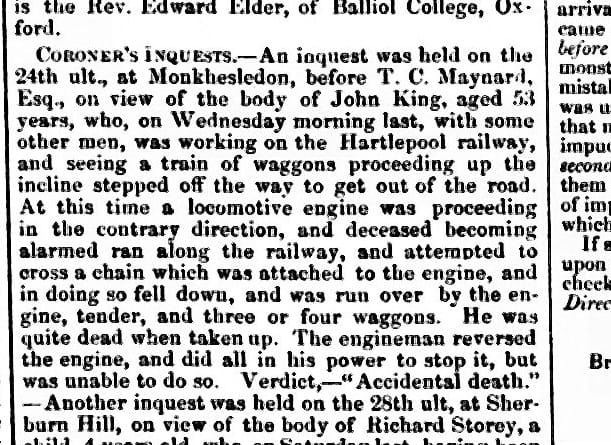
The newspapers explained it. The Durham Chronicle of Friday, 1 November 1844, under “Coroner’s Inquests,” reported that an inquest had been held on the twenty-fourth at Monkhesledon, before the coroner T. C. Maynard,
on view of the body of John King, aged 53 years, who, on Wednesday morning last, with some other men, was working on the Hartlepool railway, and seeing a train of waggons proceeding up the incline stepped off the way to get out of the road. At this time a locomotive engine was proceeding in the contrary direction, and deceased becoming alarmed ran along the railway, and attempted to cross a chain which was attached to the engine, and in doing so fell down, and was run over by the engine, tender, and three or four waggons. He was quite dead when taken up.
The engineman reversed his engine and could not stop it. The verdict was “Accidental death.” The Durham County Advertiser printed the same report that day, and the Yorkshire Gazette had given it a line the Saturday before: “John King, plate-layer, at work on an incline (near Castle Eden) of the Hartlepool railway.”
The death registrations, once bought, told the same story twice, and that is the second lesson of this hunt. John King’s death was registered at Easington on 25 October, two days after the accident, aged fifty-three, plate layer, “accidentally run over by a railway train.” That entry was later crossed through. On 15 December it was registered again, this time on the certificate of the coroner, Thomas Maynard, and there the age reads fifty-eight, the last digit written over. One death, two entries, two ages. The inquest, the first registration, and the burial all say fifty-three, and so does the 1841 census, near enough; only the coroner’s copy says fifty-eight. I have kept both and marked the conflict, because a clerk’s slip in 1844 is still evidence of what a clerk wrote.

Hartlepool, written in the margin
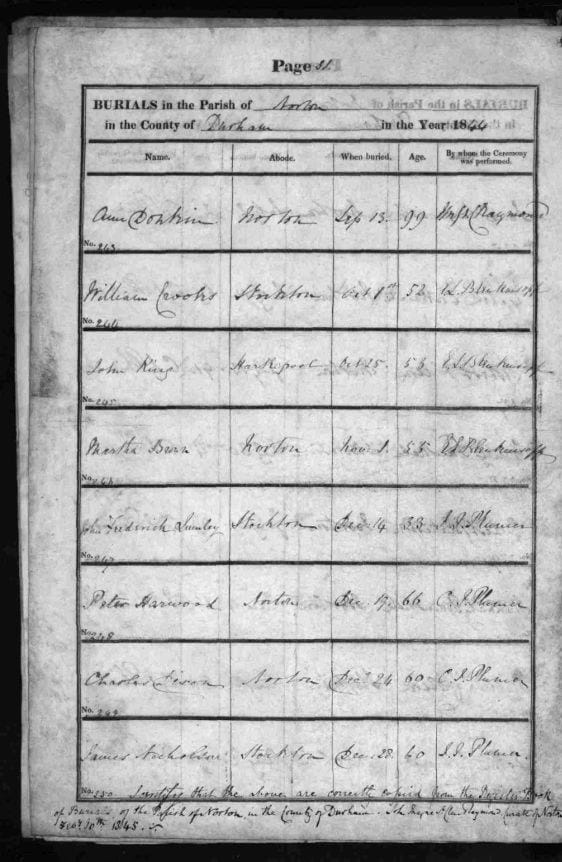
One link remained. A John King killed on the line near Castle Eden and a John King buried at Norton were very probably the same man, but “very probably” is not proof. Norton’s burial register is restricted online, so on Wednesday evening I took the question to the St. Louis County Library, where a public computer opens the films that a home connection cannot. The Bishop of Durham’s transcript of the Norton burials for 1844, page thirty-one, entry two hundred forty-five:
John King | Hartlepool | Oct. 25 | 53
Hartlepool. That one word does the work. The man buried at Norton lived at Hartlepool, where our John King lived in 1841; he was fifty-three; he was buried two days after a fifty-three-year-old plate layer was killed six miles up the line. Margaret’s husband went to work on the railway that was turning Hartlepool from a fishing town into a coal port, and the railway killed him. They carried him home to the church where he had married her twenty-nine years before.
The railway and the family
The Hartlepool Dock and Railway had opened its line to the Haswell collieries only a few years before. Its inclines carried loaded waggons down from the coalfield to the new docks, and the work on them was dangerous in ways no one then thought remarkable. The inquest that followed John King’s in the same column of the Chronicle was for a four-year-old girl whose shirt had caught fire. The one after that was for a boy of nine, crushed while riding a coal train he had been told to get off. The coroner’s district was busy. Grief was common, and so was the verdict.
It is worth saying what the railway also gave. Ann King’s husband, Henry Anderson, took his master’s certificate at Shields in 1850 and sailed colliers out of the same Hartlepool docks that John King’s railway fed. Their son John Henry Anderson grew up in the town the coal trade built; at nineteen he was a clerk at its gas works, and later a weighman on Teesside. The line that killed one generation carried the next.
What it means now
For the book, a gap in chapter twelve becomes a sentence: Margaret King was a widow in 1851 because her husband had died on the Hartlepool railway in October 1844. For anyone tracing a family through the industrial North, the method is the old one. When the index is silent where you expect the event, ask whether the event happened somewhere else. Read the newspaper column around your ancestor’s name, because it shows you the world he died in. And keep both ages when the documents disagree, because each clerk wrote what he was told.
For the family, John King now has a day, a place, and a cause, a man walking along the six-foot on an October morning, stepping off the way for the waggons. His descendants in Michigan and beyond did not know his name until this month. They do now.
Sources
- Durham Chronicle, 1 Nov. 1844, p. 3, “Coroner’s Inquests” (British Newspaper Archive via Findmypast); also Durham County Advertiser, 1 Nov. 1844, p. 3; Yorkshire Gazette, 26 Oct. 1844, p. 8.
- General Register Office, deaths, Easington district, December quarter 1844, vol. 24, p. 71 (entry 410, aged 53, registered 25 Oct.) and vol. 24, p. 75 (entry 454, aged 58, coroner’s certificate, registered 15 Dec.). Digital images.
- Norton, Co. Durham, Bishop’s Transcripts, burials 1844, p. 31, no. 245 (Durham University Library, DDR/EA/PBT/2/198), read on FamilySearch.
- Norton marriage, King × Benson, Jan. 1815 (Durham Records Online index; Bishop’s Transcript transcript); 1841 census, Hartlepool (HO 107/315); 1851 census, Hartlepool (HO 107/2384).
- The one-day-old John King: GRO deaths, Stockton, June quarter 1850, vol. 24, p. 167.