The Ship That Never Was
Edward Colver's crossing, the ships he was not on, and what an honest family history does with an empty sea
Every American family story wants to begin with a ship.
It is the oldest scene in the national repertoire: the crowded rail, the receding coastline, the ancestor's face set toward the west. Families that have lost every other particular of their founding will still, somehow, have a ship — a name, a year, a port, polished by repetition until it gleams like a brass fitting. The Mayflower families have their manifest. The Winthrop families have their fleet. And for a hundred years and more, my family had its ship too. The old genealogy said it plainly: Edward Colver sailed from London in 1635, in the company of John Winthrop the Younger, bound for the Bay Colony and the beginning of everything.1
I grew up downstream of that sentence. It is a good sentence. It has a year, a port, and a famous name to stand beside — the governor's brilliant son, alchemist and founder of towns. The only thing wrong with it is that no one can show it ever happened, and this essay is about what a family historian does when the founding scene of the whole story turns out to be an empty stretch of water.
What an arrival is supposed to leave behind
Here is the thing about the Great Migration that surprises people who have never gone looking for an ancestor in it: it was a documented undertaking. Seventeenth-century England was a bureaucratic kingdom, and leaving it legally required paperwork. Emigrants swore oaths of allegiance and supremacy before port officers. Masters entered their passengers in port books. In 1635 — the very year of my family's supposed sailing, and the peak year of the whole migration — the London port registers survive in remarkable fullness, and they are a genealogist's feast: name after name, age after age, ship after ship, some twenty vessels' worth of New England-bound passengers entered by the searchers at the custom house.2
Which is the first quiet problem with the family's sentence. If Edward Colver had sailed from London in 1635, there is a very reasonable chance we would have him — aged, oathed, and shipped, one line of secretary hand in a register that still exists. He is not there. Not on the Abigail, not on the Defence, not on the Hopewell or the Planter or any vessel whose list survives. Absence from a surviving list is not proof of absence from the year — lists have gaps, names garble, and plenty of genuine 1635 passengers slipped through unrecorded — but it converts the family's confident sentence into something much weaker: a guess that happens to point at the best-documented departure year of the century and still comes up empty.3
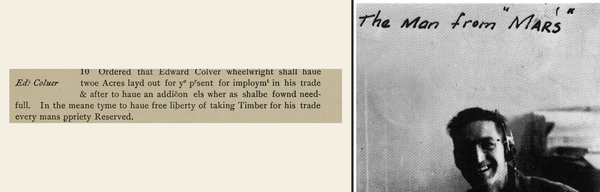
And so we fall back to the record we do have, and the record is this: Edward Colver first appears in the surviving documents of this world at Dedham, Massachusetts, in 1637. He signs the town covenant — sixty-eighth name on the roll, in a company of about a hundred and twenty-five.4 Before that line in the Dedham town book: nothing. No baptism that can be shown to be his, no apprenticeship, no oath, no port entry, no ship. He steps out of the void onto a page, already grown, already a wheelwright, already committed to a godly plantation on the Charles River watershed, and the void behind him keeps its counsel.
The man who names ships
You do not have to take my word for the void. Genealogy has a supreme court for questions of this kind, and it has ruled.
Robert Charles Anderson's Great Migration Directory is the summary judgment of a scholarly project that spent decades weighing the evidence for every known immigrant to New England between 1620 and 1640. Anderson names origins when origins can be documented. He names ships when ships can be known — and he names them with relish, because a ship is the spine of an immigrant's story. His entry for my ancestor — origin, first record, residences — reads, in its entirety, like a door closing gently:
Culver, Edward: Unknown; 1637; Dedham, Roxbury, New London.5
"Unknown" in Anderson is not a shrug; it is a verdict. It means the claims were examined and found wanting. It means that the 1635 sailing, the London origin, the Winthrop connection — all of it — stands unproven at the highest level of review the field possesses. When the man whose life's work is naming ships declines to name yours, the honest response is not to keep repeating the family sentence more loudly. It is to ask where the sentence came from.
The anatomy of a family ship
It came, as most of our sentences do, from the 1910 genealogy — the Colver-Culver Genealogy that a devoted compiler assembled from correspondence, memory, and hope, and that has served the family ever since as scripture and stumbling block together.6 On the question of origins the book is actually more honest than its readers: it concedes, in as many words, that "so far the research has failed to reveal his parentage." But it could not bear to leave the sea empty, and so it reasoned its way onto the water: Winthrop the Younger had recruited settlers in the London counties in 1635; there had been Colvers in Middlesex once — a family in the Kensington registers in the 1540s and 1550s; therefore our Edward plausibly came from thereabouts, and plausibly sailed with Winthrop. Two true facts and a therefore. The therefore was told with complete sincerity by someone who loved the subject, and it hardened, in the way of family therefores, into a ship.
Regular readers met the Kensington family this week, and know now what the 1910 book did not stay to learn: that register, read entire, records a small family being erased — a wife and her seven-year-old son dead five weeks apart in the influenza of 1559, two more Culvers dead a fortnight apart in the plague summer of 1563, and then a hundred and twelve years of silence. The Kensington Colvers were not waiting in Middlesex to board Winthrop's ship. By 1635 they had been gone from the parish, root and record, for seventy years.7
Later hands did the 1910 book one worse. Somewhere in the twentieth century the family acquired a named ship — the Mary and John — presumably because that vessel's 1630 and 1633/34 voyages are famous and their passenger lists have been lovingly reconstructed. Edward is not in those reconstructions either. And beyond even that stands the family's grandest invention, the "Kolver of Saxony" — a Continental nobleman conjured to give the dove a coat of arms — which is not a garbled memory at all but pure ornament, and which I mention here only to promise that it gets the full autopsy it deserves in a later chapter.8 The pattern in all three is the same pattern this project meets everywhere: the family never lies, exactly. It completes. Given a void, it reaches for the nearest true furniture — a famous recruiter, a famous ship, a dignified origin — and arranges it into a room no one ever lived in.
The threads that remain
What does the honest version look like? Three threads, none of them a chain, and I give them here in one paragraph each because this is a post about the sea, not the shore.
The surname's English heartland is Kent — the census mapping and the parish clusters put a third of England's Culvers in the dove-haunted country between Canterbury and the Channel — and the decisive Canterbury-diocese registers, searched at last through their modern index in the very week of this writing, yield no Edward of the name in the emigration generation. The heartland's registers are as empty of him as London's; the search did find the surname's Kentish families, going about their baptisms without him.9 The East Anglian hypothesis — that a Dedham company recruited from the Essex-Suffolk borders would have drawn its wheelwright from the same country — has exactly one compatible candidate in the free record: an Edward Colfer, baptized at Arminghall, Norfolk, in 1618, a gentleman's son, unconnected onward and honestly no more than a lead.10 And London — the 1910 book's instinct — survives in a weakened, testable form: a smith named Nicholas Culver was raising children at Ratcliff in Stepney, on the very Thames-side waterfront the emigrant ships loaded from, in exactly the emigration decade. A wheelwright kinsman lodging near the shipping would explain much. Nothing yet connects him to Edward. Threads, not chains; I set them down so that some future researcher — perhaps a reader of this post — knows where the honest ends are.11
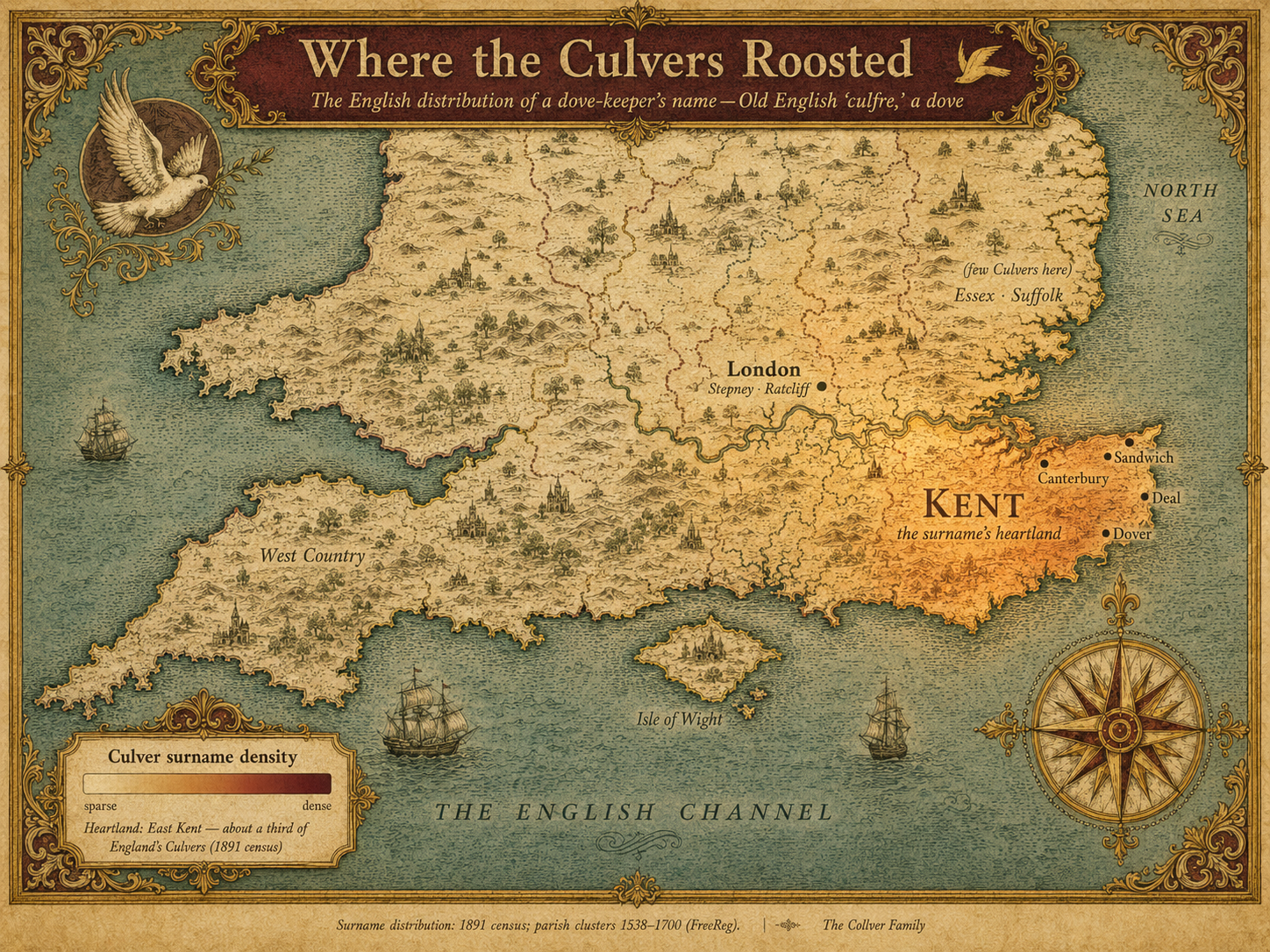
And one more thread, pulled taut in the very week of this writing. It has been suggested — the Maryland branch of the family put it in print, and the online trees have repeated it ever since — that our Edward was the grandson of a clergyman: the Reverend Edward Culver, Vicar of Harmondsworth in Middlesex. The suggestion arrives riding the phrase is said to have been, with no document underneath, and I had filed it with the ship. The vicar himself, it turns out, is entirely real. Newcourt’s Repertorium records his institution to the vicarage on the second of September, 1575; Hennessy’s Novum Repertorium records the sequestration raised at his death in March of 1594 — nineteen years in one pulpit. But between the documented vicar and our documented wheelwright stands a generation that cannot be recovered, and here the trail is not cold but burned: Harmondsworth’s parish registers were lost before 1670, so the baptisms that would prove or disprove a grandson do not exist to be searched — a claim can be neither verified nor refuted where the records themselves are gone — and no will of the vicar survives in any index I can reach. There is no extant evidence that he is ours. Possible; not provable. I will, however, set down the coincidence that keeps this thread from being cut. The family’s own legends have long placed our English origins near what is now Heathrow Airport, and the vicar’s church still stands on Heathrow’s northern boundary — the Norman doorway, the brick tower, the early-Tudor pews his parishioners sat in. Every one of us who has ever flown into London has landed, unknowing, at the edge of his parish. Legend and document agree on the ground; neither can supply the pedigree. I mark him as this book’s method requires: tradition, worth stating, unproven.
But the origin was never really the point of the family's sentence. The ship was. And here is where this essay turns, because on the ship — the actual, physical, creaking, stinking, psalm-singing ship — we are not ignorant at all.
The ship we do know
Edward Colver crossed the Atlantic. That fact is as certain as his signature in the Dedham book: a man cannot sign a covenant in Massachusetts who has not crossed the sea to reach it. We do not know his ship's name, her master, her port, or her year. But we know — with the fullness of dozens of surviving accounts, port records, and the ships' own specifications — exactly what kind of vessel she was, because the Great Migration was carried in a single, standardized species of ship, and no member of that species was very different from another. The family lost the name and kept, without knowing it, everything else.
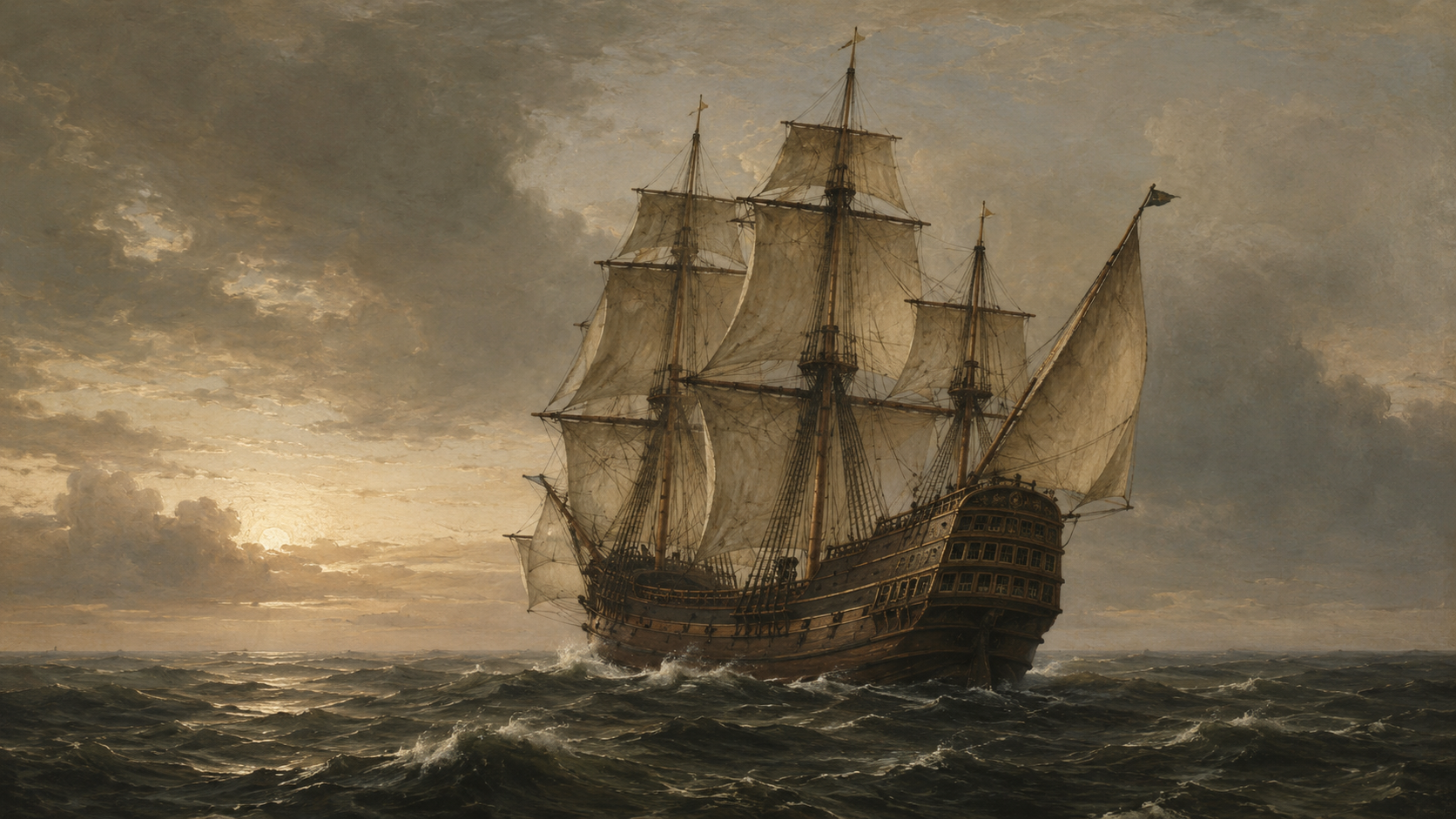
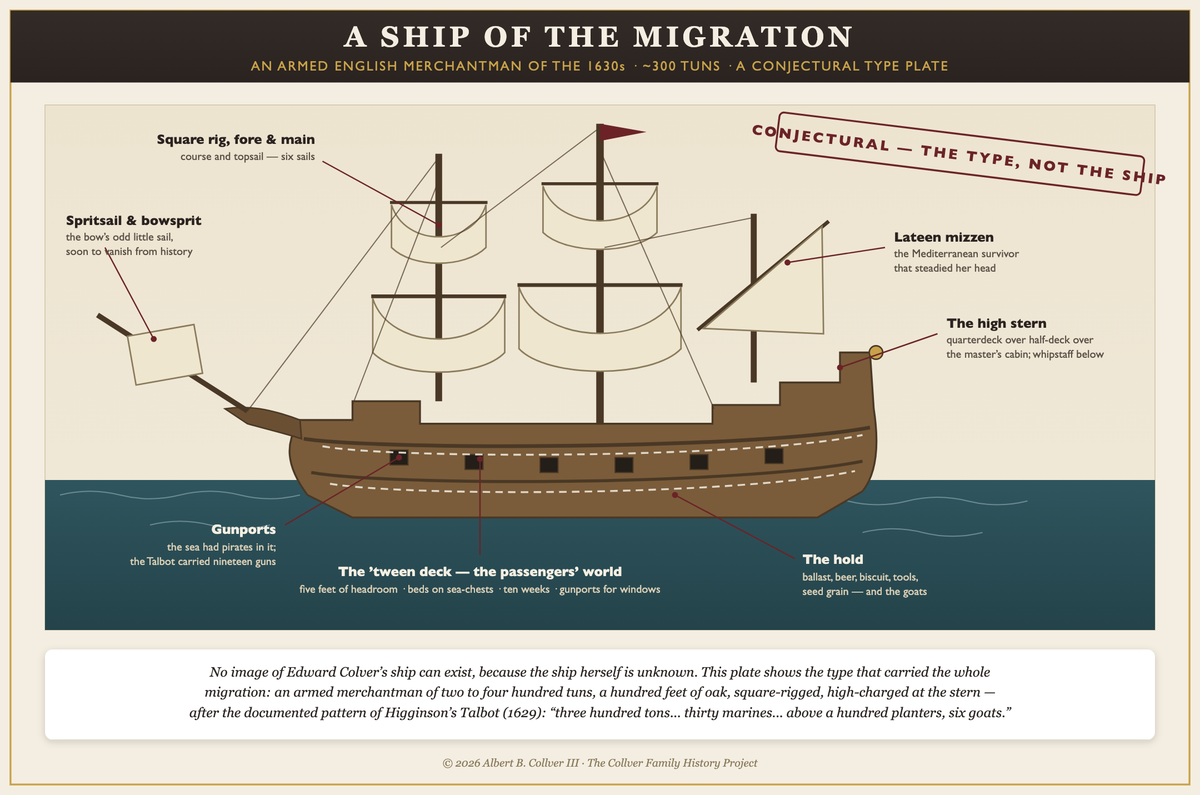
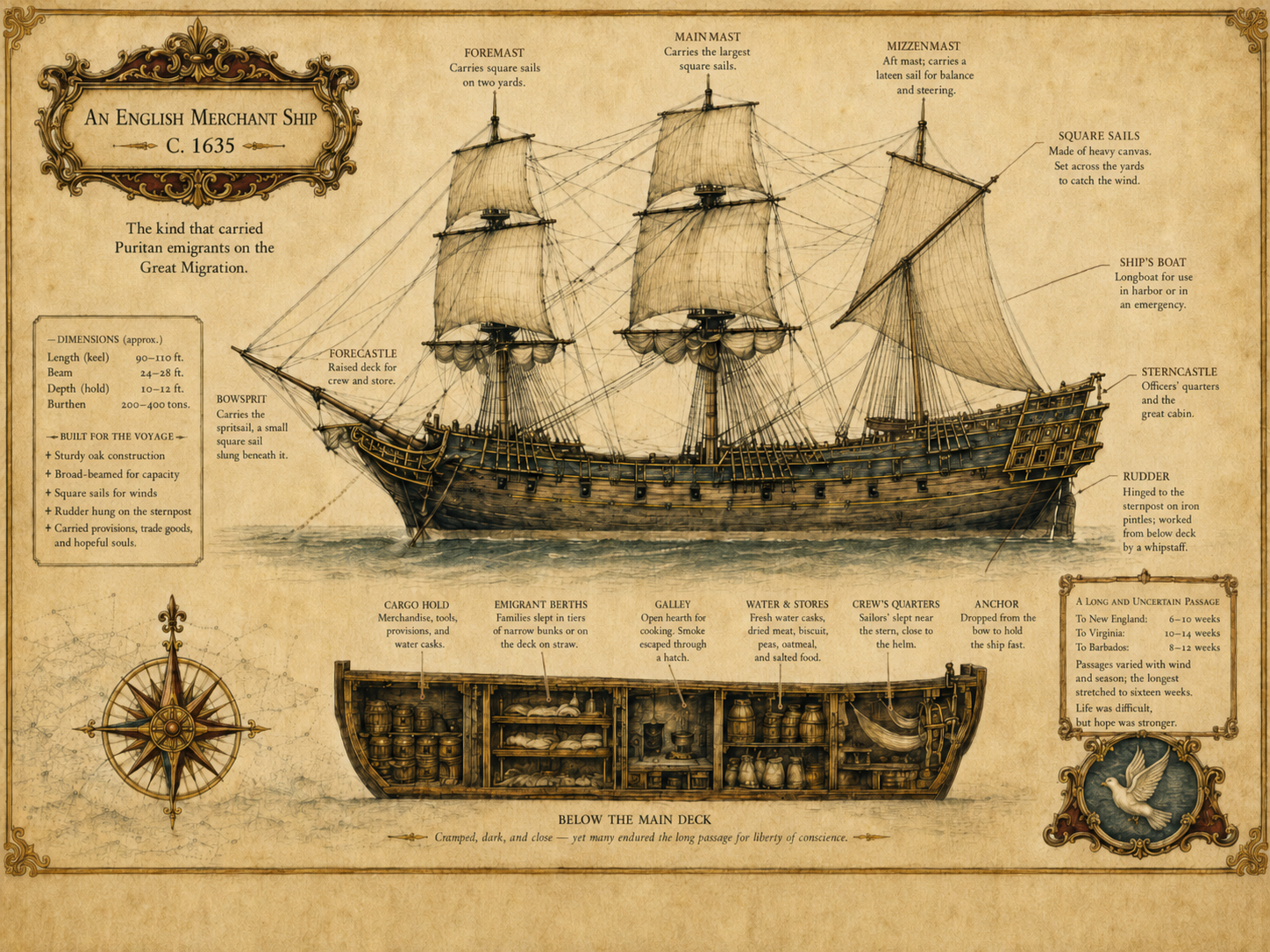
She was a merchant ship — not a passenger vessel, for no such thing existed — of somewhere between two hundred and four hundred tons burden, a workhorse built for wine, cloth, and fish, temporarily fitted for people.12 Perhaps a hundred feet from stem to stern, a third of that in beam, drawing maybe twelve feet of water: smaller than a modern harbor ferry, and expected to carry a hundred passengers, a crew of thirty, provisions for three months, and the seed stock of a new civilization. Three masts: square sails on fore and main, a slanted lateen on the mizzen, a spritsail slung under the long bowsprit. She was high-built at the stern — quarterdeck stacked on half-deck stacked on the master's little cabin — so that in profile she seemed to be perpetually climbing her own wake. She was armed, because the sea had Dunkirkers and Barbary corsairs in it, and a respectable emigrant ship bristled accordingly.
Francis Higginson, a minister who made the crossing in 1629 and kept the journal that stands for all the crossings nobody recorded, described his own vessel with a settler's inventory-love: "a good and strong ship, of three hundred tons, and nineteen pieces of ordnance, and served with thirty mariners. This ship carried above a hundred planters, six goats, five great pieces of ordnance, with meal, oatmeal, pease, and all manner of munition and provision for the Plantation for a twelvemonth."13 Read that list again: a hundred human beings share a sentence with six goats, and the goats are not the least important item in it — they were the children's milk. That sentence is the Great Migration in miniature: piety, gunpowder, and livestock, all in three hundred tons.
The passengers lived on the 'tween deck — the gun deck, cleared of most of its guns — a space running the length of the ship with perhaps five feet of headroom, so that a grown man moved through his home of ten weeks permanently stooped. Families staked out plots between the timbers and slept on or beside their own sea-chests. Light came down the hatches when the weather allowed the hatches open; when it did not, the world was a lurching wooden twilight that smelled of bilge, tar, animals, sickness, and one's neighbors. The diet was ship's biscuit, salt beef and pork, pease, oatmeal, butter, cheese while it lasted, and beer — beer for everyone, children included, because water in casks went foul and beer did not. A wheelwright in his twenties or thirties, which is the best guess for our Edward whenever he crossed, would have been an asset on board: a man good with wood, in a world made entirely of it.14
What was it like? Higginson tells us that too, in entries that need no improvement. The seasickness, first, which democratically leveled saints and sinners: "my wife and other passengers began to feel the tossing waves of the western sea, and so were very sea-sick." Then the storm, which is every Atlantic storm in one sentence: "the wind blew mightily, the rain fell vehemently, the sea roared, and the waves tossed us horribly… The waves poured themselves over the ship, that the two boats were filled with water, that they were fain to strike holes in the midst of them to let the water out."15 And then the entry that stops me every time I read it, because it prices the whole enterprise. Smallpox broke out among the children on Higginson's ship, and his own small daughter Mary sickened; blue spots came out on her breast; and "the child died about five of the clock at night, being the first in our ship that was buried in the bowels of the great Atlantic sea."16
His crossing, port to port, ran about eight weeks — spring departures could do it in six, bad luck could stretch it past twelve. Eight weeks of stooped twilight, biscuit and beer, psalms sung on the open deck in fair weather because a godly company kept its worship at sea, storms battened down in the dark, and the mounting arithmetic of the water casks. Then, one afternoon, a man at the masthead: "some went up to the top of the mast, and affirmed, to our great comfort, they saw land to the north-eastward."17 Every family of the migration has that afternoon somewhere in its past, whether it kept the memory or not. Mine too. On a day nobody wrote down, on a ship nobody named, a wheelwright leaned on a rail he had crossed an ocean gripping, and looked at the low green line of a country where, within a year or two, he would sign his name under a covenant of "Euerlasting Loue" — and the void that follows him everywhere in the English records ends at that rail, because from the covenant forward, for the rest of his long life, the records of Edward Colver are so complete you can watch him think.18
Whatever ship carried Edward Colver, she was this ship in everything but name. The drawing that accompanies this essay is labeled conjectural, and it is — but it is conjectural the way a portrait of "an English wheelwright, about 1635" would be conjectural: wrong in no particular we can check, right in every one we can.
What the empty sea teaches
I owe the reader a plain accounting of why this matters beyond one family's bookkeeping.
A missing ship is the most seductive kind of gap, because it sits at a beginning, and beginnings abhor a vacuum. Fill it, and no one will ever check — who audits a ship? Leave it empty, and every telling of the story thereafter must begin with the words we do not know, which takes a certain stomach. The 1910 compiler did not have the stomach, and I do not blame him; he lived in an age when a family history was a monument, and monuments do not have holes in the base. But this project has made the other bet: that the holes, honestly drawn, are the monument — that a reader trusts the eighty things we do know precisely because we would not fudge the one thing we don't.
And the empty sea repays the honesty, because absence has edges, and edges are information. Edward is not in the rich 1635 London registers: then the confident 1635-from-London sentence is probably wrong, and the guess should move. He is not in the reconstructed Mary and John lists: then that ship was borrowed, not remembered. Anderson, who names ships, would not name his: then no document known to the best-resourced project in the field does either, and the family should stop implying otherwise. Each absence retires a specific error. That is not nothing. That is, in fact, most of what genealogy is — the slow replacement of warm guesses with cold edges, in the faith that the true shape, whenever it finally surfaces, will fit the edges and not the guesses.
The record of this family begins with a man signing his name sixty-eighth on a page in Dedham. It does not begin on the water. Perhaps someday — a Canterbury register, an apprenticeship book, a port list miscatalogued these four centuries — the sea will give up the name, and this essay will need a happy correction, which I will make with the same pleasure I have corrected smaller things this very week. Until then the family story begins the way the documents insist it begins: not with a ship, but with a landing already accomplished; not with a voyage, but with a signature. The ship remains what she has always actually been — not lost, exactly, but unclaimed: one anonymous, creaking, goat-carrying, psalm-singing merchantman among the hundreds that emptied old England into New, any one of which would have looked, from the Dedham shore of history, exactly like all the others.
We are a family that cannot name its ship. On Monday, I will tell you about the time the sea made it up to us — when a ship, of all the ships in the water, carried our name on her stern instead. She was a brig out of Liverpool, the year was 1811, her master was a Colver, and she was called the Dove. But that is Monday's story.
You can listen to this essay as well as read it — every post is an episode of the podcast, A House Divided, on Apple Podcasts and Spotify — and if you are of this family, or of any family whose ship is missing, I hope the empty water bothers you a little less by the end. The sea kept no record of us. The land, from the first hour we touched it, kept almost nothing else.
Sources and footnotes
- Frederic Lathrop Colver, Colver-Culver Genealogy (1910), English-origins section: the London/Middlesex recruitment and the 1635 sailing "with John Winthrop Jr." The book's own concession — "so far the research has failed to reveal his parentage" — appears in the same treatment. ↩
- The 1635 London port registers, long in print as Hotten's Original Lists and successors, record roughly twenty New England-bound sailings from London that year with passengers entered by name and age. Their survival is the reason 1635 is the best-documented year of the migration. ↩
- On the limits of the lists — gaps, unlicensed passengers, and coastal departures that left no register — see the discussion in any edition of the London lists; the argument here is probabilistic, not absolute, and is offered as such. ↩
- The Early Records of the Town of Dedham, Massachusetts, ed. Don Gleason Hill (Dedham, 1892): "Names subscribed to the Couenant as followeth," Edward Colver sixty-eighth of approximately 124 (counting Hill's three-column roll column-major; the total wobbles by one or two on probable duplicates — of which more in a later post). The covenant, the count, and the wheelwright's grant are the subject of "The 68th Name," coming July 24. ↩
- Robert Charles Anderson, The Great Migration Directory: Immigrants to New England, 1620–1640 (Boston: NEHGS, 2015), 84, s.v. Culver, Edward. Anderson's conventional birth estimate of c. 1600 is given without stated reason; the 1638 Dedham marriage is equally consistent with a birth as late as c. 1613–18, and this project asserts no birth year. ↩
- On the 1910 book's methods and reach, see "The Family Pamphlet" (published July 3) and the fuller reckoning planned for the book's final chapter. ↩
- The Parish Register of Kensington, co. Middlesex, 1539–1675, Harleian Society Registers XVI (1890), read entire: ten Colver/Culver entries, 1545–1563, then silence to 1675. The register's family — Edward Colver, Alis Lincone, their sons, and their Culver kin — is treated in full in chapter one of the forthcoming book. ↩
- The Mary and John attaches to the family in twentieth-century retellings without documentation; Edward appears in no reconstruction of her lists. The "Kolver of Saxony" pedigree is the 1910 book's ornamental origin, unsupported by any record, German or English. ↩
- The 1891 surname-distribution mapping places the largest county share of England's Culvers in Kent (on the order of a third), with the East Kent parish clusters — Barham, Deal, Sandwich, Dover — pushing the pattern back into the seventeenth century. The Canterbury Cathedral Archives registers (indexed as "England, Kent, Canterbury Parish Registers, 1538–1986," some 971,000 records) were searched on 6 July 2026 across six spelling variants: no Edward baptism 1585–1620 appears — indeed no Edward of the surname before 1714. The negative is bounded by the index: registers lost or never indexed, and West Kent (Rochester diocese), remain unsearched. ↩
- Edwardus Colfer, baptized 19 July 1618, Arminghall St Mary, Norfolk, son of Edward Colfer, Generosus (a gentleman): FreeReg, Norfolk. Assessed as a lead, not an identification. ↩
- Nicholas Culver, smith, of Ratcliff, St. Dunstan Stepney, children baptized 1627–1641: FreeReg, Middlesex. Ratcliff was a fitting-out and lading shore for the emigrant ships. ↩
- The type description assembled here — burden, dimensions, rig, armament, accommodation — is the consensus picture of the ordinary armed London merchantman of the 1620s–40s as employed in the New England trade; the Talbot's own specification (next note) is a documented instance standing within a ton or a gun of dozens of others. ↩
- Francis Higginson, "A True Relation of the Last Voyage to New England… 1629," journal of the Talbot crossing, April–June 1629, as printed in Alexander Young, Chronicles of the First Planters of the Colony of Massachusetts Bay, 1623–1636 (Boston, 1846), the ships described at 215–16. Public domain; all quotations verified against Young's text (this project's research bank, higginson-true-relation). ↩
- The 'tween-deck arrangements, the victualling (biscuit, salt meat, pease, oatmeal, beer for all ages), and the ten-week planning horizon are standard across the surviving provisioning lists and voyage accounts of the migration; the details given here are the common denominators, not any single ship's manifest. ↩
- Higginson, "True Relation," entries for the western passage. ↩
- Higginson, "True Relation": the smallpox outbreak among the children and the death and sea-burial of his daughter Mary. ↩
- Higginson, "True Relation," 19 June 1629. ↩
- The completeness begins with the covenant and never relents: the marriage to Ann Ellis (1638), the sons' baptisms, the wheelwright's grant with "free liberty of taking Timber," the land exchanges, the meeting attendance, the conditional grant anticipating his departure, and the 1651/2 deed subscription — all in the Dedham town book, all coming to this blog across the next month. ↩
Adapted from a chapter of the forthcoming book on the Collver family.
© 2026 Albert B. Collver III · The Collver Family History Project. Original historical documents reproduced here are in the public domain; the research, text, and annotations are the author's. Please cite or link rather than republish.