Unto My Son Daniel
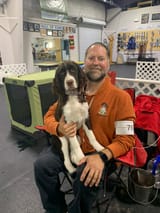
In early September a comment arrived on one of this blog's Facebook posts, from a descendant of a Louisiana blacksmith's line, asking a question this project hears in many forms: can my Culvers be traced to yours? The family had done its work — they had a name, Solan Kiser Culver, a farm in the piney woods near Vienna, Louisiana, a tombstone dated 1840, and a memory that Solan's father had been called "Heziah." Past that, seventy years of trying had not moved them one rung.
Seventy-two hours later, with the reader supplying family knowledge and this desk supplying records, the line stood eleven generations deep, documented most of the way to Edward Colver of New London — and the hunt had corrected a paragraph in this project's own forthcoming book. This post is the story of those three days, told for every reader with a brick wall of their own, because the tools that did this are free and the method is portable.
The man with two ages
The wall had a peculiar shape, and the peculiarity turned out to be the door.
Solan Kiser Culver appears in Louisiana in the 1870s, marries, farms, raises children, and dies in 1923 under a tombstone that says he was born in 1840. But for years in the middle of his life, Solan signed himself and answered to another name entirely: C. H. Culver. The 1880 census taker at his farm wrote down "Chas Culver," and — here is the strange part — gave his age as forty. Solan was twenty-eight. The alias was not a slip of a clerk's pen; it was a persona, and the persona had its own birthday, twelve years older than the man. His family carved the persona's year, 1840, on his stone — they had lived with it so long they no longer knew it was borrowed.
One record cuts through all of it, because it is the one record where the man had to explain himself to somebody with cross-checking power. In December 1881 he filed a federal pension application — he had soldiered in the regular army, Company F of the 11th U.S. Infantry — and he filed it as Solon Culver, his true name. The government's index card survives with both applications, his and, decades later, his widow's. He told his neighbors a story and told the War Department the truth, and the pension file he left behind (never granted; the papers survive at the National Archives) is now the family's best chance of hearing him explain the alias in his own words. That is on this project's order list.
And "C. H."? Those were his father's initials. Which brings us to the ladder.
Climbing out of Louisiana
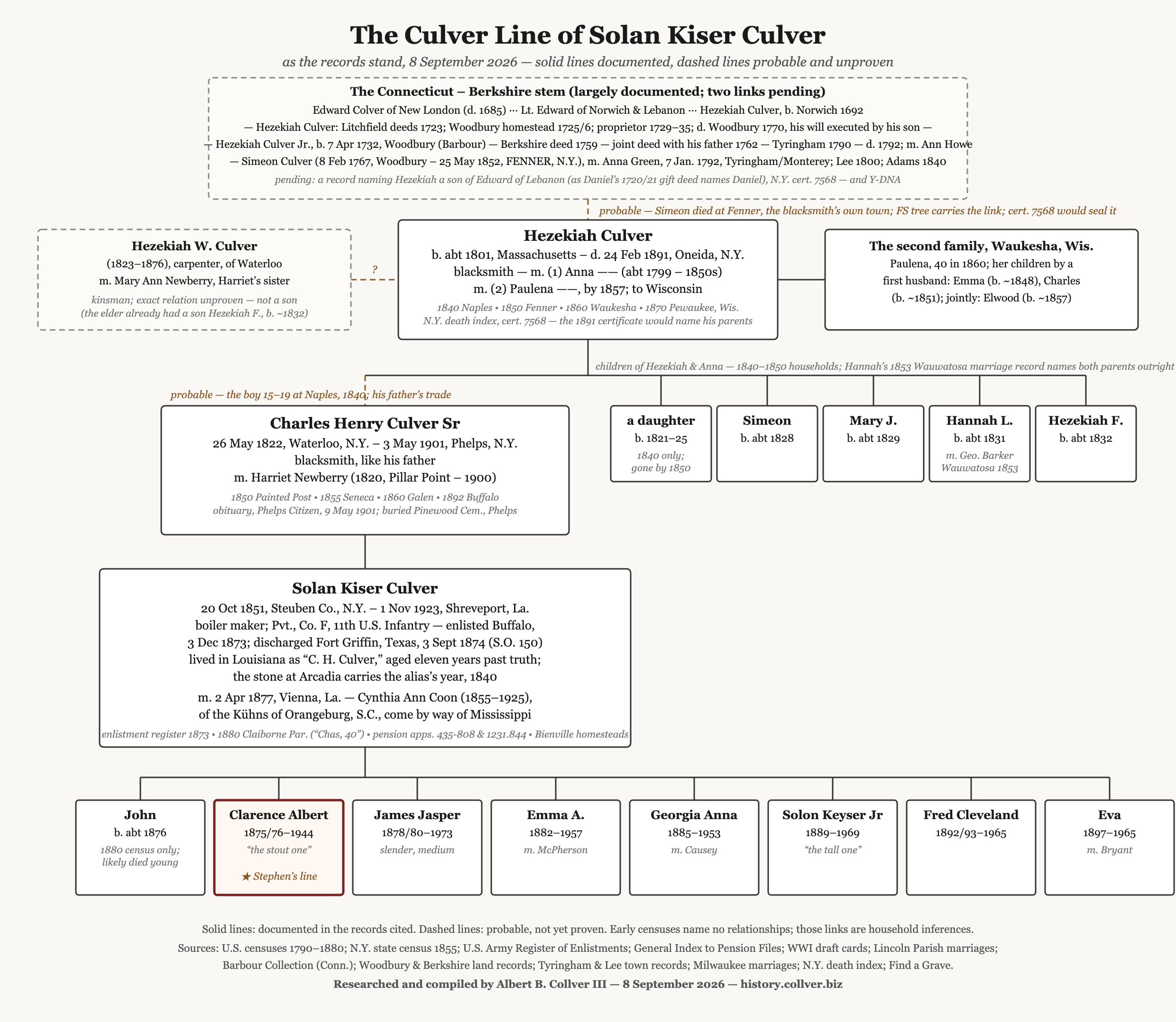
The family's memory said Solan's father was a man called "Heziah" — a country wearing-down of Hezekiah, the old Puritan stock-name, Hebrew for "the LORD strengthens," which this blog has written about before as the signature of the family's first American centuries. The memory turned out to be true, and — in the way of family memory everywhere — off by exactly one rung. Solan's father was Charles Henry Culver (1822–1901), a blacksmith who ended his days at Phelps, in the Finger Lakes country of New York; the initials Solan borrowed were his. Hezekiah was the grandfather: Hezekiah Culver (born about 1801 in Massachusetts, died 1891 at Oneida, New York), a blacksmith likewise, whose anvil the census follows from Naples to Waukesha to Pewaukee and back. A grandfather's name sliding down one generation in the retelling, in a family where the son had spent years wearing his own father's initials, is the least surprising thing in the whole file.
Above the blacksmith the trail did what brick-wall trails do — it went quiet where the census stops naming children and no vital register was kept. What bridged it was geography of a very particular kind. An old Culver of the previous generation, Simeon — baptized at Woodbury, Connecticut, in February 1767, married at Tyringham in the Berkshires in January 1792, farming at Lee in 1800 — died in May 1852 at Fenner, Madison County, New York: the blacksmith's own town, in the blacksmith's own years there. An aged Berkshire farmer does not die in a particular rural township by coincidence; he dies where a child keeps a bed for him. The link from Simeon to Hezekiah the blacksmith is the line's one remaining conjecture of consequence, and it is stated as conjecture — the sealing document, a New York death certificate that should name the blacksmith's parents, is a mail order away and on the list.
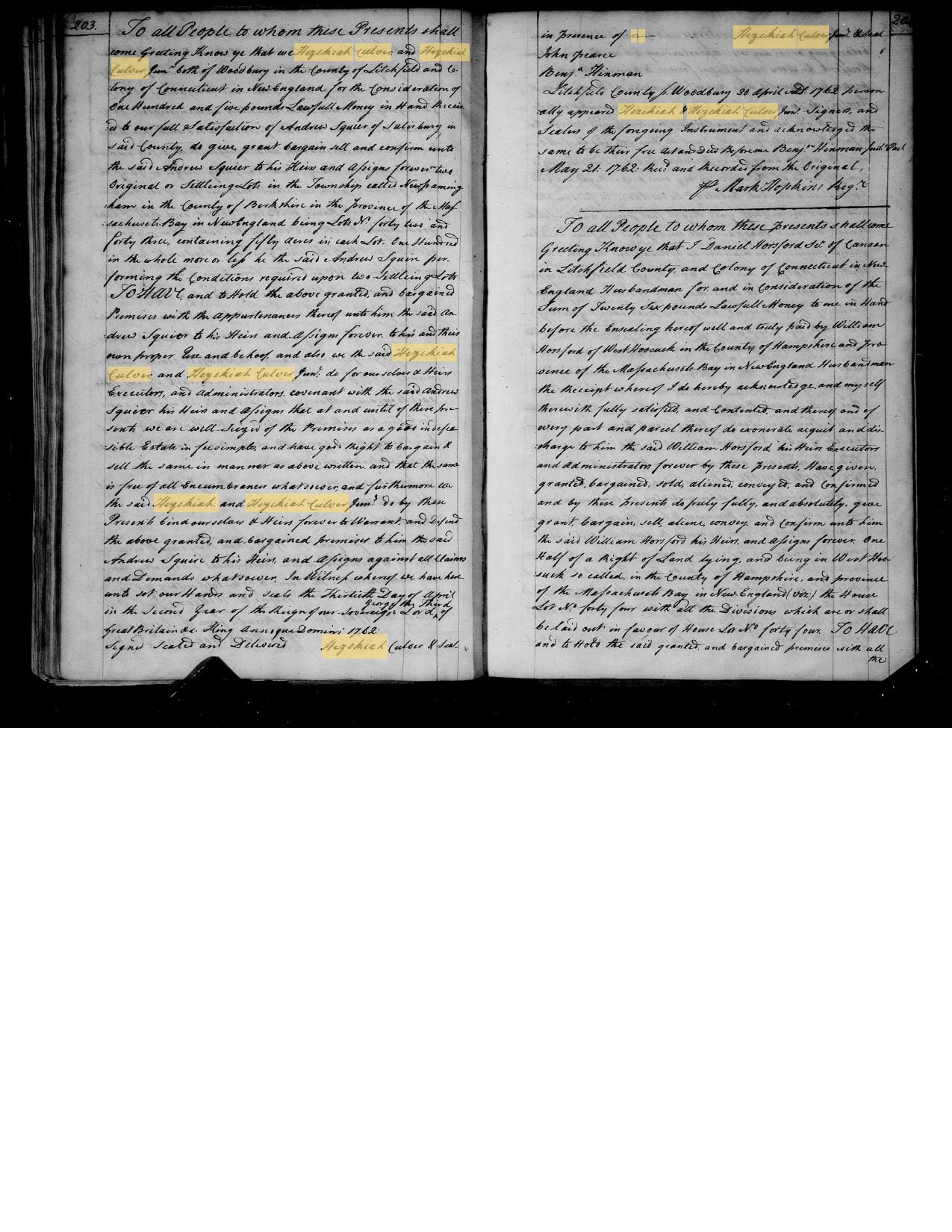
Above Simeon, the records turn abundant, because above Simeon the line is back in colonial Connecticut, where town clerks wrote everything down. Simeon's father Hezekiah the younger — named as such in the Woodbury church book, at the baptism itself — is in the town records too, born the seventh of April, 1732; a deed carries him into the Berkshires in October 1759 — "Hezekiah Culver of Woodbury" buying into the new township — and he died at Tyringham in 1792. Before he left, in 1762, he and his father sold a parcel jointly: "Hezekiah Culver Sr." and "Hezekiah Culver Jr.," both "of Woodbury," on one deed — father and son in a single instrument, which is the kind of sentence a genealogist frames.
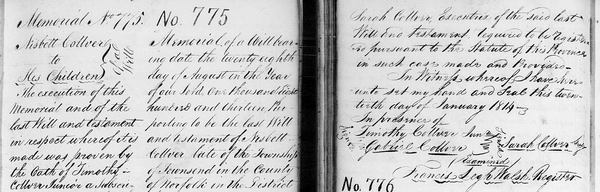
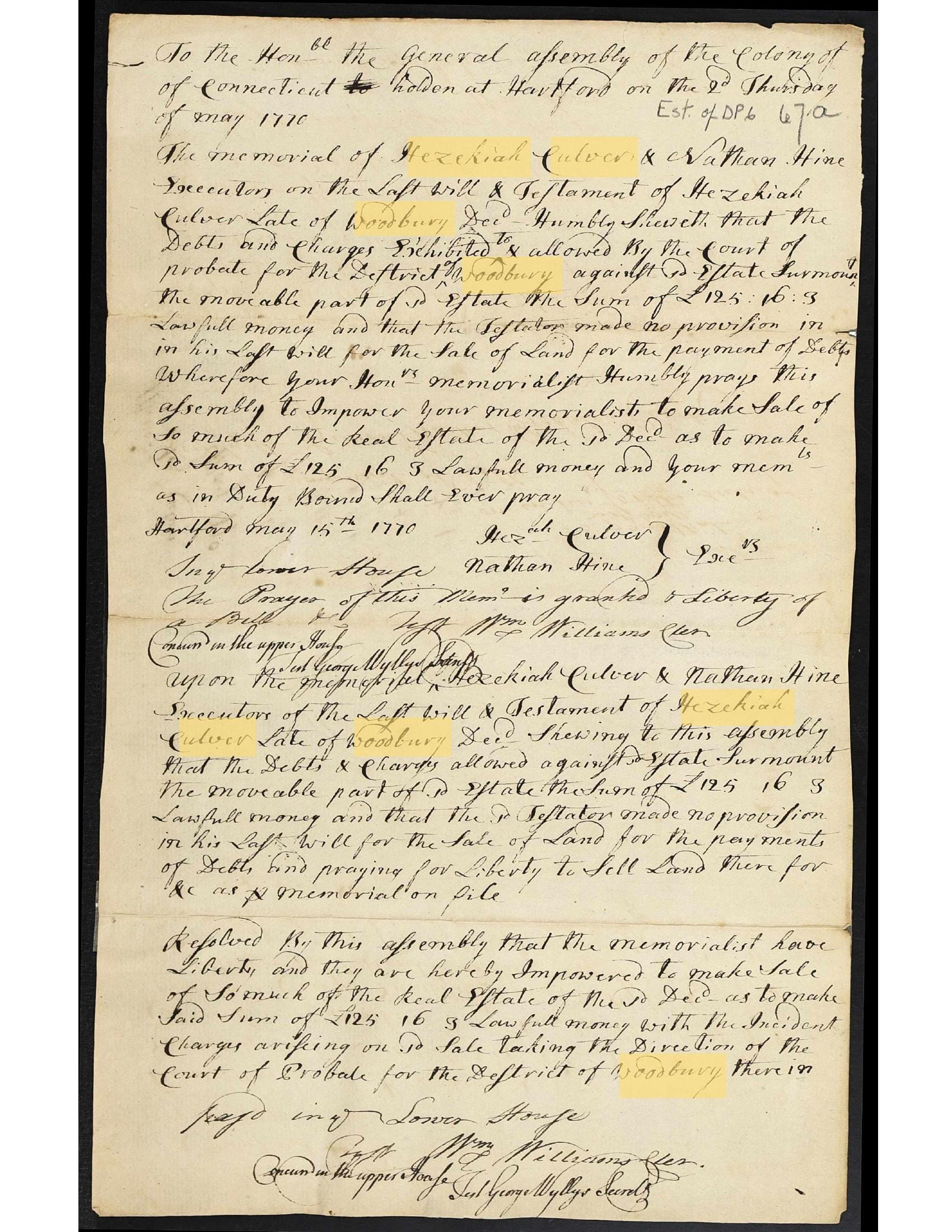
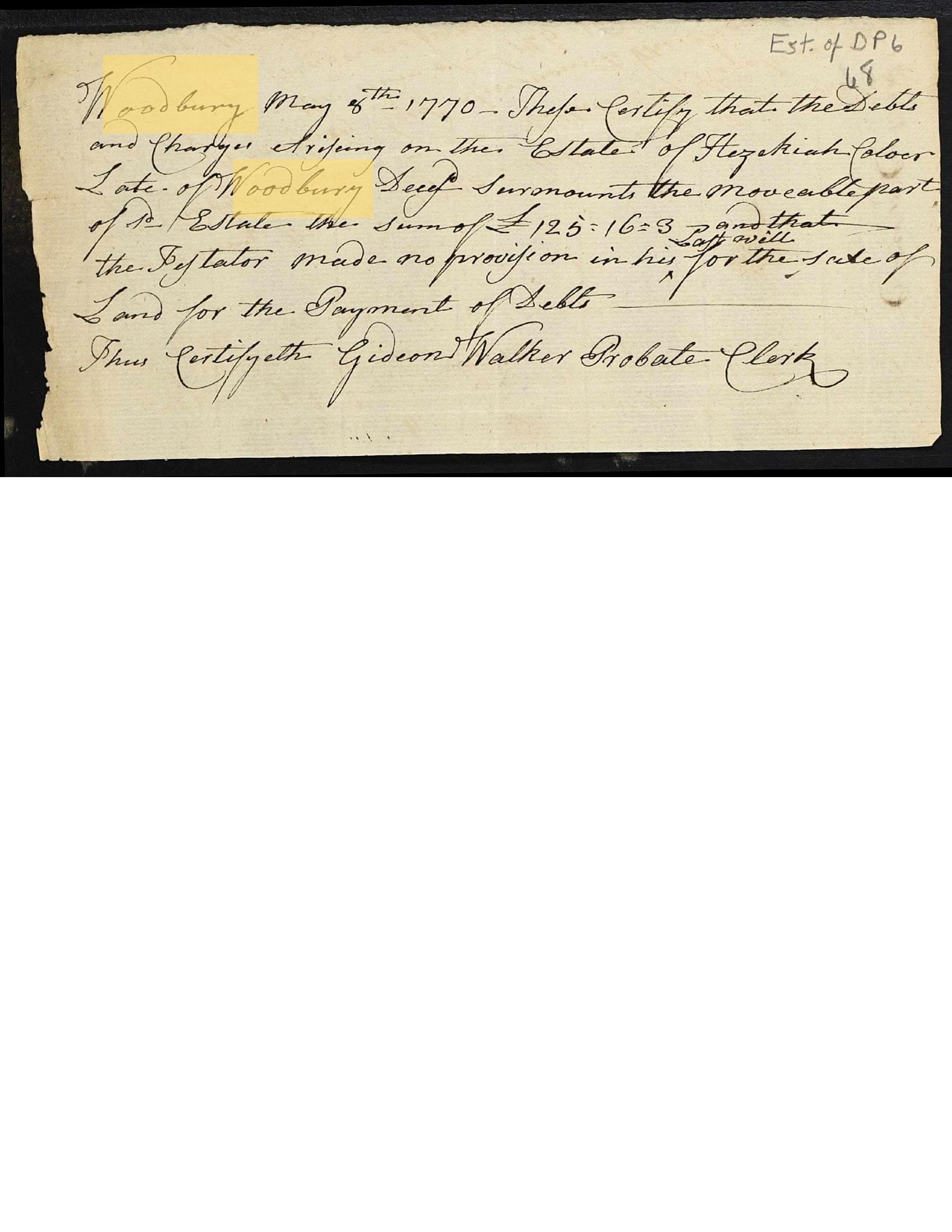
And his father, Hezekiah the elder, born at Norwich in 1692, turns out to have been a founding settler of Litchfield — buying land there by 1723, a proprietor at Woodbury by 1729 — who died at Woodbury in 1770, leaving an estate whose paperwork survives: the probate certificate, and a memorial to the Connecticut Assembly naming his executor, "Hezekiah Culver Jr." The son who signed that memorial is the man on the 1762 joint deed, the Berkshire settler, Simeon's father. The arc holds from Norwich to Litchfield to Woodbury to the Berkshires to the Finger Lakes to the piney woods of Louisiana: one line, three centuries, five states, and a man with two ages in the middle of it.
The deed that named a son
Which leaves the top of the ladder, and the reason this hunt earned a place in the book.
Hezekiah the elder's father is, by every arrow in the record, Lieutenant Edward Culver of Norwich and Lebanon — King Philip's War veteran, Lebanon pioneer, son of Edward Colver of New London, this family's immigrant. The compilers have said so for a century. But said is not shown, and this project's forthcoming book, in its appendix on the collateral branches, had flagged the gap honestly: the old Litchfield histories carried the Culver settlers there without parentage, and one of them — a Daniel — the compilers could only "set beside" the others, unproven.
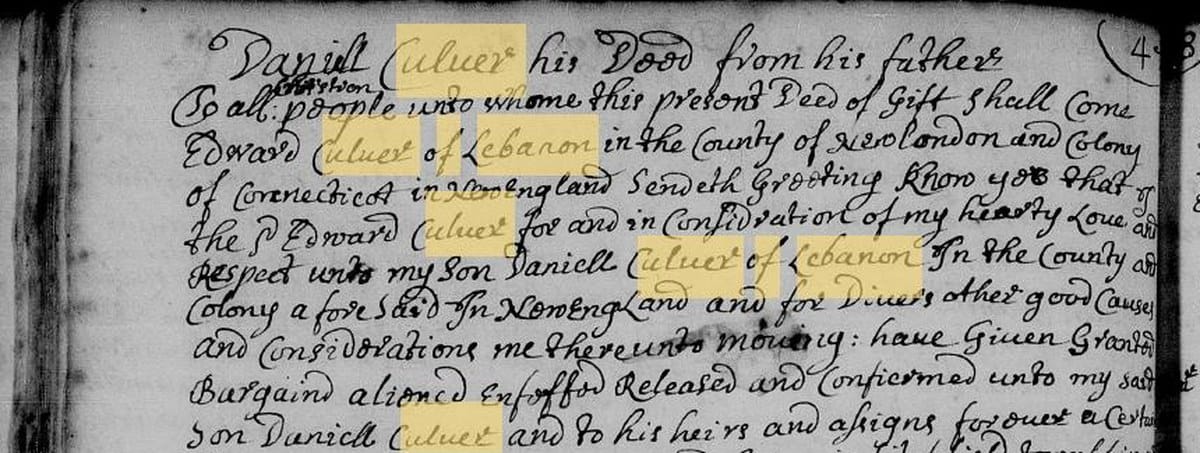
Here is what the September hunt found, in a Litchfield deed book, dated 1720/21, under the clerk's heading "Daniell Culver his Deed from his father": Edward Culver of Lebanon, conveying his Litchfield land, "for and in Consideration of my hearty Love and Respect unto my son Daniell Culver of Lebanon."
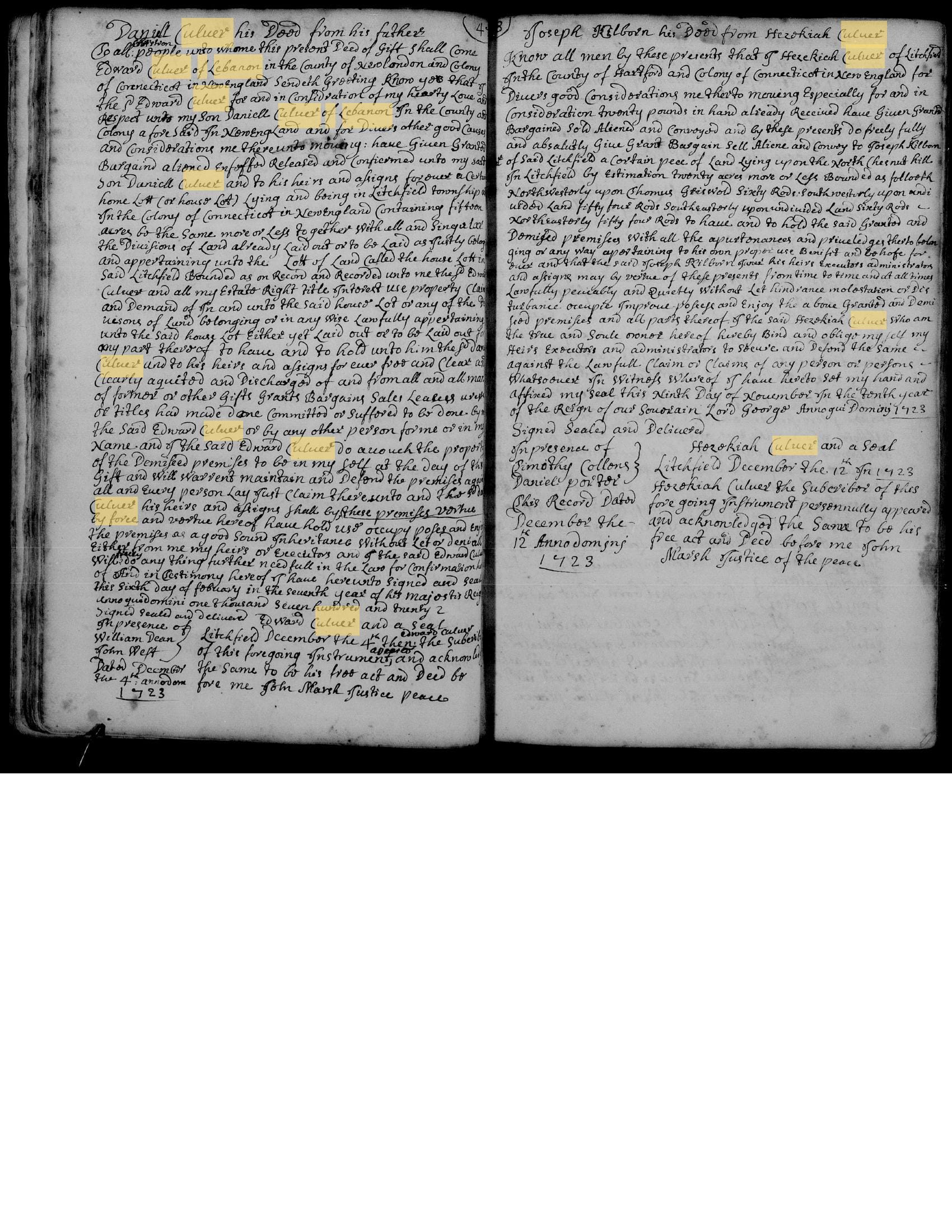
A deed of gift is the sweetest instrument in colonial genealogy, and it is worth pausing on why. An ordinary deed names a price; a gift deed names a relationship — the consideration that moves the land is not money but blood, and this grantor says so in the period's own lovely formula: my hearty love and respect. He states the kinship in his own words, under his own hand, before witnesses, in a record book the county has kept ever since. No baptismal register survives to name Daniel's father. No gravestone does. But the father himself does, in the one sentence of his that the county promised to remember. Four words — unto my son Daniell — and a question the printed genealogies left open for two hundred years is shut.
The book's appendix has been rewritten accordingly. The old caveat about the Litchfield trio is gone; the settlement now reads as the documents read it — the father held the proprietor's right, and the sons settled it: Daniel by his father's own gift, Hezekiah by purchase in the same young township in the same seasons, the brothers' households two of the plantation's founding stock. What the record still owes us is the parallel sentence for Hezekiah — a Lebanon deed in which Edward says my son Hezekiah as plainly as he said my son Daniell — and the hunt for it is open, in the Lebanon town books where Edward's other gifts should lie. Until it surfaces, the top rung is graded probable, not proven, and the line's researcher knows a Y-DNA test would settle at one stroke what no further paper may. That invitation stands.
What this is for
Every generation of this hunt used the same short toolbox: the federal censuses; the free full-text search that has lately opened the old county deed and probate books to a keyword — the tool that surfaced both the gift deed and the 1770 probate papers within days of the first question; the town vital records of Connecticut and Massachusetts; and one pension index card. Nothing behind a paywall did anything a free record did not do better. The expensive part was never money; it was the habit of writing each finding down with its source before reaching for the next one — and the willingness to let a family memory be almost right, one rung off, instead of throwing it away for being imperfect. "Heziah" was real. The tombstone's 1840 was real too — it was just somebody else's truth, a persona's, faithfully preserved by people who loved the man who wore it.
The researcher on the Louisiana end of this line, who brought the family's memory, its photographs, and its questions, is deliberately not named here — this project names living people only with their written leave. But the seventy-two hours were a collaboration, and the wall came down from both sides. If you carry a Culver, Colver, or Collver brick wall of your own — or any wall at all with a strange alias in it, a tombstone that argues with a census, a name worn soft by retelling — the comments and the mailbox here are open. The records are patient. They have been waiting under the courthouse dust for three hundred years; they do not mind waiting out one more question.
Sources and notes: Solan Kiser Culver (1851–1923), the "C. H. Culver" alias, and the persona's age are documented in the federal censuses of Louisiana 1870–1920 (the 1880 return "Chas Culver, 40"); the pension index card (T288) shows invalid application 435-808, filed 22 December 1881, Co. F, 11th U.S. Infantry, and widow's application 1231.844 (1925), no certificate granted — the files survive at NARA, RG 15. Charles Henry Culver (1822–1901) and Hezekiah Culver the blacksmith (c. 1801–1891, Oneida, N.Y., death certificate 7568, on order) are carried by the New York and Wisconsin censuses cited in the project's research dossier. Simeon Culver: baptized at Woodbury 8 February 1767, the entry naming his father Hezekiah (Connecticut State Library, Church Records Index, Woodbury; his birth date is not of record); marriage to Anna Green, Tyringham, 7 January 1792 (Tyringham VR); death at Fenner, Madison Co., N.Y., 25 May 1852. Hezekiah Culver the younger: born Woodbury 7 April 1732 (Barbour Collection); Berkshire purchase 23 October 1759; the 1762 joint deed of Hezekiah Sr. and Hezekiah Jr., both of Woodbury; died Tyringham 1792. Hezekiah the elder: Norwich birth 1692 (Savage); Litchfield deeds from 1723 (Litchfield Deeds 1719–1737); Woodbury proprietor 1729–35; died Woodbury 1770 — probate certificate and the Assembly memorial naming "Hezekiah Culver Jr." executor are in the Connecticut Archives estate papers, read from the digitized films for this project. The 1720/21 deed of gift, Edward Culver "unto my son Daniell Culver of Lebanon," is in the Litchfield deed books (1719–1737), likewise read from the film. The Edward¹–Lt. Edward² generation and the honest grading of the two remaining conjectured links follow the forthcoming book's Appendix A3 as revised this month. All record images are archived in the project's research corpus with full citations.
Adapted from the forthcoming book — We Are Doves: Four Centuries of the Collver–Culver Family.
© 2026 Albert B. Collver III · The Collver Family History Project. Original historical documents reproduced here are in the public domain; the research, text, and annotations are the author's. Please cite or link rather than republish.