Why We're Collver, Not Culver
From Old English 'culfre' to a loyalist preacher's land grant on Lake Erie: the 750-year paper trail behind the Collver family's unusual spelling.
A dove, a bitten finger, a debunked Winthrop, and a stubborn backwoods preacher: seven and a half centuries of one family name.
Everyone named Collver has had the conversation. "Culver? C-U-L—" No, two L's. "Colver?" Close. C-O-L-L-V-E-R. A pause. "Is that Dutch?"
It is not Dutch. It is English — older than England's surnames themselves, in a sense — and the reason we spell it the way we do runs through a Puritan wheelwright, a persecuted religious sect, and a preacher in his sixties who drove an ox cart into the Canadian wilderness in 1794. This post is the paper trail.
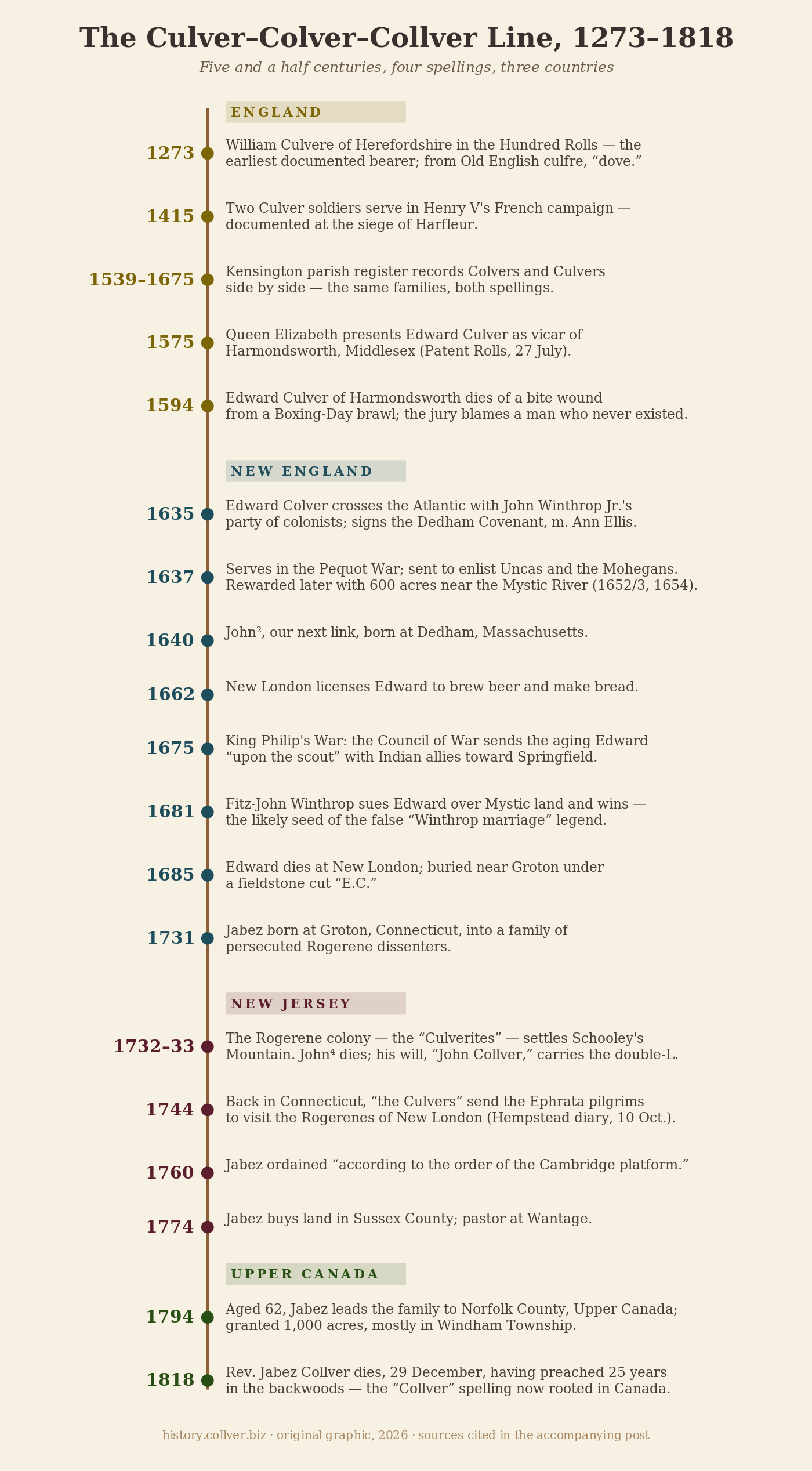
Five and a half centuries at a glance. Original graphic; sources cited below.
First, the dove
Begin with the word. Culfre is Old English for "dove" — and a native word at that: the OED weighed Grimm's guess that it derived from Latin columba and set it aside, noting that its "thoroughly popular standing" argues against any bookish borrowing. It is old enough that when the Anglo-Saxon poets retold Genesis, it was a culufre that Noah sent out from the ark. The Ormulum, around 1200, supplies the family's character reference: "Cullfre iss milde, & meoc, & swet" — the culver is mild, and meek, and sweet. It became an endearment — "Cum to me, mi leofmon, mi kulure" (come to me, my beloved, my culver), coaxes the Ancrene Wisse around 1225, and Wyclif's Song of Solomon sighs "Oon is my culuer, my parfit" — and it lived in poetry from Chaucer's colver through Spenser's culver "on the bared bough / Sits mourning" down to Tennyson. A culverhouse was a dovecote; the south of England is dotted with dove-places — Culverden and Culverstone in Kent, Culver Cliff on the Isle of Wight — and in the south and east the word survived as the everyday name of the wood-pigeon. When hereditary surnames crystallized in England in the twelfth and thirteenth centuries, "Culver" attached itself to people — perhaps keepers of dovecotes, perhaps the mild-mannered, perhaps dwellers by a sign of the dove. Nobody can say which of these produced our name, and anyone who tells you otherwise is selling something. (Some older compilers preferred a fiercer story — that the name came from Latin coluber, a snake, with a crest of a hand raising a club to kill one. The 1910 family genealogy found "no evidence to support this view," and the OED backs the doves: the only serpent on the culver page is the culverin, the Tudor cannon named from the French for snake — a different word entirely. We are doves, not snake-killers.)
The earliest bearers in the records: William Culvere of Herefordshire, entered in the Hundred Rolls of Edward I's reign, 1273; a John and William Culvard, or Culverd, of Oxfordshire slightly later; a Richard Culver, weaver, at Bristol in 1475. From the beginning the name was spelled however the clerk felt that day: Culvere, Culvard, Colver, Culver. Hold that thought; it becomes the whole story.
Soldiers and parishioners
The name stayed close to the ground for centuries — smallholders, soldiers, parish folk. Two Culver men turn up in the muster rolls of the Hundred Years' War, serving in Henry V's 1415 campaign in France (citations in my notes). Family pride wants to put them at Agincourt; the records put them at the siege of Harfleur, the campaign's grinding, dysentery-ridden first act, and go silent on whether they marched on to the famous field. Harfleur was no lesser service — dysentery outside its walls is generally reckoned to have cost Henry's army more men than the famous battle did — but honesty compels the distinction.
By the sixteenth century the name is settled in Middlesex, and the parish register of Kensington lets us watch one household for a generation. Edward Colver married Alis Lincome there in 1549. Their son Richard was baptized on 23 October 1552. Then 1559 took both Richard and Alis to the churchyard; Edward remarried, and a son William was baptized on 30 May 1563. Around them in the same register: Jone Culver married in 1545, Hughe Colver buried in 1556. Same parish, same families, same decades — Colver and Culver were simply the same name, and the 1910 family genealogy thought it "more than probable" that Edward the Puritan emigrant came from these Middlesex-London parishes, since John Winthrop the Younger recruited his colonists from Middlesex, Kent, and Essex. His actual parentage, it conceded, "the research has failed to reveal." It still has.
And the Middlesex village of Harmondsworth gives us two Edward Culvers — or possibly one, twice. On 27 July 1575, Queen Elizabeth presented an Edward Culver as vicar of Harmondsworth, an appointment enrolled in the Patent Rolls. (The Crown acted "by lapse" — the regular patron had let the six-month deadline pass, so the right of presentation fell to the Queen. A procedural royal favor, but a royal presentation all the same: our one brush with Gloriana.)
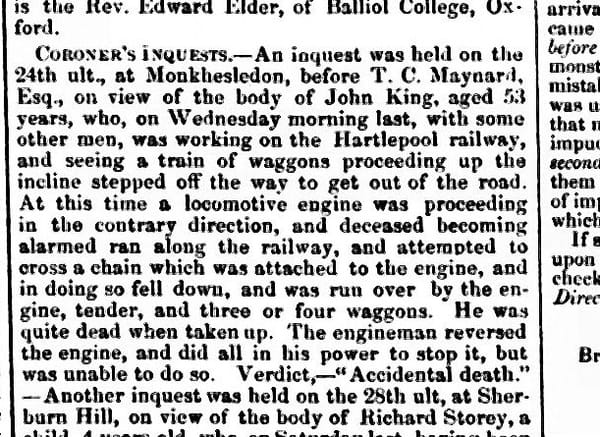
Then the Middlesex Sessions Rolls record the end of an Edward Culver of Harmondsworth with terrible Elizabethan precision. On the night of 26 December 1593 — St. Stephen's Day, the feast commonly known today as Boxing Day — he fell into a fistfight with two neighbors, and one George Hulett "with his teeth bit the middle finger of Edward Culver's left hand, so that the same left hand and the arm became putrid and sick." Edward languished three months and died on 25 March 1594. At the inquest, Hulett pleaded not guilty — and the jury solemnly declared that the killing had been done by one "Johannes Atstyle." John at Stile was a legal fiction, the Tudor John Doe. The jury blamed a man who did not exist, and George Hulett walked free.
Was the brawler the vicar, eighteen years on? The inquest does not style him "clerk," as it likely would a man in orders, so perhaps he was a kinsman in the same small parish; the records leave it open. No connection to our own line is documented either way. But a Culver presented to a living by the Queen, and a Culver killed by a bite in a St. Stephen's Day brawl, in the same tiny village a generation apart — I could not leave them out.
Edward Colver, Puritan
Our documented American ancestor is Edward Colver, who came from the southeast of England in 1635 with a party of colonists brought over by John Winthrop the Younger — fifteen years after the Mayflower. He was a wheelwright by trade and restless by temperament. Boston held him barely a year. He moved to brand-new Dedham, Massachusetts, where he became the sixty-eighth signer of the Dedham Covenant, and where the Dedham Towne Book for 28 November 1637 records the town's welcome: it was "ordered that Edward Colver (written also Ed. Coluer) wheelwright shall haue twoe Acres layd out for ye present implyment in his trade" — the parenthesis a small monument to the spelling chaos that follows this family everywhere. He married Ann Ellis at Dedham on 19 September 1638, the second marriage entered in the town's records; their son John — our line — was born there in 1640.
Edward served in the Pequot War of 1637. By the account preserved in the family genealogies, Major John Mason — commanding a force of about ninety colonists — sent Edward to enlist the help of the Mohegans, and Uncas brought roughly a hundred and fifty warriors to the campaign; Uncas held Edward in enough esteem, the tradition runs, to name a son after Edward's boy Joshua. For his service Edward later received two grants in the conquered country, recorded in the Groton land records: two hundred acres in 1652/3 and four hundred more in 1654, a few miles north of the battle ground near the head of the Mystic River.
He moved to Roxbury, helped build the Winthrops' fort at Saybrook, built Governor Winthrop's grist mill in 1650–51, and by 1653 had followed the frontier down to Pequot — soon renamed New London — where the records call him "Goodman Colver." The town licensed him in 1662 to brew beer and make bread, and in 1665 to sell liquors; at Mystic he built a house with accommodations for travelers and a water-powered grist mill of his own. He could not write his name; the deeds show his mark. In 1682, "in consideration of my own age and weakness of memory and understanding," he conveyed his land to his wife Ann. He was dead by June 1685, when the court granted administration of his estate to his eldest son John. He and Ann lie in the Wightman Burying Ground near Groton under rough fieldstones cut only with their initials: E.C. and A.C.
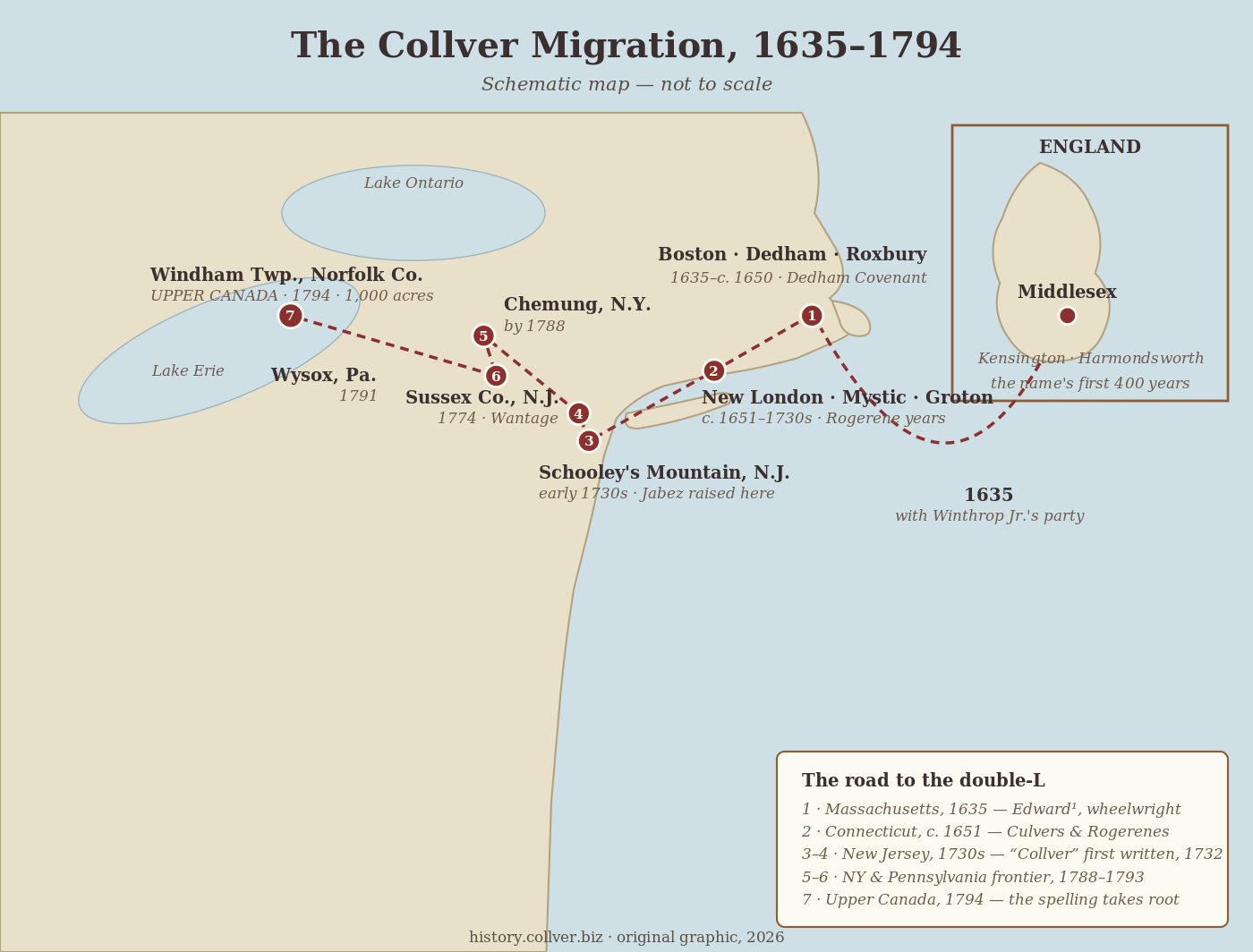
The road to the double-L: seven stops over 159 years. Schematic, not to scale.
But before age caught him, he had one more war. During King Philip's War the old man served as a scout, and the colony's own Council of War journal preserves the order: on 10 February 1675 the Council directed Edward Culver — the record spells him both ways — to "goe forth upon the scout" with a party of Indians toward Springfield, to discover what he could of the enemy. The historian Frances Caulkins called him "a noted soldier and partisan, often sent out with Indian scouts to explore the wilderness." He was, in Rosenberger's phrase, a man of "advanced age" — a grandfather scouting hostile country on foot.
The legend that needed killing
Here I must commit a small act of family heresy.
The family pamphlet — The Collver-Culver Genealogy, 1630 to 1916 — and the 1882 History of Morris County both tell a grander story: Edward arriving at New London in 1630, and a son John who married Sarah Winthrop, granddaughter of Governor Winthrop himself, before settling at Schooley's Mountain, New Jersey. It is repeated on monuments and in county histories. It is also, sadly, not true.
New London did not exist until the mid-1640s; Edward's documented arrival is 1635. And in 1955 the American Genealogist — edited by Donald Lines Jacobus, the most exacting genealogist America produced — examined the Winthrop marriages (some versions say Sarah, some Mary) and pronounced the claims "false," suggesting they may have grown, with a certain poetic irony, out of a lawsuit. The Colvers and the Winthrops both had mills near the head of the Mystic River, and in 1681 Major Fitz-John Winthrop sued Edward Culver over land there. Winthrop lost, sued again, and kept suing until he won on appeal. Half the neighborhood testified — about tides that flowed up to the mill wheel, about who got his feet wet at the riding place, about a black-oak tree that marked the old Paucatuck path. The family did tangle with the Winthrops, memorably. Just not at the altar.
I record the legend because it is ours, and I flag it because the true story needs no embroidery.
The Rogerene years
Edward's descendants multiplied around New London and Groton — and many of them joined the Rogerenes, the radical sect founded by John Rogers of New London that rejected formal clergy, kept Saturday sabbath, refused oaths, and cheerfully endured decades of fines, whippings, and jailings from the Connecticut establishment. Colvers and Lambs were arrested alongside Rogers himself for "disturbing the peace" — which in practice could mean carrying their knitting into someone else's Sunday service.
The records let us watch it happen once, by name. On Sunday, 26 July 1725, a party of eight Rogerenes was arrested at Norwich for traveling on the Sabbath — and two of the eight were John Culver and Sarah Culver of Groton, she remembered by the sect as "a singing sister." They were on their way to a baptism. Hauled before the court the next day and unwilling to pay the twenty-shilling fine, they were whipped with whip-cord, ten to fifteen lashes apiece; released, they simply walked on to Lebanon and were arrested there the very next Sabbath, until sympathetic townsfolk paid their fines. They had boasted they could "buy the idolators' Sabbaths for five shillings apiece" — and the Norwich justice observed drily that at twenty shillings the price had gone up. (Also whipped that day: a John Waterhouse of Groton — the same surname as the guardian a young Collver orphan would later choose. These were a small, intermarried band of Groton families, and the court records read like a family reunion.) This is the persecution the histories mean in the abstract, made specific: named Culvers, bleeding for their faith, six years before Jabez was born.
The connection left a lovely trace in 1744, when pilgrim brethren from the Ephrata community in Pennsylvania toured New England: it was "the Culvers," the sect's chronicler records, who urged them to visit the Rogerenes of New London, where they found a people leading "a quiet life apart" and enjoyed "a most peaceful visit." The diarist Joshua Hempstead saw the visitors on 10 October 1744 — men with beards eight or nine inches long, hatless, dressed in white.
Rogerene conviction came at a price, and the Dictionary of Canadian Biography states the consequence plainly: the family was persecuted, and Jabez Collver's grandfather "therefore took his entire family to New Jersey." Our road out of New England was paved by religious dissent.
Schooley's Mountain and the Culverites
So in 1732 a Rogerene colony of twenty-one persons, led by John Colver, planted itself at Schooley's Mountain, Morris County, New Jersey — "the first religious body in this section," Chambers records in his Early Germans of New Jersey, joined by affiliated families of Lambs, Tuttles, Burrowses, and Waterhouses. They came, in Chambers's words, from "a desire to cultivate undisturbed their strange form of religious life": all days alike, labor after worship, no oaths, no doctors or medicine, no steeples, pulpits, paid ministers, or even church buildings — and they "gloried in suffering for their belief and even courted the penalties of the whipping post." Their neighbors found them strange and gave the tight-knit colony a name: the Culverites. Local tradition even credits them with the 1734 discovery of the mineral springs that later made Schooley's Mountain a famous resort. True to form, they took off for Monmouth County after three years and came back eleven years later — "tight knit," as a later family researcher put it, "they would take off to another place like a flock of geese." The scholarship remembers who led them out: the historian Ellen Starr Brinton, writing in The New England Quarterly in 1943, records that the New Jersey Rogerene colony was "led by John Culver and his family." And the sect left its mark on the map as surely as it left it on our surname — at Mount Arlington, New Jersey, a body of water still called Lake Rogerene keeps the old faith's name a little north of the mountain where the Culverites first settled. The documented chain, per the 1955 American Genealogist corrections, runs: Edward¹ (d. 1685) → John² (b. Dedham 1640, d. Groton 1725, m. Mercy Clark) → John³ (b. Norwich area, raised Groton; settled permanently at Schooley's Mountain) → John⁴ (baptized Groton 1700; a cordwainer — a shoemaker; m. Freelove Lamb).
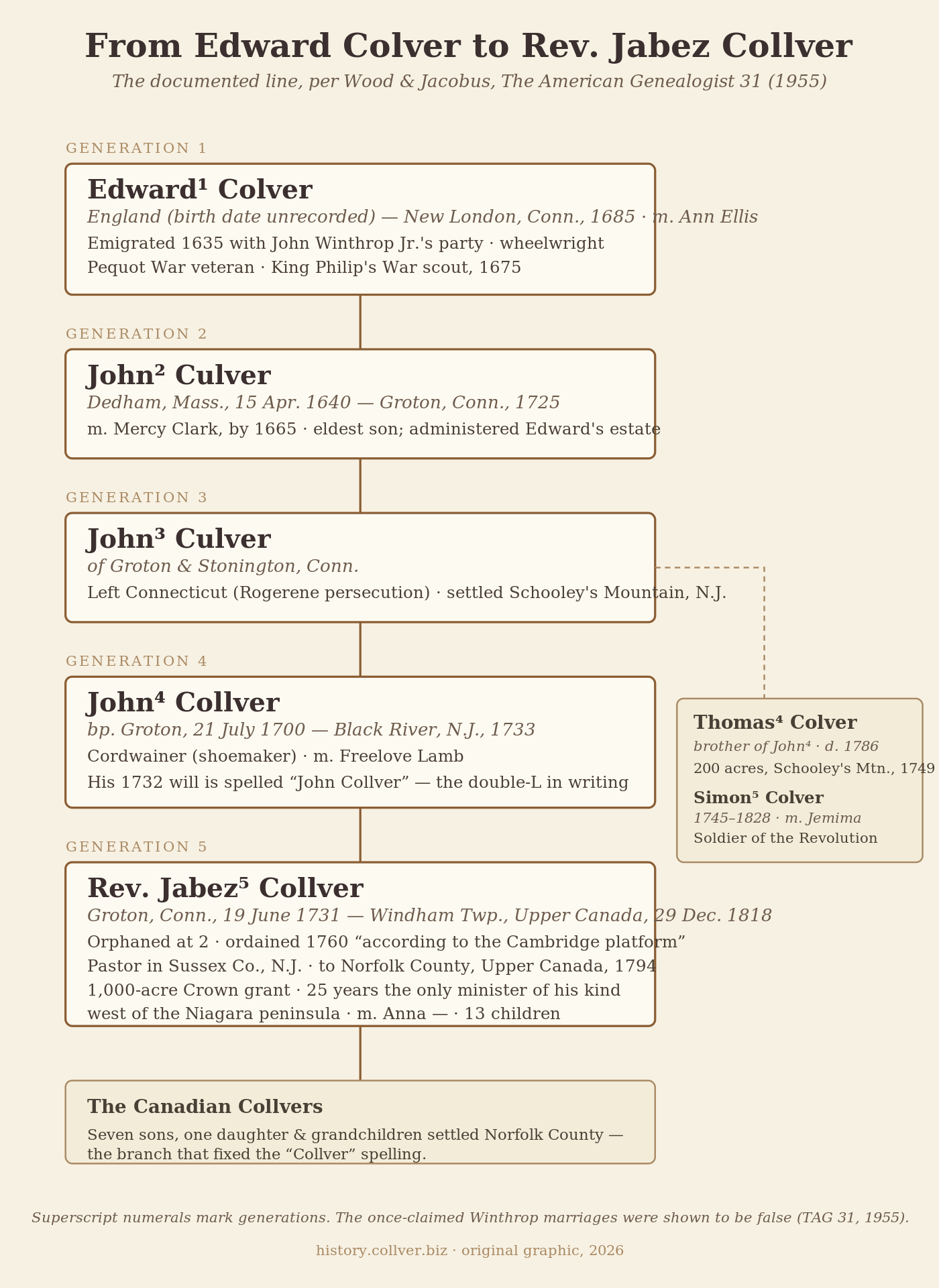
The documented line, generation by generation, per The American Genealogist 31 (1955).
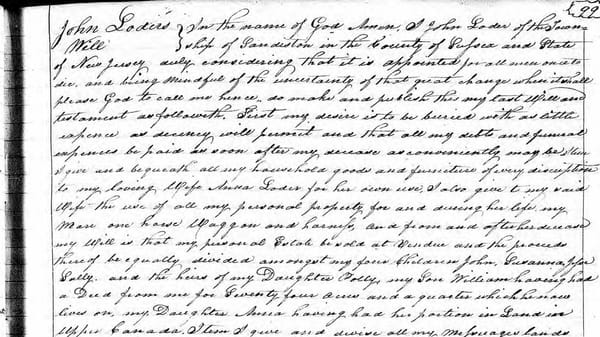
John⁴ did not live to see the family established: he died at Black River, Hunterdon County, in 1733, leaving a will made 2 December 1732 that names his wife Freelove "then with child" and his young sons — including two-year-old Jabez. And here, quietly, in a shoemaker's will in 1732, the double-L appears: "John Collver of Blackriver, cordwinder." The spelling that marks us was in the family a full generation before the man who made it stick.
The family took root on the mountain. Thomas Collver — John⁴'s brother — bought 200 acres there in 1749; Collver's Gap at the foot of Schooley's Mountain still carried the name when the pamphlet was written. Thomas's son Simon (1745–1828) served as a soldier of the Revolution and lies under a gravestone at Drakestown with his wife Jemima, who outlived him to the age of 91.
Rev. Jabez Collver, or how the spelling stuck
Jabez Collver was born at Groton, Connecticut, on 19 June 1731, carried to New Jersey as an infant, and orphaned of his father at two. At sixteen he stood before a New London probate judge and chose his uncle Isaac Lamb as guardian. He had almost no schooling. What he had instead — his own words, from a memoir he wrote at eighty-four — was "a great concern come on my mind about the end of the world," which arrived when he was six and never left.
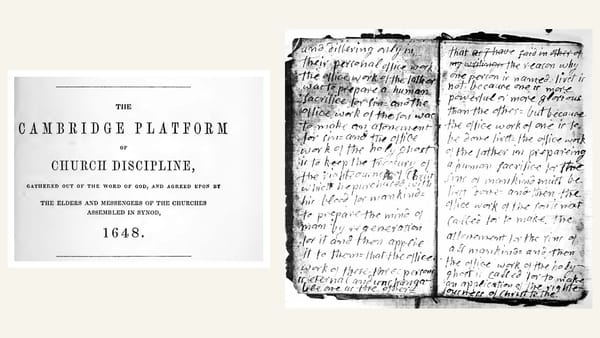
He gathered neighbors for prayer, was licensed to exhort, and in 1760 was ordained "according to the order of the Cambridge platform" — the old New England Congregational order of 1648 — by ministers and elders at the desire of his church. He bought land in Sussex County in 1774 — the purchase at the Great Pond that gave Culver's Lake and Culver's Gap their names, a story told in full elsewhere on this site — and served for years as pastor of the Beemer Meeting-House at Wantage. Family research collected by the Norfolk Historical Society describes him as a serial church-planter, "employed by the Connecticut Missionary Society to travel throughout the newly-created states and establish churches, many of which exist today" — staying with each little congregation, as at Wysox, until it could support a regular pastor, then moving on. The society's name is an anachronism (the Missionary Society of Connecticut was not founded until 1798, by which time Jabez was in Canada), but the pattern it describes matches his documented trail exactly: Wantage, Wysox, and finally the clearings of Norfolk County.
The Revolution left an honest tangle in his record. Family tradition, following Owen, makes him a chaplain in Washington's army who "chose the Bible in preference to the sword"; but in his own 1794 petition Jabez claimed he had "suffered imprisonment and loss of a great deal of property during the late rebellion on account of his loyalty," and in 1799 he petitioned — unsuccessfully — for official U.E. Loyalist status. The Norfolk Historical Society's sourcebook is blunt about the muddle: there is "no military proof" of the chaplaincy, and he was "at heart a Loyalist (to the British) but a TORY to the fighting colonists." Snell's 1881 history of Sussex County needed only one sentence for the same man: he "was known as a 'United Empire Loyalist' by the British, and by Americans as a 'Tory.'" Perhaps he trimmed his story to his audience; perhaps, like many in the neutral ground, he simply endured both sides. The documents preserve the contradiction, so I preserve it too.
After the war he drifted with the frontier: Chemung, New York, by 1788 (1,200 acres, "did not preach much"), then down the Susquehanna to Wysox, Pennsylvania. Then came Lieutenant-Governor John Graves Simcoe's proclamation of February 1792 inviting settlers to Upper Canada. Jabez rode to consult Simcoe in person and received "such private encouragement" that he committed everything. The party left New Jersey in 1793 and arrived in March 1794 — Jabez sixty-two years old — a caravan of several families with horses, cows, and hogs, "frequently attacked by the wolves" on the road. Somewhere in the Grand River swamp, his small adopted grandson Jabez B. — the orphan of his son Nathan, not yet five — sat down on a huge rattlesnake and was snatched up by an uncle, unbitten. When they arrived, the entire Long Point settlement held perhaps five families.
He petitioned for land on 11 June 1794 and was granted 1,000 acres three days later, most of it in Windham Township, where he raised the first log house in the township. (The traditions disagree agreeably here. Owen's county history remembers Simcoe promising 600 acres plus 400 for each married child and 200 for each unmarried one; Snell's 1881 Sussex County history says 1,000 plus the same; the family pamphlet — long blamed, by me among others, for inflating the grant to 3,000 — in fact prints 1,000 on a close reading of its smudged numeral; the land books record 1,000, patented in 1797. The 1912 gravestone says "settled here in 1793"; in fact they left in 1793 and arrived in 1794 — both memories half right. The pamphlet, to its credit, calls his church "Congregational"; it was later histories that promoted him to "Presbyterian" — Jabez himself said Cambridge platform, and his congregation, Presbyterian in form, answered to no presbytery on earth.)
Nor did he go alone for long. His cousin Timothy Culver — who, unlike Jabez, had seen "regular service" on the American side in the Revolution — walked with his wife all the way from New Jersey in 1795 just to visit, liked what he saw, and moved up for good in 1796. Four of Timothy's daughters — Anna, Elizabeth, Marian, and Martha — married four of Jabez's sons, and so never had to change their surname; the county historian devoted a chapter to "The Double Culver Quartette." The migration kept flowing for years: local histories describe a later Culver-Sovereign trek from New Jersey of twenty wagons, forty yoke of oxen, three hundred sheep, and a train of horses, cows, hogs, poultry, families, and carpenters. The old Culverite instinct — take off together, like a flock of geese — outlived the sect itself.
For nearly twenty-five years he was the only resident minister of his kind west of the Niagara peninsula — the second in all of Upper Canada, and, as Owen's history styles him, "Norfolk's first ordained preacher of the Gospel." His cart deserves its own memorial: a home-made wooden axle-tree fitted with the two front wheels of a "Jersey" linch-pin lumber wagon, a rope seat rigged over the axle, and a bell hung on the horse so that, while the animal picked its own living during the hours of religious service, it could be found again when it was time to jog to the next "appointment." He organized congregations at Turkey Point, in Windham, and later in Oakland; when he could no longer travel at all, he sat in a chair in his own house and preached. The province was slower to accept him than the settlers were: when he applied in 1800 for a licence to perform marriages, the district court refused him twice, unmoved even when he produced seven members of his congregation as witnesses. He was finally licensed in March 1804 — which was awkward, since he had been marrying couples since at least 1795. One suspects he lost no sleep over it.
He organized what tradition counts among the first three or four churches in Upper Canada, buried a son (whose deathbed vision he published as a pamphlet that ran through many editions), wrote his eighty-page memoir — lost since before 1906, and known to us only through an 1879 letter to the New York Observer by a reader who held it in his hands — and died in Windham Township on 29 December 1818, having preached nearly to the last.
A tempting theory
Before settling the spelling question, let me raise and test a hypothesis I carried around for a while: that Jabez adopted "Collver" deliberately — a loyalist's mark, setting himself apart from the Culver cousins who sided with the Revolution.
It is a satisfying story, and the documents kill it cleanly. The double-L appears in his father's will — "John Collver of Blackriver, cordwinder," December 1732 — when Jabez was a year old and George III's grandfather was newly on the throne; a 1667 New London deed is witnessed by a Joshua Cullver and a Joseph Cullver earlier still. Jabez himself was "Jabez Collver" when he bought his Sussex County land in August 1774, months before Lexington. And the spelling never sorted by politics: his cousin Simon Collver carried the double-L through service as a Revolutionary soldier and kept it to his grave at Drakestown. Even Jabez wasn't consistent — he published his son's deathbed vision in 1793 under the name Nathan Culver.
Nor did allegiance sort the family geographically: cousin Timothy, the Revolutionary veteran, happily settled under the British Crown in 1796 and nobody asked him to add an L at the border. The 1984 family genealogy points to the duller truth: on original deeds the family wrote Colver or Collver; it was the copyists — clerks, indexers, county historians — who smoothed it to Culver. Spelling followed the pen that held the record, not the flag on the wall. What Jabez did was simpler and more durable than a political gesture: he moved his spelling to a new country and became its record-keeper — the man who wrote the marriage registers, the land petitions, the church rolls. In Norfolk County, the pen that held the record was finally a Collver pen.
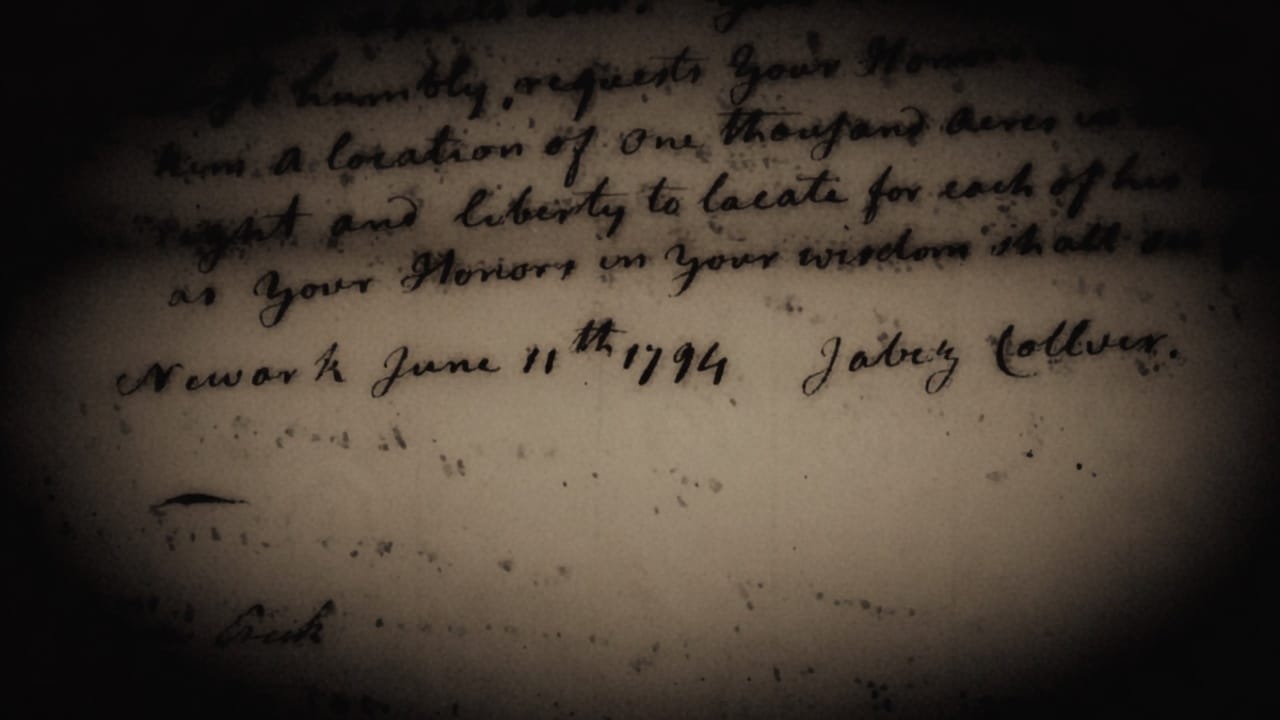
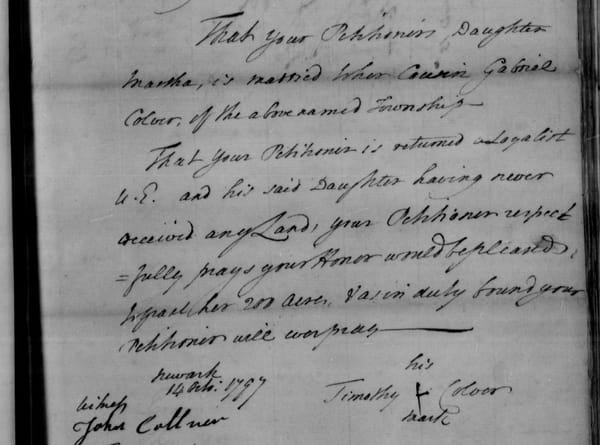
The pen in question: Jabez Collver's signature, from his Upper Canada land petitions (RG 1, L 3, Library and Archives Canada). The petitions are transcribed in full in Echoes from the Frontier.
The name takes root
And so the name he carried — the double-L "Collver" of his father's will — he planted in Canadian soil. His sons' land petitions, his church, his gravestone, and the hundreds of Norfolk County descendants who followed all spell it his way. Nor was it a small planting: a modern scholarly study of Ontario's land records, which takes the Collvers as its case study, counts forty-one Collver property owners buying and selling more than twenty-two thousand acres in Norfolk County between 1792 and 1851. From one loyalist's thousand-acre grant, the family had become one of the county's substantial landholding clans — and every deed of it spelled "Collver." (Jabez himself left no will; like his cousin Timothy, he had already passed his land to his children before he died, which is why the family's story lives in land memorials rather than a probate file.) South of the border the name mostly smoothed back to Culver. In Ontario, and in every branch that traces to the old preacher, we are Collvers.
He was buried in the southeast corner of his own farm, beside Anna, who had died in March 1813, in her 74th year. Seven months after his death, his son John deeded that acre as a public burying ground "free to people of all denominations" — a fitting gesture from a family the establishment had once whipped and fined. For nearly a century a rough triangular stone marked the grave. Then, on a rainy Friday afternoon — 25 October 1912 — descendants gathered at Old Windham Cemetery to unveil a block of gray granite, paid for by Mrs. Alice Collver Rose of Simcoe, who tried and failed to keep her gift anonymous; a tree was planted at the foot of the grave by Darius Collver, the oldest descendant present. In 1941 a cairn of native rock rose on the spot where the log house had stood, honoring Jabez, Timothy, and Joseph together. There is a quiet irony here worth savoring: the old Rogerenes, Chambers noted, "did not approve of monuments to the dead." Their descendants, being human, built them anyway — and cut them COLLVER.
And the work outlasted the stones. The congregation Jabez gathered in his log cabin in 1794 never disbanded: through Methodist and Presbyterian turns and the 1925 union that made it part of the United Church of Canada, it worships still, as Old Windham United Church near Simcoe — some three hundred members strong when it marked its 220th anniversary in 2014. The plain wooden meeting-house its people raised in 1820 also survives, shifted onto a nearby farm on log rollers around 1868 and long mistaken for a barn — one of the oldest wooden buildings left in Norfolk County. The itinerant preacher with the bell on his horse built something that is still standing, and still praying, two centuries on.
Coda
The family pamphlet of 1916, after eleven pages of begats, ends with a shrug that I have come to love: "Collver is pronounced Culver, and some spell it that way." A New Jersey pioneer historian put the same truth more precisely: "The surname is spelled Collver and Colver and Culver; the orthography has varied but the pronunciation has always been 'Cul-ver.'" He was writing about our Schooley's Mountain family — and, tellingly, he spelled the old sect's nickname "Collverites," double-L, where his own sources wrote Culverites. Even the word for how strange we were couldn't decide how to spell us.
Seven hundred and fifty years of clerks, coroners, parish scribes, probate judges, and land registrars spelled our dove every way it could be spelled. We ended up with the version a shoemaker's widow and her orphaned son carried out of New England, through New Jersey, and into the Canadian bush. It is not the tidy spelling. It is the one with the story.
Postscript: the pulpit — and the pen — never quite left the family. In 1828, ten years after the old man's death, his son John Collver had a book of his own hymns printed at St. Catharines, apologizing in the preface for "the small portion of education with which I have been favoured" — the very phrase the historians would use for his father. One hymn was "sung at the funeral service of my father, Rev. Jabez Collver," and John cast it, tenderly, as the dying man's own "last will" — a will in verse for a father who, as it happened, left none on paper. In it the old itinerant takes his leave on the same dark trails he had ridden for a quarter-century:
Long time I travell'd here below,
Oft times in a dark path;
Still my Redeemer did bestow
A little grain of faith.
He "began to preach the gospel at the age of 25," John's note records, "and died between 87 and 88 years old, having preached more than 40 years." A hundred and forty years further on, the Rev. C. B. Collver, a Free Methodist minister in Michigan, was still making his Sunday rounds of three small churches — Maple Ridge, Melita, and Turner — three services every Sunday, his family in tow. Some things travel further than a spelling.
Sources
1. 'Middlesex Sessions Rolls: 1594', in Middlesex County Records: Volume 1, 1550–1603, ed. John Cordy Jeaffreson (London: Middlesex County Record Society, 1886), pp. 219–225. Via British History Online.
2. The Parish Register of Kensington, Co. Middlesex, from A.D. 1539 to A.D. 1675, ed. F. N. Macnamara and A. Story-Maskelyne, Publications of the Harleian Society, Registers XVI (London, 1890).
3. Jesse Leonard Rosenberger, Through Three Centuries: Colver and Rosenberger Lives and Times, 1620–1922 (Chicago: University of Chicago Press, 1922), chs. i–ii.
4. The Public Records of the Colony of Connecticut, from 1665 to 1678; with the Journal of the Council of War, 1675 to 1678, ed. J. Hammond Trumbull (Hartford: F. A. Brown, 1852), pp. 408, 417.
5. Frances Manwaring Caulkins, History of New London, Connecticut (New London, 1852), p. 309; quoted in Rosenberger. And History of Norwich, Connecticut (1866), ch. XIX, "The Rogerene Episode," pp. 290–91 — the arrest and whipping of John and Sarah Culver of Groton, 26 July 1725 (eight named Rogerenes). Corroborated in R. R. Hinman, A Catalogue of the First Puritan Settlers of the Colony of Connecticut (Hartford, 1856), s.v. "Culver, Edward" — Sarah Culver "called by them the singing sister" (Hinman dates it July 1726 and says six; the post follows Caulkins's primary account). Hinman also records the 1734 Rogerene removal to Schooley's Mountain ("John Culver, his wife and ten children... twenty-one in all"), the 1675 scout order, "Goodman Culver" the New London brewer, and the Mystic farm called "Chepadaso."
6. W. Herbert Wood, "Additions and Corrections to the Colver-Culver Genealogy," ed. Donald Lines Jacobus, The American Genealogist 31 (July 1955): 129–154.
7. The Collver-Culver Genealogy, 1630 to 1916 (family pamphlet, c. 1916).
8. History of Morris County, New Jersey (New York: W. W. Munsell & Co., 1882), pp. 374–375.
8a. "Morris County Gravestones" (Old Burial Ground, Drakestown; Colver Family Burial Ground, Washington Twp.), The Genealogical Magazine of New Jersey 49, no. 1 (January 1974) — gravestone transcriptions confirming Simon Colver (d. 11 July 1828, ae. 83) and Jemima Tuttle Colver (d. 2 Nov 1843, ae. 91) and Robert Colver (d. 7 Jan 1783, ae. 69); a family stone reciting the (disproven) "Sarah Winthrop" marriage of John Colver, d. Dec. 1760.
9. "Brief Letters: A New Jersey Preacher," New York Observer and Chronicle 57, no. 3 (16 January 1879), p. 18.
10. Edith G. Firth, "COLLVER, JABEZ," in Dictionary of Canadian Biography, vol. 5 (University of Toronto/Université Laval, 2003–).
11. John R. Bolles and Anna B. Williams, The Rogerenes: Some Hidden Facts of History (Boston, 1904), p. 274; citing the diary of Joshua Hempstead, 10 October 1744.
11a. Ellen Starr Brinton, "The Rogerenes," The New England Quarterly 16, no. 1 (March 1943) — John Culver as leader of the New Jersey Rogerene colony at Schooley's Mountain, the migration to southern New Jersey, and Lake Rogerene at Arlington, N.J.
12. [Nathan Culver], A Very Remarkable Account of the Vision of Nathan Culver (Windsor, Vt., 1793, and later editions).
13. Frederic Lathrop Colver, Colver-Culver Genealogy: Descendants of Edward Colver of Boston, Dedham, and Roxbury, Massachusetts, and New London, and Mystic, Connecticut (New York: Frank Allaben Genealogical Co., 1910), "The Colvers in England." (Note: this work misconverts the Harmondsworth inquest's regnal year "36 Eliz." to 1596; the 36th year of Elizabeth ran November 1593–November 1594, as printed in Jeaffreson's 1886 edition.)
14. Valerie Dyer Giorgi, Colver-Culver Family Genealogy, as Descended from Edward Colver of Groton, Connecticut (Santa Maria, Calif., 1984), Introduction and pp. 6–7.
15. Clara E. Haid, "History of Pleasant Grove" (Tercentenary essay), and "Schooley's Mountain Springs," Newark Star-Ledger, 20 November 1955 — both as reproduced in the Collver family history collection (collver.org).
16. Letter, "Dick" to William Yeager (editor, Collver-Culver Genealogy, Norfolk Historical Society), 25 January 1997, family research papers — on the Culverites and the Culver-Sovereign trek, citing Townsend & Waterford: A Double Portrait (1977).
16a. Theodore Frelinghuysen Chambers, The Early Germans of New Jersey: Their History, Churches and Genealogies (Dover, N.J., 1895), pp. 174, 178–179 — the Rogerene colony of 1732, its beliefs, and the "Culverite" families.
16b. E. A. Owen, Pioneer Sketches of Long Point Settlement, or Norfolk's Foundation Builders and Their Family Genealogies (Toronto: William Briggs, 1898), Sketch VIII, "The Father of Norfolk Presbyterianism — Jabez Culver," pp. 56–61, and ch. XXXIV, "Culver," pp. 81–83.
16c. "Unveiling the Collver Monument," typescript account of the ceremony at Old Windham Cemetery, 25 October 1912 (family papers; also Simcoe Reformer coverage, 13 December 1928, and Old Windham Cemetery transcriptions).
16d. The Dedham Historical Register, vol. II (Dedham, Mass.: Dedham Historical Society, 1891) — text of the Dedham Covenant and list of signers, including Edward Colver.
16e. Marilyn Collver Solomon, "The ghosts are all good ones in Maple Ridge," Detroit Free Press, 11 September 1997, Metro p. 27 — Rev. C. B. Collver's Michigan circuit.
16f. Upper Canada Land Petitions, RG 1, L 3, Library and Archives Canada — Jabez Collver's petitions of 11 June 1794, 1797, and 25 June 1799 (signature image and full transcriptions at history.collver.biz, "Echoes from the Frontier").
16g. Sources in Collver-Culver Genealogy, ed. William Yeager (Simcoe: Norfolk Historical Society, 1976), p. 12 (F. McIntosh research on colonial Colvers) — the Connecticut Missionary Society tradition, the chaplaincy caveat, and the 1790 Chemung census entries.
16h. History of Sussex and Warren Counties, New Jersey, comp. J. P. Snell et al. (Philadelphia, 1881), "Churches" — Jabez Collver as early pastor, Collver's Gap and Lake, the "United Empire Loyalist"/"Tory" line, and Simcoe's offer of 1,000 + 400 + 200 acres.
16i. William C. Armstrong, Pioneer Families of Northwestern New Jersey (1979; repr. Clearfield/Genealogical Publishing Co., Baltimore, 1996/2002), Sketch 17, "John Collver," pp. 95–99 — the "Cul-ver" pronunciation statement, the "Collverites" spelling, and (drawing on Chambers and a 1934 letter from Edward Collver of North Bay, Ontario) the Schooley's Mountain Rogerene colony. Note: this pre-1955 account repeats the disproven Winthrop marriage and conflates the John generations; the lineage above follows Wood & Jacobus (TAG 31, 1955) instead.
16j. Monte Sonnenberg, "Old Windham United Church marks 220 years," Simcoe Reformer, 9 April 2014 — the living congregation Jabez Collver founded in 1794, and the surviving 1820 wooden church building.
16k. Colin Read, "The Land Records of Old Ontario, 1791–1867," Histoire sociale / Social History — uses the Collver clan of Norfolk County as its case study: 41 property owners, 22,098 patented acres (1792–1851); Jabez and Timothy left no wills, having conveyed their land before death; the four founding families named as Jabez, Timothy, Jonas, and Joseph Collver.
16l. John Collver, The Upper Canada Hymn Book, for All Christian Denominations, with Other Pious Poems on Various Subjects (St. Catharines: printed at the Journal Office, for the author, 1828) — hymns by Jabez Collver's son John of Townsend; incl. the hymn sung at Jabez's funeral (with the "began to preach at 25... preached more than 40 years" memorial) and Hymn 47 on the lightning-death of John G. Collver, 26 June 1828.
17. Clergy of the Church of England Database (CCEd), Person ID 175386, Appointment Record 129252: Edward Culver, presented vicar of Harmondsworth ("Harmansworth"), diocese of London, 27 July 1575, patron the Crown (Queen Elizabeth) by lapse; citing Calendar of Patent Rolls 1572–1575 (Presentations). https://theclergydatabase.org.uk/jsp/DisplayAppointment.jsp?CDBAppRedID=129252
18. The Oxford English Dictionary, corrected re-issue of A New English Dictionary on Historical Principles, vol. II, C (Oxford: Clarendon Press, 1933), p. 1248, s.v. "Culver, sb.¹" and "Culverin" — etymology, the Ormulum and Ancrene Wisse quotations, and the wood-pigeon usage.
18a. Doris E. Wilson and Doris Marcellus, "Timothy Collver-Culver" (U.E. Loyalist research paper) — Edward Colver as 68th of 124 signers of the Dedham Covenant; with Woodhouse United Church Cemetery records, Norfolk County.
19. The Soldier in Later Medieval England database, www.medievalsoldier.org (muster-roll records from The National Archives, Kew) — the two Culver soldiers of the 1415 campaign, documented at the siege of Harfleur. For scholarly context on the campaign and the database, see The Historian 127 (Autumn 2015), Agincourt anniversary issue, guest ed. Anne Curry, esp. Curry, "Agincourt 1415–2015."
© 2026 Albert B. Collver III · The Collver Family History Project. Original historical documents reproduced here are in the public domain; the research, text, and annotations are the author’s. Please cite or link rather than republish.