The Dove and the Snake
A Massachusetts arms list of 1629 calls for "1 whole culvering, as longe as may bee." The gun and the family look like one word. They come from two animals that could not be less alike.
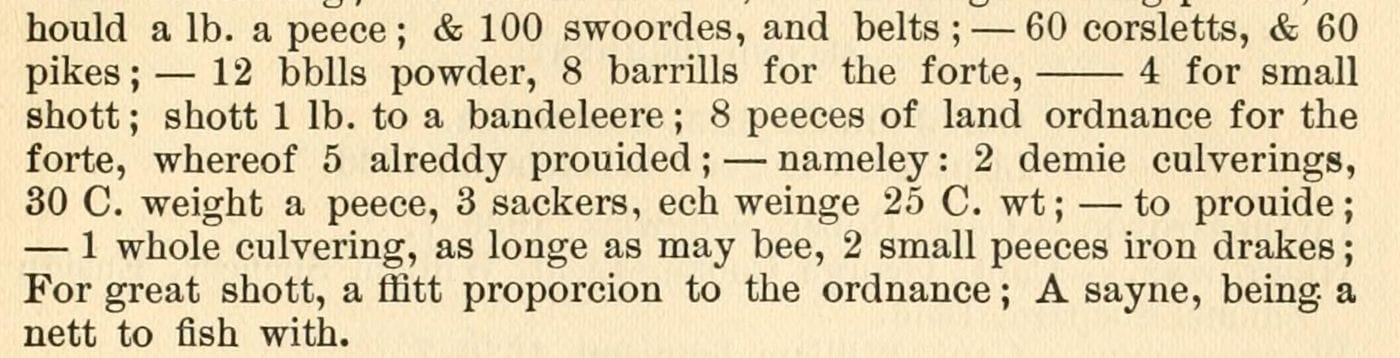
In 1629, before the first ships of the Winthrop fleet had sailed, the Massachusetts Bay Company drew up a list of what its new colony would need to defend itself. The list reads half like an arsenal and half like a hardware store: long fowling pieces and muskets, a hundred swords and belts, sixty corslets (body armor) and sixty pikes, twelve barrels of powder. Then the great guns for the fort: “2 demie culverings, 30 C. weight a peece,” that is, two half-culverins of thirty hundredweight each, three sakers (a lighter gun), and, still to be provided, “1 whole culvering, as longe as may bee.” The list closes, with a practicality I have come to love, on “A sayne, being a nett to fish with.”
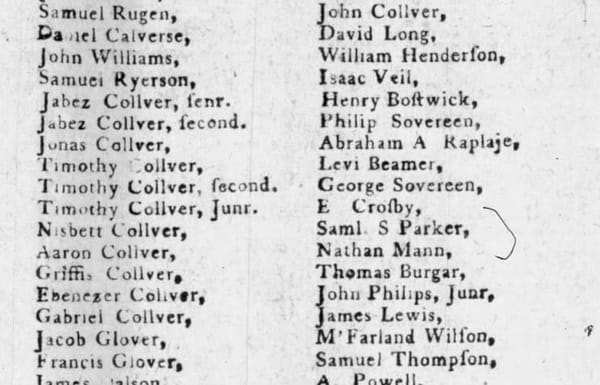
By 1637 my ancestor Edward Colver was at Dedham, and his name stands on the town’s covenant roll. Put the two documents side by side, the gun’s culvering on the arms list and the man’s Colver on the covenant, and you can see why more than one family compiler has wondered whether the gun and the family share a root. The words look like cousins. They are not even the same animal.
The snake
A culverin is a cannon, a long and slender gun of the sixteenth and seventeenth centuries, built to throw a ball a great distance for its bore. The colony kept buying them. An order out of Bilbao in 1673 calls for “twelve whole culverin, twelve demy culverin cutts, sixteen sakers” (the cutts were shortened guns), and George Madison Bodge, who printed it, adds that the great guns were “mostly for coast defence, being useless in Indian warfare.” They pointed at the sea.
The word came into English from French couleuvrine, and couleuvrine comes from couleuvre, a snake, from the Latin colubra, a snake again. The gun was named for its long, thin, serpentine barrel. The French called it, in effect, a little snake, and gun-founders sometimes cast a serpent’s head at the muzzle to make the pun in bronze.
The dove
Our name comes from somewhere else entirely. In Old English the word is culfre, a dove or a pigeon; the language did not trouble to choose between them. I traced that word through the dictionary in July, in Why We’re Collver, Not Culver. Two milestones belong beside that account.
The first is in the Gospel. When the Wycliffite translators made the first complete English Bible in the 1380s, they came to the moment in the temple when Christ overturned the tables, and they wrote that he overturned “the chayeris of men that solden culueris,” the seats of the men who sold doves (Matthew 21:12). The poor brought doves to the temple because doves were what the poor could afford. The word was in the English Bible before the name was in a parish register.
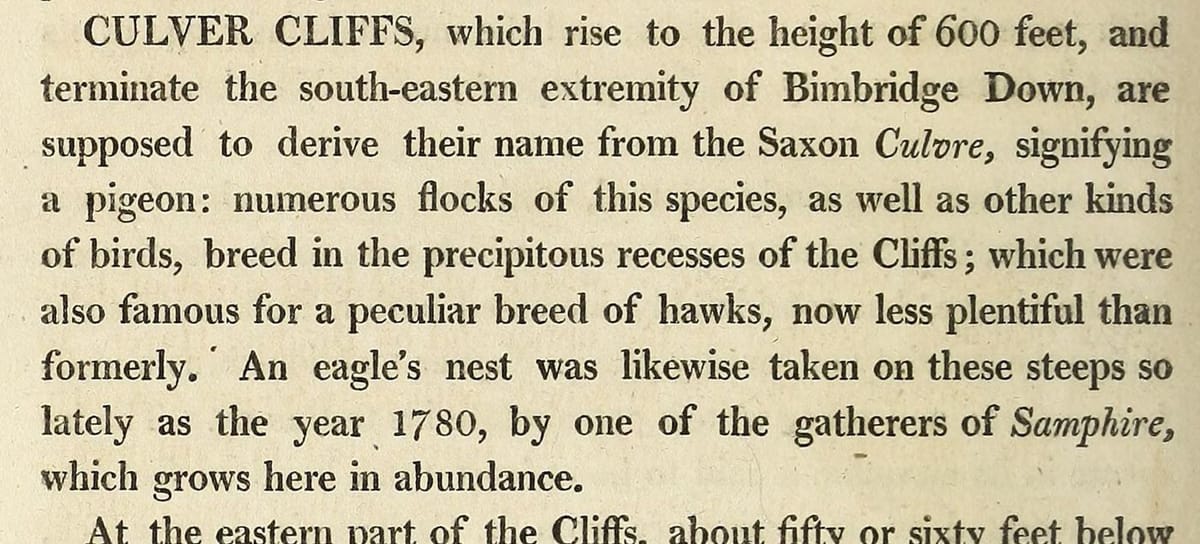
The second is in the chalk. At the eastern end of the Isle of Wight a white cliff falls into Sandown Bay, and it is called Culver Cliffs. In 1805 the topographers John Britton and Edward Brayley described it for The Beauties of England and Wales:
Culver Cliffs, which rise to the height of 600 feet, and terminate the south-eastern extremity of Bimbridge [Bembridge] Down, are supposed to derive their name from the Saxon Culvre, signifying a pigeon: numerous flocks of this species, as well as other kinds of birds, breed in the precipitous recesses of the Cliffs.
They were right about the word and right about the birds. They were wrong about the cliff. The modern survey puts Culver Down at about 341 feet, so the gentlemen overshot by some 260 feet. I find that a fair summary of most of the sources I have used for this family: better on the name than on the measurements.
The next lines give something I did not expect. The cliffs, they wrote, “were also famous for a peculiar breed of hawks, now less plentiful than formerly. An eagle’s nest was likewise taken on these steeps so lately as the year 1780, by one of the gatherers of Samphire” (a sea-cliff herb, pickled in those days and prized). Doves in the recesses, hawks in the same cliff, and an eagle on the ledge. Four centuries earlier Chaucer, telling the story of Philomela, had reached for exactly that picture of the helpless thing under the cruel one: “Or as the culver, that of the eagle is smitten.” On Culver Cliffs the poem was a natural history.
Where the word nested
A living word breeds. From culfre the language made culverhouse, a dovecote, the stone tower a manor kept for its pigeons, which were winter meat when nothing else was fresh. The most remarkable culverhouse in Britain may be the one that wears the word as its name. Culver Hole, near Port Eynon on the Gower coast of Wales, is a wall of mortared limestone some sixty feet high, sealing a cleft in the sea cliff and reachable only at low tide. Inside it rise about thirty tiers of nesting holes. The Royal Commission’s inventory of 1982 agrees it had been used as a pigeon house but, given its massiveness and its winter inaccessibility, doubts that pigeons were the whole of its purpose; it dates the wall only as medieval. The local stories of smugglers and a tunnel wide enough for a horse are a pleasure, not evidence. An English word sits on a Welsh shore because English-speaking settlers were planted on Gower after the Normans took it. The word went where the English went, and the doves went where the cliffs were.
Telling them apart
A gun named for a snake, and a family named for a dove, in the same colony, eight years apart. Two words a careless eye reads as one, from two animals that could not be less alike. The guns on the fort were snakes. The family on the covenant was the dove.
It is a small thing to get right, and getting it right is the habit this whole project is trying to keep. Much of what families are told about themselves turns out to be the gun taken for the bird, a plausible near-word standing in for the true one. Learning to tell the dove from the snake is most of the method.
In 1939 the English novelist Stella Gibbons, who had skewered rural melodrama in Cold Comfort Farm, published a romance set partly in small-town America. She seems to have wanted a name that would sound at once like the deep American past, old founder, old benefactor, the man the town is named after. What she wrote was “the Jabez Culver Infant School,” which “provided education for the children in this lonely district.”
Readers of this blog have met the real Reverend Jabez Collver, the orphan turned preacher who chose the King in the Revolution and paid for it. Did Gibbons know of him? Nothing in the novel suggests it, and I have not seen her papers. So I will say only what the evidence carries: it is a coincidence, and an uncanny one. An Englishwoman reaching for the sound of early America put my ancestor’s Christian name together with my family’s surname and hung them over a schoolhouse door. I would rather hand you an honest coincidence than a theory it cannot carry. The cannon was a lookalike that is no kin at all. The schoolhouse is a coincidence, and it stays labeled that way.
Still a dove
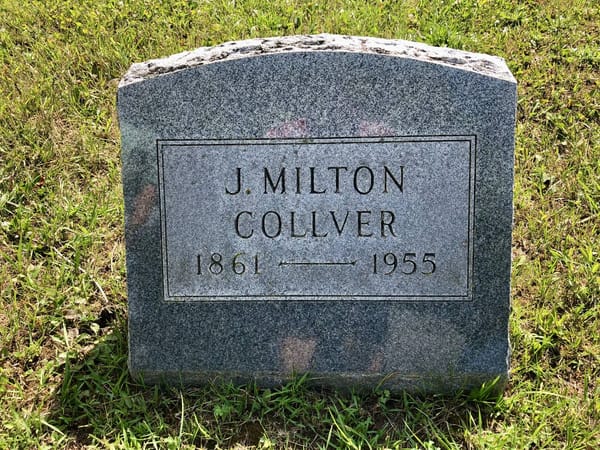
The culverins are long gone from the colony’s forts. Culver Hole still stands on its Welsh shore, and the chalk of Culver Cliffs still drops into Sandown Bay. The word culfre, the rock dove of the sea cliff, is still under Stella Gibbons’s schoolhouse the way it is under my grandfather’s headstone, unchanged while everything spelled around it drifted from Culverd to Colver to Collver, and from country to country. Whatever else we have been, we have been the dove for as long as we have been anything, and every one of us who signs the name still writes the bird.
Sources
- Massachusetts Bay Company ordnance provision, 1629, printed in George Madison Bodge, Soldiers in King Philip’s War, 3rd ed. (Boston, 1906), 471. Public domain.
- Bodge, Soldiers in King Philip’s War, 479, quoting the 1673 order from Bilbao.
- Culverin < French couleuvrine < couleuvre, adder < Latin colubra, snake; culver < Old English culfre, dove. Oxford English Dictionary, s.vv.
- Matthew 21:12, Wycliffite Bible, Later Version: “and he turnede vpsedoun the bordis of chaungeris, and the chayeris of men that solden culueris.”
- John Britton and Edward Wedlake Brayley, The Beauties of England and Wales, vol. 6, Hampshire and the Isle of Wight (London, 1805), 384. Public domain. Modern height of Culver Down about 104 metres (some 341 feet).
- Geoffrey Chaucer, The Legend of Good Women, “The Legend of Philomela” (c. 1386), as modernized in Charles Wareing Bardsley, English Surnames, 2nd ed. (1875), 495; Skeat’s text reads “Or as the colver, that of the egle is smiten” (lines 2319–20).
- Royal Commission on the Ancient and Historical Monuments of Wales, An Inventory of the Ancient Monuments in Glamorgan, vol. 3, pt. 2 (1982), 362–63 (Coflein NPRN 37514).
- Stella Gibbons, My American: A Romance (London: Longmans, Green, 1939), 228–29. Quoted briefly, with attribution.
Adapted from chapter one of the forthcoming book We Are Doves. © 2026 Albert B. Collver III.