The Lost Family Register
In 1832 an old soldier swore he had seen his birth on the family register of his father's family — and could not say what had become of it. On the registers this family lost, refused, and should not have trusted.

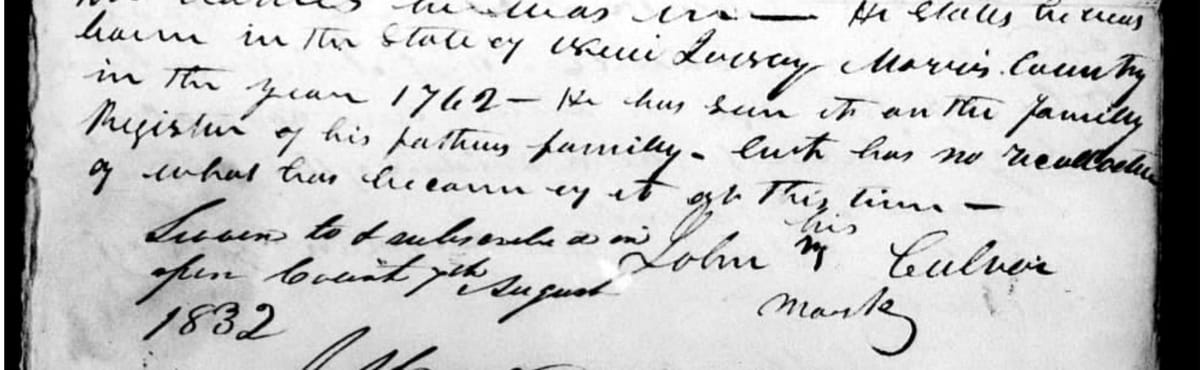
On the seventh of August, 1832, an old soldier stood in open court in Bedford County, Tennessee, and tried to prove the day he was born.
His name was John Culver. He gave his age as “between sixty nine and seventy years,” which is the arithmetic of a man who knows the year but not the day. And then he told the court, under oath, where the day had gone — one sentence, taken down by the clerk in the third person, that I have not been able to put away since I first read it:
“He states he was born in the State of New Jersey, Morris County, in the year 1762 — he has seen it on the family Register of his father’s family — but has no recollection of what has become of it at this time.”

He had seen it. It was gone. That is the whole post, and in a way it is the whole method of this project, so I intend to take my time with it.
What a register is
The word is worth a moment, because the word knows something the family forgot. Register comes down through the medieval Latin registrum from the Late Latin regesta — literally “things carried back,” from regerere, to carry back, to bring home again. A register is not merely a list. It is the past carried back within reach, so that a man standing in a Tennessee courtroom can lay his hand on a page written in New Jersey seventy years before.
For a family like this one, the register was almost never a church book. Readers of the Rogerene posts will remember why: the fellowship the family belonged to in Connecticut and New Jersey baptized no infants, married outside the established forms when it married at all, and kept no registers on principle — the best records of that fellowship are its neighbors’ complaints. So the register lived at home, on the flyleaf and blank leaves of a Bible: births in one hand, then another, then a third, as the pen passed down. One copy. One book. One house. It rode in one wagon when the family moved, and everything this post is about follows from that arithmetic.
The man in the courtroom
Readers of A House Divided have met John before. In October of 1776, at the court house at Newton in Sussex County — very likely the same building where the sedition proceedings against Rev. Jabez Collver would run the following year — a boy of about fourteen stepped up and enlisted in the Continental service. He took a bayonet wound at White Plains. He served at the Short Hills, at Springfield, at Morristown, re-enlisted for the duration, and was discharged, as he remembered it, “the 14th day of November next after the surrender of Lord Cornwallis.” Five years, by his own pretty-certain count, on the Patriot side of a family the war had split down the middle.
And here is what he did with the paper that proved it:
“This discharge I have long since lost in the State of N. Carolina, I took very little care of it, not believing it would ever be of any service or advantage to me.”
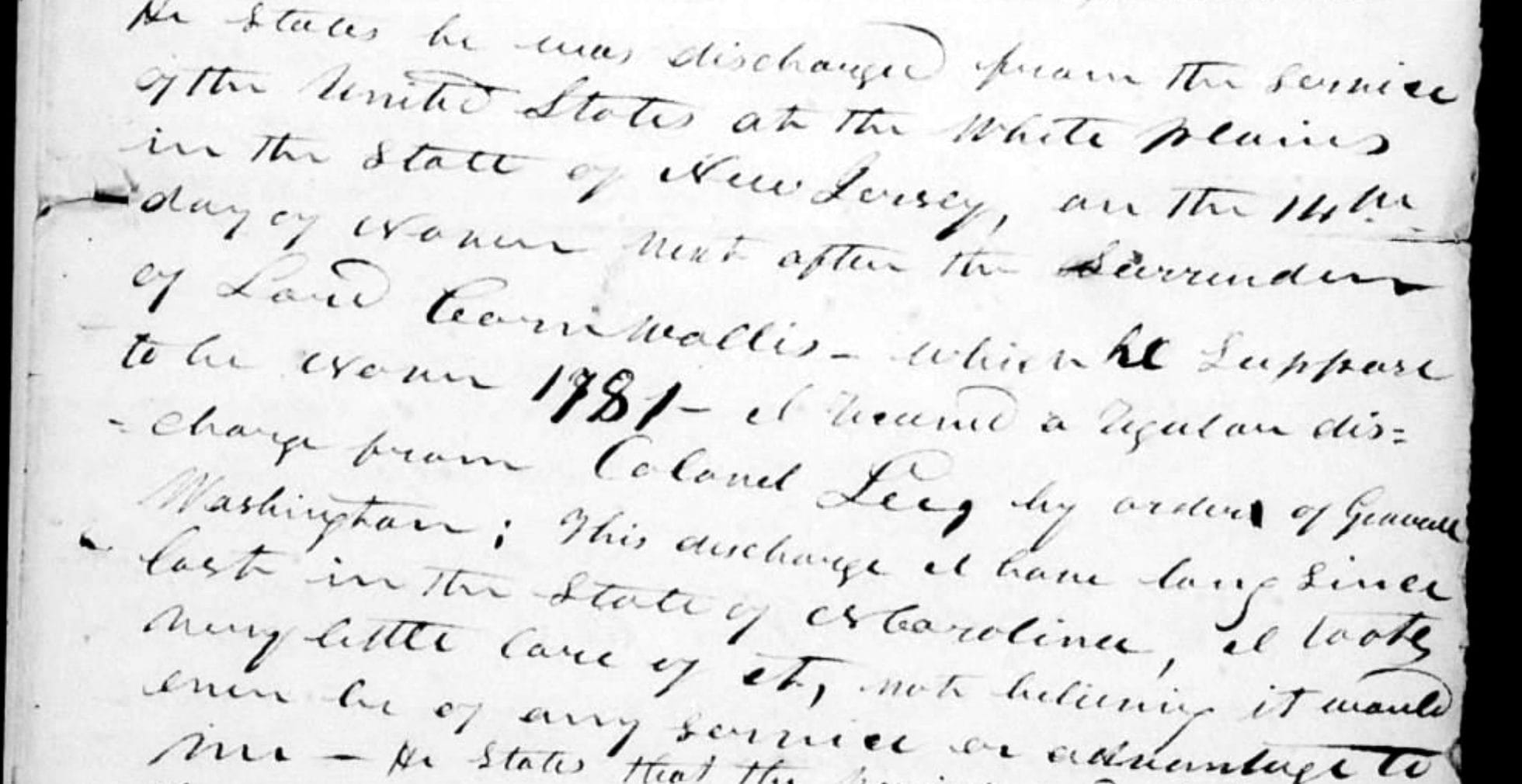
Sit with that sentence next to the first one. A man who fought five years believed the proof of it would never matter, and let it go somewhere in North Carolina. For nearly half a century he was right. Then Congress began passing pension acts, and a Tennessee farmer in his seventies discovered that the republic he had served as a boy now wished to see the paperwork.
The price of a missing page
What the file records next is a lesson in what institutions will and will not accept in place of a register, and the family paid the tuition.
In 1829 he applied under the pension act of 1828 and was turned down flat. The Bureau’s memo survives in the file: “No record of him — Not allowed.” A man with a bayonet scar, rejected because the paper trail was thinner than the flesh. A neighbor writing on his behalf put the problem exactly: “It is the common understanding of the country that he did serve during the whole of the war, but this rests on rumor only.”
In 1832 a broader act passed, and this time he came armed with what a paperless man could muster — his own oath, and his neighbors’. A clergyman named Hayman Bailey, his wife’s brother, swore he had known him about forty-five years, in Maryland, in North Carolina, and in Tennessee, and that in all that time he “was reputed & believed to be a Revolutionary Soldier, I have never heard it doubted or disputed.” His congressman added a letter vouching that John “is a man of excellent character and is universally reputed to have served as he has declared.” The congressman was James K. Polk, a dozen years before the presidency. This time the Bureau relented: certificate 13,680, eighty dollars a year, issued the first of June, 1833, and sent, the docket notes, to the Honorable J. K. Polk.
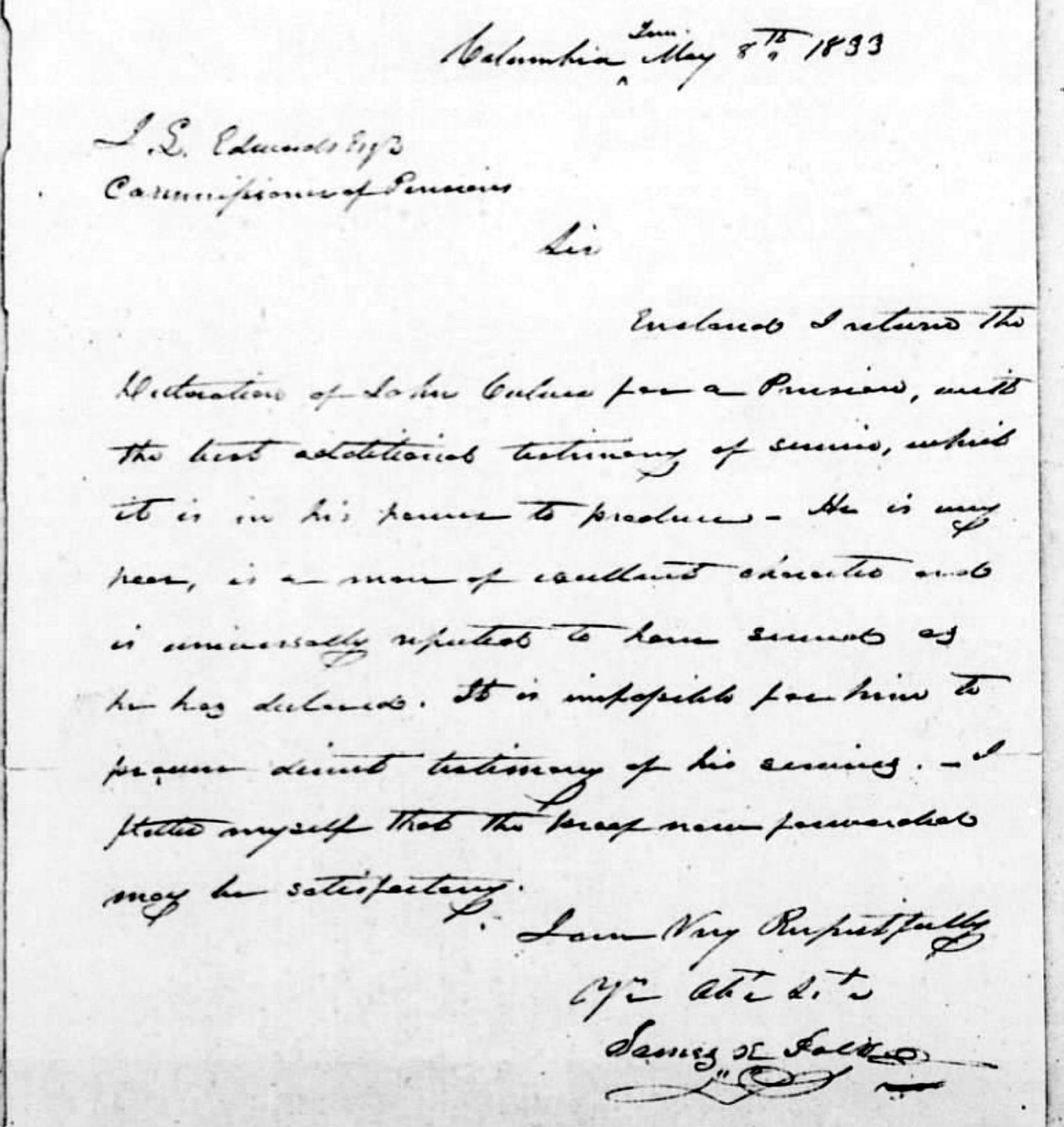
In 1833, then, the United States accepted a preacher’s word and a future president’s letter in place of one lost page. It would not do it twice.
John died in 1836; his widow Sarah died in 1843; and when their twelve children pursued her arrears, the government asked for the marriage record. The wedding was real — a Guilford County, North Carolina, frontier wedding of 1786 or ‘87, twelve children and sixty years of household to show for it, and two of Sarah’s brothers still living to swear to the day. The clerk at Greensboro searched and answered: “cannot find such bond, nor do I know of any such name as Culver in our county.” The family’s agent conceded the ground in 1853 — “No record evidence can be found of the marriage in this case” — and offered the brothers’ affidavits instead. The jacket of the file is stamped REJECTED.
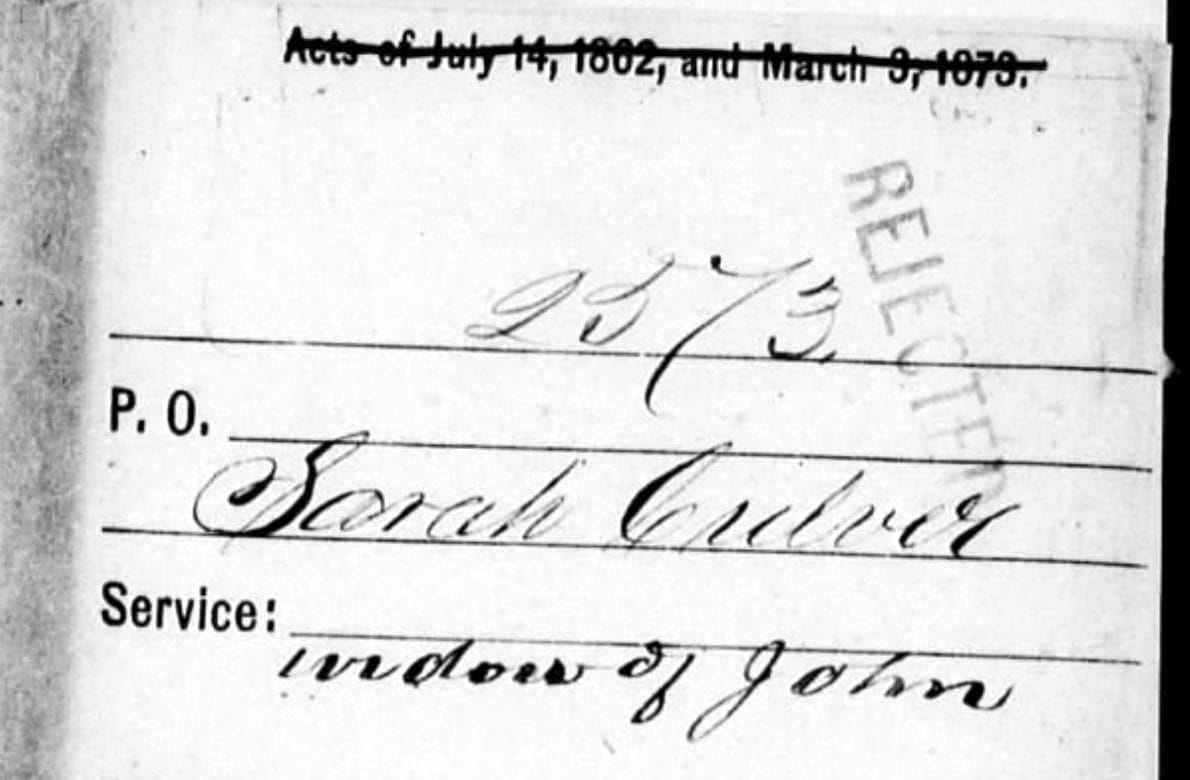
Here is the method point, and it cuts both ways. This project has said many times that the absence of a record is not the absence of the event — and this file is the proof. The birth happened; the service happened; the marriage happened; the children were undeniably there. But the Bureau was not wrong by its own lights either, because an institution cannot pension an event. It can only pension a record of one. Testimony ages with the witnesses; a register, lodged where it can be found, does not. The family had kept a register. What it had not done was lodge a duplicate anywhere outside its own four walls — and it spent a century paying for that.
The registers we almost had
John’s father’s Bible is not the only register this family reached for and closed its hand on air. Set them in a row and they make a little museum of absence.
The oldest is a parish register in Middlesex, England. The family tradition holds that the immigrant Edward descended from an Edward Culver who was vicar of Harmondsworth — instituted in 1575, dead in the spring of 1594. The vicar is real. The kinship can be neither proven nor refuted, and the reason is the subject of this post: Harmondsworth’s parish registers were lost before 1670. On that claim there is no verdict, and there can never be one. The page that would settle it did not survive to be read by anybody now living, or by anybody’s great-grandfather either.
The second is the register that never existed at all. The Rogerene generations — the family’s dissenting century in Connecticut and New Jersey — are the reason a researcher finds no baptismal record for children we can prove were born. Their absence from the church books is not a gap in the record; it is the record. A fellowship that held infant baptism to be no baptism did not fail to register its children. It refused to, and the refusal was the confession of its whole faith.
And the third is John’s — the only one of the three we know once existed, because a man swore under oath that he had seen it. Somewhere between Morris County and Tennessee, through the same decades that scattered his discharge in North Carolina, the register of his father’s family went wherever it went. He could not say. Nobody has been able to say since.
To these three I have to add a fourth, of a different and worse kind: the register that survived and cannot be trusted. In 1920 the New York Genealogical and Biographical Record — a reputable journal, then and now — published a formally registered Culver pedigree resting on photostats of “Bible records of the Culver family of Groton,” supported by the affidavits of four Culvers and a notary’s seal. The Bible had belonged to a Jersey City physician, dead in 1897, whom the registration proudly calls “a close student of Culver genealogy.” Sit with that the way we sat with John’s sentence. A family Bible owned by a genealogy enthusiast is precisely the Bible into which a man might copy what he had read in the printed genealogies — which could then cite the Bible as proof. The marriage that pedigree vouched for did not survive the twentieth century’s scrutiny; the demolition and the repair are a story this blog has told elsewhere. The lesson belongs here: a lost register leaves a hole, and a hole at least announces itself. A register written backward from the printed books fills the hole with something shaped exactly like an answer.
What the hole did
Because a missing register does not merely subtract. It invites.
Consider what the lost page has done to John himself. Had it survived, one line — a father’s name, a date — would settle in five words what four years of research cannot. Without it, the pension file and every paper his descendants filed afterward are silent above him, and the man floats: born in the right county, enlisted in the right courthouse, the right age and the right war to be Rev. Jabez’s nephew, which is what the tradition of his descendants has always called him. The book grades him carefully — kinsman beyond reasonable doubt, nephew by strong tradition and every circumstance — and assigns him no generation number, because a grading is all the surviving paper allows. He is a man standing beside the family tree with his hand on it, and the page that would have handed him up into the branches is the page nobody carried back.
And when a register goes missing, family memory does not leave the space empty. Fourteen chapters of this project have watched what memory does under load: the acres inflate, the ministry becomes a chaplaincy, the possessions migrate toward the brightest name on the shelf. Memory abhors a blank leaf. The register is what holds the facts still; take it away, and the facts begin, very slowly, to drift toward what the family wishes they had been. The drift is not lying. It is what an honest family does instead of a record.
The covenant and the register
Five weeks ago this blog counted the sixty-eight names on the Dedham covenant of 1636, our own ancestor’s among them, still readable after nearly four centuries. It is fair to ask why that page survived when the family’s registers did not, and the answer is not luck. The covenant was a community’s record: signed in a town’s book, lodged in a town’s keeping, copied and recopied by clerks whose whole office was the carrying-back. The register was a family’s record: one book, one house, one wagon. Communities lodge; families carry. What is lodged survives fires, moves, and forgetful grandsons. What is carried survives only as long as every single carrier, in an unbroken chain, knows what he is holding.
The covenant, as it happens, turns up a second time in this family’s story, a century and a half later and three hundred miles west — but that is a Friday’s post, and it is coming.
Today’s post ends where the method register always ends, which is in the present tense, with you. Whatever your family’s version of the flyleaf is — the Bible, the baby book, the folder of certificates, the box of photographs only one person can still caption — it is a register, and it is currently being carried, not lodged. So write it down, and date it. Have the one who knows the names caption the photographs this winter, not eventually. Then make the duplicate, and put it somewhere that is not your house: a cousin’s file, a church office, a county historical society, the cloud if you trust it — anywhere that breaks the one-wagon arithmetic. John’s family kept its register perfectly well until the day nobody could say what had become of it.
Regesta: things carried back. The carrying is a verb, and a verb needs somebody living. As of this Monday morning, that is you.
Sources and notes: John Culver’s pension file is R.2573 (National Archives, Revolutionary War pension files, M804), read in full from the Fold3 images for this project; all quoted phrases are the file’s, including the clerk’s record of the 7 August 1832 declaration (the birth “on the family Register of his father’s family”), the lost-discharge statement, the Bureau’s 1828-act rejection memo, the Rev. Hayman Bailey affidavit, James K. Polk’s endorsement of 8 May 1833, the Greensboro clerk’s reply of 10 June 1852, the agent’s concession of 2 June 1853, and the REJECTED stamp on the widow’s jacket. The grading of John as Rev. Jabez’s kinsman follows chapter 7 and Appendix D of the forthcoming book. The vicar of Harmondsworth (instituted 1575, d. 1594) and the loss of that parish’s registers before 1670 are set out in chapter 1; the Rogerene refusal of infant baptism and of the established registers in chapter 4. The 1920 registered pedigree appeared in the New York Genealogical and Biographical Record under John Reynolds Totten’s series, resting on the Groton Culver Bible of Dr. Joseph Edwin Culver (d. 1897); its central marriage claim was dismantled by Donald Lines Jacobus in The American Genealogist (1945, 1955), and William R. Yeager’s Sources in Collver-Culver Genealogy (1976) restored the documented wife. The Dedham covenant and its sixty-eight names were the subject of “The 68th Name” (24 July 2026) on this blog.
Adapted from the forthcoming book — We Are Doves: Four Centuries of the Collver–Culver Family.
© 2026 Albert B. Collver III · The Collver Family History Project. Original historical documents reproduced here are in the public domain; the research, text, and annotations are the author’s. Please cite or link rather than republish.