The Germans Next Door
Vanita Johnson Engelbrecht died in the small hours between Saturday and Sunday, the twenty-ninth and thirtieth of August. She was my father's eighth cousin — the two of them the same number of generations down from a couple who lie in unmarked ground on a New Jersey mountainside — and she was the mother and grandmother of people my own family worships beside today. Her husband of sixty-seven years, Adolph "Duke" Engelbrecht, went before her last October.
Readers of this blog have met her family before, though not by her name. To honor her properly I have to tell a story this project has been saving: how a family of Connecticut dissenters came down a mountain from one exile, and found the Germans already there — and what happened when the two peoples started marrying each other.
A valley filling with German names
The northwestern hills of New Jersey in the 1730s and 1740s were not English country. Beginning about 1710, German-speaking families — many of them refugees of the great Palatine emigration that the wars and winters of Louis XIV's era had shaken loose from the Rhineland — landed at New York and Philadelphia and worked their way inland, up the Raritan valleys and into the limestone hollows of what are now Morris, Hunterdon, Warren, and Sussex counties. Their historian, Theodore Frelinghuysen Chambers, could still map them a century and a half later by their churches: Lutheran and Reformed congregations at German Valley, New Germantown, Spruce Run, Stillwater — and by their names, whole pages of them. To the vicinity of German Valley, he writes, belonged the Welshes, the Hagers, the Swackhamers, the Terriberrys, the Hanns.
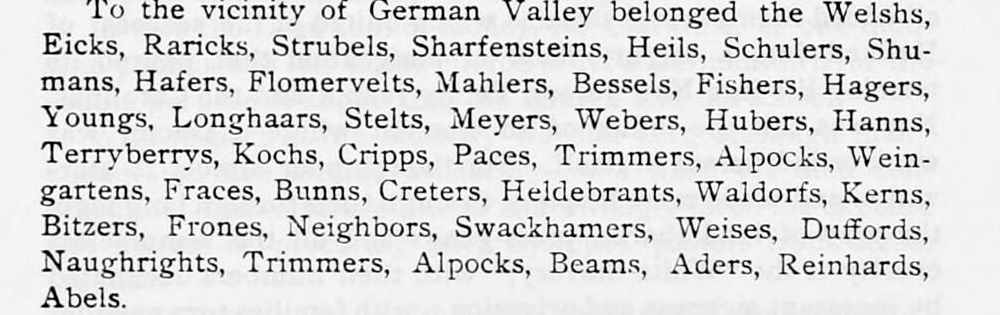
Hold that last name.
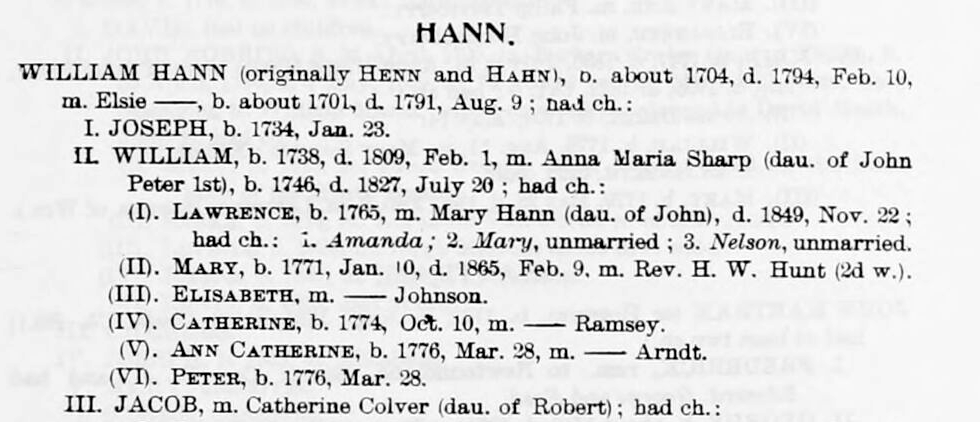
Among these families was a young couple the records call William and Elsie Hann. Nearly everything personal we know of them comes from a single stone — a memorial their descendants raised in the Pleasant Grove cemetery in 1854, sixty years after William died, which says they were "natives of Germany" who "emigrated young," and that each lived to about ninety. No surviving record names the town they left, the ship they crossed on, or the church that baptized them, so this post says German and resists saying anything finer. What contemporary paper does survive is exactly the kind a settled man generates: a New Jersey naturalization of 1730, a leasehold on West Jersey Society land in 1735, and farmland at Pleasant Grove on Schooley's Mountain, bought out of the holdings of the Quaker proprietor Samuel Schooley. Chambers says the name was originally Henn or Hahn — the German for hen, or for rooster — and that the county's English-speaking clerks sanded it to Hann, the same quiet abrasion that was working on my own family's name in the same record books. I will not lean on the ornithology, though a reader of a project called We Are Doves may smile at it; the sober likelihood is that the clerks heard a German name and wrote an English one, as they always did.
The dissenters come down the mountain roads
Into this German hill country, in the same decades, came the family this blog is about — by the strangest route of any settlers on the Mountain. The Colverites were not Germans and not churchmen of any establishment: they were Rogerenes, Connecticut dissenters who had been whipped and jailed in New London for keeping Saturday sabbaths and refusing the hireling ministry, and who left Groton for New Jersey in waves in the 1730s. Regular readers know the story — the two colonies, the shore years at Barnegat, and the return. In December 1748, Robert Collver — son of the migration's patriarch John, and grandson of the John and Sarah of Fifteen Stripes — bought the 265¼-acre farm on Schooley's Mountain that would hold the family's burying ground.
Chambers, describing that farm, gives its situation in five words that are the hinge of this whole post: "265 acres west of Henn."
The Germans were not merely in the neighborhood. They were the next farm over. The Hann land and the Collver land came out of the same Schooley holdings and touched. Two families who had crossed the same ocean a generation apart, from different countries, for different reasons — one fleeing a ruined Rhineland, one fleeing the New London house of correction — now shared a fence line on a New Jersey mountain.
What happened next is what always happens on a shared fence line.
Esther
Sometime in the early 1750s — no marriage record survives; the date is reckoned back from a first child born in 1752 — Robert's daughter Esther Collver married Jacob Hann, son of William and Elsie. She was a granddaughter of the man jailed at New London and of the Sarah who took her fifteen stripes singing; she was also first cousin to Rev. Jabez Collver, my sixth-great-grandfather. It is the earliest identified marriage of this family into the German community, and it was no isolated event: in the years that followed, the Collvers' German alliances multiplied — a Hann, a Sovereen, a Beemer — and each one, as the book will show, turned out to be load-bearing in the family's later history.
I should pause to kill a legend, since killing legends gently is this project's trade. The old Hann family chronicle, compiled for Armstrong's Pioneer Families of Northwestern New Jersey, proudly records that Esther was a great-great-great-granddaughter of John Winthrop, governor of Massachusetts Bay. She was not. That is the same Winthrop marriage myth that ran through my own family's printed genealogy for a century until Jacobus and Wood demolished it in 1945 — and it is oddly comforting to find the in-laws' book carrying the identical heirloom. Both families inherited the same imaginary governor. (Chambers's genealogy, for its part, calls Robert's daughter "Catherine." Her father's will, which named her while she lived, says Esther. The will governs.)
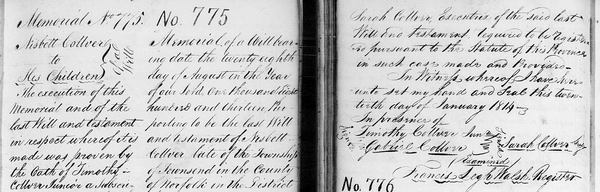
The marriage held through everything the century threw at it, including the Revolution, which divided this household as it divided every household in these hills: Esther's brother Timothy stayed loyal to the King and ended his days in Upper Canada, while her Hann in-laws sent a militiaman to the American side. When Robert Collver died in 1783, his will named as co-executors his son Timothy and his son-in-law "Jacob Hann" — the German husband standing executor to the Rogerene patriarch. And when Jacob himself died in 1802, the Hann chronicle records it was "quite probable" he was buried in the graveyard on his father-in-law's farm — the Colver burying ground this blog has visited before. Esther outlived him by two decades; her son's 1821 will still provided for "his aged mother." The family's future arrived speaking German, and the family buried it as kin.
Nine generations down
Now the chain, plainly stated, because Vanita's place in this story runs straight down from that marriage.
Esther and Jacob's son Philip Hann Sr. (1756–1821) farmed the Pleasant Grove homestead. Philip's son John (born 1788) married Margaret and died young, in 1824, leaving eight children. John's daughter Mary Ann Hann married Samuel Johnson — and here I can report a small discovery made this very week, in Chambers's own pages, where the line I expected to rest on family-tree data turns out to stand in print: his 1895 Hann genealogy carries John's daughter "Mary, m. Samuel Johnson; res. at Newton." Newton is in Sussex County, and in Sussex County the Johnsons stayed awhile: Mary Ann's son James Monroe Johnson (1840–1924) married there in 1866. His line went north into New York State — a son Esker Cole Johnson, a grandson Cole Esker Johnson of Oneida — and on the first of February, 1958, at Redeemer Lutheran Church in Oneida, Cole's daughter Vanita Johnson married Adolph William "Duke" Engelbrecht. They raised their family on an upstate dairy farm, and they raised it Lutheran.

Honesty about the middle: the upper links of this chain stand on published record and probate, and the lower links stand on living memory; some of the Johnson generations between still rest on family-tree data awaiting the record-by-record verification this project owes every line it prints. I state the chain as the family's books and trees carry it, one link now newly corroborated in an 1895 imprint, and I flag what remains to be nailed down. That is the house rule, and Vanita — a genealogist's cousin if ever there was one — deserves nothing less than the honest version.
There is one more witness, and it is the strangest one: blood itself. My father and Vanita both submitted DNA for comparison, and the laboratories found a single matching segment on chromosome 13 — 11.7 centimorgans, a sliver — shared between two people whose common ancestors died before the French and Indian War. At eight cousins' distance, DNA is a whisper, not a proof; single segments at that range can mislead, and the paper trail does the real proving. But it is something to sit with: a physical thread, copied faithfully through nine generations on each side of the fence line, from a couple married on Schooley's Mountain when George II was king.
The pew, again
Esther Collver's German marriage carried her branch of this English dissenting family into the German community, and in time into the Lutheran church — and that branch has served the church remarkably. Vanita's son, Rev. Edward Engelbrecht, was for years senior editor at Concordia Publishing House and general editor of The Lutheran Study Bible; her daughter, Deaconess Amy Rast, has served Concordia Theological Seminary at Fort Wayne, where her husband was president. And her grandson sits with his young family in the congregation I serve at Troy, Illinois — where, in 2026, her great-grandson Matthias was baptized: the newest child of Esther's line, at the font of a church his seventh-great-grandmother's marriage set the family walking toward two hundred and seventy years ago.
Nobody planned this. My family and Vanita's diverged at a couple named John Collver and Sarah Long, who lie in the burying ground on the old Robert Collver farm — Sarah under a stone cut in 1756, the earliest yet found to spell the name with the family's double L; Jacob Hann, in all probability, in the same soil. Their descendants scattered down two lines that knew nothing of each other for two centuries, and reconverged at a communion rail in a small town in Illinois that neither New Jersey nor Germany ever heard of.
This past Sunday morning, one of the two lines lost its matriarch. The record — which is what this project keeps — will say that Vanita Johnson Engelbrecht descended from Esther Collver and Jacob Hann of Schooley's Mountain, and through them from the Rogerene prisoners of New London and from a German couple who emigrated young and lived to ninety on the next farm over. The rest of what she was belongs to the people who loved her, to whom this small history is offered with sympathy, and with thanks for a cousinship that made a very old story personal again.
Requiescat in pace — may she rest in peace.
Sources and notes: The German settlement of northwestern New Jersey, the church-by-church family lists ("To the vicinity of German Valley belonged… the Hanns"), the Hann genealogy ("originally Henn and Hahn"; Jacob's marriage; Philip's 1821 will; "Mary, m. Samuel Johnson; res. at Newton"), and the situation of Robert Collver's farm ("265 acres west of Henn") are Theodore Frelinghuysen Chambers, The Early Germans of New Jersey (Bound Brook, N.J., 1895), 36–37, 297–98, 397–98. William Hann of Pleasant Grove — the 1730 naturalization, the Schooley land, the 1854 cenotaph ("Natives of Germany; emigrated young"), Jacob and Esther's marriage, the Winthrop claim, the militia service of William Jr., and Jacob's probable burial "in the graveyard on the farm of his father-in-law Robert Collver" — is William C. Armstrong, Pioneer Families of Northwestern New Jersey, Article 83, contributed by Edna Hann Apgar. Esther's name and portion are her father's 1783 will; her survival to 1821 is her son Philip's will of that year, shared by a Hann-line correspondent whose help this project has acknowledged before. Robert Collver's deed of 22 December 1748 is West Jersey Deeds, Liber O, fol. 238, New Jersey State Archives. The Winthrop myth's demolition is Jacobus, The American Genealogist 22 (1945): 107–10. The 1756 "Collver" stone is the 1974 Colver burying-ground transcription in the Genealogical Magazine of New Jersey. The Johnson generations and the 1958 marriage at Redeemer Lutheran, Oneida, N.Y., are stated from family records and the New York State marriage index, with the verification status given in the text. The DNA comparison is a GEDmatch one-to-one report between the author's father and Mrs. Engelbrecht, cited with her family's knowledge. The Rast and Engelbrecht names appear here, as in the forthcoming book, with the family's explicit permission.
Adapted from the forthcoming book — We Are Doves: Four Centuries of the Collver–Culver Family.
© 2026 Albert B. Collver III · The Collver Family History Project. Original historical documents reproduced here are in the public domain; the research, text, and annotations are the author's. Please cite or link rather than republish.