The Preacher Who Crossed Over
An orphan of the persecuted Rogerene sect chose his own guardian at sixteen, took orders under the Cambridge Platform, and spent nearly thirty years as the kind of salaried minister his family had heckled.

In July of 1747, in the probate office at New London, a sixteen-year-old boy stood before the court to do the one legal thing the law of guardianship left in his own hands. Being "a minor, over 14," he was entitled to choose the man who would answer for him, and he chose his uncle, Isaac Lamb, his mother's brother. The clerk entered it in the probate book, J5, page 59, and the court moved on to other business.
It is four lines of routine record. It is also the third arrangement made for a fatherless boy in his sixteen years, and the first he was old enough to make himself.
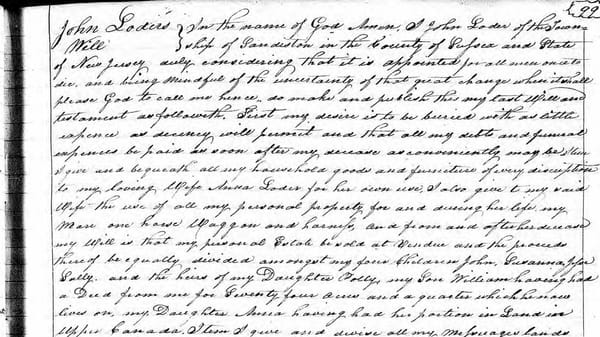
Lay the records of his childhood in a row and they tell the story plainly enough. In December of 1732 his father, John Colver, lay sick at Black River in New Jersey and made a will naming a son the clerk spelled "Jabsh," seventeen months old. Within the year the father was dead. In August of 1735 the court at New London appointed guardians for "the 3 Children of Jno Colver Junr Late of Black River Deed." In 1737 his mother, Freelove, remarried at Groton. And in 1747 the middle son, turned sixteen, stood in the probate office and chose his guardian for himself.
No published genealogy ever set those four records side by side; they lie in three archives, in two colonies, under five spellings. Put together, they explain something about the man the boy became. Jabez Collver would found a settlement in the Upper Canadian forest at sixty-two, when most men of his age were writing their wills, and every account of him marvels at it. The records of his first sixteen years take the marvel out of it and put something better in its place. The man who would rebuild in a wilderness at sixty-two had been starting over since he was two.
The date with a hole in it
A word on his birthday, because it shows how a date survives. The Groton town records, as a twentieth-century typescript renders them, give Jabez's birth as the nineteenth of June, 1739, and the indexes of the digital age faithfully repeat it. But a boy born in 1739 could not be named alive in his father's will of 1732, and could not have stood in a probate office in 1747 as "a minor, over 14." Somewhere between the old town book and the typescript, a 1 became a 9. He was born on the nineteenth of June, 1731, as the genealogists of the 1950s printed it, and the probate papers prove them right. A record can be genuine, transcribed, indexed, searchable, and wrong. It is the chain of records that keeps the date, not the single entry.
Crossing over
Sometime in his young manhood (the record does not say when, or where, or at whose preaching) Jabez Collver left the religion his family had been whipped for.
Readers of this blog know that religion. His family were Rogerenes, the dissenting sect founded at New London by John Rogers: people who refused the Sabbath laws, the church rates, and the paid ministry of Connecticut's established churches, and who went to jail and to the whipping post for it for three generations. This was the family of the fifteen stripes and the midnight jail-break. They had a word for a minister who took a salary to preach: a hireling. And the orphan they raised grew up to be one.
The next thing we hear of his religious life comes from Jabez himself, set down about 1815, in an autobiography that survives only in transcription:
I was ordained according to the Cambridge Presbyterian order, which was a congreational platform. The ordination was performed by ministers and elders by the desire of the church. In that order by the grace of God I still continue.
The ordination was about 1761; he was about thirty. To a modern ear "the Cambridge Presbyterian order, which was a congregational platform" sounds like a contradiction fumbled by an unlettered man. It is in fact an exact description of a real thing.
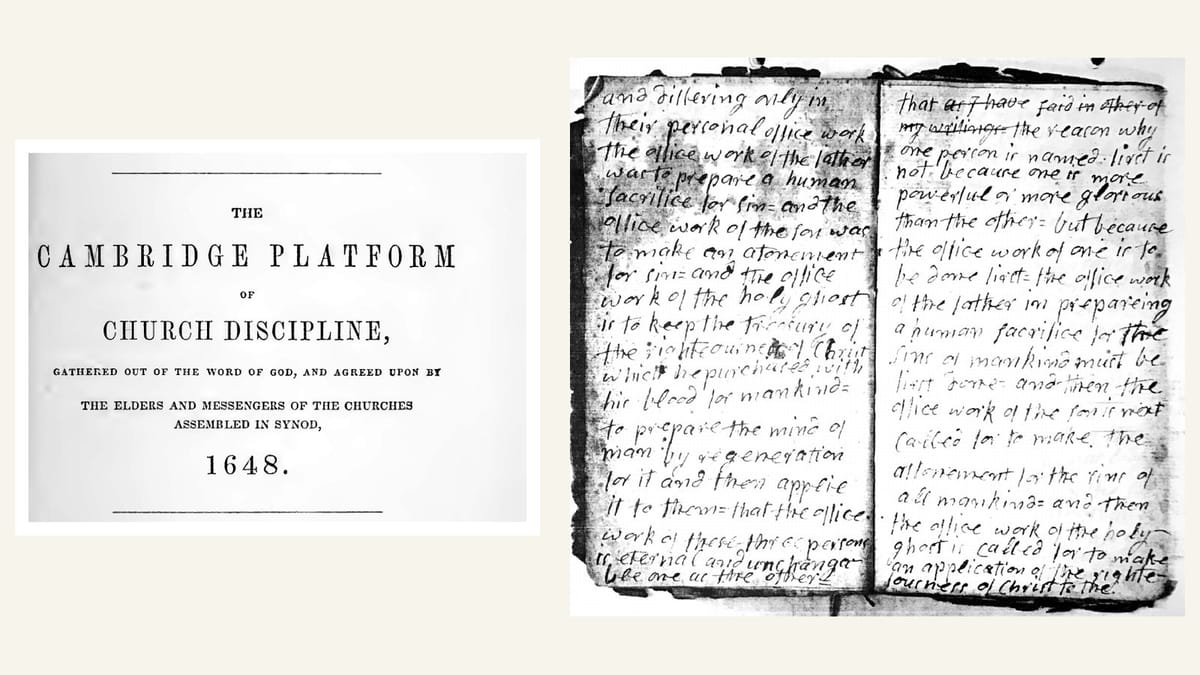
The Cambridge Platform, drawn up by the New England churches in 1648 and reaffirmed by their synod in 1680, was the constitution of the New England way. It was Presbyterian in its gravity, in its offices of minister and elder, and in its insistence on an ordered ordination. It was congregational in its first principle: that authority lived in each gathered church, which called its own minister and answered to no body above itself. Under the Platform a new congregation with no elders of its own could ask the elders of neighboring churches to lay hands on its minister, "by the desire of the church," exactly as Jabez wrote. No bishop was required, and no presbytery. A man ordained that way was a Presbyterian minister whom no presbytery on earth could unmake.
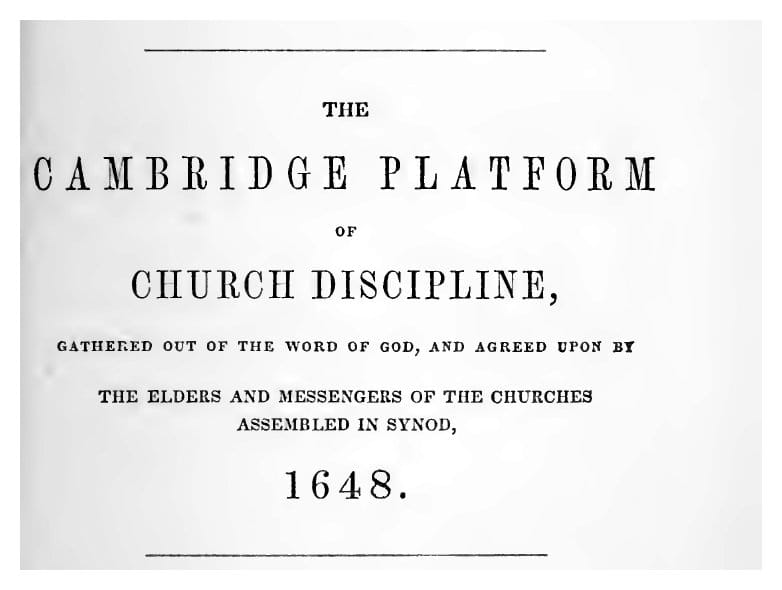
Seen that way, the conversion looks less like a betrayal and more like a road. Strip the Rogerene creed of its scandals and two convictions remain: that the gathered believers were the whole church, and that no distant authority, bishop or presbytery or magistrate, had any claim on them. The Cambridge Platform, at the respectable center of New England church life, held a quieter cousin of the same two convictions. Jabez crossed from the wild edge of congregational independence to its lawful middle. He took the learning, the order, the settled pulpit, and even the wage, and he kept the self-governing congregation his family's whole religion had been built around. He did not so much leave his family's religion as walk to the settled end of its own argument.
Nearly thirty years at the Beemer Meeting-House
The pulpit he took was in the hill country of northwestern New Jersey, in Wantage Township in Sussex County, under the Kittatinny ridge. The historian of that country, writing in 1888, kept the congregation's character and its second minister's memory in a single paragraph:
The church at Beemer Meeting House was organized by settlers from Connecticut. Its government at first was Presbyterian in form, but afterwards it united with the Connecticut Association and became congregational. Its earliest pastor was A. Augustine, of whom little is known. The second was Jabez Colver, who was accused of Toryism during the Revolutionary war, and after the conflict removed to Canada, having served this church for thirty years.
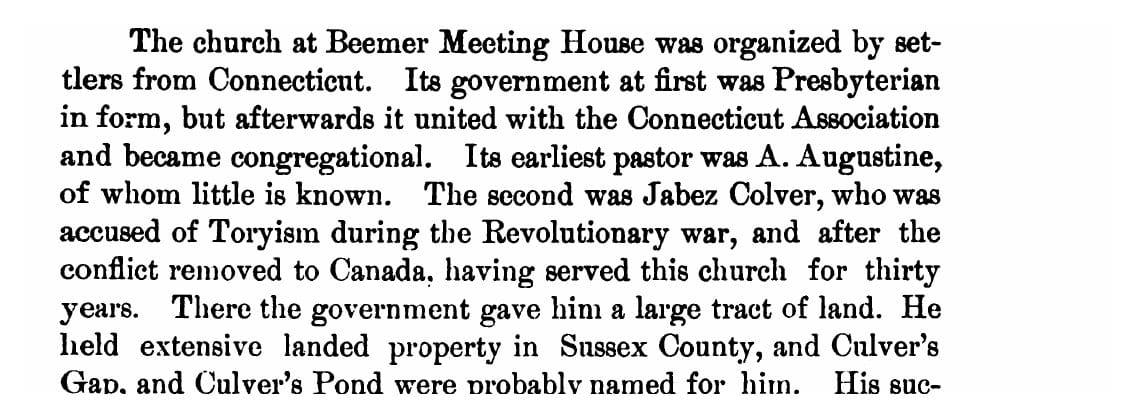
"Organized by settlers from Connecticut… Presbyterian in form… became congregational." The congregation was the ordination in miniature. Jabez's two-sided churchmanship was not a private oddity; it was the order of his own people, carried down from Connecticut with their household goods. Haines's "thirty years" is a round number (the family was on the Chemung River in New York by 1788), but for the better part of three decades he was their called minister.
Those Wantage years were the one long, settled, unpersecuted stretch this family's direct line would know between Groton and the twentieth century. He married Anna, a wife whose maiden name no one has yet recovered, and at Wantage were born their thirteen children, from Ebenezer and Jabez down to Griffiths and Benjamin. Nearly all their births are known from family record, Bible, and gravestone rather than from a church register, because no register of the minister's own congregation survives. And the county's probate files show what his neighbors thought of him. Through the war years Jabez appears as a bondsman on administrators' bonds and as one of the men who walked a dead neighbor's rooms and barns, priced the plough and the pewter, and signed the inventory the court relied on. It is worth a pause over that. His fathers' religion had refused the oath on which sworn probate ran. Their son had become the man the court sent to make the valuations.
Both sides of the pulpit
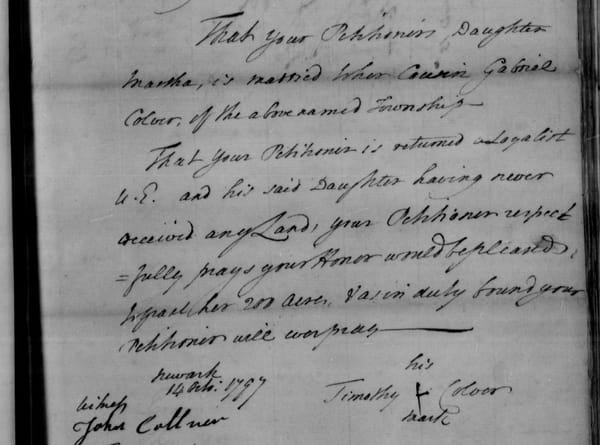
In July I told the story Henry Pitney preserved about 1770, under his own careful words, "tradition affirms": a company of Rogerenes from Schooley's Mountain, people of this family's own religious circle, walked into the Presbyterian church at Mendham with their sewing and their knitting, made "disparaging comments on 'the hireling preacher,'" and were put out. In that same year, up in Sussex County, Jabez Collver had been nine years settled as exactly the thing they came to jeer at: a called, salaried, ordained minister with a meeting-house, a houseful of children, and a congregation that paid him.
There is no record that the knitters and the Wantage minister ever met, and I will not invent a scene. None is needed. Every Sunday for nearly three decades Jabez preached as the officer of an order his father's people held to be the mark of a false church, and nothing in the record suggests either side disowned the other. The family held together through war, exile, and resettlement. They simply carried the contradiction, the way families do.
It left its mark on him all the same. When the Revolution came to Sussex County and Jabez stood accused of sedition, the words his indictment put in his mouth were not about kings or taxes: "If America overcome, the Presbyterians will pull down all other Persuasions." I wrote about that sentence at length in July, in Pull Down All Other Persuasions. What this chapter adds is where the fear was formed. It is a Rogerene fear, the fear of a church with a magistrate's arm behind it, spoken by the one member of the family who had gone furthest toward the respectable ministry and had stopped, deliberately, one step short. He had taken the orders and the wage. He had not taken a presbytery.
"An uneducated man"
The establishment never quite forgave him the irregular road. The historian of Canadian Presbyterianism, cataloguing the church's pioneers in 1907, gave Jabez a paragraph of real admiration wrapped around a backhand: "His ordination would perhaps not be considered valid to-day, for he was an uneducated man, but he was a devoted Christian, possessed of great force of character."
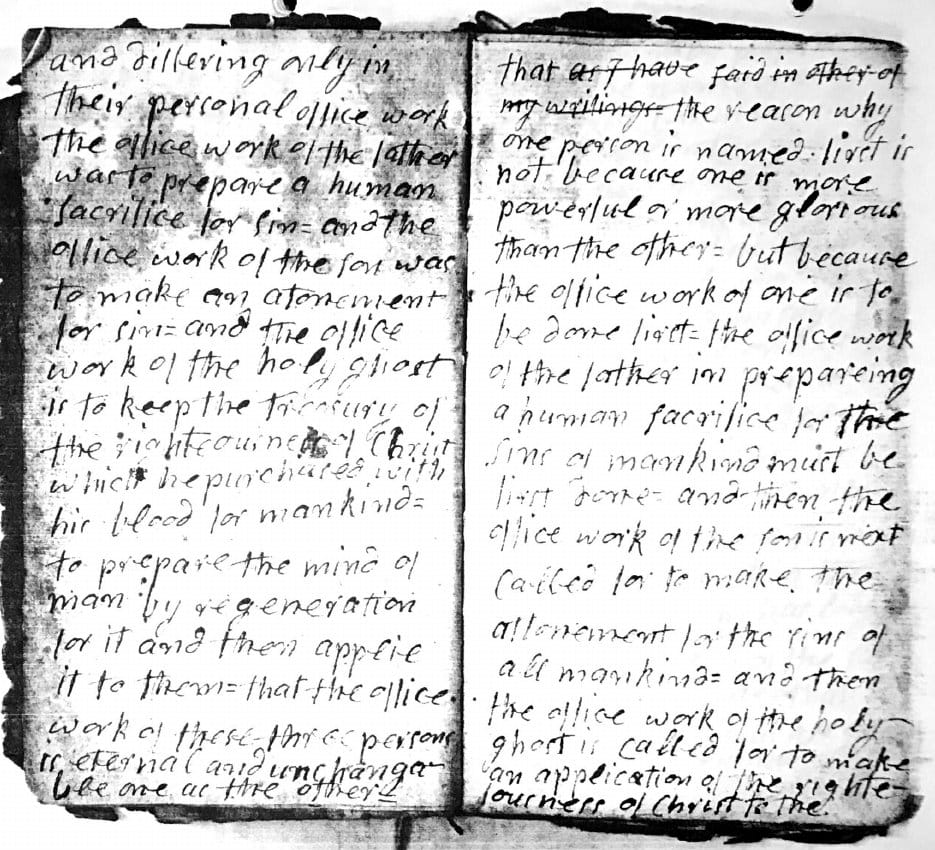
Would perhaps not be considered valid to-day. The Cambridge Platform's laying on of hands, measured a century and a half later against a presbytery's paper standards and found quaint. As for "uneducated," the word is doing the establishment's work, not the evidence's. The man it describes wrote an autobiography in his eighties, kept up a correspondence across an international border in a firm, plain hand, and left behind some thirty-eight close-written pages of systematic divinity of his own composition, stitched together by himself and signed between 1811 and 1817: The Doctrine of Christ or Pure Divinity. No college ever had him; he was raised an orphan among people whose whole quarrel with the world included its divinity schools. The historian who called him uneducated never saw the copybook.
The congregation, and the family, after him
The 1888 historian did not end his paragraph with Jabez. "His successor was Rev. Mr. Seely, a godly man," he went on, and a writer of 1844 remembered that under Seely "the church was built up by hopeful conversions to God." The congregation outlived its exiled minister, called another, and went on, which is what a congregation governed by its own gathered members is built to do. The order Jabez chose was never about him.
It is a small thing, but I notice it. Two hundred and sixty-odd years after an orphan of the persecuted sect took orders in a church his family had heckled, his descendants are still crossing over. My grandfather, born in Merritt Township outside Munger, Michigan, was a Presbyterian, at Munger and later at Westminster in Bay City. His grandson became a Lutheran pastor. Families do not keep one church; they keep the habit of taking their faith seriously enough to change it, and the stubborn conviction, older than any of their pulpits, that a congregation answers first to God.
Sources and notes: The guardianship election is New London Probate Records, J5:59 (July 1747). John Colver's will of 2 December 1732 ("son, Jabsh Coulver") is in the Calendar of New Jersey Wills II (1918), 105; the 1735 guardianship is recorded in the Diary of Joshua Hempstead (1901), 292; Freelove's remarriage is in the Barbour Collection, Groton, 1737. The typescript birth date "19 June 1739" is the Barbour Groton transcription, vol. 1, p. 127; the true 1731 is W. Herbert Wood and Donald L. Jacobus, "Additions and Corrections to the Colver-Culver Genealogy," The American Genealogist 31 (1955), 129–54. The autobiography survives in the portions printed by William J. Dey, St. Paul's Church, Simcoe, Ontario 1793–1906, as transmitted by William R. Yeager, Sources in Collver-Culver Genealogy (1976), and R. Robert Mutrie's compilation; "congreational" is kept as the fragment transmits it. The ordination "about 1761" is Mutrie's reading; some references give 1760. The Cambridge Platform is quoted from the 1850 Boston edition (ch. IX on ordination). The Beemer Meeting-House passage is Alanson A. Haines, Hardyston Memorial (1888), 131. The Sussex County estate appearances (George Green of Hardwick, 1777–78; John Dewitt Jr. of Newtown, 1781) are from the Calendar of New Jersey Wills. The 1770 Mendham tradition is Henry C. Pitney, A History of Morris County (1914), with his own "tradition affirms." The 1777 indictment is told in this blog's "Pull Down All Other Persuasions" (July 2026). The Croil quotation is James Croil, Genesis of Churches in the United States of America, in Newfoundland and the Dominion of Canada (1907), 217. The copybook, The Doctrine of Christ or Pure Divinity (1811–1817), is reproduced from the family's facsimile. Albert B. Collver Sr.'s churches are from his obituary, Bay City Times, 22–23 July 2015.
Adapted from the forthcoming book — We Are Doves: Four Centuries of the Collver–Culver Family.
© 2026 Albert B. Collver III · The Collver Family History Project. Original historical documents reproduced here are in the public domain; the research, text, and annotations are the author's. Please cite or link rather than republish.