The Loders
An 1831 will, a 1940 typescript, and a reader's letter find the daughter the family register lost.
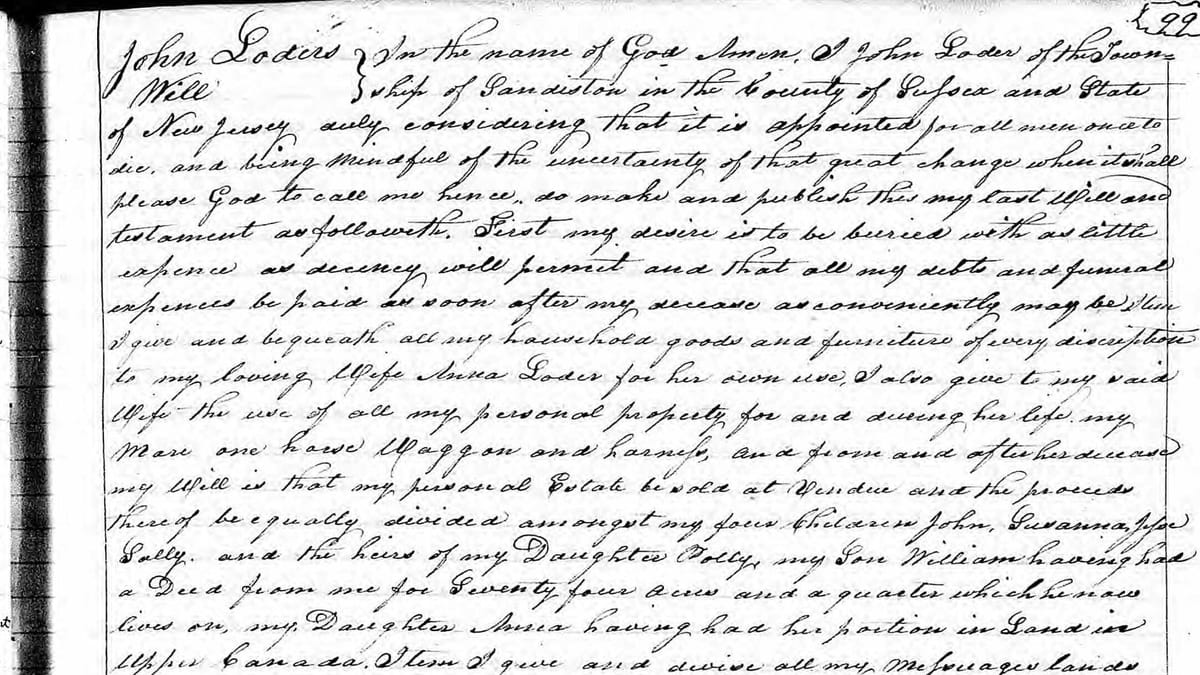
A will is a document about property, and most of it reads that way. John Loder of Sandyston Township, in Sussex County, New Jersey, made his on the fourteenth of February, 1831. He left the household goods to "my loving Wife Anna Loder," and after her death the proceeds of the personal estate to be divided among the children, John, Susanna, Jesse, Sally, and the heirs of a daughter Polly who had died before him. His son William already had his deed for seventy-four and a quarter acres. The Steuben County land went to Sally and her husband. And then, in the middle of the bequests, one clause about a daughter who gets nothing because she already has hers:
"my Daughter Anna having had her portion in Land in Upper Canada."
Portion is an old word doing exact legal work. It comes through French from the Latin portio, a share or an allotment, and in the English law of families a daughter's portion was the share of her father's estate she received when she married or left home — given in his lifetime, and therefore not given again at his death. The clause is a receipt. It tells us that John Loder had settled a daughter somewhere across the Niagara River, in land, and it tells us nothing else: not where, not when, and not, as it happens, her married name.
The will was proved in July 1832. For the next hundred and ninety-four years, as far as this family's genealogists knew, it had nothing to do with us.
The daughter the register lost
The Reverend Jabez Collver had a daughter named Anna, born about 1759. R. Robert Mutrie's register of Jabez's descendants, the most careful account of this family we have, gives her a single line: "Anna Collver, born in 1759. Mentioned by E. A. Owen, but then no further record found."
No further record found. Every register has entries like it, and they are the honest ones. A careful compiler writes down what the papers show and stops there, and the gap he leaves is a mark of care, not of failure. But a gap in a register is easily read as a fact about the person rather than about the papers. The daughter with no further record starts to look like a daughter who died young, or never married, or simply did not matter to the story. Mutrie himself, working at the edge of the evidence, floated the possibility that Anna was the Collver daughter who married Stephen Kent, the man who drowned about 1791. It was a reasonable guess about a woman nobody could find.
She was not lost. She was in New Jersey the whole time, living under another name.
A letter on a Saturday
On the twenty-second of August this year, a reader wrote to me. I had published a post the Monday before on John Earl's 1855 census of Norfolk County, and in it I had confessed that I could not place a Townsend farmer named Lodor Culver, "farmer; cheese manufacturer" in the county atlas of 1877. Lodor, I wrote, was a distinctive thing to name a child, and the family had a habit of wearing surnames from its marriages as given names; his mother or grandmother might be hiding in plain sight in his first name. If any reader descended from the cheese manufacturer, my inbox was open.
The man who answered was Jonathan Dembling of Massachusetts, and he did not descend from the cheese manufacturer. He descended from Anna. Jabez's daughter, he wrote, had married a John Loder about 1780 and lived in Sussex County until her husband's death, and then moved to her son's home in Steuben County, New York. His source was a genealogy compiled in 1940 by a Loder descendant named Frank Grant Lewis, and it quoted the will.
I owe the rest of this post to that email. I also owe a small confession to it. The same weekend, before the Lewis pages arrived, I found Lodor Culver in a book I already owned: Mutrie places him exactly, the second son of Moses Culver and grandson of Aaron, born in Townsend on the fourth of November, 1823. He had been on my shelf the whole time. I wrote a correction to the census post that Saturday, and I have not stopped thinking about its moral since: a register one has not re-read is a register one does not own.
Lewis's three carbons
Frank Grant Lewis was born in 1865, a clergyman by calling and a genealogist by the habit of a lifetime, and he descended from Anna Collver through her son Jesse Loder. His Culver (Colver)–Loder Genealogy is not a book. It is a typescript of thirteen pages, signed "Penn Yan, N.Y., Aug. 6, 1940, F.G.L.," and by his own account it was made in three copies: one for himself, one for the Institute of American Genealogy in Chicago, and a carbon for E. H. Darling of Hamilton, Ontario, whose uncle had married a granddaughter of Jabez's son Gabriel, and who had sent Lewis the Canadian side of the family. It survives today because a genealogist named Ralph Hopkins later copied Darling's carbon into a binder of family data sheets, and the binder is now on Ancestry. It is the kind of document that exists by a chain of kindnesses, each link a stranger's.
Lewis did what careful men of his generation did. He went to see things. "I visited the home in Sandyston," he writes, in the first person, and the typescript is full of what he found: church books, gravestones, deed abstracts, and the will. His account of Anna runs like this. She was born in September 1758 or in 1759, "quite certainly" in Morris County. She married John Loder "perhaps soon after 1780." He had been baptized on the eighteenth of October, 1761, at the First Presbyterian Church in Morristown, the son and grandson of John Loders before him; the family tradition carried the line back to an English John Loder who came to New York about 1723 and served out an indenture of four years. The couple lived at Sandyston, in the hills above the Delaware, and raised at least eight children — Anna, William, Susanna, John, Jesse, Polly, Sally, and a late daughter, Matilda, who died before her father. When John died, between the making of his will in 1831 and its proving the next summer, the widow went to her son John at Urbana, in Steuben County, New York. Lewis reports her gravestone there: she died, by his copy, on the tenth of March, 1837.
That date needed checking, and it has been checked. Anna's mother, Jabez's wife, died on the tenth of March, 1813, and a mother and daughter dying on the same day of the year is the kind of thing that happens when two dates pass through the same tired hand. The stone still stands, in what is now called the Depew-Wixon Cemetery in Urbana, and volunteers for Find a Grave have photographed it twice. It reads: "Anna Loder, died March 16, 1837, aged 78 years, 6 Ms. & 1 Da." The sixteenth, not the tenth. Count back seventy-eight years, six months, and a day, and she was born on the fifteenth of September, 1758 — the September Lewis found, and the year the family's lists rounded away. The coincidence was a copyist's six. Lewis would have wanted it corrected. He went to see things, and the stone is still there to be seen.
Lewis's pages settle the rest of what the register could not. Anna was Mrs. Loder from about 1780 and alive in 1837, so she cannot have been the widow of a man who drowned in 1791 while married to a Collver daughter. Stephen Kent's wife was another of Jabez's daughters, most likely Phoebe, and the old hedge in the family literature can be retired.
Then I read the will myself. The Sussex County surrogate's book is filmed, and John Loder's will is on two pages of it, in a clear clerk's hand. Lewis had quoted it accurately, word for word: "my Daughter Anna having had her portion in Land in Upper Canada."

The Loders of Long Point
Upper Canada. That is where the story comes back to us. In 1831, when John Loder wrote that sentence, Anna's brothers Aaron, John, and Gabriel had been in Norfolk County for thirty-five years, farming and milling and preaching along the north shore of Lake Erie. And they were not the only Sussex County family there.
E. A. Owen's Pioneer Sketches of Long Point Settlement (1898) gives a whole chapter to a man it calls "A Bright and Shining Example." His name was Job Loder, "a native of Sussex County, New Jersey, and a millwright and house-builder by trade." Owen tells the story with the warmth of a preacher who has found his text. Loder failed in business in New Jersey, "became hopelessly involved in debt," and went off to the Long Point country in the 1790s, where he prospered from the start. When he had money enough, he advertised that he would be "at the Court house in Newton" on a certain date, and he paid every New Jersey creditor in full, with interest, on debts the law had long since forgiven. Then he bought "the finest covered carriage in the market" and drove it five hundred miles home to Canada.
The rest of Job Loder is on paper. He kept the tavern at the Town of Charlotteville, on Turkey Point, where the courts of the whole London District sat in 1803, and that December he contracted to build the district's jail and court-house for £250. The county deed register records his purchase, on the tenth of June, 1806, of Lot 1 on Court Street, one acre, to "Job Loder of the same Township, Carpenter." Readers of "A Mason's Sign at the Rope" have already met him once more: on the twenty-eighth of March, 1816, the Sovereens sold "Job Lodor … Merchant" the Waterford mill seat on Nanticoke Creek, in Townsend, for £1,005 — the mill McArthur's raiders had burned sixteen months before. Owen says Loder "built most of the pioneer mills in the settlement." There was a John Loder in the settlement too, an overseer of roads with Job in 1809 and a signer, that same year, of the loyal address to the lieutenant governor, on a list that carries a dozen Culvers.
And the families married. Owen's sketch of the Shoaf family, whose founder Michael married Jabez's daughter Freelove, says that "Dennis Shoaf, second son of Michael, married a sister of Job Loder, and settled on part of the homestead." A Loder woman was raising Freelove's grandchildren on Freelove's land in Townsend.
How Job Loder was related to John Loder of Sandyston, the papers do not yet say. Lewis lists the Sandyston John's uncles as Samuel, Benjamin, James, and William; there is no Job among them. Sussex County was not so large that two Loder families in it need be strangers, and Job's route north ran through the same townships as the Collvers', but a likelihood is not a pedigree, and I will not draw a line the documents have not drawn. What can be said is enough. By the time John Loder of Sandyston settled a daughter's portion in Upper Canada, there were Loders on the lake shore with a tavern, a mill, and a store; a Loder wife on the Shoaf homestead; and a daughter of the Sandyston Loders with land of her own somewhere in the province, among her mother's brothers.
Two children with borrowed names
Now look again at the names.
In Sussex County, on the twenty-second of December, 1808, Anna's son William Loder and his wife Mary had a daughter, and they named her Anna Culver Loder. She is buried at Sandyston, in the Mettler Cemetery, under a stone that gives her whole span: born December 22, 1808, died June 16, 1886. In Townsend, on the fourth of November, 1823, Anna's nephew Moses Culver and his wife Sarah had a son, and they named him Loder. The two families were several hundred miles apart by then, across a border that had lately been a war. Each of them put the other's surname on a child.
The family's naming habit is familiar to readers of this blog, and this is it at its most eloquent. A surname given as a Christian name is a small act of memory: the family writing down, in the only register every child carries for life, whom it belonged to. Whether Moses was naming his son for his aunt's marriage or for the Loders he knew at the Waterford mill, the records do not say, and it may be that to Moses there was no difference. What the names say together is plain enough. Years after Anna's brothers crossed into Canada, and a generation after the last of Jabez's household left Sussex County, the families were still counting each other as kin.
Loder Collver kept the name all his life and made something of it. Earl found him in 1855 on the east half of Lot 2 in Townsend's twelfth concession. Owen, writing of Anna's brother Aaron, remarks that Aaron's first log cabin had stood "on a knoll now included in one of the broad fields of the Loder-Culver farm" — so the boy named for the Loders grew up to farm the ground his grandfather had first cleared. He bought more of the neighbouring lot in 1867 and 1870, went into cheese, and died on that ground in 1902, "a prominent farmer of the township of Townsend." The name is carved in one family and remembered in the other.
Her portion
One question remains, and I want to hand it to the readers, since a reader started all of this.
Where was Anna Loder's land? The younger Anna — John and Anna's daughter, born in the 1780s — received her portion in Upper Canada before 1831, and the will does not give her married name. I have searched the Norfolk County deed registers and found no Anna Loder in them before 1830, which is what one would expect of a woman holding land under a husband's name. There are threads. A Maria Loder, born in the United States about 1815, was living in Townsend at the census of 1851; the Sussex Loders had a Maria born in 1816. A Joseph Loder, born about 1793, was boarding in Bayham, in Elgin County, the same year. A New Jersey genealogy of 1895 has a John Loder marrying, "in Canada," a daughter of the Lawrence family of Dover. None of them is proven, and all of them are findable.
If your family has a Loder grandmother in Norfolk, Elgin, or the Niagara country, or a deed from a Collver or Culver to a woman named Anna, I would very much like to hear from you. My inbox is open, and as the last three weeks have shown, it is the best research tool I have.
The Lewises of Steuben County
The Loders spread through Steuben County from Urbana and Wheeler, and Anna's descendants went out from there. Jonathan's line runs from Anna through her son Jesse Loder and Jesse's daughter Susannah, who married Samuel Lewis and had ten children. Frank Grant Lewis was the son of the eldest. Jonathan comes down from the second, Alonzo, and he sent me Alonzo's story along with the pedigree.
Alonzo Lewis enlisted in 1862 in the 107th New York Infantry with his younger brother Jesse and fought at Antietam. He came down with typhoid, recovered in hospital, and was sent to the convalescent camp at Alexandria, Virginia, and from there he walked away. Nobody knows why. He made his way home to Steuben County and took work in a sawmill under an assumed name, and on Christmas Eve 1863 he caught his sleeve in a band saw and was killed. He left a wife and four children. The youngest, Oscar, was hardly old enough to remember him.
Oscar Lewis went west to North Dakota for work as a grown man, leaving his wife and infant son in Addison, and never came home. His letters home were kept in the family, and Jonathan's father gave the originals to the University of North Dakota. Jonathan has transcribed them and put them online, at oscarlewis.wordpress.com, with his own commentary. They are well worth an evening. It is not often that a family in this blog speaks in its own hand, and here is Anna Collver's great-great-grandson writing home from the Dakota prairie to Steuben County.
Oscar's son Harold died in the influenza of 1918, six months before his youngest child was born. She was Pearl Lewis, and when she married David Dembling she converted to Judaism. Jonathan closed his letter with a thought about that, and I will close with it too, since he has given me leave. The family, he pointed out, had been Puritans, Presbyterians, Rogerenes. "Pearl," he wrote, "was not the first Collver descendant to observe a Saturday sabbath."
The historian in me wants to add a footnote, and so I will. John Rogers found his faith among the Seventh Day Baptists of Newport and kept the seventh day with them before he broke with them in 1677 and went on to keep no day holy at all. The family's sabbaths have wandered, like its spellings. But the cousin's point holds, and it is the point of this whole post. A daughter with no further record turned out to have eight children, a gravestone, a will naming her, a grandson who wrote her genealogy, and a descendant who read my blog and wrote to me. The register did not lose her. It only stopped looking.
Sources and notes: John Loder's will, dated 14 February 1831 and proved 27 July 1832, is in Sussex County Surrogate, Wills vol. C–D, p. 99 (New Jersey Wills and Probate Records, on Ancestry); the two pages are reproduced here. Frank Grant Lewis, "Culver (Colver)–Loder Genealogy" (typescript, Penn Yan, N.Y., 6 August 1940), is preserved in Ralph Z. Hopkins, Hopkins and Family Data Sheets, pt. 1 (U.S., Family History Books, on Ancestry); Lewis died in 1945, and the thirteen pages are reproduced here in full. Anna C. Loder's stone ("born Dec. 22. 1808: died June 16. 1886") is in the Mettler Cemetery, Sandyston Township, Find a Grave memorial 12943925. Anna Loder's gravestone, Depew-Wixon Cemetery, Urbana, Steuben County, is Find a Grave memorial 173421909, with two photographs of the stone. Mutrie's line on Anna is from R. Robert Mutrie's register of the Rev. Jabez Collver family, child iii; Loder Collver's birth, parentage, farm, and death are from the same work and were set out in the correction to "The Schoolteacher's Census" (17 August 2026). Job Loder's sketch, the Shoaf marriage, and the Loder-Culver farm are from E. A. Owen, Pioneer Sketches of Long Point Settlement (Toronto, 1898), 283–86 and the Shoaf and Culver family sketches. Job Loder's purchase of Lot 1, Court Street, Town of Charlotteville (10 June 1806, memorial No. 330) and of the Waterford mill seat (28 March 1816, memorial No. 892) are from the Norfolk County deed registers, 1797–1813 and 1813–1825, on FamilySearch; the 1809 road overseers are in Owen; the Loyal Address signers are in the York Gazette of 6 December 1809. The Lawrence–Loder marriage is from Theodore F. Chambers, The Early Germans of New Jersey (1895), Lawrence family; the 1851 Loder entries are from the census of Canada West. The Lewis family story after Susannah Loder, including Alonzo Lewis's service and death and the Oscar Lewis letters, is Jonathan Dembling's, from his letters of 22 and 23 August 2026, and is used with his permission; the letters themselves are at oscarlewis.wordpress.com, the originals at the University of North Dakota. On John Rogers and the Seventh Day Baptists, see chapter four of the forthcoming book. The Loders are Appendix G §B4 of the book; the younger Anna's married name remains among its open questions.
Adapted from the forthcoming book — We Are Doves: Four Centuries of the Collver–Culver Family.
© 2026 Albert B. Collver III · The Collver Family History Project. Original historical documents reproduced here are in the public domain; the research, text, and annotations are the author's. Please cite or link rather than republish.