The Noted Hunter of Sheshequin
Sergeant Timothy Culver of the Connecticut Line, the Patriot cousin, read from his own pension file: four enlistments, a leg hurt hauling timber in 1781, and the 1820 schedule that lists every one of his six chairs.
In 1878 the Reverend David Craft, writing the history of Bradford County, Pennsylvania, came to the township of LeRoy and the year 1799, and set down the newcomers of that season. Aaron Cook, a chair manufacturer, located near Robert McKee's. And "Tim Culver, a noted hunter, on the south side of the creek, opposite McKee's."
Nine words. They are the nearest thing to a portrait anyone in Bradford County left of a man this blog has mentioned several times and never properly introduced. Noted, in the county histories of that decade, is a working word. Craft and his successor Heverly give it to men who killed panthers, who kept a settlement in venison through a first winter, who could be sent for. It is not a decoration. It says what the neighbors found him good for.
This post is for his branch, and for the reader who pulled him out of the family's genealogies, where he had been welded for a century to another man.
Two Timothys
The received story made one Timothy of two. The family's compilations long carried a Timothy Culver who managed to be both a sergeant of the Connecticut Line and a United Empire Loyalist of Upper Canada, a feat beyond even this family's flexibility. There were two men, first cousins of each other and of the Reverend Jabez Collver, because their fathers were brothers. Timothy Collver the Loyalist, born in New Jersey in the 1730s, stood with the Crown and died in Norfolk County in 1813. Sergeant Timothy Culver, born in Connecticut in 1741, served the Patriot cause for the duration and died at Sheshequin, on the upper Susquehanna, in 1829. Two men, one name, two flags.
The reader who sent this research back to the Connecticut records is the sergeant's descendant, Molly Sexton, and the book's thanks to her are recorded as they were recorded here. One caution belongs in print. The sergeant's own oath gives his birth at Woodbury, and the baptismal evidence for a Woodbury family of that name is hers. The 1955 study of the family in The American Genealogist called the step from the Groton Culvers to the Woodbury ones not proved. The book carries it as probable, on the strength of the name, the dates, and the brothers' known movements, and says so.
The file
A Revolutionary pension file is the closest thing most eighteenth-century farmers have to an autobiography, because the Act of 1818 required an old soldier to tell his service under oath and the Act of 1820 required him to tell his poverty. Timothy Culver told both.
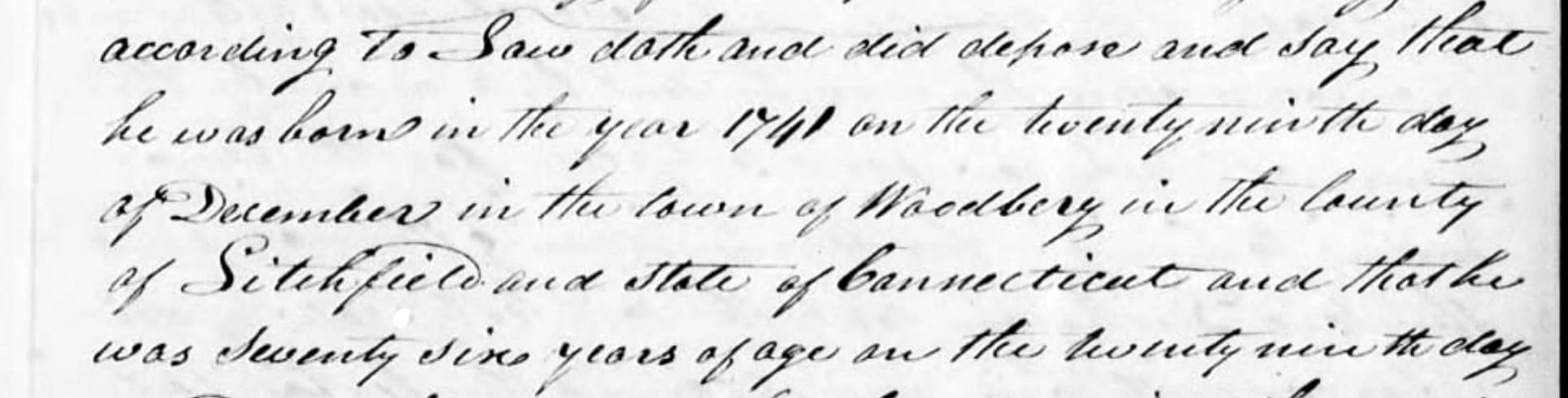
On the fifteenth of April, 1818, before George Scott, judge of the court of common pleas at Bradford County, "Timothy Culver of the township of Ulster" swore that he was born "in the year 1741 on the twenty ninth day of December in the town of Woodbery in the county of Litchfield and State of Connecticut." Then the service, in order. In the spring of 1775 he enlisted under Captain Caleb Trowbridge for seven months and served them at Roxbury, in the siege lines around Boston. In the spring of 1776 he enlisted for a year under Captain Parmelee in Colonel Elmore's regiment, went to the German Flats on the Mohawk, raised the picket forts there, and was marched to Fort Stanwix, where he stayed out his year. And in the spring of 1778 he enlisted "for during the war" under Captain Judd in Colonel Samuel Wyllys's regiment of the Connecticut Line, and stayed with it until the fall of 1781, when "he was carrying timber to build winter huts and fell with a heavy stick on his shoulder and hurt his left leg very much." He was transferred to Colonel Nicola's regiment of invalids and served there to the end of the war.
He had entered a private. The War Department, checking the rolls, admitted him as a sergeant. The discharge itself he no longer had: years after the war he had sent it by a man named Dickeson to draw the hundred acres of bounty land owed him, and Dickeson came back with the land certificate and kept the discharge. "From his reduced circumstances," the declaration ends, "he needs the assistance of his Country for support." He signed it himself, in a clear hand. The pension was eight dollars a month.
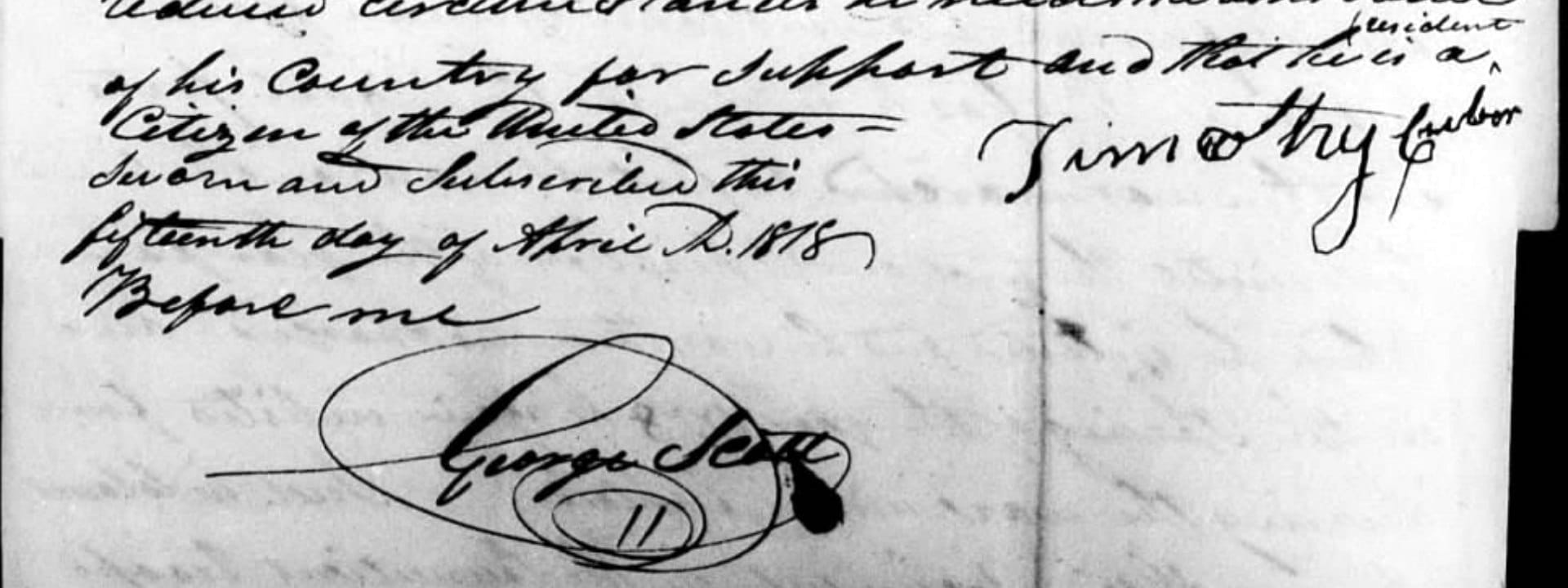
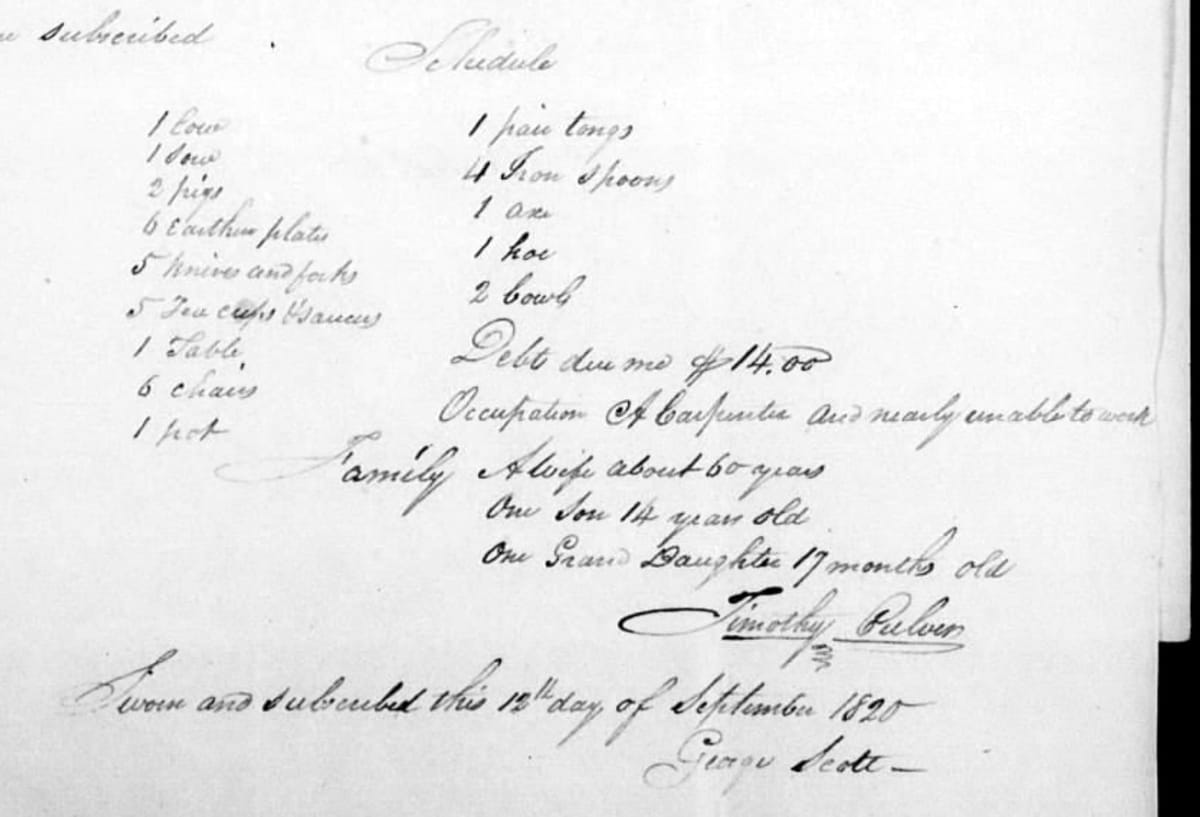
Two years later the law asked for more. On the twelfth of September, 1820, in open court, Timothy Culver, "aged seventy nine years," swore to a schedule of everything he owned. I give it as the clerk wrote it, because it is the fullest portrait of the man that exists:
1 Cow, 1 Sow, 2 pigs, 6 Earthen plates, 5 Knives and forks, 5 Tea cups & saucers, 1 Table, 6 chairs, 1 pot, 1 pair tongs, 4 Iron Spoons, 1 axe, 1 hoe, 2 bowls. Debts due me $14.00. Occupation: A Carpenter and nearly unable to work. Family: A wife about 60 years; One son 14 years old; One Grand Daughter 17 months old.
A man is more than his six chairs. But the six chairs are what the republic wrote down, and it wrote them down because he asked it to, at seventy-nine, with an axe and a hoe and a fourteen-year-old son in the house.
The sketch
The town's own history, published in 1902, adds what the file cannot. Its account of the Culver family came, by the book's own acknowledgments, from the sergeant's great-grandson, a state legislator named Lafayette J. Culver, which means it is family tradition set in type three generations on. Read it as that.
Heverly's Timothy "joined the Lower Sheshequin settlement between 1790 and '95." His regiments are the file's regiments, which is reassuring about the rest.
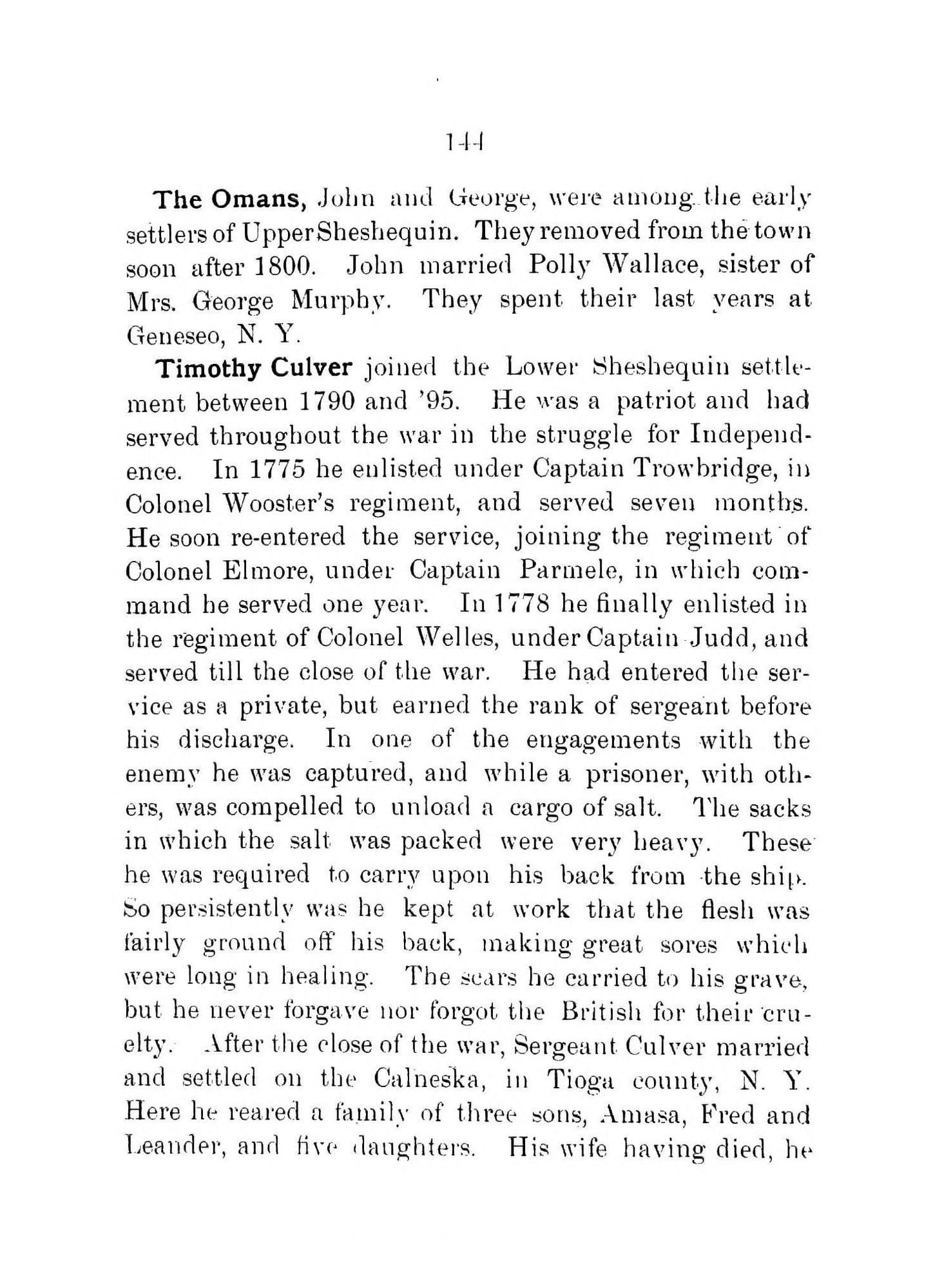
The sketch adds a captivity: taken in one engagement, he was made with other prisoners to carry sacks of salt from a ship, "so persistently" that "the flesh was fairly ground off his back," and "the scars he carried to his grave, but he never forgave nor forgot the British for their cruelty." The file says nothing of a capture. A family remembers the scars; a pension office records the regiments. Neither is lying, and the difference is the whole business of this blog.
After the war, the sketch continues, he married and settled on a creek in Tioga County, New York, raised three sons and five daughters, lost his wife, moved to Chemung County, and there "became acquainted with and married Mary Brink, sister of Benjamin Brink of Sheshequin." He followed the Brinks to the Hornbrook settlement, "where he continued to reside till the close of his life. He was a carpenter by occupation and did the building in the new settlement." Three more children came of the second marriage: James, Charity, and Daniel Bunnell Culver. And then the line every descendant should have: "Sergeant Culver is remembered as a kindly, genial old gentleman, greatly esteemed by all his neighbors."
He died in September 1829, the cemetery register says, aged eighty-eight, and lies in the Hornbrook burying ground beside Mary, who outlived him by sixteen years. The family's own research has carried a February date for his death. The file gives none. I set both down and do not choose.
The ground
The farm his family came to own at Sheshequin had a Revolutionary history before any Culver plowed it, and it is the kind of history this family seems to attract.
In December 1777, the very season his Loyalist cousins were refusing the oath of abjuration in New Jersey, Colonel Denison at Wyoming sent a hundred and eleven men up the Susquehanna under Lieutenant-Colonel Dorrance to find hidden Tories. At Sheshequin they came to the house of an Indian leader the English called Hopkins, who held a British captain's commission and "was then residing on what is now the Culver farm." He was reported to be keeping several prominent Tories. The soldiers took him, he tried to escape, and Rufus Baldwin, set to guard him, shot him through the body. "This was the first bloodshed in this valley during the Revolutionary contest." Hopkins recovered, and fought at Wyoming the next summer.
Two years later General Sullivan's army, marching north to burn the Iroquois towns, came up the same flat and camped on it. One officer's journal describes "a most beautiful plain," chiefly meadow, "the grass remarkably thick and high," and the town historian glosses the spot in a parenthesis: "This encampment was on what is now the Culver farm." The first house of public entertainment in the valley, opened in 1789, was still standing in part in 1902, "and forms a part of the Culver residence."
So a Patriot sergeant's family settled onto ground where the valley's first Revolutionary blood had been shed hunting Loyalists, and where the Revolution's most terrible expedition had slept in the dooryard, while some two hundred miles to the north-west his first cousin and namesake was clearing Crown land granted for the opposite allegiance. Nobody arranged this. The ground simply kept the record.
The cousin across the river
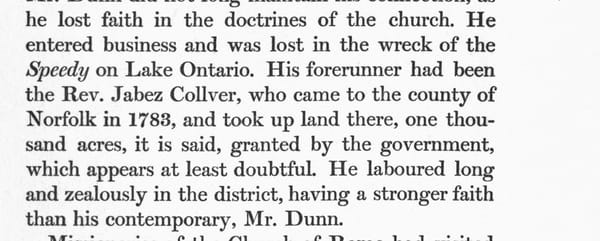
One question the sketch raises I can only half answer. The Reverend Jabez Collver, the Loyalist minister, preached in this same valley from 1789 and on the third of October, 1791, organized the first church in Bradford County at Wysox, a few miles down the river from Sheshequin. Among the day-one communicants was a Rachel Brink. He left the region in 1793.
Was his Patriot cousin already there? Heverly's sketch says between 1790 and 1795. The hard record is a storekeeper's ledger: an account under Timothy Culver's name running from the twenty-ninth of April, 1795. At the early edge of the window the two cousins were neighbors on one river for three years, the minister's new church enrolling communicants from the sergeant's own settlement; at the late edge they missed by two. No letter, minute, or memoir puts them in one room. The near-miss is documented. The meeting is not. The book has walked to the exact edge of that evidence, and will not step past it.
The reader's question
In August a question arrived from the sergeant's branch: did he and the family's other Patriot soldier, John Culver, ever serve together?
John was a New Jersey private, the minister's probable nephew, whose own pension file this blog has quoted before. Read the two files side by side and the answer is nearly yes. In the spring of 1778 both men enlisted for the war in the Connecticut Line: Timothy under Judd in Wyllys's regiment, John under Captain Chapman, who belonged, by the Pension Bureau's own pencil note in the margin of John's file, to Colonel Bradley's. From that spring until Timothy's injury in the fall of 1781, weeks before John's discharge, the minister's nephew and the minister's cousin were in sister regiments of one small state's line. Whether they ever stood together no roll says, and one wrinkle keeps it honest: John remembered serving most of that enlistment in Connecticut itself, while Wyllys's regiment was generally with the main army.
The Treasury's check of John's claim turned up one more Culver: a John Culver who enlisted in Bradley's regiment on the first of July, 1780, for six months. Our John swore that man "was a cousin of this deponent." Two John Culvers in one regiment in the last half of 1780, the second of them sworn to kinship and still not placed on the family's tree. Readers of this blog have found people for it before.
What the title owes the reader
Craft's noted hunter of 1799 lived in LeRoy, on Towanda Creek, a dozen miles from Sheshequin. The sergeant is proved at Sheshequin by the ledger of 1795, by a road petition of 1800 that he signed with the Brinks and the Hortons, and by the Tioga township tax list of 1812. Heverly says he "owned and occupied different properties." Whether the hunter on the south side of the creek was the sergeant between properties, or a son who carried his name, the county's historians do not say, and I cannot. The dates fit the old soldier. The title stands on the only words anyone wrote about him while his neighbors still remembered him, and I have told you exactly how far they reach.
What it means now
Heverly's honor roll of the valley's Revolutionary dead ends its list of cemeteries with "Sergt. Timothy Culver and Elijah Horton in the Hornbrook cemetery." His grandson Daniel Bunnell Culver was township constable in the 1840s. His great-grandson Hiram, a sergeant in the 141st Pennsylvania, was killed at the Wilderness on the sixth of May, 1864, at thirty-one. Another great-grandson sat in the state legislature and told the town's historian what the family remembered. The Patriot line kept paying.
A century later the Loyalist line is writing it down, and the sergeant's descendants are reading and correcting it. The two Timothys took opposite sides of a war, and their cousins' cousins now trade pension files across a comment box. That is the family's history working the way it always has, by households, along lines of kinship, with the women's relations lighting the road, and this time without the war.
Sources.
- Revolutionary War pension file S.40871, Timothy Culver, Connecticut Line (National Archives, M804): the declaration of 15 April 1818 before Judge George Scott, Bradford County, with the birth at Woodbury, the four enlistments, the injury of 1781, the Dickeson episode, and the signature; the admission slip ("Rolls. Admitted"); the certificate at eight dollars a month; the schedule of 12 September 1820, quoted as written.
- C. F. Heverly, History of Sheshequin, 1777–1902 (1902): the Timothy Culver family sketch (pp. 144–45); Colonel Dorrance's expedition of December 1777 (p. 24–25); the Sullivan campaign journal with the editor's parenthesis on the Culver farm; the Gore tavern of 1789 in the Culver residence; the store ledger account from 29 April 1795; the road petition of November 1800; the honor roll of Revolutionary soldiers; the Hornbrook cemetery register ("Sept. 1829, Sergt. Timothy Culver"); the 141st Pennsylvania roster; the preface's acknowledgment of Hon. L. J. Culver.
- Rev. David Craft, History of Bradford County, Pennsylvania (1878): the LeRoy settlers of 1799 ("Tim Culver, a noted hunter"); the Tioga township taxables of 1812; the Wysox church of 3 October 1791.
- Revolutionary War pension file R.2573, John Culver, New Jersey (National Archives, M804): the second enlistment under Captain Chapman; the Third Auditor's report of October 1829 with the pencil query "What regiment did Capt Chapman belong to? Col. Bradley's" and the muster entry of 1 July 1780; the deposition "was a cousin of this deponent."
- Donald Lines Jacobus's and the later study of the family in The American Genealogist 31 (1955), on the Groton and Woodbury Culvers.
- Earlier posts on this blog: A House Divided; The Judge, the Preacher, and the Log Gaol.
Adapted from the forthcoming book — We Are Doves: Four Centuries of the Collver–Culver Family.
© 2026 Albert B. Collver III · The Collver Family History Project. Original historical documents reproduced here are in the public domain; the research, text, and annotations are the author’s. Please cite or link rather than republish.