Why Michigan? The Gilbert Brothers of Bay City
The direct line left Norfolk for the Saginaw Bay country in 1887. Why that county and not Dakota or Oregon? A wedding in 1858, four brothers in Bay City, and a grave the printed genealogy put in the wrong country.
On the nineteenth of June, 1890, the clerk of Arenac County, Michigan, copied a birth into the county's return for the year before. Record number 790. A boy, born the second of February, 1889, in the township of Clayton. Father, Milton Collver, farmer. Mother, Mary Collver. And in the column headed Birthplace of each, one word written twice: Canada. Canada.
It is the first American record of my direct line in nearly a century. The line had left the republic as Loyalists in 1794 and come back into its books as Canadian immigrants in 1889, and the clerk who entered a farmer's son closed that circle without knowing there was one.
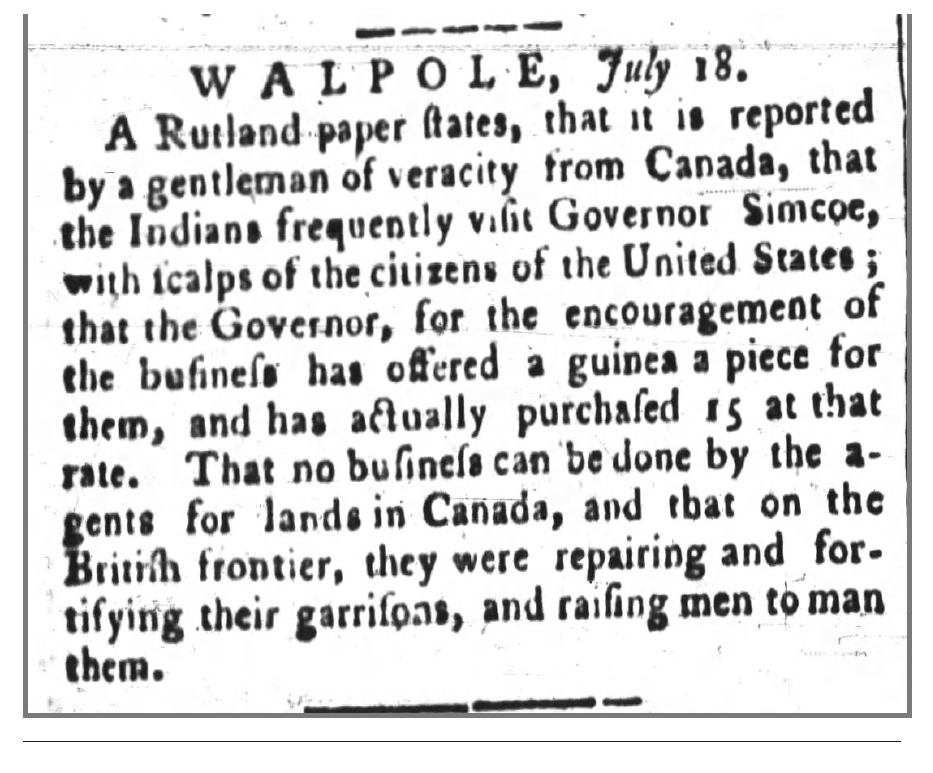
The question this post answers is the one my grandfather never did, at a kitchen table in Munger, when he told the stories about scalps and Simcoe and three thousand acres. Why Michigan?
The received answer
The received answer is true and not enough. Ontario emptied in the 1880s. The good land was taken up, wheat prices slid through a long depression, and the farms that had seated every son for three generations could seat no more of them. The province's own statisticians watched the rural townships thin and called it, with a shudder, the exodus. The Norfolk farmers who joined it had a plainer word for where they were going. They called it Michigan.
That explains why a young man left. It does not explain where he went, or why he went there and not to Dakota, or Oregon, or the Thumb, where cousins of his were already farming. For that you need a wedding, twenty-nine years earlier.
The Gilbert road
In January 1858, at Simcoe, William Valentine Collver, my third-great-grandfather, married Samantha Gilbert. Readers of last week's post left him in 1877, lettered on the Charlotteville sheet of the county atlas with a hundred and thirty acres and six children.
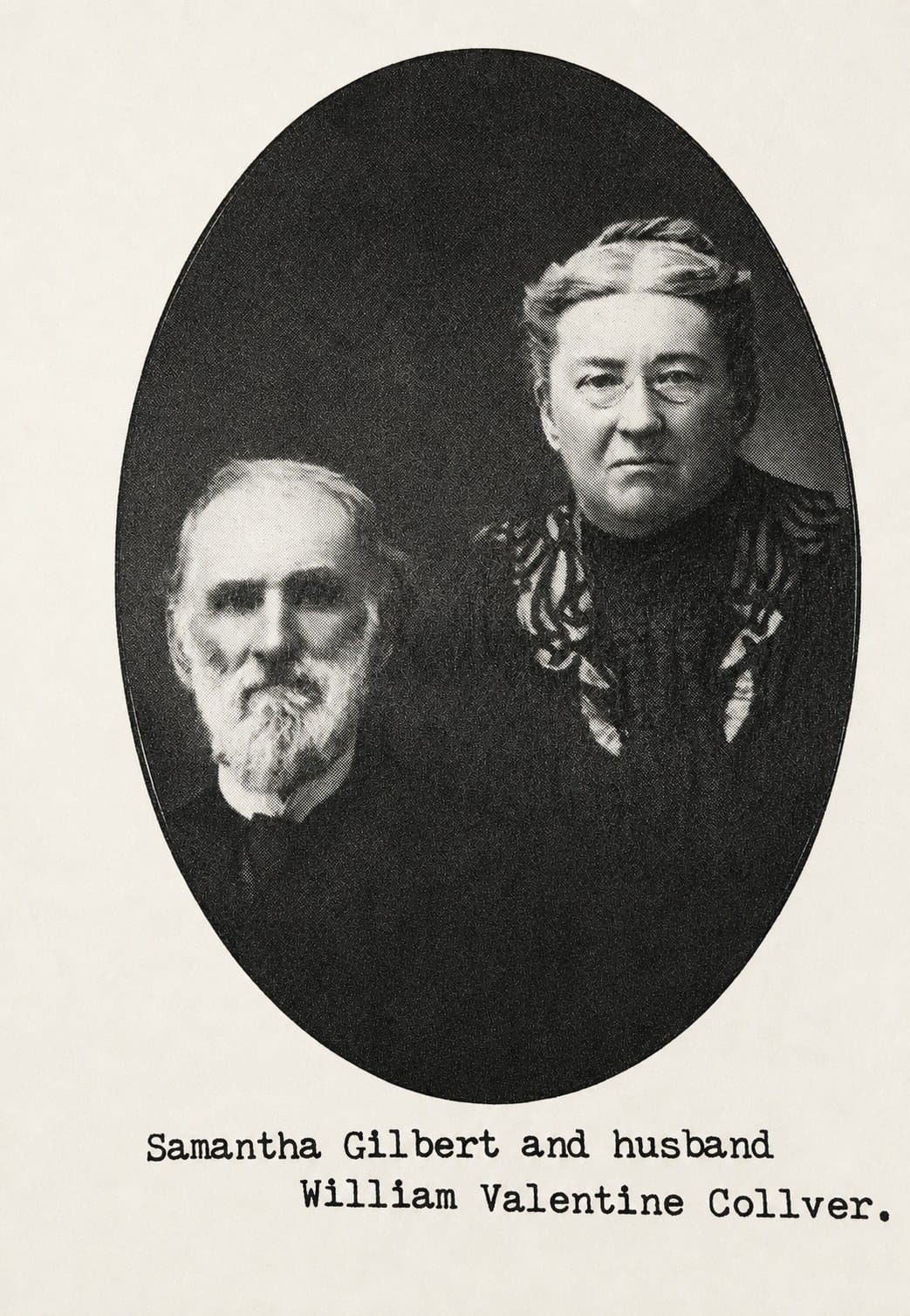
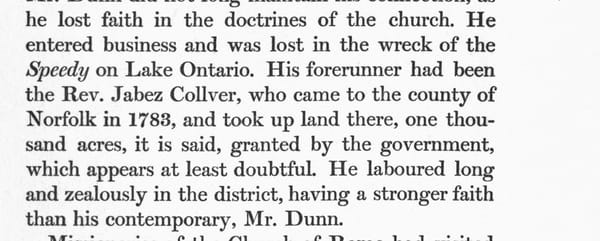
The Gilberts deserve a paragraph, because their road to Norfolk makes the Collvers' own look almost leisurely, and because the two roads are the same road. Samantha's great-grandfather, Isaac Gilbert of Ridgefield, Connecticut, served the Crown in the Revolution as a sergeant in the Queen's Rangers, the corps of Colonel John Graves Simcoe himself. He went out with the Loyalist fleet to New Brunswick in 1783, farmed the Saint John River country for sixteen years, and brought the whole family to the Long Point settlement in the summer of 1799. The Reverend Jabez Collver's family had come at Simcoe's invitation. The Gilbert family had carried Simcoe's muskets. In Woodhouse the old sergeant and his wife died on the same day in September 1822 and lie under matching stones four miles south of the town named for their colonel.
Two generations on, John Wyckoff Gilbert's daughter married the Presbyterian minister's great-grandson. Now watch what her brothers did.
Four brothers and a list
Bay County's own history, published in 1905, profiles a physician of Bay City named Harvey Gilbert and lists the children of his father, John Wyckoff Gilbert of Woodhouse:
Samantha, wife of William V. Culver, of Simcoe, Ontario; Peter, of Sterling, Michigan, formerly a member of the State Senate; Harvey, of this sketch; Isaac, an attorney at Bay City; Albert, operating the homestead farm; and Frank O., who is a dental surgeon at Bay City.
Read the list as an Ontario farm family would have read it. Of six Gilbert children, one daughter and one son stayed in Norfolk. Four brothers went to Michigan and rose: a state senator at Sterling, a physician, an attorney, and a dental surgeon at Bay City. The professional establishment of the Saginaw Bay country, in one family, in one generation. Their mother's obituary in the Simcoe Reformer of December 1898 had already named the same four, "all of Bay City," and added that they "were all raised on the old Gilbert homestead, Lot 4 of Woodhouse Gore."
The same county history takes care to say where the Gilberts had come from. Their ancestor was "a settler in New Brunswick, under the proclamation in favor of loyal Tories." Hold the two facts together. The grandsons of the Loyalist who followed the King's colors out of revolutionary America were senators and officers of the bar inside it, and their standing would now draw the Loyalist preacher's line back across the border behind them. The Revolution had sorted this family out of the republic. The republic's farmland and its lumber money sorted them back in. Loyalty, it turns out, is a generation deep. Kinship is the durable thing.
The son who went
John Milton Collver, William Valentine and Samantha's son, had helped his father build the district schoolhouse in Woodhouse as a boy. On the twenty-second of December, 1886, he married at Port Dover. He was twenty-five, a farmer of Charlotteville. The bride was Mary Elizabeth Caldwell, twenty-three, a widow born at Wainfleet, whose maiden name was Durham. Within the year the couple was gone. Asked by a census-taker four decades later what year he had come to the United States, John Milton answered 1887.
Where he went is exactly where the Gilbert list points. Clayton Township, Arenac County, is the pine-stump farm country north of Bay City, six miles from Sterling, where his uncle Peter Gilbert was the neighborhood's great man. The 1889 birth register is the proof of arrival. The directory of those years gives the hamlet whole: Melita, population 350, on the Rifle River, "6 miles from Sterling. Has a Wesleyan Methodist church, a feed mill and 2 saw mills. Stage daily to Prescott, fare 50 cents." A Methodist chapel, a feed mill, sawmills, and a stage. Windham Township with pines.
Historians of migration have a term for this, and it is worth glossing because it describes my family in every century. Chain migration is movement along lines of kinship: one household goes, and the next follows to the place where the first one already is, because a brother-in-law there is worth more than a government pamphlet anywhere else. The chain is rarely the men. It is the wives whose brothers went first, the mothers who follow the sons, the sisters whose kitchens become the way-stations. John Milton did not go to Michigan. He went to his uncles.
A second son was born at Clayton in October 1893, Daniel William, my great-grandfather. Then the pattern this family's women have borne in every century: Mary Elizabeth died in 1897, at thirty-four, leaving two sons under nine. What the widowed emigrant did not do is the telling thing. He did not go home. The census of 1900 finds him still at Clayton, farming, with Clark and Daniel in the house.
The mother who followed
The migration's most surprising traveler was its oldest. William Valentine never went. He farmed Charlotteville, finished where his people had started, in the Gore of Woodhouse, and died there in July 1907, at seventy-seven. Samantha, widowed at sixty-six, appears in the 1911 census of Canada in her daughter's household in Townsend, a mother-in-law among the Methodists of the old county. But the state history of Michigan compiled about 1915, profiling her brother the doctor, records the family's understanding in the present tense: Samantha "is the widow of William Culver, and lives in Bay City."
The directories of those years bear it out. In her seventies, a weaver by the census and a midwife by neighborhood repute, she crossed an international border to live for a season in an American lumber city where two of her brothers practiced and her son traded. Then she came home to Norfolk, died at Townsend Centre in August 1921, and was buried beside William among the Gilberts at Old Woodhouse. The family's women had been crossing this border since Freelove Shaw walked it in 1794. Samantha crossed it both ways in her eighth decade.
Munger
Daniel grew up entirely American. His First World War draft card, filled out at twenty-three in Wexford County, is a small portrait in government ink: farmer, self-employed, married, short, medium build, blue eyes, brown hair, and, the registrar duly recorded of a man of twenty-three, bald. He claimed exemption for the harvest. After the war he came back down to the Bay country, and the rest of his life belongs to Munger, the crossroads village in Merritt Township east of Bay City. He carried the rural mail. He served many years as an elder of the Munger Presbyterian Church, a Presbyterian again after the family's Methodist century, the old firm reclaiming its own. And he belonged to Bay City Lodge No. 129 of the Masons.
Mark what the lodge completes. This blog last saw the family's Masonic thread at the warrant of Lodge No. 26 in Townsend in 1812, and at the rope at Waterford. In Michigan the thread was waiting. By 1915 the grand lecturer of the Masonic order for the whole state, its traveling master of the ritual, was Frank O. Gilbert, the dentist of Bay City, Samantha's brother. When Daniel took his degrees he joined an institution in which his family had a century of standing on both sides of the border. When he died, on his mail route in the snow in January 1955, the lodge buried him.
A correction, gently
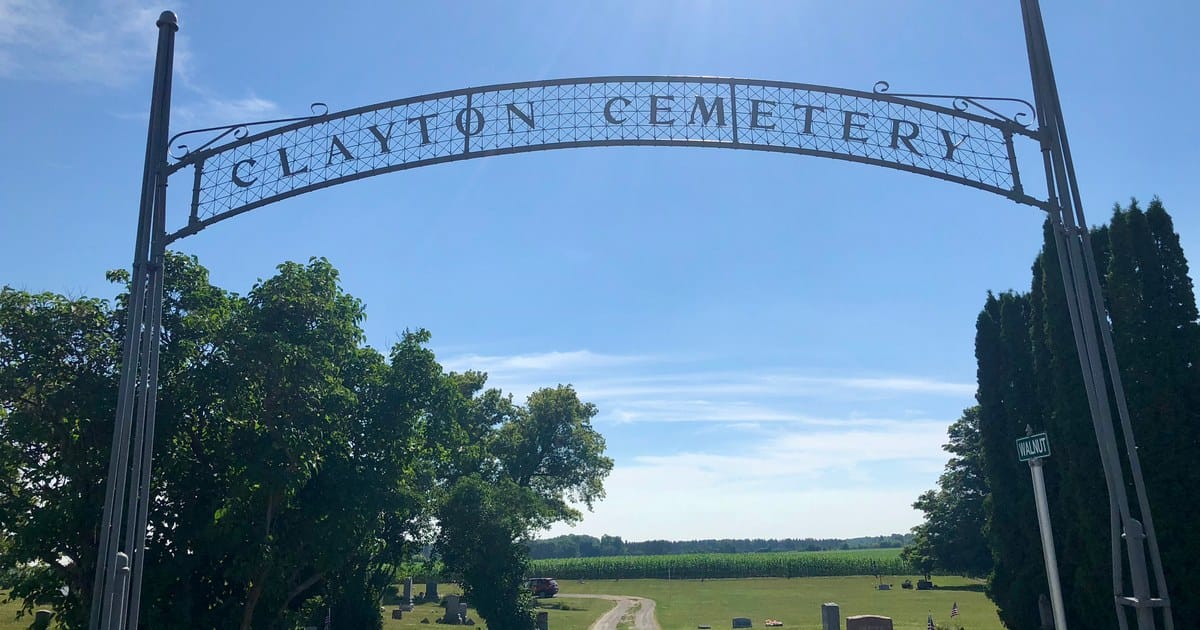
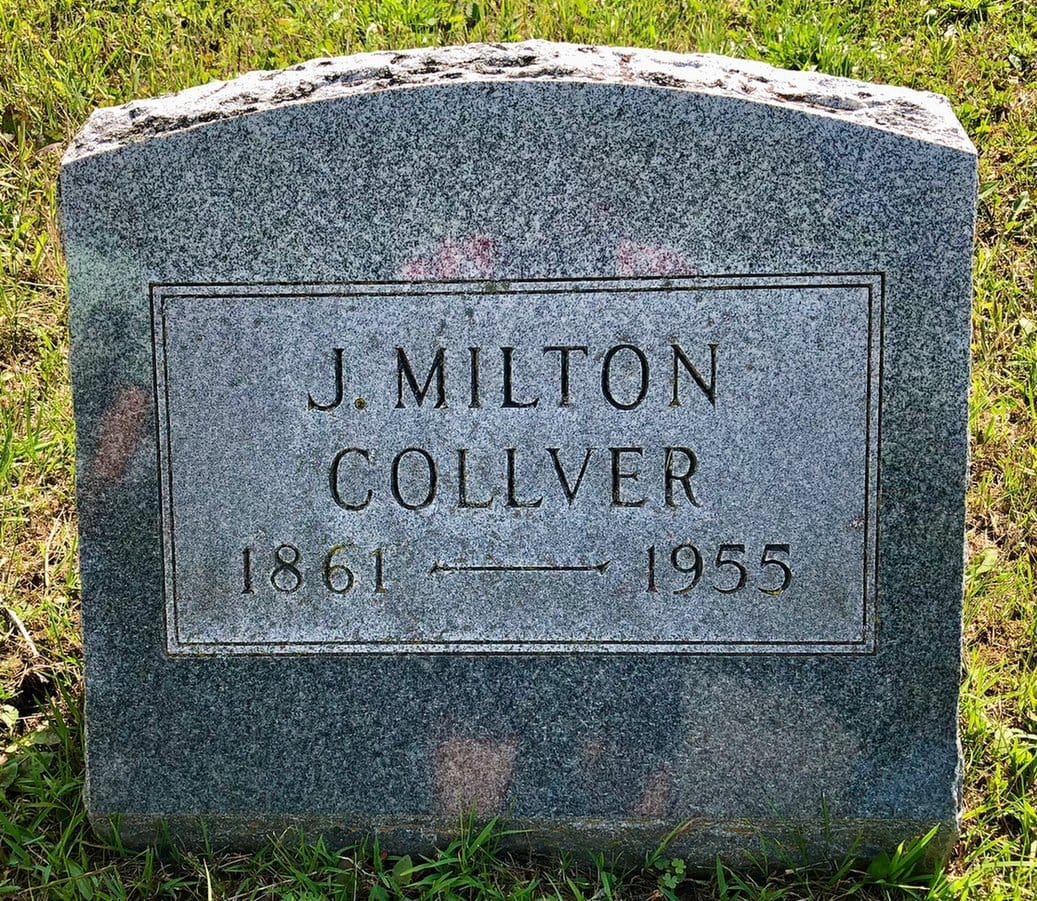
Here I must correct the family's best compiler, with the affection the book owes him. Mutrie's genealogy of the Jabez Collver family buries John Milton at the Old Woodhouse Methodist cemetery in Ontario, beside his fourth wife. There is indeed a stone there with his name on it. It is a cenotaph, a memorial without a grave, raised by a great-grandson "with pride in their lineage from Rev. Jabez Collver," and the record-keepers themselves now mark it so. The man is buried where his American life was lived: Clayton Cemetery, at Melita, in Arenac County, row four, block C, the fifth grave from the south, six miles from the Sterling country his uncles had made the family's beachhead seventy years before.
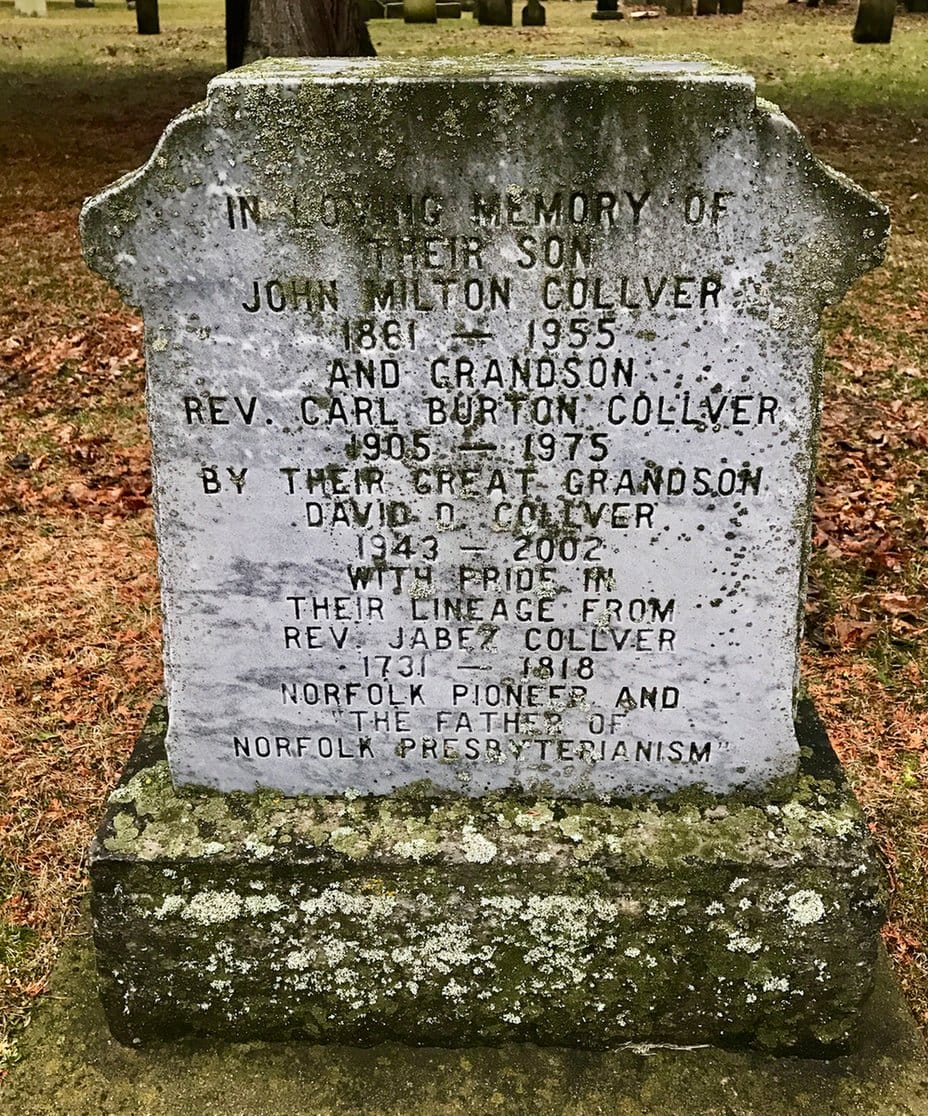
I can add a private verification. I have stood at that grave, and remembered standing there, and for years could not square the memory with the printed genealogy. The memory was right. The compilation described the monument and missed the man, which is the exact error the family's own literature made about Jabez's thousand acres, running the other direction. Even the errors in this family rhyme.
One more name, graded honestly. The same Bay County history records an Amos Culver, born in New Jersey about 1814, who located in Williams Township in 1854 among the county's first settlers and raised its first square-log house. A Jersey-born Culver pioneering Bay County forty years before John Milton arrived is either a coincidence or a first scout. No record yet ties him to this family, and the book leaves him exactly where the evidence does: a lead, unplaced.
What it means now
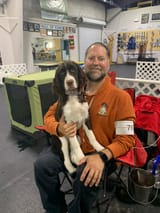
I grew up inside this post and did not know it. I hunted deer as a boy in the country around Sterling, on the same Rifle River flats where Peter Gilbert had his farms and John Milton cleared his, because that is simply where my family went in November. In July 2018 I drove my son up to Clayton Cemetery, in under the iron arch, past the township's posted listing with its column of Collvers, and we stood where I had once stood as a boy at the stone of the man who crossed in 1887.
The family did not move to Michigan the way a man moves to a job. It moved the way water rejoins water, down lines of kinship, into channels the Gilberts had already cut, until the new country was so thoroughly its own that its children could be born inside the map and mistake it for empty. Nobody repented anything. They just crossed. And three generations on, the road disappears into the ground you stand on.
Sources.
- "Return of Births in the County of Arenac for the Year Ending December 31st, A.D. 1889," Clayton Township, record 790 (Michigan Department of Health digitization), quoted as entered.
- Augustus H. Gansser, History of Bay County, Michigan, and Representative Citizens (1905): the Dr. Harvey Gilbert sketch, with the list of John Wyckoff Gilbert's children and the New Brunswick proclamation; the Williams Township narrative for Amos Culver.
- Charles Moore, History of Michigan (1915), vol. 2, the Gilbert sketch: Samantha "lives in Bay City"; Frank O. Gilbert, grand lecturer; Peter Gilbert "recently retired" from the state senate.
- Obituary of Christina (Smith) Gilbert, Simcoe Reformer, 1 December 1898, as transcribed in R. Robert Mutrie's Gilbert genealogy.
- Ontario marriage registration C07891 (Norfolk, Port Dover division, 1886): John Milton Collver and Mary Elizabeth Caldwell.
- United States census, 1900 (Clayton Twp., Arenac Co.) and 1930 (Wilson Twp., Charlevoix Co.), the latter with the immigration year 1887; census of Canada, 1911 (Townsend).
- R. L. Polk & Co., Michigan State Gazetteer and Business Directory, the Melita entry (edition year not yet established).
- U.S. World War I draft registration, Wexford Co., Mich., 5 June 1917, card 664.
- The Bay City Times, 25 and 26 January 1955 (the accident; the lodge funeral); 5 April 1955 (the memorial communion table, Munger Presbyterian Church).
- Clayton Cemetery, Melita: the stone, the township's posted listing, and the gate, photographed by the author, 16 July 2018; Find A Grave memorial 39096142. The Old Woodhouse memorial is labeled a cenotaph on the stone itself.
- R. Robert Mutrie, genealogy of the Jabez Collver family, for the Old Woodhouse burials and the family record.
- Earlier posts on this blog: The Family on the Map, 1877; A Mason's Sign at the Rope.
Adapted from the forthcoming book — We Are Doves: Four Centuries of the Collver–Culver Family.
© 2026 Albert B. Collver III · The Collver Family History Project. Original historical documents reproduced here are in the public domain; the research, text, and annotations are the author’s. Please cite or link rather than republish.