The Quartette
Four brothers married four sisters, all of the same name. The land office of Upper Canada paid the dowries.
Quartette is a word from the music room. It came into English in the eighteenth century from the Italian quartetto, a little diminutive of quarto, fourth, and behind that the Latin quartus: four voices, each carrying its own line, heard as one sound. The spelling with -ette is the French dress the word wore in Victorian parlours, and it was in that dress that a Norfolk County historian borrowed it in 1898 for the most remarkable set of weddings in his county's history.
E. A. Owen, who married into this family and collected its stories from the people who had lived them, gave the thing a sketch to itself and a title to match, "The Double Culver Quartette." It opens:
In the Culver family, of Norfolk, were four brothers who married four Culver sisters. The brothers were sons of that father of pioneers, Rev. Jabez Culver; and the sisters were daughters of Timothy Culver, who came to the settlement in 1796. It is the only case on record in the history of our old families, where four brothers married four sisters, all of the same name, and all the grandchildren of one common marriage union.
The whole sketch, with the scene of the first night in Townsend that every descendant should read once, is transcribed on this site. This post is about what the records add to it, and the one thing they correct.
Four and four
The brothers were Jabez, Aaron, John, and Gabriel, the sons of the Reverend Jabez Collver of Wantage. The sisters were Anna, Elizabeth, Miriam, and Martha, the daughters of Timothy Collver of Schooley's Mountain. And Owen adds the detail that makes the thing a set rather than a coincidence: "They married in the order in which their names are written." Jabez to Anna, Aaron to Elizabeth, John to Miriam, Gabriel to Martha, eldest to eldest, down the line.
Owen calls the eight "the grandchildren of one common marriage union." They were a generation further off than that. The two fathers were first cousins, not brothers: Jabez was the son of John Colver, the cordwainer who died at Black River in 1733, and Timothy was the son of John's younger brother Robert, who bought the Schooley's Mountain homestead in 1748. Their common grandparents were John Colver and Sarah Long, the Rogerene couple who led the family out of Connecticut in the 1730s. So the eight young people who paired off in Sussex and Morris counties were second cousins, and the one marriage union they shared was their great-grandparents'. Owen, writing a century after the weddings, lost a generation in the telling, as family historians do. The remarkable part he got exactly right.
Three out of their family
The weddings came in the years after the Revolution, and the best witness to them is the groom's father. In the late 1780s Jabez had taken his household up the Susquehanna to the Chemung River in New York, and from there he wrote to his son Ebenezer, already settled at Niagara. Two of those letters survive, and the one of March 1790 carries the family news in a single run-on sentence of satisfaction:
we hear John is married to another of Timothy Collvers daughters so that we have three out of their family.
Three out of their family. Jabez Jr. had married Anna; Aaron had married Elizabeth; now John had married Miriam, who was about seventeen. The father counted them off from a riverbank two hundred miles from the brides, the way a man counts a harvest. The fourth daughter, Martha, was twelve that spring.
A word about which Timothy, because this family had two, and they have been confused in print for a century. The brides' father was Timothy Collver the Loyalist, Robert's son, born about 1734–38 near Schooley's Mountain, who would be "returned a Loyalist U.E." by the magistrates of Upper Canada. The other was Sergeant Timothy Culver of Woodbury, Connecticut, a Continental soldier who settled at Sheshequin on the Susquehanna, and whom readers met in The Covenant Signed Twice. Same name, same generation, opposite flags, and no daughter of his married into the quartette. The editor's note on the transcription flags the two; the land papers below settle which one was the brides' father.
The fourth wedding
By the time Martha was of an age to marry, the whole connection had moved. Jabez petitioned the government of Upper Canada from Newark in June 1794 and was granted a thousand acres in three days, a story told in Echoes from the Frontier. His sons took up four hundred acres apiece in Townsend and Windham, with John and Miriam first on the ground, Miriam asleep on pine boughs with her babies the night they arrived.
Timothy came more slowly and more strangely. He walked. He came first alone, on foot, to see the country; then in the fall of 1795 he came again with his wife, the two of them on foot from northern New Jersey to the Long Point country and back, better than a thousand miles round, a couple near sixty going to visit their married daughters and judge the land. What decided him, Owen records without a trace of sentiment, was his son-in-law Aaron's turnip patch: the soil would answer. They went home, settled their affairs, and came north for good in the spring of 1796. The staff Timothy carried on those walks, brass-headed and steel-tipped, has a post of its own.
And so the last of the four weddings was made in Canada. Gabriel, the youngest brother, married Martha, the youngest sister, on the twenty-third of May, 1797. Owen judged it "quite probably the first marriage solemnized in Windham township." The district's marriage register names the minister: the bride and groom, "both of Townsend," were married "by J. Collver Sr." The groom's father married his youngest son to his cousin's youngest daughter, and the witnesses were family too: Michael Shoaff, the husband of Jabez's daughter Freelove; Nisbet Collver, the bride's brother; and a John Collver, almost certainly the groom's brother, who had married her sister some seven years before. The fourth voice of the quartette was sung in Canada, with the family standing round.
A dowry in the Crown's name
Then the land papers do something quietly remarkable.
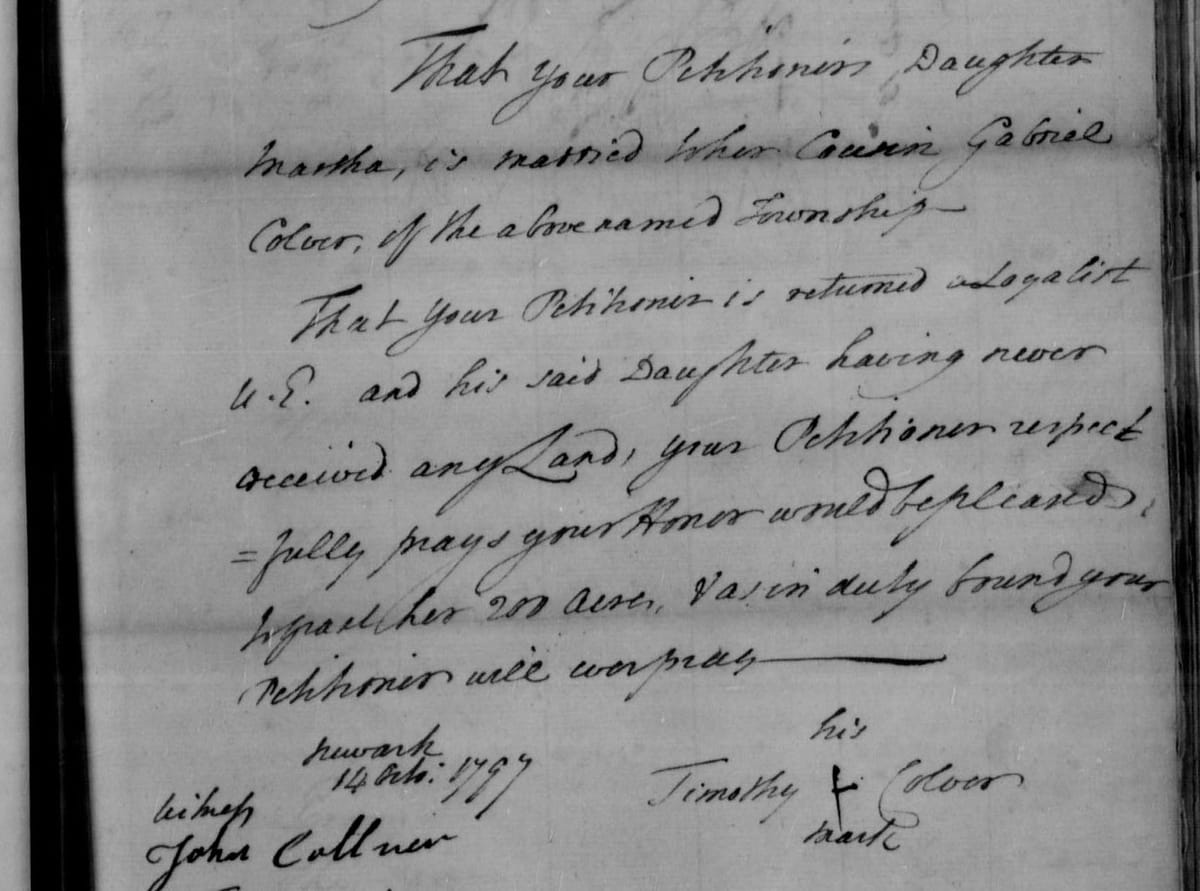
Under the rules of Upper Canada, a man returned on the list of United Empire Loyalists could claim land not only for himself but for his children, and a Loyalist's daughter was entitled to two hundred acres of the Crown in her own name. In October 1797, at Newark, Timothy Colver sat down to claim them. He signed with his mark; his young cousin and son-in-law John Collver stood witness. In a single week he petitioned for his daughter Anna, "married to Jabez Colver Junior," for his daughter Elizabeth, married to Aaron, and for his daughter Martha, "married to her Cousin Gabriel Colver." John petitioned separately for his own wife, "Marian the Daughter of Timothy Colver (Cousin of your Petitioner)."
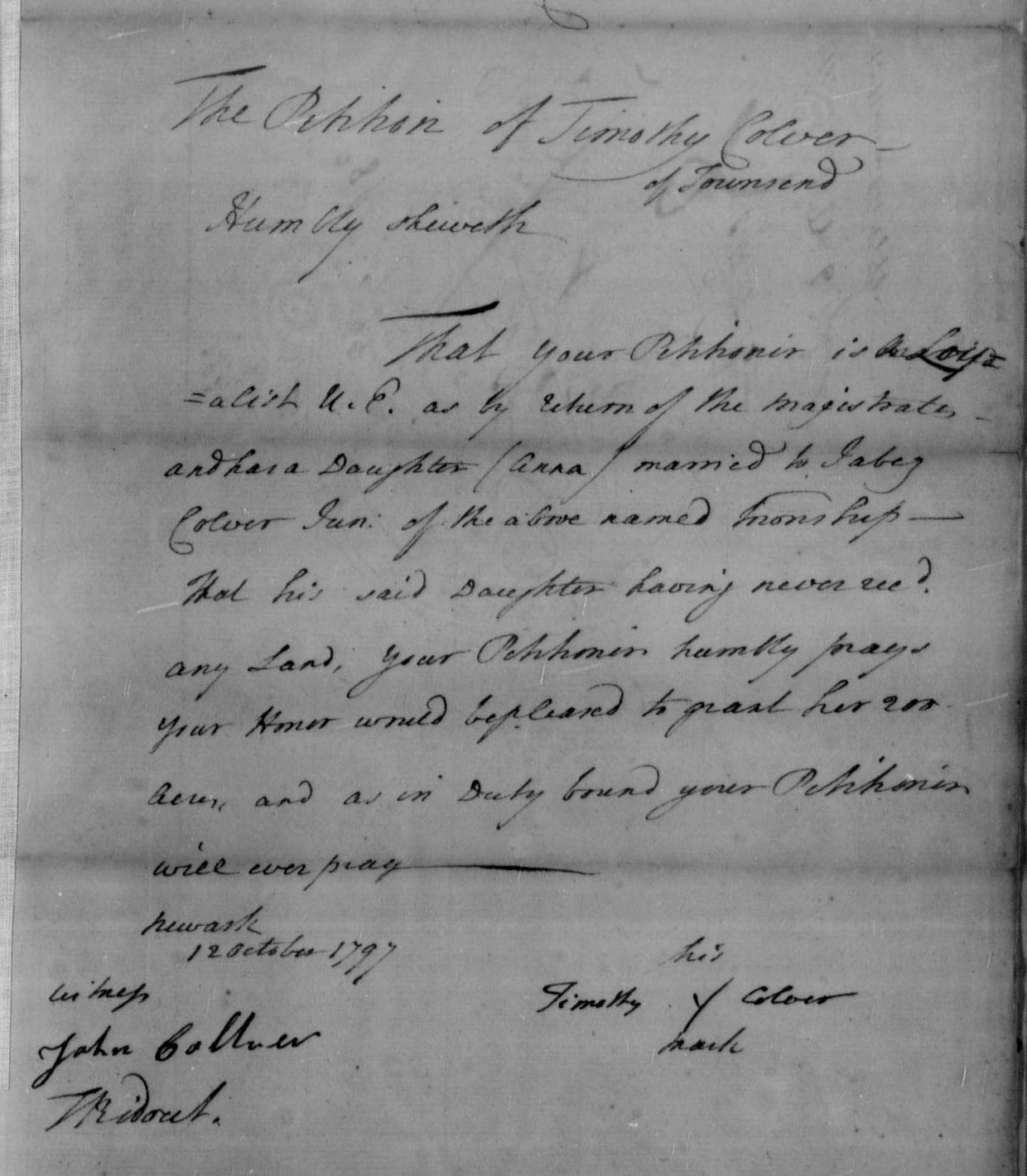
The petitions were referred, examined, and allowed. On the eighth of October, 1799, Timothy swore the oath that tied them together:
Timothy Colver maketh Oath this day that Elizabeth, Anna, Martha and Marian Colver are his Daughters & of Age & Married
with John Collver standing witness once again. The warrants issued in November 1799: two hundred acres to each of the four sisters.
Sit with what that file means, because it is easy to read past. The four marriages that bound the two households together were not only a family's mending. Under Upper Canada's land law they were a conveyance. Each daughter carried into her marriage a two-hundred-acre right that existed because her father had stood by the King, and each cousin-husband's farm was enlarged by his wife's share of her father's loyalty. The Crown paid its debt to Timothy in his daughters' names, and his daughters' names were already Colver on both sides of the ledger.
The old word for what a bride brings to a marriage is dowry, which came through French from the Latin dos, a marriage portion, and dotare, to endow. The quartette's dowries were paid by the government, years after the weddings, in acres.
A lot that belonged to nobody
One more file deserves its paragraph, for what it shows of how the country was actually settled. In June 1800 Martha petitioned again, in her own cause, to locate her two hundred acres on a particular lot in Townsend: Lot 1 in the tenth concession, which the surveyors had once assigned to an Ebenezer Averill Jr., a sixteen-year-old who never came to the province. The petition is signed "Gabriel Collver for my wife Martha Collver," with a neighbour's certificate sworn before a magistrate.
The paper townships of Upper Canada were full of phantom grantees like young Averill, boys in New Jersey and New York who took locations and never crossed. The actual country was settled by the people who showed up and petitioned the phantoms' lots out from under them, one marriage and one certificate at a time. This family's women had grown up in a sect that kept no church register of them. For one decade at the end of the eighteenth century, Upper Canada's land office made them the best-documented Collvers alive.
Sands on the sea-shore
Owen closed his opening paragraph with a line from Genesis. The four couples, he wrote, "all settled here more than a hundred years ago, their posterity having become as 'sands on the sea-shore,' forming no inconsiderable portion of Norfolk's present population."
That was true in 1898, and its consequences are with us still, in a form Owen could not have imagined. A descendant of any of these four couples descends from John Colver and Sarah Long twice over, once through the father's line and once through the mother's. Genealogists call it pedigree collapse: the family tree folds back on itself, and the same ancestors fill two places in it. Anyone who has taken a DNA test and descends from Aaron and Elizabeth, or John and Miriam, or either of the other couples, will find that their matches with other Norfolk Collvers and Culvers run closer than the paper relationship predicts, because they share more of the same ancestors than the chart first shows. It is a puzzle that has sent more than one tester looking for a nonexistent closer cousin. The answer is nearly two hundred and forty years old, and it was written down in 1790 by a father counting weddings on the Chemung: three out of their family, and one to come.
The Reverend Jabez preached on three frontiers. Timothy walked a thousand miles to look at a turnip patch. Between them they married their families into one, and the land office of a new province paid for it in the daughters' names. Four voices, each on its own line, heard as one sound: Owen chose his word better than he knew.
Sources and notes: Owen's sketch is E. A. Owen, Pioneer Sketches of Long Point Settlement (Toronto, 1898), Sketch XII, "The Double Culver Quartette," pp. 84ff., transcribed in full on this site; the walking visits and the turnip patch are his Sketch XCIX, "Wonderful Pedestrian Feats of a Pioneer Father and Mother," with L. H. Tasker, "The United Empire Loyalist Settlement at Long Point, Lake Erie," Ontario Historical Society Papers and Records II (1900), independently confirming the 1795 walk and the removal "in the early spring of 1796." The genealogy of the two fathers follows the corrected register of the forthcoming book (John⁴ Colver, will of 2 December 1732; Robert⁴, will of 1783). Jabez's letter of 22 March 1790 to Ebenezer Collver is in the Norfolk Historical Society Collections (Doc. 4808–9), as transcribed by R. Robert Mutrie, whose register also supplies the brides' birth dates; the 23 May 1797 marriage, "by J. Collver Sr.," with its three witnesses, is from the London District Marriage Register as Mutrie transcribes it. The daughters' petitions are Upper Canada Land Petitions, "C" Bundle 5, Pet. 34 (Anna) and Pet. 68 (Martha and Elizabeth), and "C" Bundle 4, Pet. 88 (Marian), Newark, 12–14 October 1797, quoted from the manuscripts; the oath of 8 October 1799 and the dockets, with warrants of 13 November 1799 (Tasker prints the Order in Council as 14 November and places the grants in Walsingham). Martha's own petition is the "Ca" bundle, Pet. 14, York, 2 June 1800, with the certificate of Mordecai Sayles. Tasker, ch. XXII, is the source for Jabez's Sabbath services "in his own house" from 1794. Sergeant Timothy Culver's service is his pension file, S40871.
Adapted from the forthcoming book — We Are Doves: Four Centuries of the Collver–Culver Family.
© 2026 Albert B. Collver III · The Collver Family History Project. Original historical documents reproduced here are in the public domain; the research, text, and annotations are the author's. Please cite or link rather than republish.