The Covenant, Signed Twice
In 1636 a wheelwright signed a covenant at Dedham, sixty-eighth on the roll. In 1791 his great-great-grandson organized a covenanted church in the Pennsylvania wilderness. One hundred fifty-five years, one revolution, one sedition conviction — and the same instrument, signed twice.
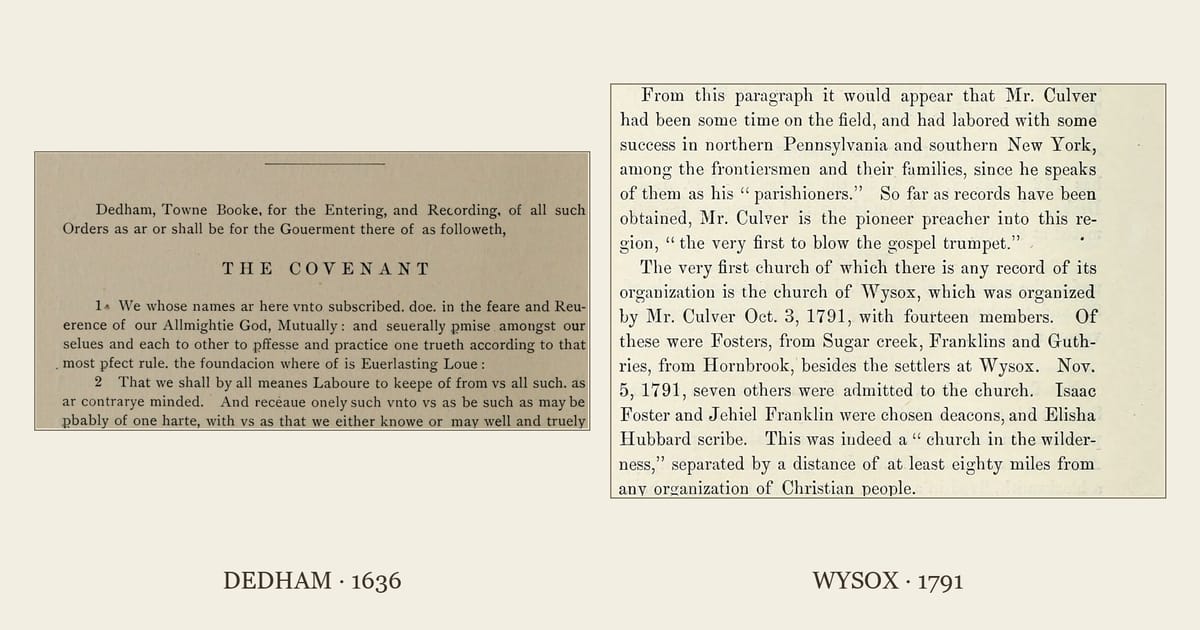
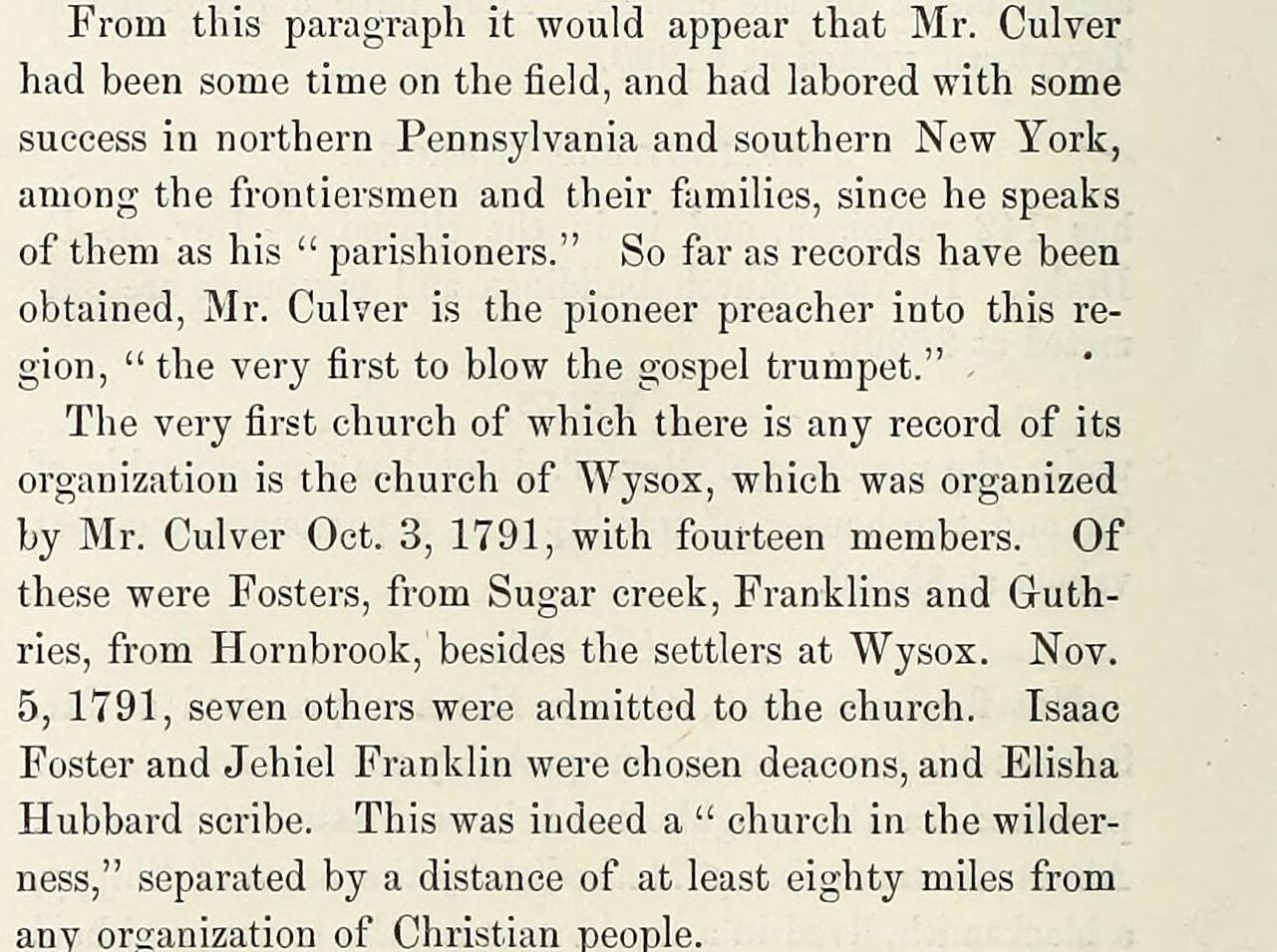
On the third of October, 1791, in the house of Captain Jehial Franklin at Wysox, Pennsylvania, fourteen settlers organized themselves into a church. The nearest body of organized Christians of any denomination lay, by the county historian’s measure, at least eighty miles away. The county itself did not exist — Wysox lay then in Luzerne, and Bradford County, which would one day claim the evening as its founding religious act, was two decades from erection. Its historian, the Rev. David Craft, a minister writing in 1878 with the congregation’s own records in front of him, gave the scene the standing it deserves: “The very first church of which there is any record of its organization is the church of Wysox.”
The man who gathered them was sixty years old that autumn, and regular readers of this blog have met him at nearly every station of the road that brought him there: a Groton boy of jailed Rogerene stock, a New Jersey farmer-preacher ordained to no establishment, a convicted seditionist at five pounds’ fine, an exile on the Chemung whose name heads the deed records of an American county — and, in the one outsider’s portrait of him that survives, “a dissenting minister” spending a most agreeable evening at a stranger’s fireside in the spring of that same year. He was Jabez Culver, and at Wysox he did the thing his family had been rehearsing, refusing, and returning to for a century and a half. He drew up a covenant of the New England pattern, and people signed it.
This post is about why that scene, which looks like a founding, is better read as a repetition — and about one name on the communion roll that I will ask you to hold in your hand until nearly the end.
The first signing
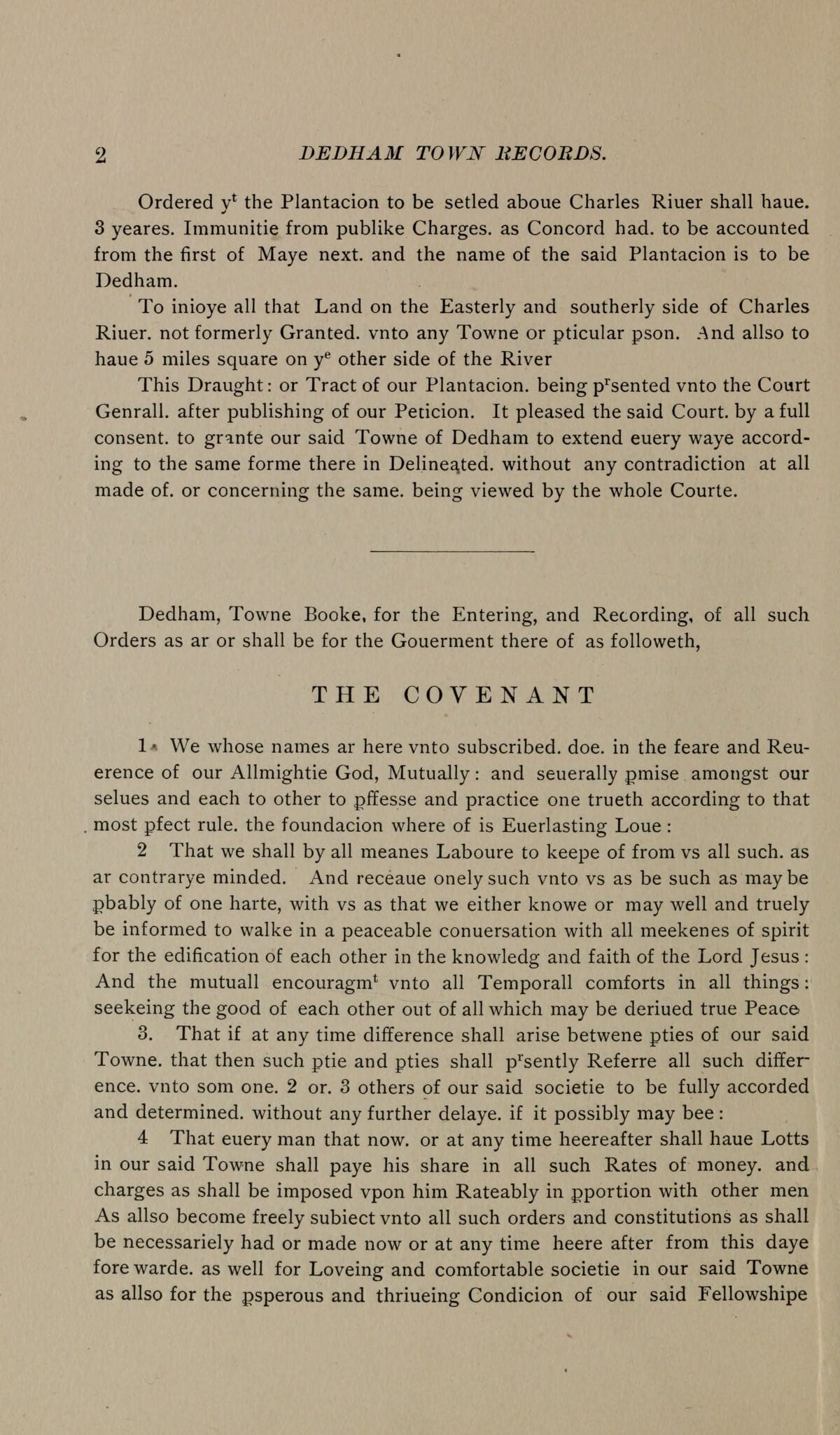
Readers of “The 68th Name” this July will remember the first document. In 1636 the founders of Dedham, Massachusetts — a town that had petitioned, unsuccessfully, to be called Contentment — opened their town book with an agreement the clerk headed simply THE COVENANT. Its first two articles carry the theology of the whole: the subscribers promise “to pffesse and practice one trueth” whose “foundacion where of is Euerlasting Loue,” and in the same breath “to keepe of from vs all such. as ar contrarye minded.” (The crossed p of the scribal hand drops a syllable; read professe, perfect, probably, and you are reading what the clerk intended.) Everlasting love as a foundation, and a fence against the contrary-minded — the two clauses sit side by side without embarrassment, and the whole of Puritan New England is in the fact that they could.
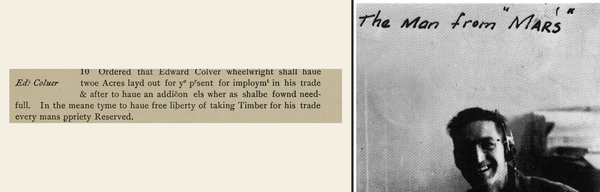
It is the fifth article that matters tonight: “euery man so receaued: to subscribe heere vnto his name. there by obligeing both himself and his successors after him for euer.” Beneath that sentence the clerk ruled his columns and gathered the names, and sixty-eighth on the roll stands Edward Colver, wheelwright — my first documented ancestor, a man of unknown origin and unknown ship, admitted by a vote of wheat and beans and capitalized with two acres and the freedom of the town’s timber. The honest cautions from July still stand: the roll is undated, gathering subscribers across the town’s early years, and in the surviving church records Edward appears only as a blank beside his wife’s name. The covenant he demonstrably set his name to was the civil one. Hold that, too.
How the pen traveled
Between the two signings the family’s relationship to covenanted religion became the strangest story I know how to tell, and this blog has been telling it in installments all summer. Edward’s son John followed John Rogers out of the establishment and into the courts of New London; John’s son John was jailed with his wife Sarah among the Rogerenes — the same Sarah whom a county court sentenced to fifteen stripes for seventeen words spoken to the bench, as readers of last month’s post will remember. The family learned to keep its registers at home, where the parish clerk could not reach them — a habit whose costs this project is still paying, as Monday’s post on the lost registers laid out. A generation later the line removed to a New Jersey mountainside; a generation after that, Jabez — born at Groton in 1731, carried south as a small boy — preached to his neighbors without a settlement or a salary, chose the King in 1776, and was convicted of sedition in a courtroom full of men who knew him. The exile that followed put him, by 1788, on the Chemung River in New York, where the earliest dated deed on the records of Tioga County carries his name.
Notice what that sequence is and is not. The family was whipped out of the standing order’s churches; it never once stopped being covenantal. The Rogerenes did not abandon the covenant idea — they abandoned the establishment that administered it, and kept the gathered, subscribed, mutually bound congregation with a stubbornness that cost them skin. A family can lose its membership, its standing, and its registers, and keep the reflex. The reflex is the inheritance.
The trumpet
What was a convicted Loyalist seditionist doing gathering churches on the American frontier? Exactly what he had done on every frontier of his life. Craft, reconstructing the region’s religious beginnings, found no minister before him: “So far as records have been obtained, Mr. Culver is the pioneer preacher into this region, ‘the very first to blow the gospel trumpet.’” Colonel Thomas Proctor’s journal — the fireside portrait readers met in “The County’s First Deed” — had already caught him in March of 1791 speaking of the settlers as “his parishioners, inhabitants of the district of Tioga,” which drew from Craft the dry and correct inference that the man “had been some time on the field.” A parish with no church, no salary, no establishment, and no legal existence: he had, in other words, reconstituted his New Jersey ministry on new ground, among families the Revolution had scattered as thoroughly as it had scattered his own.
And on the third of October, 1791, the trumpet call became a church.
The third of October
The record of the founding survives in two independent county histories, and they agree. Fourteen members organized at Captain Franklin’s house: Fosters from Sugar Creek, Franklins and Guthries from Hornbrook, and the Wysox settlers themselves. On the fifth of November, seven more were admitted. Isaac Foster and Jehiel Franklin were chosen deacons, and Elisha Hubbard scribe — a covenanted body, gathered by subscription, with its officers elected from the floor and its records kept from the first day. “This was indeed,” Craft wrote, “a ‘church in the wilderness,’ separated by a distance of at least eighty miles from any organization of Christian people.”
Craft then adds the sentence that a descendant of Dedham reads twice. “The form of the organization seems to have been borrowed from churches common in Connecticut,” he observes — noting the ruling elders the congregation would elect a few years on — “and yet it was all the while a Congregational church.” A body with a Presbyterian skeleton and a Congregational soul: students of New England church polity will recognize the Connecticut hybrid at a glance, and readers of this blog will recognize the man. Every clerk who ever met Jabez Culver filed him under a different label — Presbyterian here, Congregationalist there, “dissenting minister” at Proctor’s fireside — and at Wysox he built a congregation that would confound the filing clerks in precisely the same way. Heverly’s Sheshequin history, the third independent account, adds the arc: the body “originally known as ‘The Church of Christ at Wysox’” in time “became a Presbyterian church.” The congregation repeated the man.
One small correction of the kind this project collects: Craft’s deacon is Jehiel Franklin and Heverly’s host is Captain Jehial — the same man, and the clerks of two county histories never did agree on the spelling. Readers who remember “Colloor,” “McCulver,” and the rest of chapter one’s specimen jar may add this one to the collection.
A hundred and fifty-five years
Now let me say plainly the thing this blog has been building toward all summer. In 1636, at Dedham in Massachusetts, a covenant was drawn whose fifth article required every man received to subscribe his name, obliging himself and his successors after him for ever; a wheelwright signed it sixty-eighth. In 1791, at a captain’s house in the Pennsylvania wilderness, that wheelwright’s great-great-grandson stood before fourteen settlers and organized them into a covenanted church of the same New England pattern — one hundred and fifty-five years, measured document to document, and five colonies and states, one revolution, and one sedition conviction later. (Measured signature to signature the arithmetic is humbler, since Edward’s subscription is undated; call it a century and a half and the count cannot embarrass you.)
The symmetry is not decoration. The family had been whipped out of the covenant’s churches, had kept its registers at home where the parish could not reach them, had crossed to the far bank of the establishment and back; and when the wilderness needed gathering, the gathering hand still moved in the old form. Same instrument, same theology, same act of subscription — the names set down one after another, each signer bound to the rest. This blog calls itself a family history. It is equally the history of a reflex — the covenanting reflex, Dedham to Wysox — and the reader who keeps that frame in view will need no other map for the posts ahead.
Rachel Brink in the room
Here is the name I asked you to hold. Heverly, listing the persons admitted to full communion on the founding day, preserves five from the Sheshequin side of the river: “John Newell, Arnold Franklin, Abigail Franklin, Sally Gore, Rachel Brink, Oct. 3, 1791.”
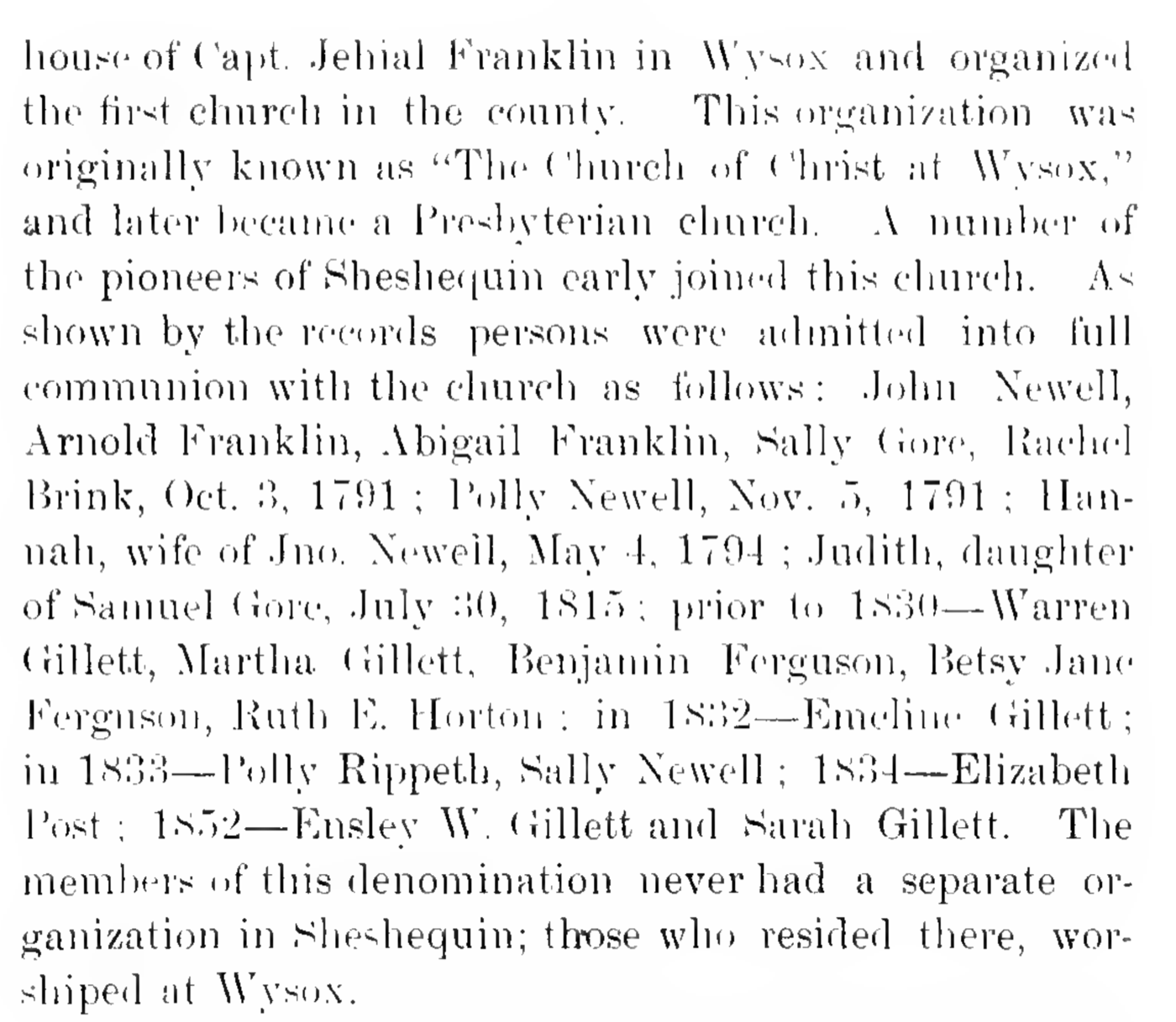
The Brinks were a Sheshequin settler family, and the reason the name stops a Collver genealogist mid-sentence is this: Sergeant Timothy Culver — the Patriot cousin, Woodbury-born, five years a Continental, the man whose British captors ground the flesh off his back under salt sacks and whose descendants held the Sheshequin farms for a century — would in time marry Mary Brink, sister of Benjamin Brink of Sheshequin. The sergeant settled at Lower Sheshequin in the first half of the 1790s, a few river-miles from Wysox; his cousin the Loyalist parson preached and organized in that valley through 1791 and left it in 1793. For as much as three years, the minister who chose the King and the sergeant who bled for the Congress — first cousins, one name, two flags — may have been neighbors on one river system, the minister’s new church enrolling communicants from the sergeant’s own future township and his future wife’s own family.
May have been. Now watch the discipline, because this is the whole method of this project in one paragraph. No letter, ledger, minute, or memoir puts the two men in one room. The sergeant’s arrival is bracketed by tradition, not dated by record; if he came at the window’s early edge the cousins overlapped, and if at its late edge they missed by two years. As for Rachel herself, no surviving record says how she stood to Mary and Benjamin — the Brink genealogies of the county histories name a Rachel only in the next generation, a child in 1791 who cannot be the communicant at Franklin’s house. What the record proves is exactly this much: on the founding day of the Loyalist’s covenant church, a woman of the family the Patriot cousin married into stood in the room and set her hand to full communion. The near-touch is documented. The meeting is not. The difference between those two sentences is everything this family’s history has taught me, and I will trade a dozen thrilling maybes for one dull certainly any day the archives are open.
The covenant traveled
Jabez did not stay to enjoy what he had planted. The Rev. Ebenezer Martin succeeded him at Wysox within the year, and the church went on without its founder — electing its elders, keeping its records, and in 1804 joining four sister congregations in a convention at Wysox that resolved to take a firmer stand against the prevailing evils of the day, “especially against Sabbath-breaking, profanity, and gambling.” The founder, by then, was two hundred miles away and under another flag: he had gone to Niagara in 1793, an old man starting a fourth life in a third jurisdiction. There is one more covenant coming in this story, in another country, and the same hand will sign it. That telling is a few weeks off.
The documents, meanwhile, have outlived everyone in this post. Hill printed Dedham’s town book in 1892; Craft printed the Wysox founding in 1878; Heverly printed the communion roll in 1902; and all three volumes sit on the Internet Archive now, free to any reader, the names still subscribed and still testifying. If your own people passed through New England or its diaspora, some ancestor of yours is standing in a printed covenant, compact, or communion roll at a countable position — and as I said in July, there is no substitute for the small shock of arriving at the name yourself.
The wheelwright’s covenant obliged “his successors after him for euer.” For euer is a long word to set down in a town book at the edge of a wilderness. But the subscription has held, by my count, for three hundred and ninety years so far — Dedham to Wysox to places this blog has not reached yet — and among the successors it obliged are a minister or two still moving a pen in the old form.
Sources: Rev. David Craft, History of Bradford County, Pennsylvania (Philadelphia, 1878) — the Culver material and the Wysox organization at pp. 156–57, quoting Proctor’s journal from Pennsylvania Archives, 2d ser., vol. IV; C. F. Heverly, History of Sheshequin, 1777–1902 (Towanda, 1902) — the founding and the communion roll at p. 272, Sergeant Timothy Culver and the Brink family in the family sketches; Don Gleason Hill, ed., The Early Records of the Town of Dedham, Massachusetts, 1636–1659 (Dedham, 1892) — the covenant at pp. 2–3, the signer roll at p. 3; all freely readable at archive.org. All quotations collated against the printed volumes. The Dedham covenant appears entire, with its roll, in an appendix to the book.
© 2026 Albert B. Collver III · The Collver Family History Project. Original historical documents reproduced here are in the public domain; the research, text, and annotations are the author’s. Please cite or link rather than republish.
Adapted from the forthcoming book We Are Doves: A Collver Family History (2026), chapter eight, “The Between Years.”